What is true crime? Facts, formats and the evidence behind the story
What is true crime? Understand the nonfiction genre, its history and formats, and how to distinguish a real case from a reconstructed scene or fictional story.

TL;DR
True crime is nonfiction storytelling about real crimes, criminal cases and their aftermath. You encounter it in books, documentaries, podcasts and reported articles. A real event supplies the subject; it does not guarantee that every scene, quotation or explanation is accurate. Ask what happened, how the account was made and what supports its claims.
What does true crime mean?
The “true” in true crime refers to a real-world subject. The crime happened, was alleged to have happened or is being investigated. The story follows that event and the people affected by it, rather than inventing a crime and its participants from scratch.
The Oxford Learner’s Dictionaries definition places books and films about real crimes within the genre. That gives you a useful starting point: nonfiction about crime, presented as a story. Audio reporting, television and other published accounts extend that idea across different media.
A murder investigation is a familiar subject, but the category also accommodates fraud, organized crime, wrongful-conviction reporting and unsolved cases. You do not need a solved mystery or a convicted offender for an account to concern a real criminal case. You do need language that distinguishes an accusation from an established finding.
Why is the boundary disputed?
A short definition leaves difficult questions. Does a historical trial count? What about a scripted drama that uses real names? Must the story aim to entertain, or can an investigation written to expose an injustice belong to the genre?
In The Ethics and Aesthetics of True Crime, philosopher Erich Hatala Matthes proposes a narrower definition centered on recent nonfiction crime narratives made for entertainment. His discussion also acknowledges disputed boundaries. That is an argued position, rather than a universal rule for classifying every book or programme.
We use a broader working definition that includes historical cases and reporting with educational aims. The distinction matters when you compare recommendations: two publishers can use the same genre label while including different kinds of work. Identify the actual subject and format before deciding that one of them has used the term incorrectly.
A real case is not the same as an accurate account
A documentary can concern a real prosecution while leaving out evidence. A podcast can quote a witness accurately while giving their account more weight than it deserves. A drama can reproduce an event’s outline while inventing the conversation that leads to it. Each concerns something real; each makes additional choices you can examine.
Our editorial method separates documented events, attributed claims and our interpretation so that you can question the step between evidence and explanation. Apply that distinction to anything you watch or read: who made this claim, what supports it and what has the storyteller added?
Suppose an account of a fictional case says that someone left a building at 9 p.m. An authenticated recording could support the departure time. An interview could establish that a witness reported that time. A recreated scene could illustrate the departure. Those are three different statements about the evidence, even if all three show the same clock.
The word “true” describes the story’s connection to a real case. Accuracy has to be assessed claim by claim. A genre label cannot do that work for you.
Documentary, reconstruction and drama
A documentary draws on recorded material, interviews, documents and narration. Its selection, sequencing and editing still shape what you see. An interview is a record of what the interviewee said; it is not automatic confirmation that the account is correct.
A reconstruction depicts something the makers could not record as it happened. Actors, animation or a staged location can help you understand a proposed sequence. The recreated scene itself does not prove the sequence occurred. Its value depends on how clearly the account identifies what the reconstruction is based on.
A drama uses scripted performance. It can follow a real event closely, invent many details or fall somewhere between those approaches. The description “based on a true story” does not tell you which dialogue, motives or characters were invented.
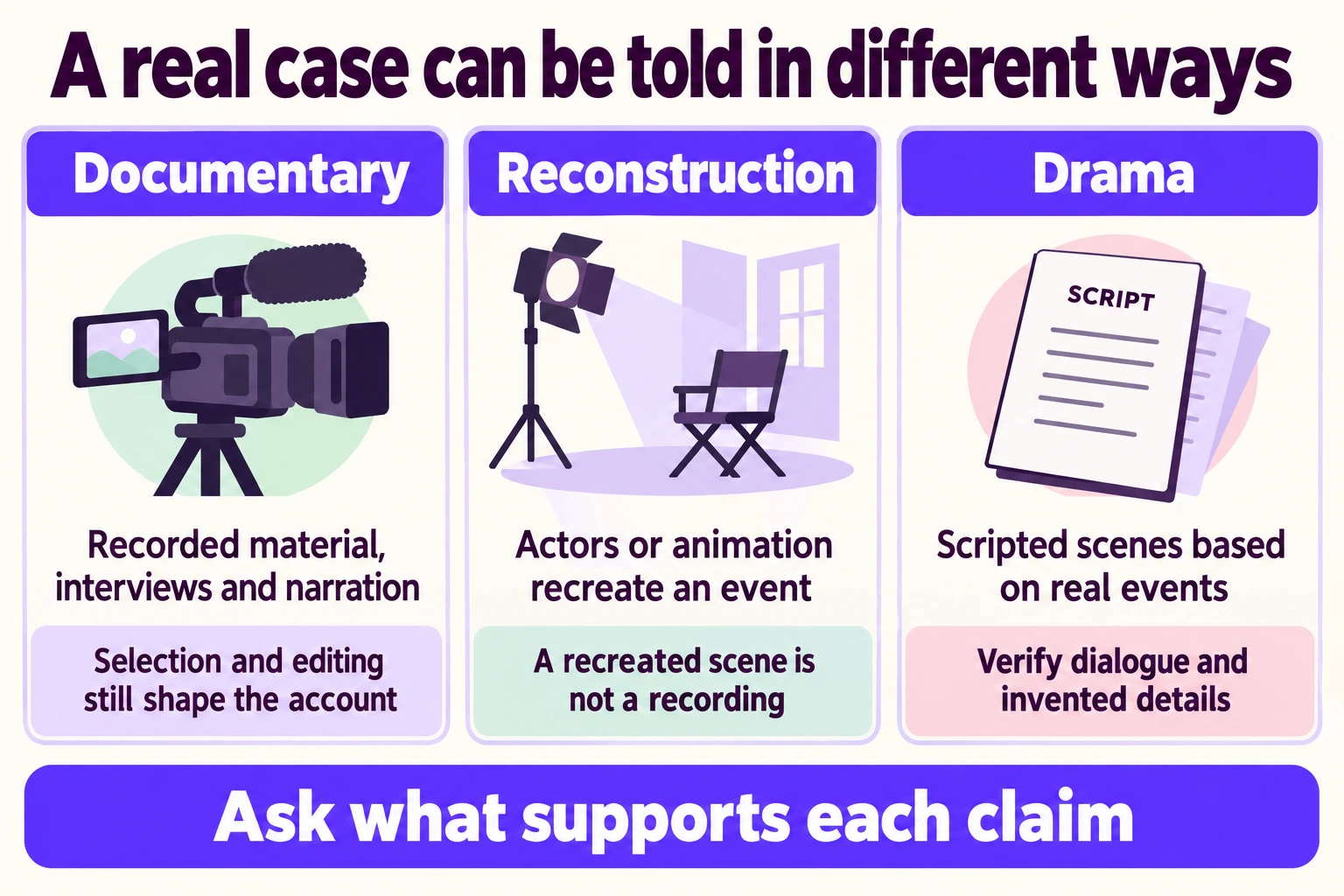
These formats can coexist in one work. A documentary may insert a reconstruction between interviews. A podcast may employ an actor to read a transcript. The useful question is what kind of material supports the particular claim you are hearing, rather than whether the entire work fits one tidy category.
True crime existed before streaming
Public accounts of criminal proceedings long predate modern podcasts. The University of London’s Institute of Advanced Legal Studies identifies the published Old Bailey proceedings as a collection covering 1674–1913. Those dates describe the surviving published proceedings in that collection; they do not establish when people first used the phrase “true crime.”
The historical comparison helps explain the continuity. Readers could follow a real trial through a printed account; today, listeners can follow a case through episodes. The medium changes how material is selected and delivered. It does not remove the distance between an event and its published account.
We have not established an earliest use of the genre’s name. It is more defensible to distinguish a long history of crime storytelling from a precise, unsupported claim that the modern category began with one publication.
Three works that show the range
Truman Capote’s In Cold Blood illustrates book-length narrative nonfiction. Penguin Random House describes its account of the Clutter family murders and notes its serialization in The New Yorker in 1965. The example shows how a real case can become a sustained literary narrative. That classification does not settle the accuracy of every detail in the book.
Serial illustrates episodic audio reporting. Its producer identifies the first season as airing in fall 2014. Interviews, records and a continuing narrated investigation allow listeners to follow how an account develops across episodes. This is a description of the format, not a judgment about the present legal status of the case it covered.
Making a Murderer illustrates a television documentary series. Netflix announced the ten-part series in November 2015 for release on 18 December 2015. A series has room to assemble interviews and a case narrative over several instalments. The release history does not establish current streaming availability in your country.
These examples are not ranked recommendations. They show three ways publishers distribute nonfiction crime stories: a book, an audio series and a documentary series. We have used publisher and producer descriptions for this comparison; it is not a claim to have independently verified every assertion in those works.
Crime journalism, fiction and historical accounts
Crime journalism reports on real events and can overlap with true crime. A short report announcing a hearing and a long investigation following a case may concern the same people. Calling the longer work true crime describes its subject and storytelling approach; it does not give it a higher standard of proof than the news report.
Crime fiction invents its narrative. A novelist can borrow an incident or a setting without offering a factual account of the people involved. Real-world inspiration alone does not turn an invented detective story into nonfiction.
Historical crime writing can reconstruct events from surviving records. Distance can leave missing testimony, disputed translations or later retellings that are difficult to separate from earlier accounts. You can still learn about an older case, provided the account identifies those limits instead of filling every gap with certainty.
What can you learn from a true crime story?
A carefully documented account can help you understand the chronology of a case, the competing explanations and how an investigation was presented. It can also prompt a more precise question: which claim changed when new evidence appeared, and why?
That is a possible use of the material, not a promised effect of consuming the genre. Enjoying a series does not make you an investigator. A dramatic explanation of a motive does not establish that motive. The educational value comes from the evidence and reasoning you can inspect, rather than the confidence of the narration.
The entertainment purpose also carries a tension. The people in a real case have lives beyond their role in a story. An account can be compelling while still flattening a person into a villain, a suspect or a plot device. Consider whose account is included and whether the work treats an unresolved allegation as a settled fact.
How do you assess the account in front of you?
Begin with three questions. They are an editorial reading framework, not a validated accuracy score.
- What is the subject? Identify the real event or allegation and the date of the account. An older publication may describe a case before later developments.
- What is the format? Distinguish original recordings and documents from narration, reconstructed scenes and scripted dialogue.
- What is the evidence? Look for attribution, material that supports the claim and an explanation of what remains unresolved.
Now test one consequential sentence. If the narrator says someone “knew,” “planned” or “intended” something, what establishes that mental state? A quoted message, a witness’s account and the narrator’s inference are different kinds of support. Identify which one is being offered before adopting the conclusion.
There is no universal percentage that measures how “true” a work is. Counting documents or interviews would not establish whether they were represented fairly. A more useful assessment names the claim, describes its support and states the remaining uncertainty.
What if the evidence is missing?
If a programme does not identify the document behind a claim, leave that claim unresolved. Repetition in several recaps does not show that independent sources confirmed it; the recaps may all depend on the same account.
If a reconstruction is not labelled clearly, distinguish what you can verify from what the scene asks you to imagine. You can understand the proposed sequence without treating the actors’ expressions or dialogue as evidence of the actual participants’ thoughts.
If you discuss the work with someone else, carry the distinction into your wording. “The series argues that…” identifies an interpretation. “The person definitely did…” makes a claim about the case itself. The second needs support beyond the fact that a series said so.
Questions readers ask about the genre
Does true crime only mean murder?
No. Murder is a familiar subject, but real criminal cases can concern other offences. Check the work’s subject rather than assuming that the genre name identifies one type of crime.
Can an unsolved case be true crime?
Yes. The existence of a real investigation does not depend on a resolved outcome. An account of an unsolved case should distinguish known events, competing accounts and unanswered questions.
Is every real-event drama true crime?
There is no universally accepted boundary. Some discussions include dramatized works; a strict nonfiction definition excludes invented narratives. Describing a work as a scripted drama based on a real case gives you more information than relying on the genre label alone.
Is a true crime podcast evidence?
It can contain or describe evidence, but the podcast is also a published account. Identify the recording, document or testimony behind the claim and distinguish it from the host’s interpretation.
Does an old publication become wrong when a case changes?
A later development does not automatically invalidate everything published earlier. It does mean you should assess time-sensitive statements against the date of the account. An unresolved question at publication can later have an answer.
What should you carry into the next story?
Keep the subject, the format and the evidence separate. A story about a real case belongs to nonfiction crime storytelling; the reliability of its details remains a separate question. Historical distance, polished production and an absorbing narrative do not answer that question for you.
Start with the claim that most affects your understanding of the case. Work out what supports it, who disputes it and what would change your conclusion. That gives you a concrete way to engage with true crime while leaving room for an answer the story has not yet established.
If a claim in a true crime story leaves you uncertain, describe the published claim and the evidence you think is missing. We welcome questions about how accounts distinguish fact from interpretation.
Ask about a true crime claim