True crime documentaries 2026: new releases and confirmed dates
New true crime documentaries released in 2026, with dates, films versus series, territory notes and a separate confirmed November premiere.

TL;DR
New true crime documentaries in 2026 include Kidnapped: Elizabeth Smart, The Investigation of Lucy Letby, Lost Women of Alaska, Trust Me: The False Prophet, Should I Marry a Murderer?, The Crash, Maternal Instinct and The Widower: ’Til Death Do Us Part. Below, eight selected releases run from January 21 to September 30, with their formats and platform dates. Unprotected: Murder in Galicia has a confirmed November 6 announcement and is still upcoming as of our October 24 check. An older film arriving on a service needs its original year kept visible.
Which releases belong to 2026?
You find an appealing documentary in a “new this year” roundup, open the details and discover it has already played festivals. That may still be a useful viewing suggestion. It just answers a different question from “what was first released in 2026?”
Murder in Glitterball City reached HBO in the United States on February 19, 2026. Its Sheffield DocFest world premiere was on June 20, 2025, with an 81-minute festival version. The HBO release is described as a two-part documentary. Both records matter: they identify different presentations and different release events. We keep that title in the earlier-year discussion below.
A dated platform announcement gives firmer information about a specific viewing release. The Netflix announcement for Trust Me: The False Prophet specifies April 8, 2026 in the United States and a four-part series. That tells you when that edition arrived and what kind of commitment it involves. It does not establish availability in every country today.
The same care applies to the label “documentary.” True crime documentaries can combine interviews, archive recordings and reconstructed scenes, so the kind of material you see still matters even when the programme describes real events. A reconstructed conversation cannot provide the same evidence as a contemporaneous recording.
Our coverage of true crime documentaries explains those differences through viewing examples. Here the organising question is the release date: which titles entered the 2026 calendar, what their publishers say they contain, and what you should verify before pressing play.
Finding true crime on Netflix also involves checking your country’s catalogue and the particular edition. A release date gives you a starting point for that search. The entries below run chronologically, with no quality ranking or claim that every film has been watched in full by this editorial team.
Eight releases, with dates you can actually use
This selection contains five standalone films and three multipart series. Those are counts of the titles discussed here, rather than a measure of the worldwide documentary market. The dates describe the named platform or broadcast debut; an international festival premiere, another country’s launch or a later catalogue addition can have a different date.
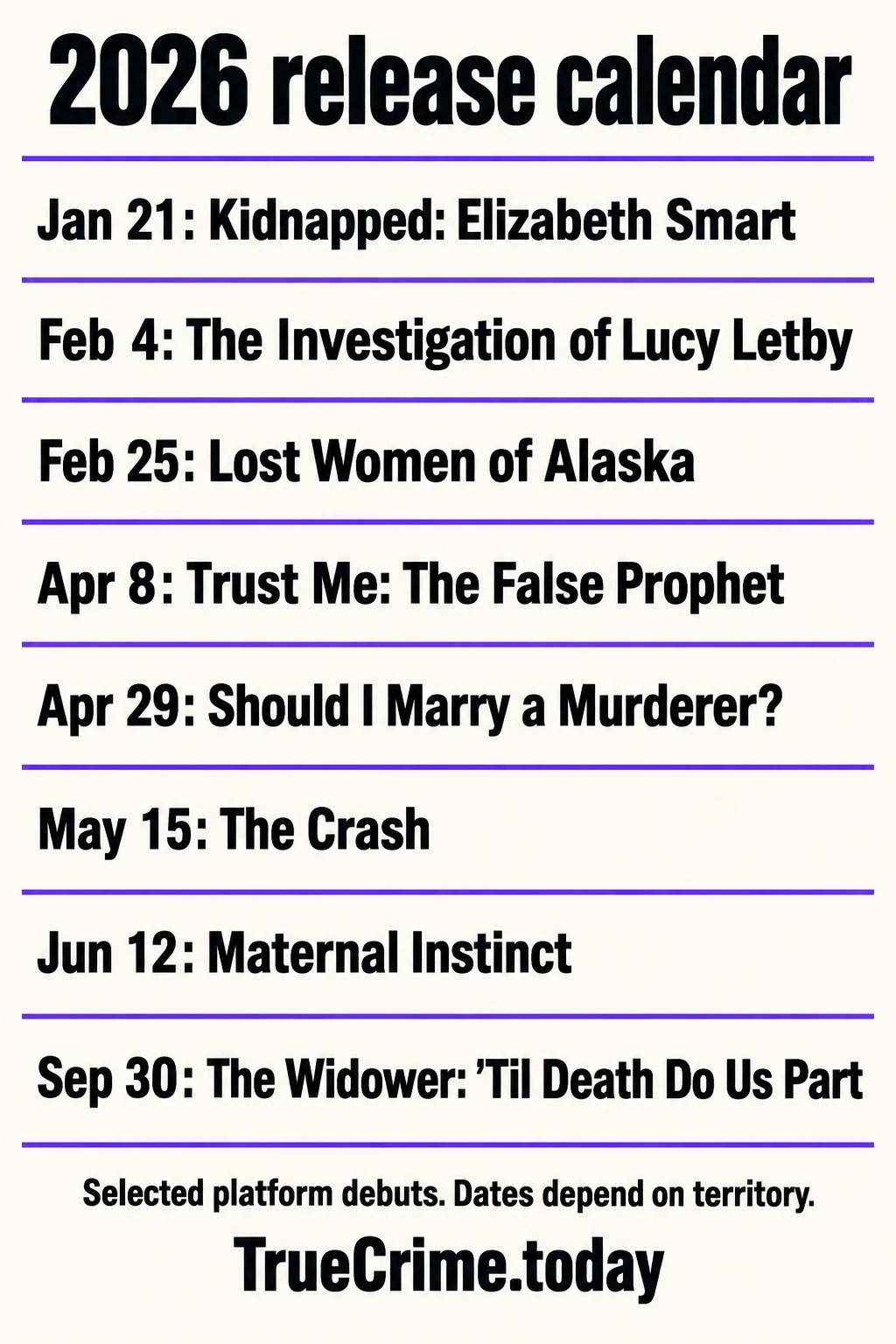
Netflix supplies seven of the eight entries; Investigation Discovery supplies the other broadcast premiere. That reflects this selection’s scope and available first-party records. It gives no basis for saying Netflix made seven-eighths of all new true crime documentaries. Nor does a year label alone prove that a work never appeared anywhere earlier.
January 21: Kidnapped: Elizabeth Smart
Film. Netflix debut: January 21, 2026. Benedict Sanderson’s documentary returns to Smart’s 2002 abduction from her home in Salt Lake City. Netflix describes a film built around her account, interviews with family and investigators, and archival material.
The important distinction is whose story you are choosing to hear. Smart survived the captivity and speaks about what happened to her. That creates a different starting point from a police-led search reconstruction or a film organised around an offender. Her experience can also carry the story beyond the moment of rescue, into recovery and the effects of public attention.
Expect material involving the abduction and abuse of a child. A hopeful account of survival can still be difficult viewing. The premiere date tells you which film this is; it cannot tell you how much detail you want to encounter tonight.
February 4: The Investigation of Lucy Letby
Film. Netflix release: February 4, 2026. ITN Productions announced that date for Dominic Sivyer’s documentary. Its stated material includes arrest and questioning footage, detectives, a family member, and contributors who dispute aspects of the evidence in the British nurse’s case.
Those different positions make the identity of each speaker important. A detective explaining an investigation, a bereaved parent describing loss and a contributor criticising evidence are doing different things. Listen for which claim a particular scene supports, rather than treating the presence of opposing voices as a verdict on who is right.
This is a release entry, rather than a current assessment of Letby’s legal position. A documentary questioning a conviction does not itself change a court order. Infant deaths and bereavement are central subjects; consider that before choosing it as background viewing.
February 25: Lost Women of Alaska
Three-part series. US premiere on ID: February 25, 2026; HBO Max streaming was also announced. The broadcaster scheduled the programme across an 8–11 p.m. Eastern window. That is a broadcast slot, not a promise of three hours of uninterrupted footage.
The series concerns the killings of Alaska Native women Veronica Abouchuk and Kathleen Jo Henry. Octavia Spencer is an executive producer. The publisher presents the investigation alongside failures affecting Indigenous women, bringing attention to whose disappearance receives recognition and whose account is heard.
That wider question deserves room beside the investigation. Try to notice whether a woman is introduced through her life and relationships or only through the evidence of her death. Violence and material concerning real victims make this an entry to approach deliberately, rather than on the strength of a dramatic trailer alone.
April 8: Trust Me: The False Prophet
Four-part series. Netflix US release: April 8, 2026. Rachel Dretzin directs the story of Samuel Bateman through the access obtained by Christine Marie and videographer Tolga Katas inside a religious community.
Their proximity is the series’ distinguishing feature. It offers material from within a group that outsiders might struggle to observe. At the same time, footage gathered by people involved in events has a point of view. Their decisions, observations and interpretations need to remain distinguishable from independently established facts.
The subjects include coercive control and sexual abuse involving minors. The series may interest you if you want to follow how people documented warning signs and responded to disclosures. Four episodes also allow a different pace from a single feature, though episode count alone does not demonstrate greater accuracy.
April 29: Should I Marry a Murderer?
Three-part series. Netflix release recorded for the UK and New Zealand: April 29, 2026. Josh Allott’s documentary follows Caroline Muirhead after her fiancé, Sandy McKellar, tells her about the death of cyclist Tony Parsons in Scotland.
Netflix describes interviews with Muirhead, people close to her, investigators and legal participants, together with material from her personal archive. The viewing question goes beyond whether a secret is revealed: what does coming forward require from the person who knows it, and what protection or support follows?
The title is a dramatic invitation to watch, so avoid using it as a substitute for the precise legal terminology of the case. The programme also includes reconstructed scenes. When a sequence depicts an earlier event, check whether you are seeing a reconstruction, an original record or someone’s later account.
May 15: The Crash
Film. Netflix debut: May 15, 2026. Directed by Gareth Johnson and produced by RAW, the documentary examines the fatal Ohio collision involving Mackenzie Shirilla and the investigation that became a murder case. Netflix describes a combination of firsthand accounts and case evidence.
It is useful to keep three questions apart as you watch: what the vehicle did, what a speaker thinks the driver intended, and what the court concluded. A collision’s outcome does not make every interpretation of the driver’s mental state self-evident. Equally, a participant giving an interview is not a new legal finding.
The publisher flags teen deaths, drug use and disturbing responding-officer footage. That is more useful for deciding whether to watch than the broad promise that a documentary is “shocking.”
June 12: Maternal Instinct
Film. Netflix debut: June 12, 2026. Jessica Dimmock directs this account of a 2020 Texas case involving Taylor Parker and a claimed pregnancy. A traffic stop becomes the starting point for unravelling a story that had been presented to people around her.
The film’s premise makes it tempting to look for one revealing gesture or an obviously false sentence. A more useful question is what could be checked: which parts of the story depended on another person’s belief, and which could be tested against a record or physical evidence?
The subject involves pregnancy, lethal violence and infant death. You can understand why it belongs in the release calendar without needing graphic details of the offence here. People looking for a survivor-led account should also know that this is a different kind of story from Elizabeth Smart’s film.
September 30: The Widower: Til Death Do Us Part
Film. Netflix US release: September 30, 2026. The media centre identifies The Widower: ’Til Death Do Us Part as a Chris Smith documentary film, produced by Library Films and NBC News Studios. Its synopsis follows a journalist and a detective examining suspicious deaths and marriages.
That makes the investigator-and-reporter partnership the useful viewing distinction. A documentary about events spread across years can arrange them into a persuasive pattern. As you follow it, notice when a connection comes from an original document and when it comes from a participant looking back.
The film label matters too. A related title elsewhere, an older programme or a different edit need not have the same structure. Match the full title, year and creator before assuming that an episode count found in a search result belongs to this release.
Confirmed for November 6: Unprotected: Murder in Galicia
Netflix’s October 9 announcement names November 6, 2026 for Jorge Laplace’s documentary about Isabel Fuentes, whose case took place in Galicia in 2015. The publisher describes a reconstruction of the case and shortcomings in the protection of the victim.
At our October 24 check, this is an announced premiere. There is no basis here for a review of the completed film, a claim about its available language tracks or a promise that it will appear in every territory on that date.
A fictional series, Murder in Galicia, is announced for a week later. The documentary and drama should have separate entries in your viewing plans. Even when they concern the same case, a scene performed by actors has a different evidential status from an interview or original recording.
Two films that need an earlier-year label
Murder in Glitterball City remains a legitimate 2026 HBO viewing release, provided its earlier history stays visible. Sheffield’s 2025 world-premiere record and HBO’s two-part 2026 presentation describe different events and formats. Croatia’s official HBO Max schedule gives February 20, a day after the US date, showing why a territory is useful beside a date.
Free Leonard Peltier also premiered at Sundance in 2025. A new streaming placement or a festival article posted in 2026 cannot reset that premiere. If you want a recently available documentary, either film may still fit. If you want works first released in 2026, the earlier date answers your question.
These examples explain why the calendar uses named release events and avoids claiming a complete worldwide first-premiere inventory. Festival, television and streaming histories can overlap, and the different versions need to be checked individually.
What the formats mean for your evening
A film and a three-part series can look interchangeable when both have one cover image. The actual episode timings for Should I Marry a Murderer? illustrate the difference: the BBFC records 50 minutes 4 seconds, 44 minutes 15 seconds and 56 minutes 47 seconds. Together, that is 2 hours 31 minutes 6 seconds before any breaks you take.
A separate classification summary rounds the episodes to roughly 56 minutes each. That is useful as a rough description, but it would give a different total. For a tight viewing window, the actual episode listings are the better basis. Likewise, ID’s three-hour broadcast slot for Lost Women of Alaska should not be treated as an exact streaming runtime.
You may prefer a complete feature tonight and save a series for several evenings. That choice does not require a claim that one format is more truthful. It requires the correct version, the correct timings and an idea of how much emotional attention you want to give it.
What a 2026 release cannot tell you about a case
The release year dates the programme. The investigation, interview, trial and any appeal can belong to different years. A newly released film may contain an interview recorded long before publication, while a court decision may arrive after the edit is finished.
For that reason, treat a programme’s final update as a dated account. When its conclusion matters to your understanding of someone’s legal position, check the corresponding court record separately. Commentary, an assertion in an interview and a judicial finding each need to be identified in their own terms.
The same applies to access. A platform can accurately say it has an exclusive interview while the account still leaves questions open. You can value the interview for what the person describes without making it carry the entire case.
Before you commit to a subscription
Check the title in your country’s catalogue, then open the audio and subtitle options for that particular entry. The availability of a translated description does not guarantee the language track you want. The dates above also do not promise that a title remains available everywhere today.
The last time we checked the release records and the November announcement was October 24, 2026. This is a selected calendar with clear date and format labels. It leaves room to add further verified releases without quietly turning older films into new premieres or future announcements into films you can already watch.
You can ask the editorial team about a release date, version or format listed in this 2026 documentary calendar.
Ask about a documentary release