True crime community: finding a discussion worth joining
Find your place in the true crime community: check moderation, trace claims to original sources and join a discussion without spreading rumours.

You finish a documentary and want to talk about the detail that bothered you. The true crime community can give you people to talk to, someone who knows where a document came from, or a different way to understand an interview. Finding a discussion worth joining takes a little more care than choosing the busiest comment section.
This is for you if you want to read, ask questions or contribute without turning a stranger into your suspect. You can start with a public source and an ordinary question. You do not need specialist software, a paid membership or a personal story to tell.
TL;DR
The true crime community includes readers, listeners, viewers, creators and people who discuss real crimes. It has no single membership list or governing body. Look for clear rules, sources you can follow, corrections that remain visible and moderators who stop harassment. Before sharing a claim, find its origin, check the context, separate what happened from what someone thinks happened, and remove private details. Popularity tells you what caught attention; it does not settle a case.
You can take part without playing detective
A community might form around a podcast, a documentary, a forum or a single case. Some people come for the storytelling. Others follow court reporting, compare historical accounts or talk about how victims are represented. Understanding what true crime covers helps you choose a conversation that fits your interest: discussing a film’s editing is a different task from checking a claim about a hearing.
You might notice that a timeline skips a day, find a public interview that another reader missed, or ask which speaker made a statement. Those are useful contributions because someone else can follow them. You can also listen. A group should not require you to name a suspect or adopt a theory before you belong.
If your comment asks what everyone thinks of a whole case, you may get replies about completely different things. A focused social media discussion starts with a specific situation and a question someone can answer. Give the passage or timestamp you mean, then ask about the detail that is missing.
TrueCrime.today is an editorial website. We do not operate a discussion forum or a private investigation service. The examples here help you assess spaces run by other people; they are not a certification of any community.
Look at how a group handles disagreement
Read a few threads before joining in. Find one where people disagree and one where an early claim needed correcting. Does someone ask for the source? Can a newcomer question a popular view without being insulted? Does the correction appear where later readers will see it?
For a concrete platform example, Reddit’s Moderator Code of Conduct calls for clear expectations and active moderation. Those requirements give you questions to ask of a subreddit. They do not prove that every conversation there meets them.
A moderator is a person who helps run the space and enforce its rules. That role does not make them a court authority or an expert in every case. Look for explanations of decisions and a way to report a problem. A locked thread may be an attempt to stop harassment; it may also stop a worthwhile exchange. The reason matters more than the lock by itself.
A small group can have thoughtful discussions, while a large one can collect information quickly. Neither size tells you how well claims are checked. Avoid treating membership counts as a measure of trust.
A popular comment is still only a comment
The need for moderation is not hypothetical. In a March 2022 statement from r/TrueCrime’s moderators, the team described victim blaming, racism, misogyny and calls for vigilante justice. They said roughly 98% of the problematic comments they were discussing came from accounts with no previous participation in that subreddit.
That figure describes the moderators’ account of a particular set of comments. They did not publish a denominator or a method there, and it is not a finding that 98% of members behaved badly. It also does not establish today’s behaviour. The useful point is that a discussion can be disrupted by people who were not previously part of it, so rules need enforcement as well as a place in the sidebar.
The same care applies when someone writes, “Everyone thinks this.” Everyone in which thread, at what time? A visible selection of comments cannot tell you what all viewers believe. Votes can help a comment travel without giving it another source.
Follow a claim before you share it
Suppose three accounts post the same cropped interview clip. That is an invented practice example, not a report about a particular case. All three may be repeating one upload. Their agreement gives you three reposts, not three independent accounts of what happened.
Reddit’s Reddiquette encourages people to find the original content rather than keep passing along chains of references. For a crime discussion, the original might still need checking: a video can be edited, a witness can be mistaken and a document can contain someone’s allegation.
When analysing a true crime case, we distinguish a statement, its source and what the record actually establishes. You can use the same distinction in a comment. “The witness said the call came before dinner” preserves who supplied the information. “The call definitely came before dinner” asks more of that source.
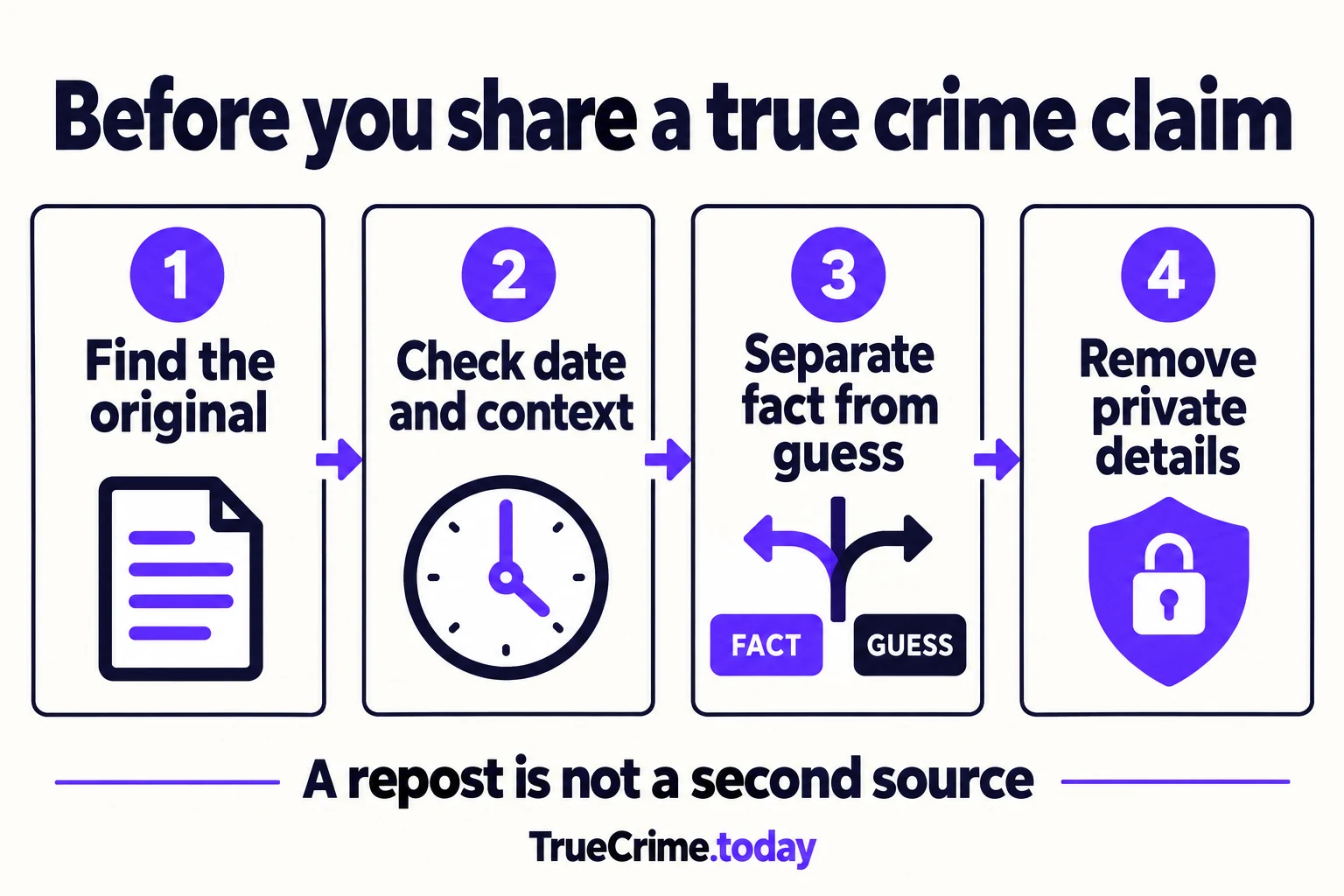
The diagram is our practical sequence, not a validated scoring system. Check origin, context, claim and privacy separately. A post can identify its source correctly and still make an unsupported leap about motive. It can also be accurate but expose someone who has no reason to become a public target.
Choose the kind of conversation you want
Episode discussions work well if you want to compare what a podcast or film showed. Expect spoilers, and notice whether people can distinguish the programme’s account from the underlying events. A production may leave something out for reasons you cannot infer from the finished episode.
Case threads can help you follow a timeline or find public documents. Look for dates, links and a distinction between an allegation, a charge and a court finding. An old opening post can become misleading if later developments are buried hundreds of replies below it.
Reading groups offer another pace. You can discuss an author’s choices or follow a footnote together. That lets you talk about true crime without constantly waiting for a new arrest or a dramatic reveal.
These are different uses, not a ranking. Start with the conversation you want to have. If you are looking for support after violence, a public case forum may expose you to speculation or unwanted contact. It should not be treated as confidential support simply because its members are sympathetic.
Make your first contribution small and checkable
Before posting, read the group’s rules and the existing thread. Keep the source open beside the comment box. Use the browser’s search or find function to see whether someone has already answered your question; include enough information to make the passage easy to locate.
A first attempt can follow four steps:
- Name the detail you want to understand.
- Give the public source, date and a timestamp or page where useful.
- Say what the source shows and what you still cannot establish.
- Ask a question that does not identify a new suspect or expose private information.
In our cropped-clip example, “Does anyone have the full interview? This upload begins midway through the answer” is a workable question. “The neighbour is hiding something” adds an accusation the clip cannot support.
You may get an answer, a better source or nothing at all. No response does not confirm your theory. Keep the unanswered question as unanswered. If you find the same material through another account, check whether it leads back to the upload you already have.
When a source changes, change your post
Good participation includes returning to something you wrote. If you misread a date, correct the date and explain the change. If your conclusion depended on it, revisit that conclusion too. A tiny edit at the bottom may leave the most misleading sentence intact.
For an ordinary factual error, a visible correction can help later readers understand what happened. If the post exposed someone’s private information, remove that information and contact the moderators. Do not preserve the harmful detail in your explanation of the correction.
As you become more familiar with a case, keep a simple note of the source, its date and the claim it supports. That is more useful than collecting a folder of screenshots with no context. It also makes it easier to explain why you changed your mind.
Protect people while you discuss the record
Being able to find an address, workplace or relative online does not make it useful to publish. Ask whether the detail explains the public record, or merely makes a person easier to contact. Do not ask a group to message relatives, employers or people who resemble someone in a video.
You can argue for strong lawful accountability for proven violence without choosing punishments for an untried person in a comment thread. Preserve the difference between a suspicion and a finding. A discussion of shortcomings in an investigation should identify the record behind the criticism and what is still unknown.
These recommendations are for an international readership. Platform rules and national laws are different things, and permission to post under one set of rules does not resolve every legal question. If you need advice about a specific accusation or disclosure, it depends on the jurisdiction and facts.
You do not owe a group your personal story
A question about violence can land differently for someone who has lived through it. You can skip a thread, mute notifications or leave. You do not have to explain your experience to justify that choice.
The same applies to other members. A survivor’s account deserves careful listening, without demands for intimate details to satisfy a discussion. An attributed account and an independently established fact are different kinds of information; recognising that difference does not require turning the person into an adversary.
We last checked the platform guidance used here on October 12, 2026. The moderator statement is explicitly a historical example from 2022. Before joining a particular space, read its current rules and recent threads rather than assuming old behaviour describes it now.
Questions before you join
Is the true crime community one organised group?
No. The term covers many audiences and spaces, including people who only watch or read. A forum’s rules apply to that forum; a popular creator cannot speak for everyone interested in crime stories.
Does strong moderation prevent honest criticism?
It can if rules are vague or applied to silence disagreement. It can also make criticism possible by stopping insults and intimidation. Look at whether a sourced challenge stays visible, and whether the group explains removals.
Should you contact someone connected with a case?
A public discussion is not an invitation to approach relatives or witnesses. If you have genuine information relevant to a crime, use the appropriate official reporting channel. Do not turn a forum’s enthusiasm into a request to investigate a private person.
Start with a question someone can answer
Choose a thread that welcomes sources and correction. Read the rules, follow one claim to its origin and ask about the part you cannot establish. That gives other people something useful to respond to, while leaving room for you to change your mind.
Have a question about a discussion rule or the origin of a claim? Send a public link and the passage you mean. Do not send passports, contracts, bank details or other personal documents.
Ask about a discussion