True crime books: what you’re reading and how to judge it
Understand true crime books, from reporting and memoir to literary reconstruction. Learn to check a scene, source notes and the edition before you buy.

True crime books give you more time with a story than a clipped interview or a final episode. You can return to a sentence, follow a note and notice whose version the author has chosen. That makes the reading rewarding, especially when you want to understand how a convincing account was assembled.
Before choosing a title, it helps to know what you want from it: reporting on a crime, a person’s experience, a history of the people affected, or a literary account of events. Those forms offer different kinds of access. This introduction helps you recognise them and try a small source-checking exercise, without turning your reading into a second job. The examples concern murder, imprisonment and loss.
TL;DR
True crime books are nonfiction accounts of real crimes and the people affected by them. They include reporting, memoir, history and literary reconstruction. Look at who is telling the story, how an important scene is sourced and which edition you are buying. Notes can help you check a claim, while a dramatic scene or a long bibliography alone cannot establish every detail. Choose a reading question before choosing a famous case.
A true crime book can tell several kinds of story
A book can follow an investigation, recover the lives of victims or examine how a justice system treated someone. That range explains why two books sold on the same shelf can feel so different. The distinction between true crime and crime fiction matters when you want a factual account: a novel inspired by an actual murder can invent people, dialogue and events.
Within nonfiction, reporting brings together documents and interviews; memoir presents the author’s experience; history works with evidence from the past. A nonfiction novel uses literary scene-building to tell a real story. These categories overlap, so they work best as questions about a book’s approach rather than rigid boxes.
A victim biography can have a clear purpose even if it never identifies the killer. A memoir can show what a legal struggle felt like without describing every hearing. If you begin with that expectation, you can judge whether the book delivers the kind of understanding you wanted.
The narrator changes what you can know
Bryan Stevenson’s Just Mercy draws on his work representing people caught in the US criminal justice system. Hallie Rubenhold’s The Five follows women killed in London in 1888. The first offers a practitioner’s experience; the second works backwards through historical material to restore lives that popular accounts reduced to their endings.
The difference concerns access, not an automatic truth score. A person who was present can recall an event but miss what happened elsewhere. A historian can compare records while leaving a private conversation unknowable. When you practise case analysis through documents and testimony, identifying who could know a detail is a useful starting point. The same habit helps with a book.
Notice how an author moves between these positions. “She later remembered” attributes a recollection. “The report recorded” identifies a document. A sentence about what someone silently intended needs another explanation. Smooth storytelling can make those changes easy to miss, so slowing down at one of them is worth the effort.
A vivid scene deserves a source question
Truman Capote’s In Cold Blood grew from reporting on the 1959 murders of the Clutter family in Kansas. Its publication history also leaves evidence of editorial checking: a magazine serial in 1965, followed by the book in 1966. Those dates show a writing and publication sequence, rather than a guarantee that every detail was independently established.
The University of Delaware’s Capote fact-checking archive describes Sandy Campbell’s correspondence and work on the magazine serial, including checking with people connected to the case. For you as a reader, this is a concrete trail behind a famous narrative. Its existence lets you ask more precise questions about reporting; it does not settle the accuracy of every conversation or imagined thought.
You can bring that question to a much less famous book. Choose one scene and look for its origin: an interview, a contemporary record, an account written years later or an inference. A note that names a source is a starting point. You still need to ask whether the source supports the particular claim being made.
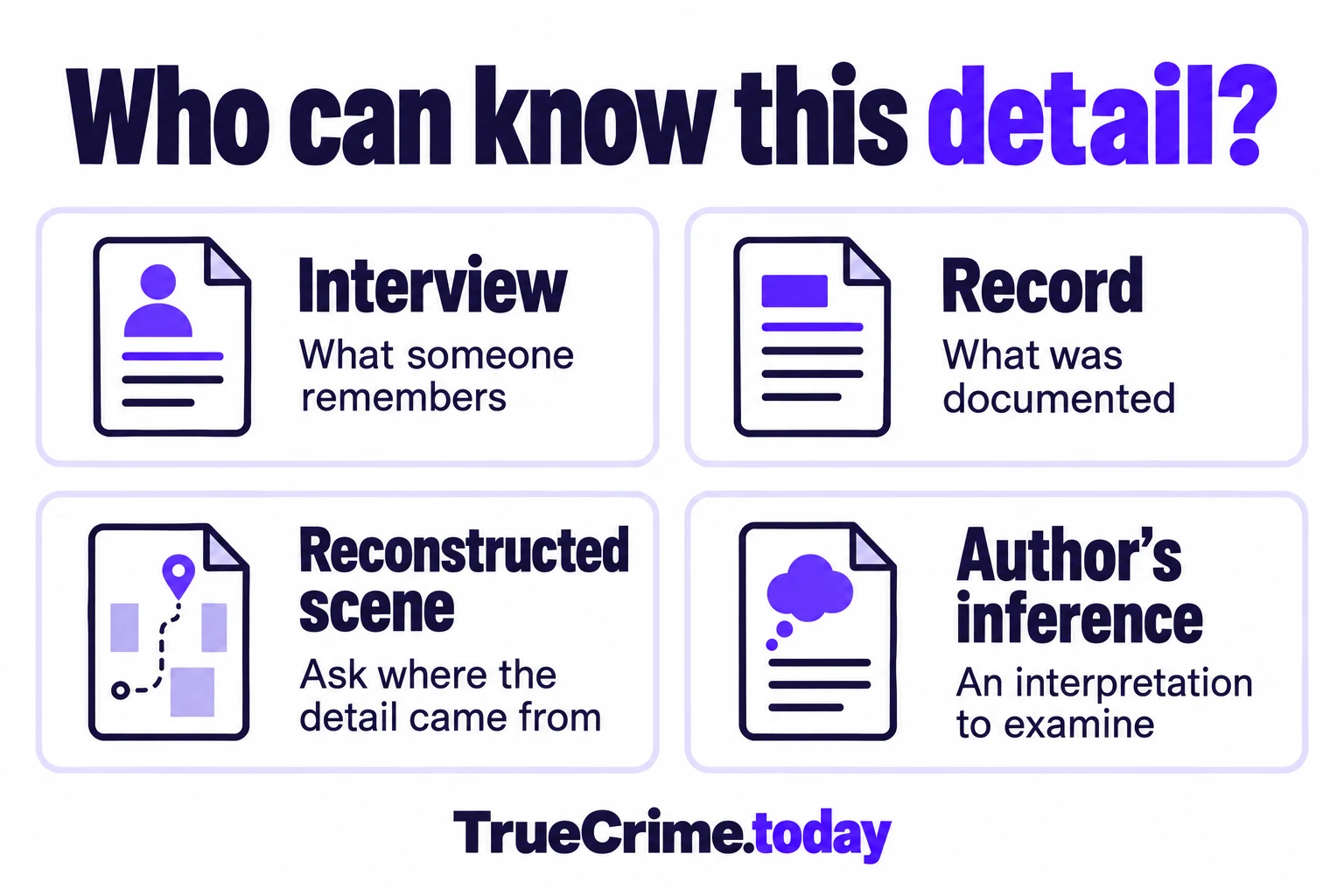
The diagram separates the source of a detail from the way it is presented. A reconstructed scene can draw on several records, and an interview can appear inside it. Keeping those layers visible helps you enjoy the narrative while understanding where its certainty ends.
The edition is part of the story you buy
A film tie-in cover, a paperback date and an ebook listing can all refer to versions of the same work. Before buying, match the author, language, publisher and format. Then look for a statement that the text has been revised or expanded. A new publication date on a shop page alone cannot tell you what changed inside.
The International ISBN Agency’s edition and format rules distinguish different language editions and formats, which need separate ISBNs, from an unchanged reprint, which keeps its number. This helps you identify the product you want. An ISBN records identity; it does not certify reporting accuracy or tell you whether a shop has a copy today.
An adult memoir and a young-adult adaptation also deserve separate attention. Just Mercy exists in both forms. If you want the adult book, verify that the listing describes that version rather than assuming a matching author and similar cover mean identical contents. English-language editions vary between the US, UK and other markets, so compare the actual edition rather than a global-looking search result.
Reporting, memoir and history ask different things of you
Investigative reporting suits a reader who wants to follow how accounts and documents were connected. Patrick Radden Keefe’s Say Nothing examines Jean McConville’s disappearance and the Northern Ireland conflict. Its scope includes memory and aftermath, so a reader looking only for a compact suspect-and-solution story should expect a wider discussion.
With memoir, pay attention to the narrator’s involvement. Stevenson’s position as a lawyer gives Just Mercy its perspective and emotional force. That perspective is part of what you are reading. It does not make the author a witness to every event described or require you to agree with every interpretation.
Historical investigation connects a crime to a longer period. David Grann’s Killers of the Flower Moon follows the murders of Osage people in 1920s Oklahoma alongside oil wealth and the investigation. Rubenhold’s The Five instead centres the biographies of women killed in Victorian London. These are different questions within historical nonfiction, rather than competing promises to give you the same answer.
If you know which question holds your attention, a library catalogue or publisher’s sample can help you find another book with a similar purpose. You can also choose a collection of shorter reports if you want to meet several approaches before committing to one long account.
Try one scene before you commit to the book
Choose an ordinary scene from a sample, rather than the most sensational passage. Look for a conversation, a description of a home or an explanation of what someone believed. Then work through four checks:
- Write down one factual claim in the scene.
- Find its note, attribution or explanation in the author’s account of the research.
- Identify whether the support is a document, recollection or interpretation.
- Record one question that remains unanswered.
The result can be modest: you have found a source, or you know why you cannot check the detail yet. Neither outcome requires you to decide that the entire book is reliable or unreliable. It gives you a more accurate expectation of the reading ahead.
Try a second passage if the first is unusually dramatic. A quieter section reveals how the author handles everyday information and transitions between people’s accounts. You can learn quite a lot about the book’s method before you know the ending.
Paper, audio and ebooks reveal different details
A printed book lets you hold a place in the chapter while turning to a map or endnote. An ebook can make that easier with working links, but the navigation depends on the edition. Try a note in the sample and check that you can return to the passage without searching for it again.
For audio, ask whether there is a companion PDF or another way to access notes, photographs and maps. A narrator’s voice can make a memoir especially engaging. If your interest is verifying a particular quotation, access to the written source apparatus becomes a separate consideration.
Library borrowing can also help you test the fit without paying for a book that overwhelms you or tells a different kind of story than you expected. Availability varies, so check your own library and the edition it holds. We last checked the examples and edition rules on October 11, 2026; local stock, prices and supplementary audio materials need their own check.
Three reading traps worth catching
The first trap is treating length as a research score. More pages can mean more context, larger type or a different edition. A short account focused on one question can be more useful to you than a sprawling narrative. Compare what is covered and how it is supported, rather than expecting a page count to measure accuracy.
A second trap is expecting a book to contain the latest case outcome. Every manuscript has a stopping point. Michelle McNamara’s I’ll Be Gone in the Dark was first published posthumously in February 2018, before the April 2018 arrest in the Golden State Killer investigation. A reading account of the search and a later account of the proceedings have different time limits. Verify whether a particular edition includes additions.
The third trap is reading confidence as proof. A source can sound sure and still be mistaken, while an author who describes a gap may be handling evidence carefully. The useful question concerns the support for the assertion, not how forcefully the sentence is written.
Keep the people in the story in view
After a chapter, see what you can remember about the people harmed apart from the crime itself. Their work, relationships and choices help you notice whether the narrative gives them lives or uses them mainly to move the investigation along.
You can discuss an author’s framing without making new accusations against a living person. A scene that makes a relative seem cold does not establish involvement in a crime. Looking for that person’s address or contacting them about a book crosses into their life without improving your understanding of the text.
A reading group can focus on sources, narrative choices and uncertainty. Nobody needs to share a personal experience of violence to take part. You can skip a disturbing section, stop a book or choose a different subject and still have a serious conversation about how nonfiction works.
Questions when you move from screen to page
A documentary gives you images and edited voices; a book gives you a different opportunity to examine wording and references. That change raises a few questions about genre, age and the amount of research a reader can expect to see.
Can a novel based on a crime count as true crime?
A crime-inspired novel can invent scenes and characters within its fiction. For nonfiction reading, check how the publisher and author describe the work and what they say about reconstruction. A real event behind a plot does not make every detail in the novel a factual claim.
Does an old book still have something to offer?
Yes. It can preserve reporting, a person’s perspective or the assumptions of the period in which it was written. Its age becomes a problem when you expect current procedural information. Separate the book’s historical value from the question of what has happened since publication.
Do more pages mean better research?
No. Pagination depends on format as well as contents. A bibliography with detailed entries can help you find material, but the relationship between a source and a specific assertion matters more than the size of the list. A memoir without extensive notes can still offer a meaningful account of experience, with a different basis for what you can verify.
Choose the question you want to stay with
Before your next book, finish one sentence: “I want to understand…” The answer could be a life, the handling of evidence, the effects of a conviction or how an author reconstructs the past. Match that question to a sample and one source check. You then have a reason to keep reading that will survive the first dramatic chapter.
Have a question about a true crime book or a puzzling source note? Send the title and a public link. Keep passports, contracts, bank details and other personal documents out of the form.
Ask about a book