True crime by country: cases, records and the questions to follow
Choose true crime by country across ten destinations. Understand the cases, court records and statistical differences before comparing what happened.

Choose a country
True crime in Brazil: cases, court records and the bigger picture
Understand true crime in Brazil through the Evandro case, Boate Kiss and Vladimir Herzog, with Brazilian court terms, original records and crime-data limits.
Read the guideTrue crime in France: cases, courts and the records behind them
Read about true crime in France through Dreyfus, Outreau and the Klaus Barbie trial. Understand French court terms, historical archives and documentary claims.
Read the guideTrue crime in Germany: cases, court records and the numbers behind the headlines
True crime in Germany through Hinterkaifeck, the NSU and Hanau: court records, German procedure and what the 2025 police figures can tell you.
Read the guideTrue crime in Italy: cases, appeals and the stories behind the numbers
True crime in Italy through the Meredith Kercher, Talpis and Matteotti cases: court outcomes, Italian appeals and the limits of homicide statistics.
Read the guideTrue crime in the Netherlands: cases, court records and misleading numbers
Dutch true crime through Lucia de Berk, Peter R. de Vries and the De Witt brothers: court records, homicide data and the questions behind the headlines.
Read the guideTrue crime in Poland: cases, missing evidence and court decisions
Polish true crime through Tomasz Komenda, Iwona Wieczorek and Grzegorz Przemyk: verified court outcomes, investigation failures and police figures.
Read the guideTrue crime in Russia: cases, court decisions and evidence
Russian true crime through Politkovskaya, Chikatilo and Dyatlov: what court decisions, scientific models and official crime figures can tell you.
Read the guideTrue crime in Spain: Asunta, Wanninkhof and what the courts decided
Spanish true crime through Asunta Basterra, Rocío Wanninkhof and Marta del Castillo, with appeal decisions, jury rules and 2025 crime figures.
Read the guideTrue crime in the United Kingdom: cases, courts and wrongful convictions
Stephen Lawrence, Sally Clark and Andrew Malkinson: British cases, wrongful convictions, Scottish verdicts and what homicide figures actually count.
Read the guideTrue crime in the USA: cases, courts and the evidence behind the story
True crime in the USA through the Central Park Five, Scottsboro and Emmett Till: understand the cases, court decisions and numbers behind American crime stories.
Read the guideYou remember a case name, but the place can be the detail that makes the story understandable. Which court heard it? Where could you find the decision? Does the crime figure in the documentary describe that country, one part of it or a different year?
This collection helps you choose true crime by country through ten existing country discussions: Brazil, France, Germany, Italy, the Netherlands, Poland, Russia, Spain, the United Kingdom and the United States. Each offers cases, records and a question worth following. The countries are reading destinations, rather than a ranking of danger or a claim to cover every case within their borders.
TL;DR
Choose a country to find the right records and context, then check what those records actually establish. Court systems, privacy rules and crime statistics differ. A police suspect count is not a conviction count; a regional homicide series is not a national total; an appeal may correct one finding while leaving the conviction intact. The country collection gives you places to start, while the comparisons below explain how to avoid losing those distinctions.
Choose the question before choosing the country
If you want to follow an investigation, look for the source that recorded the lead and the checks that followed. If a verdict surprised you, look for the judgment and its reasoning. If you want to understand a pattern, start with the statistical definition and coverage. Those interests may take you to different countries without requiring you to decide which country has the most dramatic crime stories.
The Cornell 7 case is a useful US example because a university response and a New York civil complaint describe different kinds of action. Knowing the location helps you identify the bodies involved; it does not make their decisions interchangeable.
The Lindsay Clancy case brings a different question in Massachusetts: what did the judge decide, and what was left unresolved by the jury? Both stories belong to the United States, but a single national label does little to explain the particular procedure. That is why each country discussion starts with a more specific problem.
Country boundaries matter before the numbers do
The United Kingdom is one reading destination here, but England and Wales, Scotland and Northern Ireland have different legal systems and statistical coverage. A headline using “British crime” can describe a smaller area than you expect.
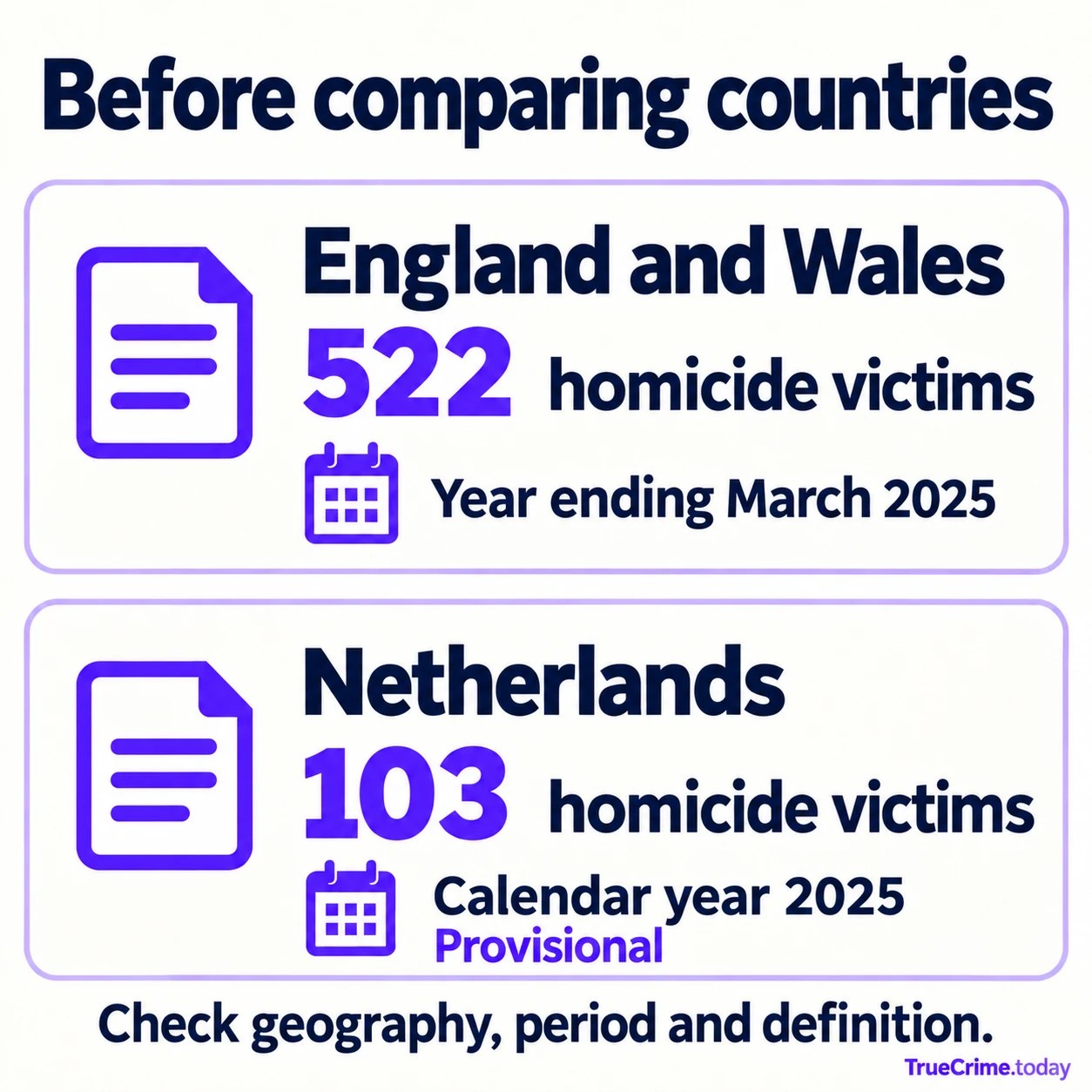
The ONS homicide series for England and Wales recorded 522 victims across 508 incidents in the year ending March 2025. The figures describe two units within one specified area and period. Several deaths can occur in one incident; neither number is a count of convicted people.
There is also a date distinction. The Homicide Index organises the data by the year an offence was recorded, rather than necessarily the year the death occurred or the case reached court. A historical event added later can affect a later series. Before interpreting a rise or fall, ask which date the statistic follows.
When two homicide totals answer different questions
The Netherlands provides a useful second example. The CBS provisional homicide count for 2025 reports 103 victims in the Netherlands during the calendar year. It combines the Dutch murder and manslaughter categories in that statistical collection.
You now have two real figures, but they are not a ready-made comparison of personal risk. The territories and populations differ; the periods are not identical; the data collection and classification need checking. Comparing the totals alone would discard those differences.
The last time we checked these two releases was October 14, 2026. The publication year does not turn either series into a measure of deaths during 2026. The Netherlands figure is provisional, so a later revision may change it. Read the figure together with its label and update status.
The United States and the United Kingdom: find the right court
For US cases, start with the state and the court, rather than assuming every famous crime becomes a federal proceeding. State and federal courts have different jurisdictions. A state criminal case and a university disciplinary investigation can coexist without one acting as an appeal from the other.
The US discussion also distinguishes police records from victimisation surveys. A survey can include experiences that were never reported to police, while homicide cannot be captured by interviewing the person who died. Two measures of violence can tell different stories without either being a simple mistake.
For the United Kingdom, cases reviewed by the Criminal Cases Review Commission offer a way to examine wrongful-conviction questions. In Sally Clark’s case, the record describes misleading medical or statistical evidence and undisclosed bacteriological findings; her convictions were quashed in 2003. The important reading question is what new material changed the assessment, not just whether the story acquired a different ending.
Keep the actual court jurisdiction beside the case name. It helps you identify the relevant procedure and prevents a document about England and Wales from being treated as an explanation of every UK court.
Continental Europe: read the decision in its own procedure
A familiar English word can conceal a different procedural role. Ask whether a court is hearing evidence again, checking a legal point or deciding whether new information justifies reopening a completed case.
Italy and France: an appeal can change a different question
Italy gives you a way to follow different decisions within the same history. The Meredith Kercher case contains murder proceedings and a separate accusation involving Amanda Knox and Patrick Lumumba. A change in one cannot be used to rewrite the outcome of the other. The Italian discussion also uses homicide data with a defined reference year, rather than treating a current publication as current events.
For France, the distinction between appeal and cassation is useful. Cassation examines the application of law and procedure without becoming a fresh examination of all the facts. A report that says a judgment was challenged needs to explain which procedure was used and what it could change.
French criminal courts also do not all have the same composition. Official guidance distinguishes the departmental criminal court, with professional judges, from the ordinary assize procedure with its jury structure. Knowing the court helps you understand who decided the case; the generic phrase “French jury” may not fit the actual hearing.
Germany and the Netherlands: suspect records and published judgments
Germany’s official methodology distinguishes police cases and suspects from defendants and people convicted by courts. The groups overlap, but they are not identical. Not every suspected person is charged, and not every charge leads to a conviction.
That is a useful question for a country discussion built around an apparent crime trend. What stage of the process supplied the number? A police series does not show that every recorded allegation became a proved offence. The statutory investigation duties also require attention to exonerating circumstances, not only information supporting an accusation.
In the Netherlands, a published judgment may replace names with neutral descriptions. Publication rules protect identities, including those of victims and witnesses. A pseudonymised copy can still be useful for checking what the court decided. It should not be treated as proof that someone improperly concealed the evidence.
The ECLI identifier helps you locate the decision, but you still need to distinguish a judgment from an advisory opinion. A document belonging to the same legal dispute can play a different role from the court’s final answer.
Spain and Poland: look for what a later decision corrected
The Spanish discussion includes the Asunta case, where an appeal examined particular inferences while maintaining the convictions. That is a more informative reading exercise than asking only whether the appeal “succeeded.” A court can reject part of the reasoning without changing every part of the result.
When you follow that history, identify the challenged finding, the appellate response and the effect on responsibility. Do not turn a correction about one alleged movement or scene into a claim that the whole prosecution disappeared.
Poland provides a different example in Tomasz Komenda’s case. The Supreme Court acquitted him in May 2018 after reopening the case. Release from custody earlier that year and the later acquittal were separate steps. A chronology makes the difference visible, including what evidence prompted the review.
These two histories should not be flattened into one category of “a changed case.” Their later decisions did different things. The country discussions give you the background needed to compare those effects.
Brazil and Russia: identify the record behind the account
A court announcement, an administrative crime bulletin and a historical case record are all useful materials. They have different authors, dates and purposes. These last two destinations make that difference especially clear.
Brazil: a vote in an appeal is not the whole court’s decision
The Brazil discussion follows the Boate Kiss proceedings and the way later court reporting describes them. A September 2026 STJ notice recorded a reporting judge’s proposed sentence changes and a request for further examination that paused the sitting. That dated notice does not tell you the outcome of every later proceeding.
The distinction is between an individual judicial position and the adopted collective result. If you read a report about increased sentences, check whether it describes a proposal, a completed vote or a decision already entered. The wording can change the meaning of the headline.
Brazilian homicide reporting raises another source question. The Atlas da Violência discusses officially recorded deaths and problems in classification. The year in an edition title can be later than the year represented by the figures. Publication, registration and event dates need to remain visible when you compare reports.
Russia: a convicted perpetrator may leave questions about an organiser
The Russia discussion separates the deaths, investigated offences and court findings behind familiar stories. It includes Anna Politkovskaya’s murder and the later scrutiny of the investigation. Establishing the guilt of perpetrators is a different question from adequately examining who commissioned the crime.
The European Court’s 2018 judgment in Mazepa and Others concerned that investigative duty. It is a dated assessment with its own reasoning and dissent, rather than an announcement of a new conviction. Read it for the issue it examined, and keep it separate from the domestic criminal judgment.
Russian administrative statistics also sometimes combine murder with attempted murder. That combined category cannot be compared directly with another country’s homicide-victim count. Some attempts do not cause a death, and registered offences do not count convicted people. A familiar crime label is only the beginning of the comparison.
What language can help you find, and what it cannot decide
Knowing a country’s language can help you search for judgments and understand the vocabulary used by its institutions. When a familiar court term appears, check what that court can actually decide. Its name and powers tell you more than the nearest English word.
An English report about Italy might call two different challenges an “appeal.” Look for the original name of the proceeding and the issue being challenged. Was the court asked to reconsider evidence, correct a legal error or reopen a completed case? Those questions help you follow what changed.
Translation tools can help with an unfamiliar term, but check the document’s identity, date and procedural role before relying on the wording. A fluent summary can still misdescribe an allegation as a finding or an advisory opinion as a judgment.
A practical way into an unfamiliar case
Pick one country and one question. Find the case name, then the court or agency that issued the document. Note the event date, document date and the issue it addressed. If a later decision is mentioned, compare what changed rather than replacing the whole earlier account with the latest headline.
For a statistic, add territory, reference period, unit and whether the result is provisional. For a published court record, check whether names were altered for privacy and whether material was withheld from the public copy. Missing public information can limit your reading without proving misconduct.
The country articles are starting discussions, not complete national crime archives. Their coverage will grow through documented cases and researched questions. A meaningful starting point is more useful than a claim to represent every region, era and offence already.
Questions about exploring true crime by country
Are these the countries with the most crime?
No. They are the countries covered by this reading collection. A comparison of crime levels requires compatible definitions, periods, population measures and reporting coverage. The number of famous stories cannot supply those data.
Does every country publish a complete case file?
Public access varies by document, proceeding and privacy rule. Even a published judgment is not necessarily the full file. Identify what you have before assuming it contains every interview, exhibit or investigative action.
Start with one country and one source question
Choose the place that interests you, then keep a question beside it: who made this finding, what did it establish and what remains unknown? The answer gives you a way into a particular case without turning the whole country into a stereotype.
For a question about a country case, court record or crime figure, send the public source link and the passage you mean. Do not send passports, contracts, bank details or other personal documents.
Ask about a country discussion