True crime podcasts: find the kind of story you want to hear
Choose true crime podcasts by story length, reporting style and source access. Understand seasons, multipart cases, transcripts and what to check before listening.

You want a true crime podcast for the walk home, and the first result turns out to be part seven of a story you know nothing about. Or you have a whole weekend free and keep finding short conversations that end just as the case gets interesting. Choosing gets easier when you look at how a show tells its story before you look at its chart position.
True crime podcasts tell nonfiction stories about crime, wrongdoing and the people affected. This guide helps you choose a format, find a sensible starting point and check what sits behind the narration. The examples are English-language productions; their availability can vary by country and subscription. We last checked their published descriptions and catalogues on October 15, 2026.
TL;DR
For a single listening session, look for a self-contained episode. For a longer investigation, start with the first chapter of the relevant case or season. Then choose the presentation you enjoy: narration, interviews or conversation. Check the episode’s length, content notes and source material separately. A calm voice, a long runtime or a transcript can make a story easier to follow without settling whether its claims are correct.
True crime podcasts can fit one walk or several evenings
The first choice is how much of a story you want to take on. An episodic show usually lets you choose individual stories. A serialised story develops across several episodes, so listening out of order can leave you missing the reason a person or document matters. A feed can contain both.
That range is part of true crime: the subject covers reporting, retelling and discussion of real events. The category alone tells you little about how an episode was researched or whether you need earlier chapters.
Serial gives you a concrete example of a season-long commitment. Its original producers describe Season One as one story told in 12 episodes, released in 2014 and revisiting a 1999 Baltimore murder case. Twelve chapters describe that original season’s structure, rather than the number of episodes now in the entire feed. They also say nothing about the case’s current legal position.
A different kind of entry point is Criminal, whose producers describe travelling to interview people about wrongdoing and its consequences. Its scope includes people affected by crime as well as those accused of it. If you want a human story rather than a season-long puzzle, that broader description gives you something useful to look for in an episode summary.
Story order and hosting style are separate choices
A conversation between two hosts can cover one case over several weeks. A single narrator can tell a complete story in one episode. “Conversational” and “serialised” answer different questions: who is speaking, and how far does the story continue?
Casefile shows why you should check the item rather than assume the whole feed follows one pattern. Its catalogue includes a three-part Waco story, published on April 18, April 23 and May 2, 2026. The labels run from part 1/3 to part 3/3. You would start that sequence at part one, even if your app happens to show the final part first.
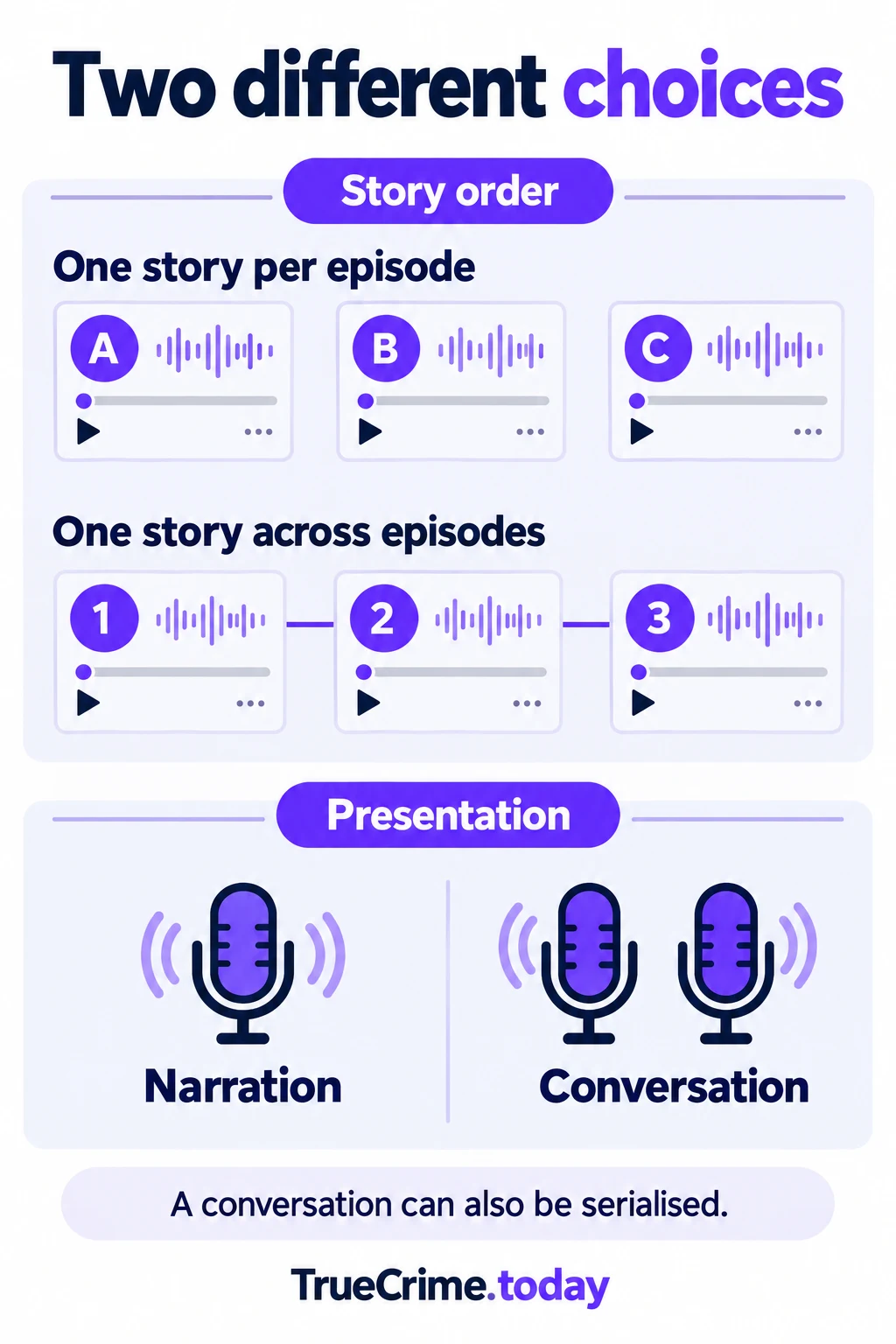
This diagram describes choices, not a reliability scale. Conversation can make uncertainty audible through questions and disagreement. Narration can make a complicated chronology easier to follow. Either still needs evidence for the claims it makes.
What a transcript actually lets you check
A transcript helps you find a name, revisit a sentence or follow speech you cannot comfortably hear. First check what it transcribes. Casefile’s Case 54 recording transcript labels a particular recording. Its presence should not be read as a promise that every episode has a complete transcript of its narration.
The distinction matters when you want to quote something. A text of a recorded conversation, an edited programme transcript and automatic captions can cover different material. Identify the speaker and compare the relevant passage with the audio when possible, especially if a name or a single negative changes the meaning.
When you analyse a true crime case, tracing an assertion back to its source matters more than how neatly it appears in text. A transcript can show what a speaker said. Whether the statement is accurate calls for the underlying evidence and context.
Pick a starting episode without spoiling the whole season
Open the programme description and the description of the specific episode. Look for a case title, season number and any “part of” label. If the story is connected, find the first chapter of that story. You do not necessarily need the first episode the programme ever published.
For a self-contained episode, choose a subject you actually want to hear about. An interview about a wrongful accusation, a fraud investigation and a historical murder can all sit within the genre while offering very different evenings.
If you dislike spoilers, avoid the newest update until you know where it belongs. An update may assume you know the original reporting and reveal its ending in the opening sentence. Conversely, if you mainly want the latest information, the original finale may leave you years behind the public record.
Listen for the source behind the confident voice
As you listen, notice how the programme introduces its information. “We interviewed the person who made the call” describes one reporting step. “A newspaper reported that a call was made” describes another. Both may be useful; they give you different opportunities to check the account.
A host’s reaction adds a further layer. Surprise, anger or disbelief can make a conversation engaging, but the reaction does not establish what happened. You can enjoy the hosts’ company while keeping their interpretation separate from an interview or document they discuss.
Look for credits and supporting material in the episode notes. A specific publication, dated document or clearly introduced interview gives you more to work with than a general assurance that research was extensive. An omitted reference leaves a question open; it does not by itself prove that the story is false.
How much time are you agreeing to?
Check the duration of the actual item you are about to play. A trailer, bonus conversation, update and main episode can have very different lengths. The number beside a show’s name may count all of them together.
For a connected story, inspect the whole sequence before saving it for a journey. Three parts can fit very differently from twelve, but the count alone still does not tell you the total listening time. Add the listed durations if that decision matters to your plans.
Playback speed changes the time you spend, and it can also change how easily you catch names, accents or overlapping speech. Choose a speed that lets you follow the story. There is no prize for reaching the final episode while losing track of who said what.
Before you pay for access to an archive
Find out what the subscription unlocks: an archive, early access, bonus material, fewer adverts or a separate series. An episode appearing in search results does not guarantee that its audio is available through your account.
Check the programme’s own listening information and the offer shown in your country. Avoid assuming that the price, payment options or library described by another listener will apply to you. Likewise, a show website being accessible does not establish that every linked app will play every episode where you live.
If written access matters to you, check for transcripts before subscribing. A short episode description is not enough to follow a full programme, and a transcript available for one story may not cover the archive.
When a polished story leaves a question unanswered
Good editing helps you understand a complicated account. It also means someone chose which interviews, pauses and background details to include. Even when the account is easy to follow, there may be gaps in what is publicly known.
You do not have to become suspicious of every sound effect. Instead, notice the moment a description becomes a conclusion. Does the host explain why a piece of information supports that conclusion? Is a competing explanation considered? Can you tell what would change the account?
A finished season can end with uncertainty. That may reflect the limits of the evidence rather than a failure to tell a satisfying story. The question is whether the programme makes those limits understandable, instead of asking you to supply the missing answer yourself.
Make your next listen a little easier to follow
Choose one episode or the first chapter of one case. Check its length and content notes, then listen until you understand who is involved and what question the programme is asking. If the format does not suit you, try a different kind of programme rather than forcing yourself through an entire archive.
If a detail catches your attention, save its timestamp and the episode date. That small note is more useful for a later conversation than a half-remembered claim about “something the host said”. You can return to the passage and see whether it was a reported fact, a quotation or a suggestion.
When discussing the story, keep the people in it separate from the entertainment around it. A compelling suspect narrative is no reason to contact someone’s family or share private details. You can ask difficult questions about evidence without turning a listening session into an accusation.
Questions before you press play
Do I have to start at episode one?
Start at the beginning of the relevant story when it spans several episodes. For an ongoing programme with independent stories, an episode description may give you everything you need to begin. Check for a continuation label rather than relying on the app’s default order.
Can I use a transcript instead of the audio?
Yes, when a complete, accessible transcript is available. Check whether it covers the whole programme or only a source recording. If you are analysing how something was said, written words will not preserve every feature of the audio.
Does a finished season mean the case is over?
It means that run of the programme has ended. A later correction, interview or court decision may change the story. Keep the season’s publication date in mind and look for subsequent information before repeating an old conclusion as a current fact.
Send the public episode link, its timestamp and your question about the story or source. Do not send private documents or personal details about people in a case.
Ask about a podcast episode