Central Park Five case: the confessions, DNA and overturned convictions
How the Central Park Five were convicted, what the confessions got wrong, how Matias Reyes changed the evidence, and what the court and settlement decided.

TL;DR
The Central Park Five case concerned five Black and Latino teenagers convicted after a woman was raped and nearly killed in New York in 1989. Their incriminating statements became the heart of the prosecution, despite conflicts between the accounts and the lack of a DNA match to any of the five. In 2002, Matias Reyes admitted the attack and DNA linked him to it. A judge vacated all their convictions, and prosecutors dismissed the charges. The city’s later $41 million settlement resolved a civil lawsuit; it did not establish individual officers’ liability at trial.
What happened in Central Park on April 19, 1989
Trisha Meili went out for a run and suffered an attack that almost ended her life. She was found unconscious in the park early the next morning. Her survival and long rehabilitation belong at the centre of this story. The people wrongly convicted of attacking her lost years of freedom; she lost the life she had known before the assault.
Other people were assaulted and threatened in Central Park that evening. Police responding to those incidents detained several teenagers before Meili was found. Investigators later treated the assaults and the attack on her as parts of a group rampage. That connection helped make the prosecution’s story persuasive, but it also meant that evidence about one event could colour judgments about another.
The five men now known as the Exonerated Five are Antron McCray, Kevin Richardson, Yusef Salaam, Raymond Santana and Korey Wise. They were between 14 and 16 at the time. Older court documents call Wise Kharey Wise; the different spelling does not identify a sixth member of the five.
Five defendants, two trials and different verdicts
The familiar group name can make the original proceedings sound like one trial with five identical outcomes. There were two trials in 1990. McCray, Salaam and Santana were tried together; Richardson and Wise were tried together later that year. Age affected which offences could stand against each defendant.
The 2002 ruling in People v. Wise records those differences: Wise’s convictions included assault and sexual abuse, while the surviving verdicts against other defendants included rape and robbery. It is inaccurate to say that all five received the same rape verdict. All five carried convictions arising from the prosecution of the jogger attack.
Their accounts were incriminating statements, not guilty pleas. They contested the charges at trial. That matters when someone says they “admitted it”: a person can make a damaging statement in an interview, retract it, challenge its reliability and plead not guilty. Calling all of those things a confession hides the questions the jury still had to decide.
The distinction continues after exoneration. New York City’s 2014 settlement statement acknowledged the injustice of wrongful imprisonment while expressly declining to admit law-enforcement misconduct. We can explain that reservation without treating the men’s overturned convictions as if they still stood.
Why the confessions looked persuasive
A recording of a teenager describing a terrible crime is difficult to set aside. The viewer hears concrete details, sees a person speaking and wonders why anyone would invent a role in something so serious. Prosecutors could also point to several accounts and argue that the statements supported each other.
A useful question in criminal psychology is how age, exhaustion and expectations can change a person’s choices during questioning. Someone who wants the interview to end can focus on the next hour rather than the consequences of a statement years later. That explanation needs evidence about the actual interview; it cannot be read from a nervous expression or a confident voice.
The distinction between a recorded statement and a recorded interrogation is especially important here. Four defendants gave videotaped accounts; Salaam’s incriminating account was not recorded on video. The recordings did not document every earlier conversation through which the accounts emerged. You can watch the ending without being able to reconstruct how each detail entered the story.
The men have described pressure, threats and promises during questioning. Police defended their conduct, and the original suppression proceedings allowed the statements into evidence. A ruling permitting a statement to be used does not guarantee that its contents are true. The reliability of those contents became a different and devastating problem when the case was reviewed.
The details did not tell one consistent story
Nancy Ryan’s December 2002 affirmation for the Manhattan District Attorney examined what the defendants had actually said. Her review found disagreements about who began the attack, who knocked Meili down, what weapons were used, the participants and the order of events.
One comparison makes the problem concrete. Santana named Richardson as the person who knocked the jogger down; McCray described a group rushing her; Wise’s account changed whom it named. These were disputed historical statements later examined during the vacatur review, not established findings that those individuals attacked her.
Differences between witnesses do not automatically make every account false. People see different things, forget details and protect themselves. The difficulty here was that the disagreements reached the mechanics of the crime the statements were supposed to explain. A convincing tone could not reconcile incompatible descriptions.
Agreement also needs scrutiny. If two accounts contain the same information, you still need to know whether the speakers supplied it independently. A shared detail can come from an event both witnessed, from discussion between witnesses, or from information introduced during questioning. Counting repetitions without tracing their origin risks counting the same information more than once.
What the DNA could establish in 1989 and 2002
DNA evidence did not suddenly appear in this case in 2002. Earlier testing had already failed to connect any of the five to the semen evidence. The prosecution could still argue that a participant in an assault would not necessarily leave a recoverable biological trace. Exclusion as the source of a sample is not, by itself, proof that someone was absent from the scene.
When you assess evidence in a criminal case, separate the question “Who left this sample?” from “Who took part in this offence?” The prosecution’s explanation for the mismatch depended on its wider account of a group attack. That account needed support beyond the existence of the statements.
The 2002 comparison identified Reyes as the source of the semen evidence, and his account supplied an alternative explanation of the attack. This changed the question from why the five did not match to whether there was dependable evidence that they had participated at all. DNA and the surrounding evidence now had to be considered together.
Hair comparisons deserve the same care. Ryan’s review described later testing and reassessment that weakened the earlier hair evidence, including exclusions and inconclusive results. It did not turn every recovered hair into a clean identification. A statement that a hair looks consistent with someone’s hair is also much weaker than an individual identification.
Matias Reyes supplied a claim investigators could test
Reyes was already imprisoned for other violent offences when he came forward in 2002. He said he had attacked Meili alone. His criminal history gave investigators a reason to examine him, but a history of violence would not have proved this particular crime.
Investigators compared his account with the location, physical evidence, missing property and other known circumstances. They also examined his connection to the five and his account of encountering Wise in prison. The district attorney’s review reported no evidence of a connection between Reyes and the defendants before their incarceration, or that they had induced his confession.
His words mattered because they could be checked against material that did not depend on believing him. The DNA match was part of that checking. The review also considered his other offences, including a separate attack in Central Park shortly before Meili was assaulted. None of that requires us to pretend his account was complete in every detail or that investigators could prove his private motives.
December 19, 2002: what the judge actually decided
Judge Charles Tejada considered the applications under New York Criminal Procedure Law 440.10(1)(g), the newly discovered evidence provision. The question was whether the new material created a probability of a more favourable verdict if it had been available at trial. This was a post-conviction proceeding, not a new jury deciding guilt from scratch.
The prosecution consented to vacatur. Tejada decided the applications on the papers, explaining why a factual hearing was unnecessary in the circumstances. He set aside all the convictions, including those concerning other attacks in the park, because the evidence and the statements had been presented as an interconnected case. Prosecutors then dismissed the charges.
That broader relief did not mean DNA had identified the assailant in every separate park incident. It meant that the new evidence undermined the prosecution as it had been put to the juries. You can acknowledge the other victims’ real injuries while accurately reporting that these defendants’ convictions were vacated.
The men are widely and officially recognised as the Exonerated Five. Explaining the legal mechanism does not diminish that outcome. It shows how the court reached it and avoids inventing an acquittal at a retrial that never happened.
Two pages from the police review
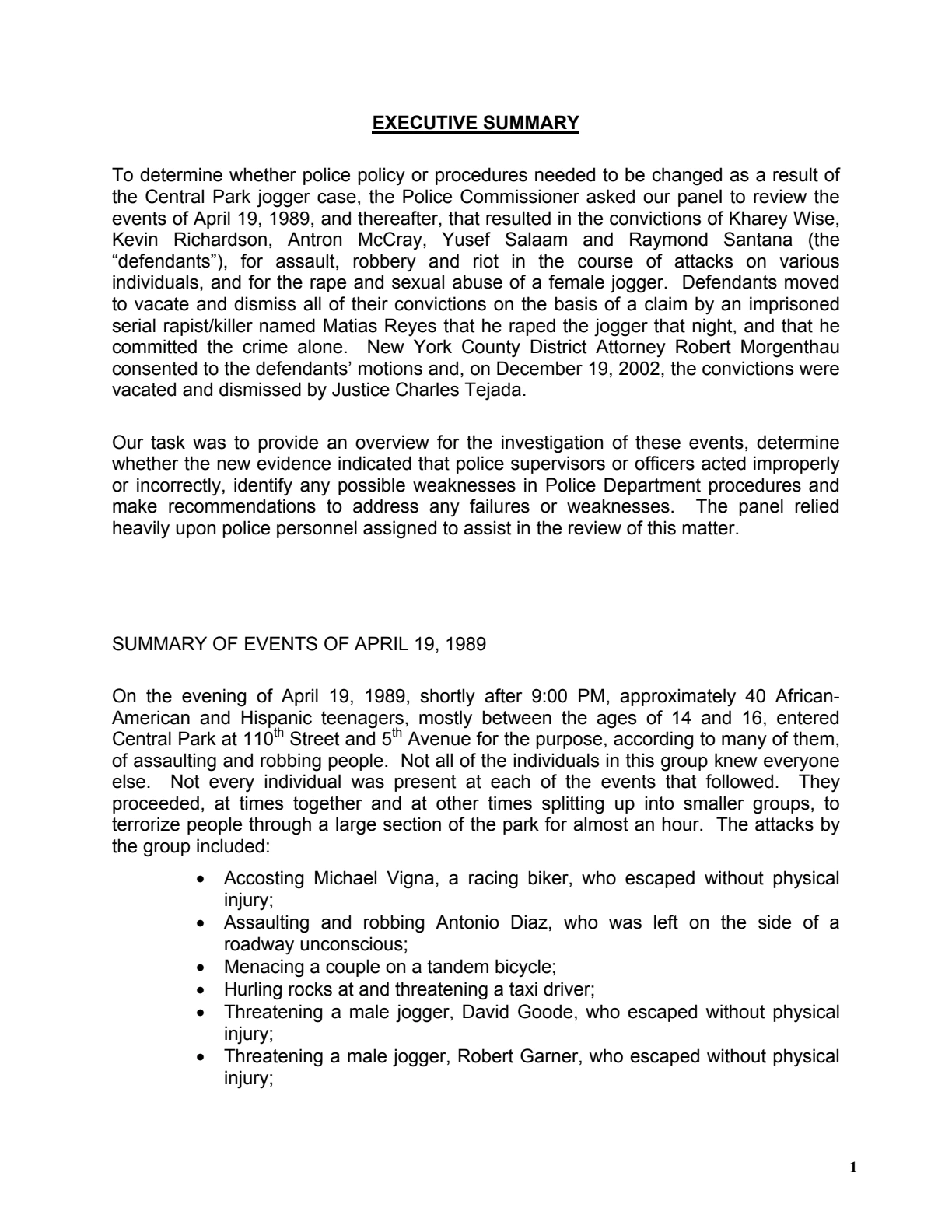
A genuine page from the January 2003 police-commissioned review. The opening identifies the panel’s remit. Its account must be read as the panel’s position, rather than substituted for the court’s decision.
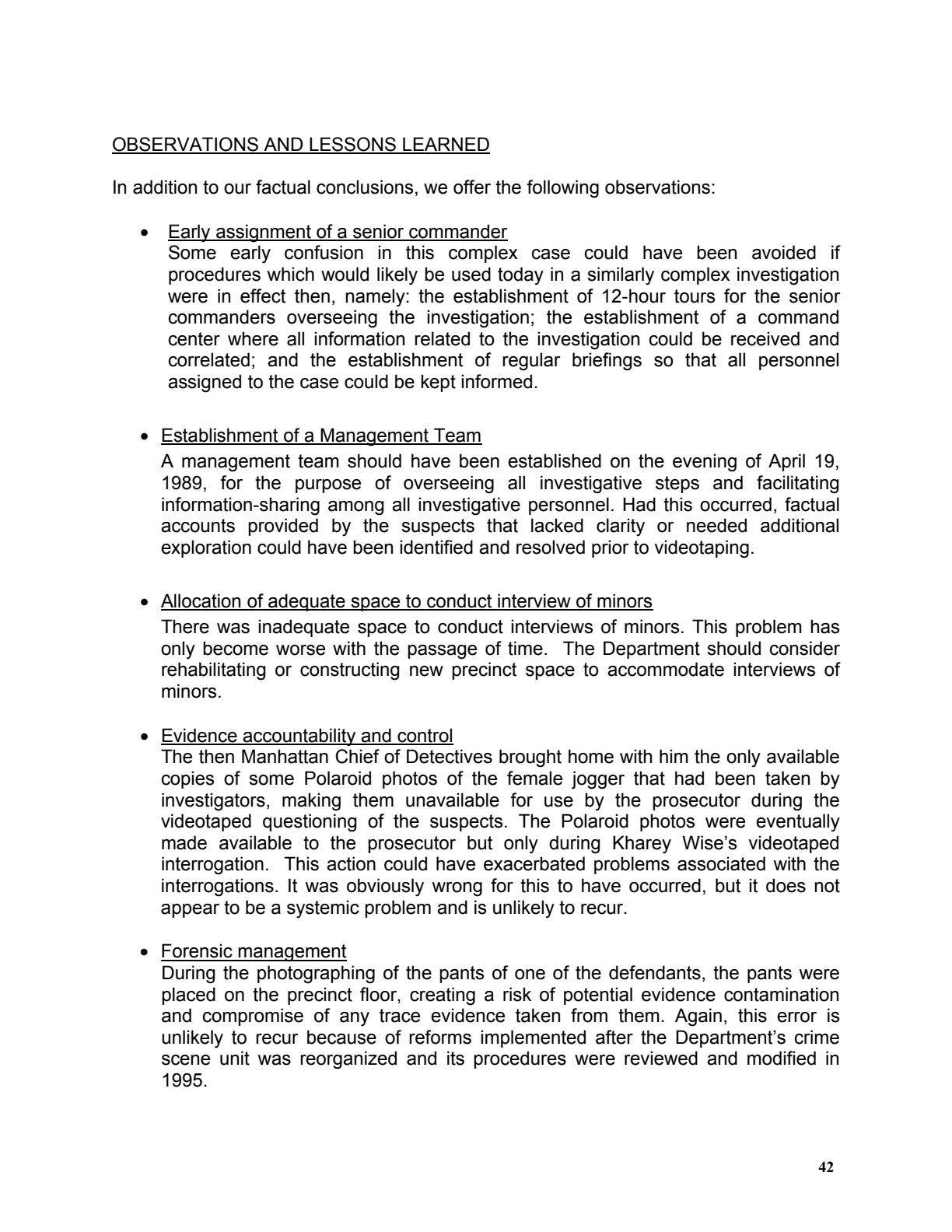
The same report’s observations. The panel criticised the handling of photographs and described a contamination risk when a defendant’s trousers were placed on a precinct floor. A documented risk does not establish that contamination actually occurred.
Why the Armstrong panel disagreed
Police Commissioner Raymond Kelly commissioned a panel led by Michael Armstrong to review police conduct. Its January 2003 report defended the investigation and considered continued involvement by the five more likely than Reyes acting alone throughout the entire encounter. That was an alternative theory offered by a police-commissioned review, not a judgment restoring the convictions.
The panel relied heavily on police personnel. It also listed material it had not received, including some additional forensic results and the district attorney’s interviews with Reyes. Those limits matter when comparing its conclusions with the prosecution’s reinvestigation. The existence of two reports does not make them interchangeable, and the panel’s conclusion did not undo the court order.
Its criticisms are worth examining on their own terms. The report called for better coordination and information sharing, more suitable space for interviewing minors and better control of evidence. Its description of misplaced photographs and the trousers on the floor shows why even a report defending investigators can contain material that deserves scrutiny. It would overstate that material to claim the panel found every statement fabricated or all forensic evidence contaminated.
The $41 million settlement answered a different question
In September 2014, a federal judge approved the city’s $41 million settlement of the men’s civil-rights litigation. That amount covered the group; it was not $41 million for each man. The city acknowledged an injustice while retaining its position that the investigators and prosecutors had acted reasonably under the circumstances.
The agreement ended a contested lawsuit without a jury resolving the individual misconduct allegations. Compensation, criminal exoneration and a finding of personal liability are different outcomes. The settlement cannot put lost years back into a life, and it should not be used to invent a civil verdict against a named officer or prosecutor.
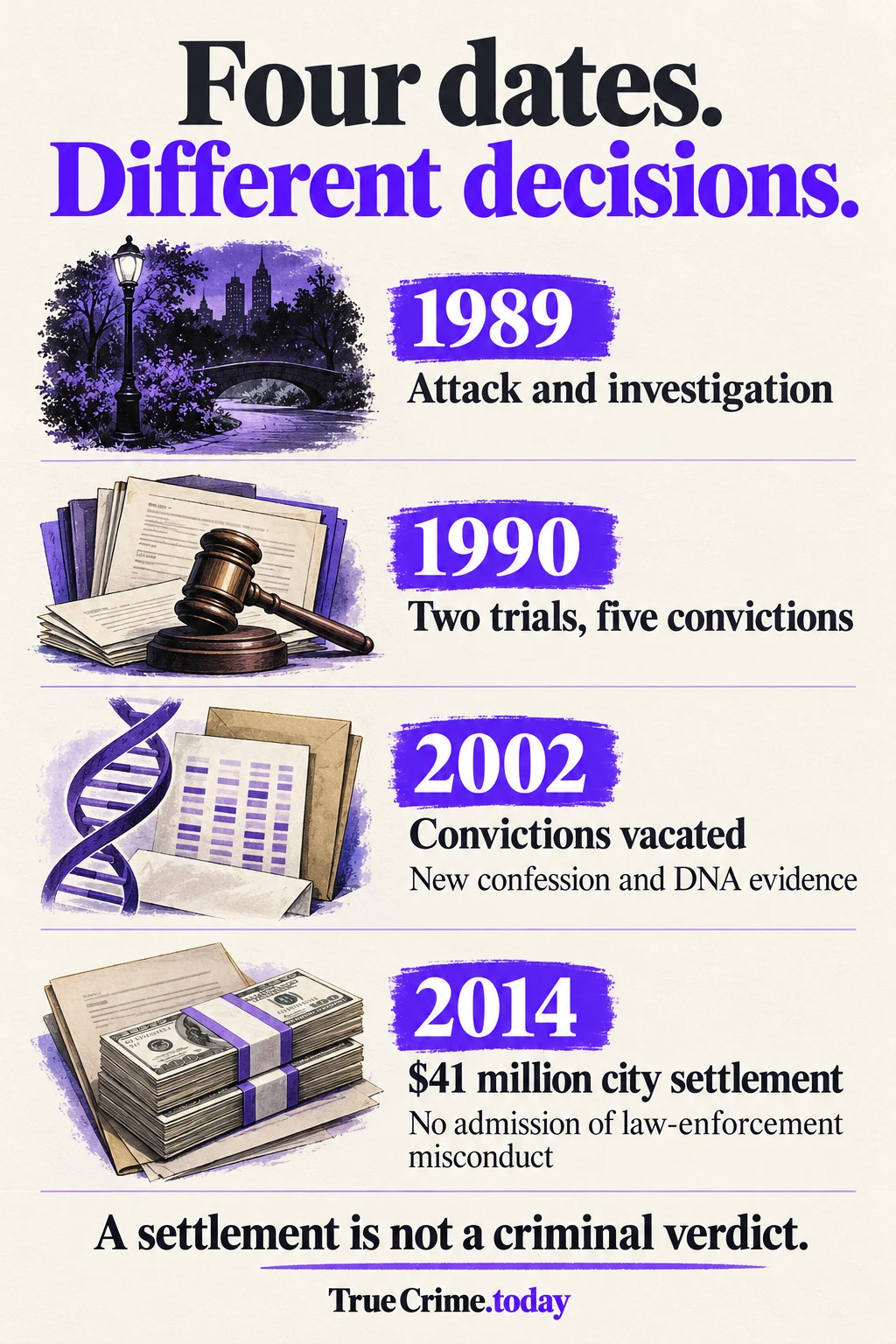
Four dates with different meanings. This editorial illustration separates the criminal proceedings from the later civil agreement; the spacing is not a scale of elapsed time.
Trisha Meili and the limits of memory
Meili publicly identified herself through her 2003 memoir, I Am the Central Park Jogger. Her account concerns survival, rehabilitation and rebuilding a life. Her lack of a memory of the attack prevented her from identifying the attacker from her own recollection. It did not make her responsible for mistakes in the prosecution.
In a 2019 ABC interview, she expressed a belief that more than one person had attacked her and wished the civil case had gone to trial. Those are her stated beliefs and preferences. They cannot serve as an eyewitness identification of an event she does not remember, nor do they reverse the exonerations.
Concern for a survivor and concern for people wrongly convicted can coexist. Holding the right person accountable depends on evidence. Meili’s recovery should not become a prop for either a defence of the old convictions or an argument that her experience no longer matters.
Watching the men speak, rather than watching actors
CBS Sunday Morning, May 12, 2019. Maurice DuBois interviews the five men and filmmaker Ava DuVernay. This is retrospective reporting, with the men describing their experiences; it is not a continuous recording of the original interrogations.
When They See Us can make the human cost easier to understand. Its dialogue and scenes remain a dramatisation. A scene can suggest a question worth investigating, but it cannot establish that a real person spoke those exact words. The documentary The Central Park Five likewise needs to be distinguished from the four-part drama and from the underlying court record.
Three arguments that keep returning online
The following short excerpts come from public Reddit conversations in 2019. They illustrate questions people ask, not a survey of public opinion or evidence about what happened inside an interview room. We have kept the original wording and left out usernames.
Pressure during questioning
A comment about interrogation pressure points to vulnerability:
“It helps if the suspect is sleep-deprived, stressed”
The full comment lists other circumstances too. Its explanation invites a useful question about the person’s condition and choices, but it does not document the circumstances of a particular defendant’s interview. That requires the records and the participants’ accounts, including the disagreement over police conduct.
Fear of a wrongful conviction
Another reply about the fear of going to trial describes the stakes:
“you’re gambling with your life in these situations.”
This expresses a fear that can make an innocent person’s decision less puzzling. It is not a legal forecast or proof that a particular deal was offered in this case. The five contested their charges; an argument about guilty pleas in other cases should not be substituted for what they actually did.
Asking for the evidence behind a claim
In a separate, politically divided thread, a comment asking for citations challenges an article:
“Can whoever wrote this back any of it up? No citations”
That demand is useful even when you dislike the source’s politics. It does not validate the commenter or the linked article. A claim that the convictions still stand can be checked against the court order; a claim that the settlement proved a named person’s misconduct needs a different record. Links should let you make that distinction.
What changed after exoneration
On December 19, 2022, New York dedicated the Gate of the Exonerated at Central Park’s northern edge, twenty years after the convictions were vacated. The naming recognised both the five men’s experience and the wider harm of wrongful convictions.
The number five also leaves out an important related proceeding. Steven Lopez, another teenager originally charged, took a plea to a separate robbery count. In July 2022, the Manhattan District Attorney moved to vacate that conviction, and the court granted relief. That was a separate case development, not a delayed sixth signature on the 2002 decision.
How to judge the next confession clip
When you watch a person admit involvement, ask where the details came from and what verifies them independently. A complete recording can help answer that question; a brief edited clip leaves much more unseen. Check the actual allegation and outcome for each person instead of treating a group nickname as a verdict.
The last time we checked the court decision, the panel review and the settlement statement was October 24, 2026. Taken together, they show how a case that once persuaded two juries came apart. The lasting question is how much confidence a statement deserves when the other evidence fails to support it.
You can ask the editorial team about a specific statement, test result or court decision discussed here.
Ask about the Central Park Five evidence