True crime documentaries: choose a story and know what you’re watching
Choose true crime documentaries by format, footage and point of view. Real film examples show how to read interviews, reconstructions and an unfinished ending.
True crime documentaries use interviews, recordings, documents and other material to tell stories about real crimes and the people affected by them. To choose one, start with the question you want to spend time on: how an investigation unfolded, why a conviction was challenged, or what happened to a family afterward.
Then check the format and the kind of material the filmmakers use. A polished reconstruction, an old recording and a new interview can all appear in the same documentary, but they give you different kinds of information. You can enjoy the storytelling while keeping those differences in view.
TL;DR
- Choose a feature film for one continuous viewing session, or check the episode lengths before starting a series.
- Look for the film’s central question and whose experiences it follows.
- Separate material recorded during events from later interviews and reconstructed scenes.
- Keep the film’s ending date apart from the present state of the case.
Start with the kind of evening you want
Sometimes you want a complete film before bed. Sometimes you want a longer story you can return to over several nights. Decide that first, before a trailer turns a small time commitment into an entire weekend.
Also think about what interests you. A film built around conflicting witness accounts asks you to follow a different thread from a series about how relatives lived through an investigation. Neither needs to supply every possible perspective to have something worthwhile to say. It does need to make its subject understandable.
This is part of choosing what true crime means to you as a viewer: real events can support investigative, historical and personal stories. The category alone tells you less than the question the film pursues.
The examples below show how those choices work. Before settling on a title, check the service and language options available where you live.
A feature film gives you one stopping point
A feature has one advertised running time, although editions may differ. That makes it a useful place to start if you want to follow one argument from beginning to end in a single session.
Criterion lists Errol Morris’s The Thin Blue Line, released in 1988, at 102 minutes. That is a concrete commitment you can check against the edition you plan to watch. The number tells you how much time to allow; it does not measure how thoroughly a film covers its subject.
A shorter film necessarily selects. It may concentrate on an inconsistency in an investigation or on the experience of one participant. Ask whether that selection matches what you want to understand, rather than expecting the running time to tell you how much evidence exists.
A series can follow several stages of a story
A series gives filmmakers room to develop different periods, voices or questions. It can also repeat material or delay an explanation. Episode count is useful for planning your evening, while the programme’s structure tells you more about what the time is used for.
American Murder: Laci Peterson is a three-part documentary series released in 2024. Netflix describes a mixture of news clips, interrogation and courtroom footage, and later interviews, including conversations with Laci’s mother and friends. That mixture may suit you if you want both an investigation timeline and memories of Laci as a person. For the time commitment, check all three episode lengths on the edition you can watch.
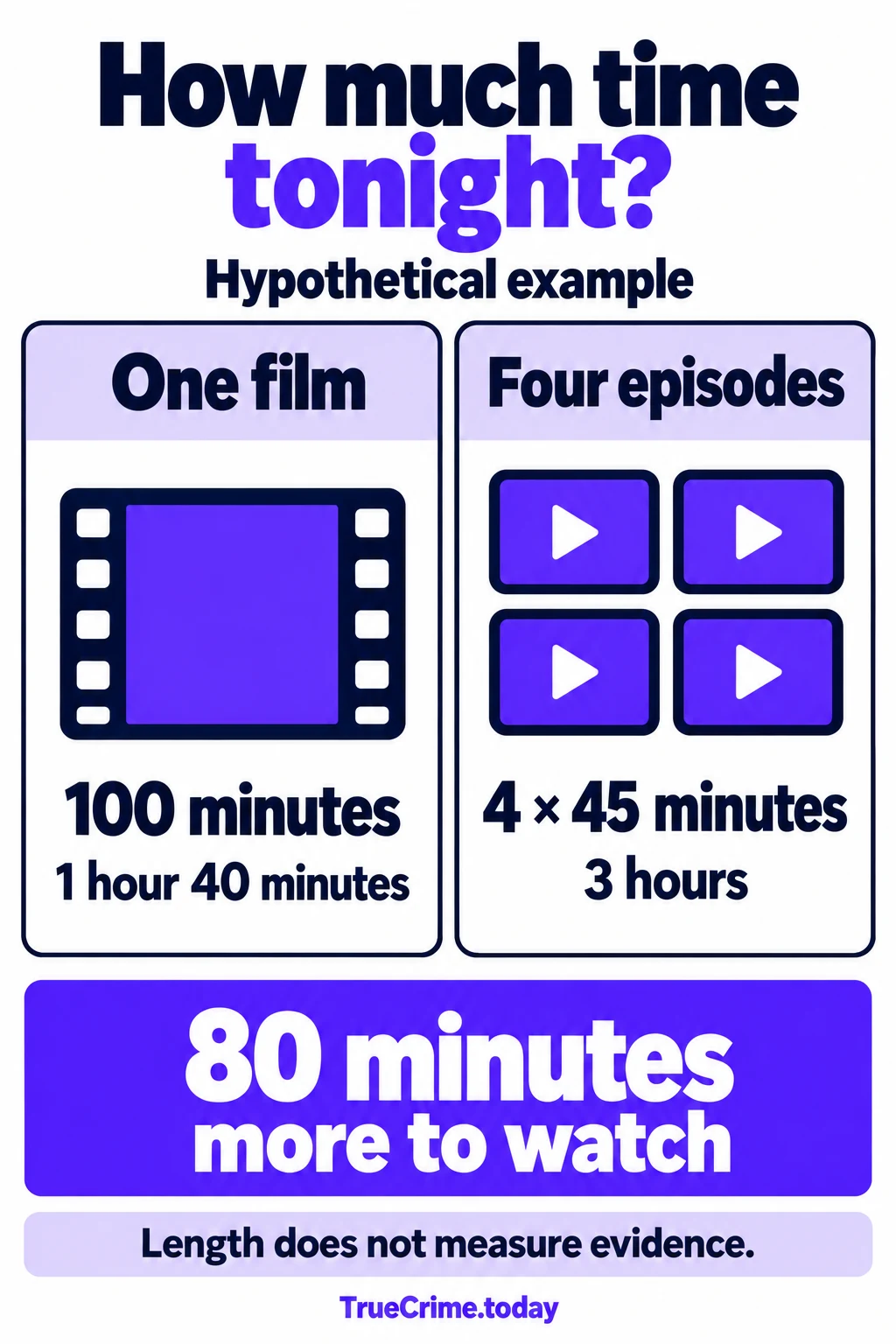
The arithmetic in this graphic is an invented planning example. Four episodes of 45 minutes make 180 minutes. A film of 100 minutes takes 80 minutes less. Use the actual episode list for a real title, including any later additions or companion programmes.
Look at how the film knows what it shows
Once you know the format, look at the materials. An interview records what someone says at the time of filming. An archive recording preserves something captured earlier. A reconstruction stages a version of an event for the camera.
Each can be useful. The question is what a particular shot supports. A recording may show words or actions within its frame, while leaving out what happened before it started. An interview may explain a person’s experience without independently resolving every disputed detail. A reconstruction lets you picture a claim, but the staged action needs a basis elsewhere.
That is why checking the sources behind a case matters when a scene changes your view of a real person. You can usually begin with one claim and one supporting document, instead of trying to investigate the entire case yourself.
Reconstruction in The Thin Blue Line
Criterion’s description of The Thin Blue Line identifies stylized reenactments alongside interviews and Philip Glass’s music.
The film’s use of reconstruction offers a useful question for any documentary: are you looking at a recording of an event or a scene made to represent an account of it? The answer changes how you should describe what you saw afterward.
A staged image can make positions, timing or competing explanations easier to follow. Its clarity does not independently confirm the account it illustrates. If you tell a friend that a camera recorded an action when the film actually reconstructed it, you have strengthened the claim beyond what the image itself provides.
The reverse mistake is to dismiss every documentary that uses staged scenes. Reconstruction can help explain an uncertainty. What matters is whether its status and basis are clear enough for you to follow the argument.
The archive-led approach of American Murder
The production description for American Murder: The Family Next Door says director Jenny Popplewell built the film from archival material including social posts, law-enforcement recordings, text messages and home videos.
That gives you a different starting point from a reconstruction-led scene. You are encountering material that already existed, selected and arranged for a later film. The filmmakers still decide what comes first, what stays outside the sequence and how sound or text connects the pieces.
Consider a general viewing situation: a message appears after a troubling recording. That order can suggest how to interpret the message. Before treating the sequence as a chronology, look for dates or an explicit explanation of timing. Editing can connect ideas without claiming that the events happened one immediately after the other.
When you notice such a connection, keep two questions separate: when did these events happen, and why did the editor put them together? Dates help answer the first; the second asks how the film builds its argument.
An interview adds a voice and a point of view
A participant can describe an experience that documents barely convey: waiting for news, being questioned or living with the consequences of a public accusation. That contribution matters even when the interview does not supply new forensic evidence.
Ask how the person knows the detail being discussed. Did they witness it, hear it from someone else, read it later or come to an opinion about it? Those are different foundations for a statement. A useful documentary can make that distinction without interrupting every sentence with a disclaimer.
The date matters too. Someone interviewed years later may know how the story developed. Their account of what they felt then and their explanation now belong to related but different moments.
You do not need to distrust the speaker to keep those moments separate. It helps you understand both the person and the claim.
What the ending can actually settle
An ending may tell you that the film reached a verdict, that someone changed their account or that a family still had questions when filming stopped. Those are very different forms of closure.
Before looking up more, decide whether knowing the outcome would spoil the viewing experience you want. You can check the release date and the period covered without immediately reading every later development.
If you do discuss the case afterward, keep the film’s account dated. A final caption is part of a work completed at a particular time. Later proceedings require later sources. A documentary can still explain an investigation or a personal experience after later proceedings have changed its final update.
Be especially careful with “solved.” A film may answer its own question while leaving other issues unresolved. Describe the actual development rather than borrowing a broader label from a trailer.
A documentary and a drama can cover the same case
The Central Park Five, the 2012 documentary by Ken Burns, Sarah Burns and David McMahon, and When They See Us, Ava DuVernay’s 2019 dramatized series, concern the same underlying history. They ask you to read their images differently.
In a documentary interview, the person on screen speaks as a participant or contributor. In a drama, an actor performs a written scene. A drama based on real events can communicate a historical experience powerfully, but its dialogue cannot automatically be cited as a verbatim recording of what someone said in life.
Genre labels, cast credits and production notes can help you avoid choosing the wrong work when titles or descriptions look similar. The important distinction is the form of the evidence you are watching, not whether one form is allowed to be moving.
Whose experience gets space on screen?
Look at who gets to speak about the person harmed. Friends and relatives can describe a life beyond the circumstances of a death. Survivors may explain consequences that an investigation timeline leaves out.
Their presence alone does not certify every claim in the film. It does tell you something about its focus. If the story spends most of its time on the offender’s personality, that is a different viewing experience from one centered on the people harmed.
You can also notice which questions remain unanswered. An absent interview does not tell you why someone declined, could not participate or was not included. Treat an explanation from the filmmakers as an attributed explanation, and keep silence separate from an admission.
Before you press play in your country
Find the exact title and year on the service you can use. Check whether the listing is a full film, a complete season, a trailer or a related interview. A short clip with a familiar title can look deceptively like the main programme in search results.
Check audio and subtitles on that edition. A translated description does not guarantee a dubbed track, and language options can differ by territory or title. Confirm access before paying for a subscription on the strength of a recommendation.
Finally, read the content information. Detailed violence, recordings of distress and accounts of abuse can make a programme a poor choice for a particular evening. Choosing another film or stopping does not mean you have failed to engage seriously with the subject.
Try checking one scene, not the entire film
Choose a moment that changed your understanding. Write down its timestamp, what kind of material it uses and the claim you took from it. Then ask what would let you check that claim.
For an interview, that might mean finding whether a public document supports the date mentioned. For a reconstructed event, it might mean identifying whose version is being shown. If the necessary record is unavailable, keep the uncertainty rather than filling it with a confident guess.
This small exercise helps you explain the film more accurately to someone else. It also makes a disagreement manageable: you can discuss a particular statement and its basis instead of trading verdicts about the entire production.
When another title tells the story differently
Two films may emphasize different people, periods or disputes. Start by checking whether they actually make conflicting factual claims. Different focus alone does not prove that one has concealed the truth.
If the claims do conflict, compare the dates and the source for that specific point. A later interview may add an account; a later court document may establish a procedural development. Neither automatically resolves every issue in both films.
The related selections below help with different decisions: choosing recent releases, checking Netflix viewing questions and finding the right programme on YouTube. Use the one that matches what you need next.
Questions about true crime documentaries
Does documentary mean every scene was filmed as it happened?
No. Documentaries may combine archive recordings, later interviews, illustration and reconstruction. Look for labels and production explanations, then describe the scene according to the material it actually uses.
Do I need to know the verdict before watching?
That depends on how you want to watch. You can avoid spoilers while checking format, content information and release date. If you later make a factual claim about the case today, check an appropriate current source.
Does a series have more evidence than a film?
Its extra running time may allow more material, voices or explanation. It can also contain repetition. Episode count alone tells you neither how much independent evidence appears nor how well the claims are supported.
Choose a film you can describe accurately
Pick a question, check the time commitment and notice how the work presents its material. Afterward, try naming one thing the film established, one account it presented and one question it left open.
That is enough to start a thoughtful conversation about a documentary without turning your evening into an investigation or treating an ending as the last word on a real person’s life.
Send the public programme link and the scene, format or source question you want to discuss. Do not send passports, contracts, bank details or other personal documents.
Ask about a documentary