True crime news: what changed in October 2026
October true crime news: new federal charges in Virginia and a clemency decision in Oklahoma, with the dates, case stages and unanswered questions kept clear.

Two items in this month’s true crime news describe very different moments in the justice system. In Virginia, prosecutors announced new charges over a double killing in 2022. In Oklahoma, the attorney general reported a clemency denial for a man already convicted of murder.
The last time we checked these developments was October 15, 2026. Both announcements were published on October 14. This October review covers those two US updates; it is a selection, rather than a complete account of the month’s crime news.
TL;DR
- Federal prosecutors in Virginia announced a superseding indictment against Jordan Isaiah Pierce. The charges are allegations, and he is presumed innocent.
- Oklahoma’s attorney general reported that the Pardon and Parole Board denied clemency to James Pavatt, who was convicted of killing Rob Andrew.
- A new charge, a conviction and a clemency decision answer different questions. Keep the stage and the date when you share the news.
- A future date in an announcement still needs checking when that date arrives.
What changed on October 14?
The Virginia announcement concerns an accusation brought years after the killings. The Oklahoma statement concerns a decision after conviction. Putting both under “case update” is convenient, but it can hide the most useful piece of information: what actually changed?
If you follow true crime through documentaries and discussions, a familiar story can make a fresh headline feel like the ending. Pause at the verb. “Charged” describes an allegation; “denied clemency” describes a different decision in a different case.
Neither item tells us whether crime is rising. Two selected announcements are two editorial choices, not a sample from which to calculate a national trend. Their value here is more concrete: they tell you where these particular stories stood when the agencies spoke.
Virginia: new charges in a 2022 double killing
In its announcement of the charges against Jordan Isaiah Pierce, the US Attorney’s Office for the Eastern District of Virginia said a federal grand jury returned a superseding indictment on October 14, 2026.
Prosecutors allege that Pierce, 24, and another person robbed a Newport News convenience store on June 15, 2022, and that Pierce shot and killed two employees. The announcement lists two counts involving a firearm used in a crime of violence resulting in death, alongside robbery, conspiracy and firearm charges. It identifies the federal case as 4:26-cr-70.
The date explains why this belongs in an October review even though the deaths occurred in 2022. The development is the new charging document. It does not establish that the allegations have been proved. Pierce is presumed innocent.
Prosecutors describe the document as a superseding indictment. To establish precisely what was added or changed, you would need to compare the new indictment with the earlier one. The announcement alone is not that comparison, and it gives no account of the defence’s response.
When a headline leaves you wondering what supports an accusation, analysing a true-crime case begins with that narrower question: which document or testimony supports the detail you want to repeat?
Oklahoma: clemency denied for James Pavatt
The Oklahoma attorney general’s statement on James Pavatt’s clemency denial says the state Pardon and Parole Board denied clemency on October 14, 2026.
Pavatt was sentenced to death for the 2001 murder of Rob Andrew, a 39-year-old father of two. Attorney General Gentner Drummond welcomed the board’s decision and referred to an execution date of November 12.
Clemency asks for relief from punishment after conviction. Commuting a death sentence in Oklahoma requires a favourable board recommendation before the governor can grant it. This is a different question from whether a jury has found someone guilty.
November 12 is a reported future date. It does not tell us that an execution has happened or guarantee that it will happen on that day. A later order or official update would need to be checked before describing the outcome.
This statement is also an advocate’s response. It tells you what the attorney general says about the decision. It does not reproduce the full clemency record or the arguments presented on Pavatt’s behalf. A fair account of the hearing would require those materials as well.
Why those two headlines need different verbs
You can lose a great deal of meaning by shortening an update to “the case is over” or “they got him”. The Virginia story concerns an indictment. The Oklahoma story concerns clemency after a conviction. The two should stay separate when you discuss them.
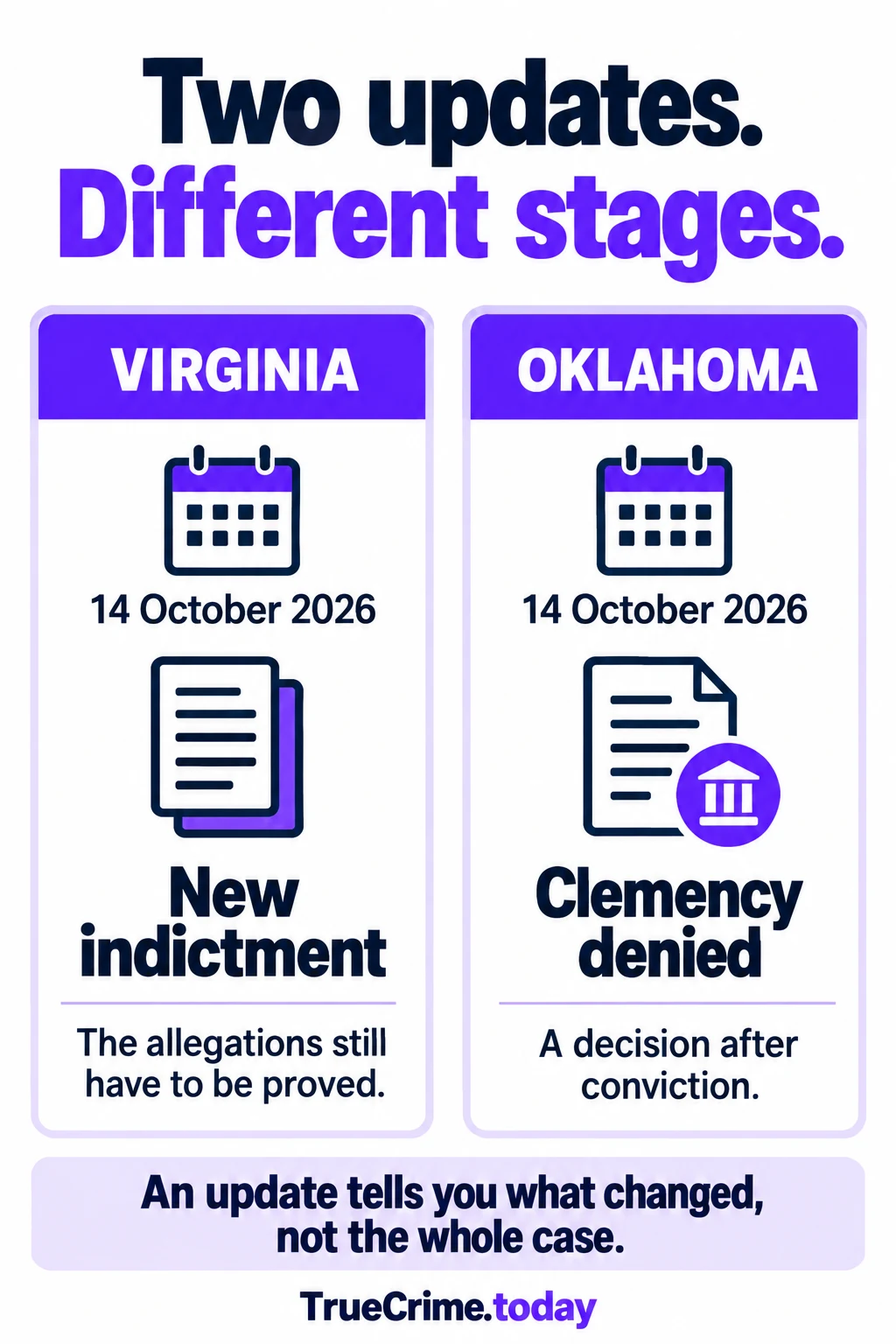
The distinction also changes the next question. In a prosecution, you may want to know the defendant’s response and what happens next in court. After a clemency decision, you may want the decision record and any later order affecting the announced schedule.
What the official statements leave open
An agency is a direct source for its own announcement. That makes a release useful for identifying a date, an action and the agency’s position. It does not make every allegation an independent finding of fact.
The Virginia release sets out the prosecution’s account. Without the relevant filings and a verified response, you cannot turn that account into a complete description of the evidence or assume what the defence will argue. Silence in a short release tells you nothing about whether another party agrees.
The Oklahoma release gives the attorney general’s reaction to clemency being denied. It does not give us the full discussion that preceded the decision. You can report the development while leaving the broader arguments open until you have the record.
That does not mean official announcements are useless or that every story must wait for every possible document. It means matching the size of the conclusion to the material available. An announcement can support “the agency reported this action on this date” without settling every disputed part of the underlying story.
The same care applies to images. An old photograph, a thumbnail or a clip from a different hearing can make a post appear more complete than it is. Neither a face nor a dramatic edit supplies the missing decision record.
How to check the next development
Start with the claim that changed. If someone says a hearing has happened, look for the outcome of that hearing, rather than another post repeating the scheduled date. If someone says a charge was dismissed, identify which charge and which proceeding.
For the Virginia prosecution, the case number in the announcement helps distinguish the federal file from another person with a similar name or from a separate proceeding. Keep that identifier with your notes. An unfamiliar legal term is a reason to slow down, not to fill the gap with a familiar television plot.
For the Oklahoma development, keep the board’s action and the later schedule separate. A date mentioned in an official statement is worth noting, but the passage of time does not turn a plan into a completed event. Check for a later change before repeating it as the current position.
If you encounter a correction, ask what it corrects. A spelling correction, a changed hearing date and a revised account of an allegation have different effects on the story. Preserve the detail that changed instead of treating every updated timestamp as a new revelation.
When a new post tells you an old story
A video uploaded today may contain an interview recorded years ago. A documentary released this month may end before a recent court decision. The upload date tells you when that version appeared, not necessarily when its information was current.
Look for three dates: the event, the official action and the post you are reading. In the Virginia item, the alleged killings and the charging announcement are separated by several years. That gap is part of the news; it is not something to smooth away when summarising it.
A familiar case can also draw unrelated rumours into a discussion. Before sharing a claim about a private person, ask whether it appears in a document or an attributable account. A comment repeating another comment does not become an additional witness.
You can still talk about what a story makes you feel. Keep that conversation distinct from accusing someone of a crime, predicting a verdict or treating an expression in a short clip as proof of dishonesty. People affected by a case do not owe viewers private explanations.
What would make us change this review?
A new filing, a published decision, a verified response or a correction from the issuing agency could change the account. We would identify the new development and its date so that an older description does not silently become a claim about the present.
This is an October review of selected developments, not a promise of continuous coverage. If you arrive later, keep the October 15 check date in mind and look for a newer official record before relying on a schedule or a procedural status.
For now, the useful distinction is clear: Virginia’s announcement reports new allegations; Oklahoma’s reports a clemency decision after conviction. Keeping those differences intact lets you follow the news without asking one headline to tell you the whole case.
Send the public announcement and the detail you think needs checking. Do not send passports, court papers containing personal data or other private documents.
Ask about a news update