True crime cases: 12 famous stories and the evidence behind them
Read about 12 true crime cases, from Jack the Ripper and the Unabomber to Meredith Kercher and Lindsay Clancy: evidence, court outcomes and unanswered questions.

A case can stay with you because of a missing person, an extraordinary clue or a verdict you cannot quite understand. But the moment that makes a good documentary is rarely the whole story. A decoded message may leave the killer unidentified. A confession may follow months of other investigative work. A person can leave prison years before a wrongful conviction is finally overturned.
Here are twelve case histories, including ten famous historical investigations and two developing stories with detailed coverage on this site. They span the United States, England, France and Italy. Each gives you a different question to follow, rather than a contest over which crime was most shocking.
TL;DR
Start with the story, then ask what the evidence actually established. The Unabomber, BTK and Golden State Killer cases show different ways of identifying an offender. Jack the Ripper, the Zodiac and Elizabeth Short show why a memorable clue can leave a murder unresolved. Dreyfus, Meredith Kercher and the Manson murders show why the precise charge and court decision matter. The Lindbergh kidnapping connects an early forensic investigation with a heavily publicised trial; Cornell 7 and Lindsay Clancy bring those reading questions into current proceedings.
Start with two cases still drawing questions
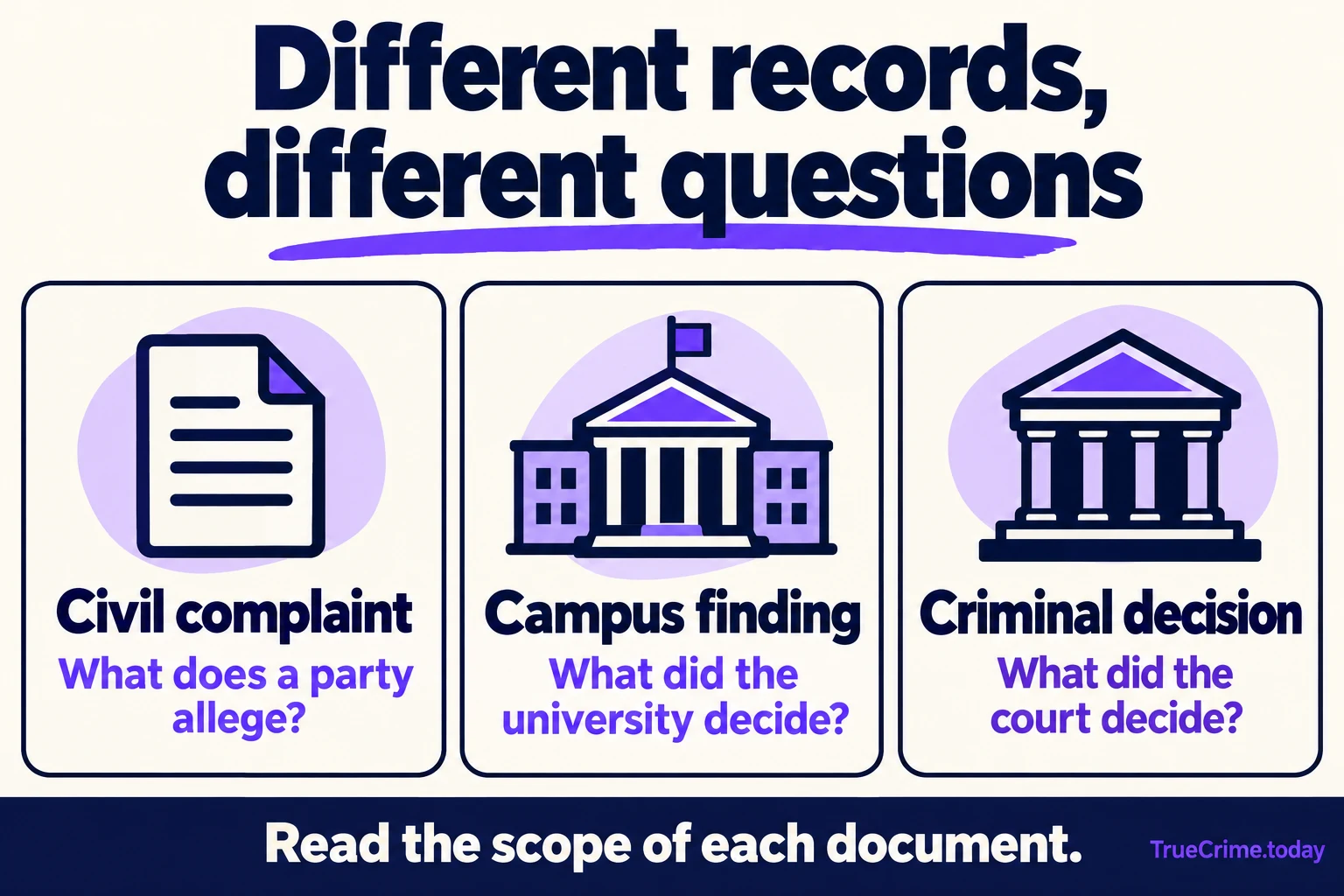
For an older case, you can usually separate the investigation from the final court outcome. With a developing story, you also need to ask whether the headline describes an allegation, an interim ruling or a completed trial. These first two entries are useful places to practise that distinction before moving through the historical cases.
Cornell 7: a civil complaint and a university response
The Cornell story concerns allegations arising from events in 2024 and a civil complaint filed in New York in September 2026. That gap between the events and the filing matters: a new court document can describe an older alleged assault without announcing a new criminal conviction.
Our Cornell 7 case coverage follows the allegations, the people and proceedings they concern, and the documents behind the public discussion. A complaint sets out a claimant’s case. It is something to investigate and test, rather than a verdict to read backwards into every named person’s role.
The last time we checked Cornell’s response was October 14, 2026. Its FAQ describes university investigations and disciplinary measures, while distinguishing those procedures from criminal proceedings. That is the university’s account of its own actions; it does not settle every question about how it handled the allegations. The important next question is which decision you are reading and whose conduct it addresses. A sanction against one person does not establish the same outcome for everyone mentioned in a lawsuit.
Lindsay Clancy: what a hung jury leaves unresolved
Lindsay Clancy’s case began with the deaths of her three children in Duxbury, Massachusetts, in January 2023. The courtroom dispute asks about criminal responsibility as well as what happened. That makes it easy for a short headline to lose the distinction between the acts alleged and the legal questions the jury must decide.
The Lindsay Clancy case discussion covers the family history, evidence, testimony and the proceedings. A jury that cannot agree leaves a different situation from an acquittal or a guilty verdict: the trial has ended without that jury resolving the charges.
There is another distinction in the judge’s signed October 1, 2026 order denying a motion for a required finding of not guilty. That ruling concerns whether the prosecution’s evidence meets the standard for surviving the motion. It is not a replacement jury verdict. The last time we checked that order was October 14. If you follow later news, look for what has changed in the proceedings, rather than assuming every ruling answers the ultimate question of guilt.
When one breakthrough changes an investigation
The next four stories are often remembered through a single object: a manuscript, a disk, a DNA profile or a banknote. The object matters, but so does the work that connected it to a person and to the offence. That is where the familiar “one clue solved everything” version can become misleading.
The Unabomber: a brother recognised the writing
Between 1978 and 1995, the Unabomber sent or placed explosive devices in the United States. The FBI’s chronology records sixteen devices; three people were killed and nearly two dozen injured. The long investigation struggled to turn bomb components and witness information into an identification.
In 1995, publication of a roughly 35,000-word manifesto gave the public something different to examine. David Kaczynski recognised features of his brother Ted’s writing and supplied earlier letters. The FBI’s Unabomber history explains how linguistic comparison, alongside facts about the bombings and Kaczynski’s life, helped investigators obtain a search warrant.
The search in April 1996 supplied physical evidence, including bomb-making material, journals and a live device. Kaczynski pleaded guilty in January 1998. The writing comparison helped investigators reach the cabin. It did not mean that a phrase alone proved every offence.
If forensic language analysis interests you, that distinction makes this a rewarding case. Ask which similarities raised suspicion, what independent information supported the warrant, and what was found afterwards. Recognising a relative’s voice and proving authorship through a defensible comparison are different tasks; both are different again from proving a bombing.
BTK: a disk brought investigators to Dennis Rader
Dennis Rader’s renewed communication with investigators eventually exposed information he had left on a computer disk. The FBI’s Kansas City history describes a deleted file containing the name Dennis and a Wichita church. Those details gave investigators somewhere specific to look in 2005.
Rader pleaded guilty to ten counts of first-degree murder on June 27, 2005. His offences extended across years, and the investigation did not end with finding a first name. Police developed further information, searched his home and obtained admissions; the FBI account describes items linked to victims and equipment associated with his crimes.
It is tempting to tell this as a criminal caught by his own technological mistake. That is part of the story, but the distinction between a clue and proof still matters. A file naming a church can point to someone with access to a computer. It cannot, on its own, establish who committed ten murders.
For you as a reader, the interesting sequence is the narrowing of possibilities: what the disk disclosed, how investigators checked the connection, and how the later evidence matched particular offences. It also gives a concrete example of why deleting a file need not remove every trace of its contents or origin. That is a feature of this investigation, not a promise that all deleted material can always be recovered.
Golden State Killer: a family tree led to a suspect
The Golden State Killer investigation connected crimes across California in the 1970s and 1980s. Joseph James DeAngelo was identified in 2018 through investigative genetic genealogy, more than three decades after the last murder identified in the prosecutor’s account, in 1986.
Genetic genealogy is different from simply finding a suspect already listed in a police DNA database. Genetic relationships can help investigators reconstruct a family tree and narrow the people who might fit. The relative whose data helps reveal a connection is not, by that fact, an offender.
DeAngelo’s eventual court outcome was separate from that search process. On August 21, 2020, he received eleven consecutive life terms without parole for thirteen first-degree murder counts, with an additional kidnapping term and weapon enhancements. Thirteen counts and eleven life terms are not a typo: counts of conviction and the structure of a sentence need not be identical.
This case is worth following if you want to understand both the power and the privacy questions of a new technique. A genetic lead still needs checking against the offence and the candidate’s circumstances. The sentencing record tells you the legal outcome; it does not establish that every possible use of a genealogical database is accurate, lawful or proportionate.
The Lindbergh kidnapping: follow the money, then the trial
On March 1, 1932, twenty-month-old Charles Augustus Lindbergh Jr. was taken from his family’s New Jersey home. His parents paid a $50,000 ransom, but the child was not returned. His body was found in May.
The investigation followed recorded serial numbers on ransom currency. Gold certificates helped make some of that money traceable; later discoveries led investigators towards Bruno Richard Hauptmann. The prosecution also relied on evidence involving the ladder used at the home and the ransom notes. Hauptmann was convicted in 1935 and executed in 1936.
What makes this more than a famous kidnapping is the way different kinds of evidence had to fit together. Possession of ransom money raises one question. The construction of a ladder raises another. Handwriting evidence raises a third. You cannot assess the strength of the whole case by mentioning just the most memorable exhibit.
The FBI’s Lindbergh kidnapping account also describes misinformation, false leads and people trying to profit from the family’s desperation. That background complicates the tidy version in which every tip moves an investigation forward. The official history presents the investigation from an agency perspective; it is a starting record, rather than a new independent assessment of each forensic conclusion made in the 1930s.
Famous cases that still have no proven killer
In the cases above, investigators reached a named offender and a conviction or guilty plea. These next three stories leave a different kind of gap. A victim’s identity, a letter’s contents and a killer’s identity are separate questions. Progress on one can leave the others unanswered.
Jack the Ripper: five women behind a familiar nickname
The Whitechapel murders of 1888 are usually told around the name Jack the Ripper. The five women commonly associated with the series were Mary Ann Nichols, Annie Chapman, Elizabeth Stride, Catherine Eddowes and Mary Jane Kelly. Remembering their names changes the focus from a mysterious figure to the lives that were taken.
The National Archives preserves a letter postmarked in Birmingham in October 1888, signed with the killer’s nickname. Its account identifies this as a hoax among hundreds of letters claiming to come from the murderer. A document can be a genuine surviving Victorian letter while its claim about who wrote it is false.
That is one reason the correspondence deserves care. The killer was never caught, and the archive says there is no strong evidence that the letters were written by the murderer. A frightening message may reveal the behaviour of a hoaxer or the public response to the crimes, rather than the offender’s psychology.
If you enter the case through a suspect theory, return to the original record and ask what actually connects that person to a murder. Familiarity, opportunity or a resemblance to a later profile is not the same as an identification. Meanwhile, assumptions about the women’s lives should be checked too: repeating a lurid stereotype can distort the people at the centre of the story before the suspect discussion even begins.
The Zodiac: a solved cipher, an unsolved identity
The Zodiac case concerns murders in Northern California in 1968 and 1969, alongside letters and coded messages sent to newspapers. The FBI’s historical account describes five killings and its technical assistance to local investigators. An archive of FBI material does not mean the FBI was the lead agency for those murders.
One famous message contained 340 characters. It was sent in 1969 and decoded by David Oranchak, Sam Blake and Jarl Van Eycke in 2020, fifty-one years later. Their documentation records FBI verification of the solution. The breakthrough made the message readable; it did not reveal a proven identity for the killer.
Those are two very different achievements. You can test a cipher solution by whether its method consistently produces the text. Identifying the person who wrote it requires a further connection to a real individual and the offences. A short decoded passage is also a poor basis for a confident clinical diagnosis.
This is the case to read if an “unsolved mystery finally solved” headline has ever pulled you in. Look for the object of the word solved. Was it the message, a timeline, a particular lead or the murders themselves? No suspect is presented here as the Zodiac, and repetition of an accusation across documentaries or discussion boards does not supply the missing proof.
Elizabeth Short: identifying a victim did not identify her killer
Elizabeth Short was twenty-two when her body was found in Los Angeles on January 15, 1947. The press nickname Black Dahlia became more familiar than her name. That change helped turn an actual woman’s death into an enduring cultural mystery.
The FBI reports that it identified her fifty-six minutes after receiving transmitted fingerprints from Los Angeles. Existing prints in its records made that possible. The Los Angeles Police Department led the murder investigation, with FBI assistance on records, interviews and technical work.
The speed of that identification is striking precisely because it did not lead to a comparably quick identification of her killer. The official account describes the murder as unresolved. Knowing who died gives investigators a life history and people to contact; it does not automatically explain who caused the death.
When you read a proposed solution, ask whether its strongest claim concerns Short’s movements, a suspect’s opportunity or evidence connecting that suspect to the killing. Those questions can be related without being interchangeable. A compelling biography of a suspect is not a verdict. We avoid graphic detail here because the evidential distinction is understandable without turning the injuries into the attraction.
When the courtroom story has to change
An unresolved investigation is not the only reason a story lacks a neat ending. Courts can revisit a conviction, decide a separate charge or hold someone responsible for participation in a crime without treating every participant’s conduct as identical. These last three historical cases make those differences visible.
Alfred Dreyfus: a pardon was not an exoneration
In France in 1894, army captain Alfred Dreyfus was convicted of treason. Handwriting comparison played a role in the accusation; the proceedings also involved a secret dossier. Antisemitism helped make a Jewish officer into a target, while evidence pointing away from him struggled to dislodge the accusation.
Later investigation exposed fabricated material and evidence implicating another officer. Yet Dreyfus was convicted again in 1899 and then pardoned. The Court of Cassation annulled that judgment without ordering another trial on July 12, 1906. The French justice ministry’s history traces these separate stages.
The gap between pardon and rehabilitation is the central reason to include this case. Ending a punishment and undoing the underlying conviction are different legal acts. If you stop the story at his release, you lose the years spent pursuing recognition that the accusation was wrong.
Dreyfus also complicates the idea that handwriting evidence always offers a neutral answer. The questions include who performed the comparison, what disagreement was acknowledged, and which material the defence could challenge. This does not make every handwriting examination worthless. It shows why an expert conclusion needs a disclosed basis and a process capable of testing it, especially when prejudice makes one explanation politically convenient.
Meredith Kercher: separate the murder case from the Knox proceedings
Meredith Kercher, a British student, was killed in Perugia, Italy, in 2007. Much international coverage centred on Amanda Knox and Raffaele Sollecito, but the victim and the different proceedings should not disappear behind a single defendant’s name.
Knox and Sollecito were acquitted of the murder and sexual-assault charges in 2015. Rudy Guede’s conviction was a separate outcome; the European Court of Human Rights’ account records a final sixteen-year sentence in 2010. Knox also faced a distinct malicious-accusation case concerning Patrick Lumumba, whom she had accused during questioning.
In 2019, the European Court found violations concerning legal assistance and interpretation, and a failure to investigate Knox’s allegations of mistreatment. It did not find the alleged physical mistreatment proved. Those findings concern procedural protections and must not be compressed into either “everything she said was proved” or “the murder acquittal did not count.” The 2019 account does not tell you the current position of every later proceeding concerning the separate accusation.
For you, the useful question is what each judgment decided about each person and charge. A murder acquittal does not become a conviction because a separate accusation was contested. Nor does focusing on an acquitted defendant tell the whole story of Kercher’s death. Read the charges separately and keep the timeline of each proceeding in view.
The Manson murders: responsibility beyond the person holding a weapon
The Tate and LaBianca killings took seven lives in Los Angeles over two successive nights in August 1969. Sharon Tate’s fame helped shape the coverage, but Steven Parent, Jay Sebring, Abigail Folger, Wojciech Frykowski, Leno LaBianca and Rosemary LaBianca were also victims.
Charles Manson, Susan Atkins and Patricia Krenwinkel were convicted of seven murders and conspiracy to commit murder. A published 1976 California appellate opinion upheld their convictions while modifying the death penalties to life imprisonment. It also explains why conspiracy evidence concerned communications, conduct and shared plans, rather than only who physically inflicted an injury.
That makes the case useful if you are puzzled by responsibility in a group offence. The court expressly distinguished mere association with a perpetrator from proof of conspiracy. Membership of a group is not enough by itself; the prosecution must establish the relevant participation and agreement under the applicable law.
The familiar account of Manson’s influence and the prosecution’s Helter Skelter theory can dominate retellings. Keep motive, an individual’s actions and the legal basis for conviction separate when you read them. A court’s decision is stronger evidence of what was adjudicated than a documentary’s dramatic explanation of why every person acted. Questions about a motive do not automatically erase evidence of participation.
What these cases tell you about evidence
There is a thread across these stories, but it is not a single technique that solves crime. The Unabomber writing comparison helped open a search. BTK’s disk helped narrow an identity. Genetic genealogy helped identify a candidate. Short’s fingerprints established who the victim was. The Zodiac cipher revealed a message. Each answered a different question.
That distinction gives you a way to judge what a retelling leaves out. Ask what had to happen between the discovery and the legal outcome. Was the clue checked independently? Could the defence challenge it? Did the court decide guilt, a sentence, an appeal or just one motion?
Official histories have limits too. An investigating agency may highlight the breakthrough more than the false leads. A prosecutor’s sentencing statement tells you the outcome from one side of the proceedings. A judgment may decide a narrow appeal issue without recounting every part of a family’s experience. Read each for the question it can answer, then look for what it leaves out.
These twelve cases are an editorial selection, concentrated in the United States and Europe. They do not measure which countries have more crime or what proportion of investigations involve a miscarriage of justice. Their value is in the differences you can examine, not in a statistical conclusion drawn from famous stories.
Choose a record that answers your question
If you are starting after a film or podcast, first write down the claim you want to check. For an alleged confession, find the circumstances of the interview and how the court treated the statement. For a new forensic technique, distinguish the identification lead from the later confirmation. For a changed verdict, find the charge, the court and the date.
With an older case, that may mean locating an archive reference or a published judgment rather than a present-day summary. With a developing case, it means checking later rulings against earlier ones. Save the document’s date as well as the date you read it, so that a later update has something concrete to change.
You do not need to watch every distressing image to do this. Text, a non-graphic exhibit or a hearing about a disputed point may explain the evidence better than repeated crime-scene footage. Choose the material that answers your question.
Questions about following true crime cases
Does an acquittal explain everything that happened?
It settles the charges addressed by that decision under the relevant legal standard. It does not necessarily establish a complete account of every event. That distinction should never become an excuse to continue presenting an acquitted person as a convicted offender.
Is a famous unsolved case open to any theory?
You can ask questions, but an accusation still needs evidence. A theory that explains one detail should also face the details that contradict it. Publicly naming someone adds consequences for that person and their family; a mystery’s popularity does not lower the standard for making the claim.
Where should I begin?
Choose the problem that interests you. Start with the Unabomber for language and authorship, the Golden State Killer for genetic leads, Dreyfus for a wrongful conviction, or the Zodiac for the limits of a breakthrough. If you want a developing courtroom story with deeper records on this site, begin with Cornell 7 or Lindsay Clancy. Keep one question beside you as you read: what did this evidence actually establish?
Have a question about a case entry or a quoted record? Send the public source link and the passage you mean. Do not send passports, contracts, bank details or other personal documents.
Ask about a case entry