Lindsay Clancy trial: hearings, testimony and what happens next
Follow the Lindsay Clancy trial: the rejected split, testimony, jury deadlock, October ruling and the November hearing. No confirmed retrial date.

Short version
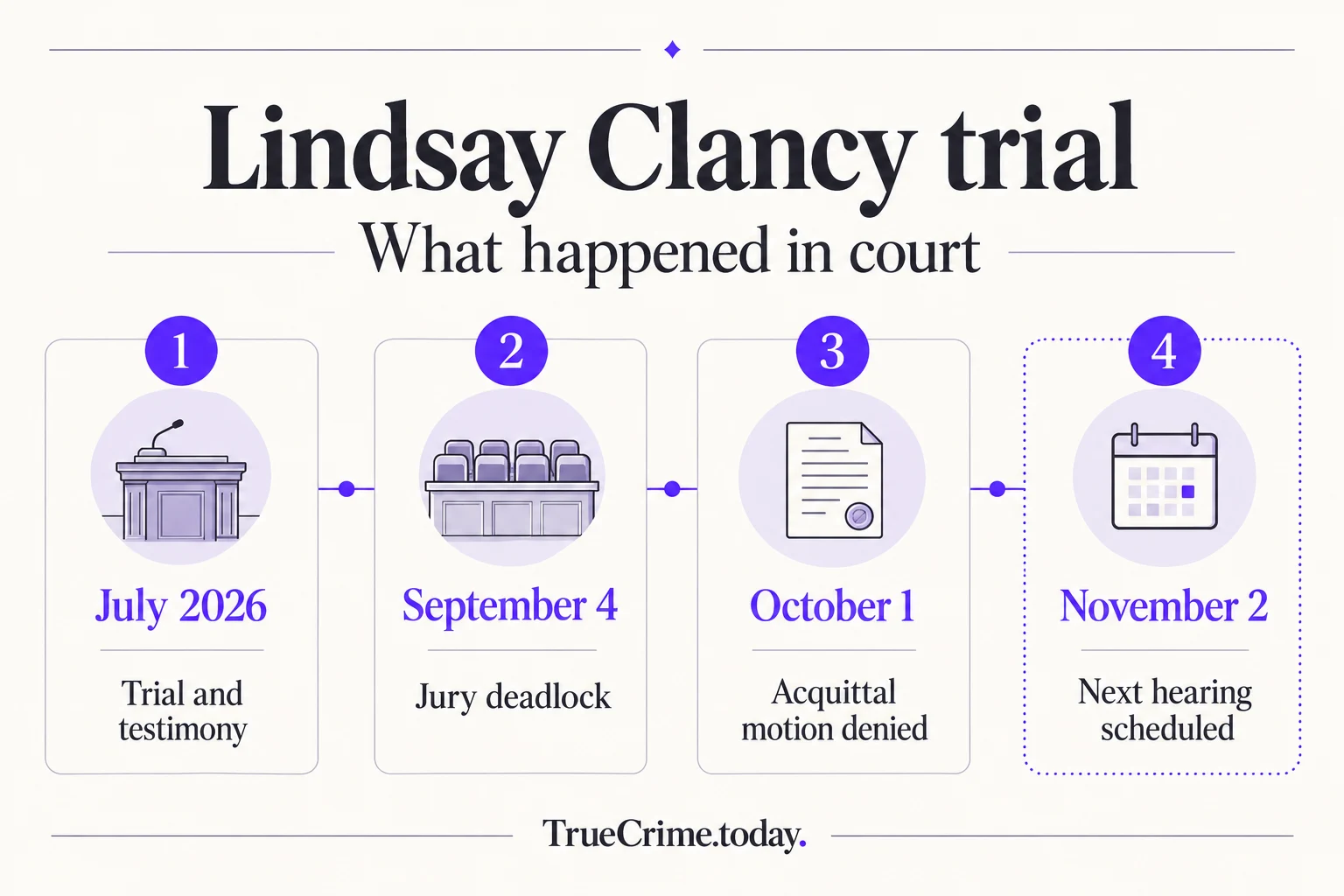
The Lindsay Clancy trial ended in a mistrial on September 4, 2026, after the jury failed to agree on whether she was criminally responsible for killing her three children. On October 1, Judge William Sullivan denied a defense request for a finding of not guilty. Those two decisions leave the murder charges unresolved.
The last time we checked the court developments was October 7, 2026. The next hearing is scheduled for November 2, when the parties are expected to argue further motions and discuss a possible retrial date. We have not verified a confirmed date for a second trial.
If you’re catching up through courtroom clips, the distinction that matters is who was deciding what. The jury weighed the evidence and could not reach unanimity. The judge later decided that the prosecution’s evidence was legally sufficient to put before a jury. That ruling left the question of guilt open.
Which court is hearing the case?
The proceedings are in Plymouth Superior Court, Massachusetts, under case number 2383CR00198. The Commonwealth of Massachusetts prosecutes the case. Judge William F. Sullivan presides, and Kevin Reddington represents Clancy. Timothy Cruz is the Plymouth County district attorney; the trial prosecutors and the district attorney have different day-to-day roles.
Clancy faces three murder indictments arising from the deaths of Cora, Dawson and Callan at the family’s Duxbury home on January 24, 2023. The separate strangulation counts were dropped before trial. That change reduced the set of charges; the three murder counts remained.
Massachusetts Rule 27 requires a unanimous jury verdict. That requirement is why eleven jurors favoring the defense could not resolve the charges when the twelfth disagreed.
The Lindsay Clancy case includes the treatment history, the children’s deaths and the family’s accounts that shaped the evidence presented in court. The trial concentrated those events into a narrower question: what had the prosecution proved, and how did Clancy’s mental condition affect criminal responsibility at the time?
What did the prosecution have to prove?
The prosecution had to prove the charged offenses beyond a reasonable doubt. Once the evidence raised lack of criminal responsibility, Massachusetts law also placed the burden of proving responsibility on the Commonwealth. The defense did not have to prove its position beyond a reasonable doubt.
The responsibility test asks whether a mental disease or defect seriously reduced the person’s ability to appreciate the criminality or wrongfulness of the conduct, or to act as the law requires. The loss of ability need not be total. The two parts matter because understanding that an act is wrong and being able to control conduct are separate questions.
Sullivan’s October 1 decision explains that both sides presented evidence of serious mental illness, while disagreeing about its effect on responsibility. A diagnosis and a conclusion about legal responsibility answer different questions. The jury had to evaluate the connection between the illness, the evidence and the time of the killings.
That also explains why testimony about ordinary activities received so much attention. Prosecutors used Clancy’s actions surrounding the deaths to argue that she retained the relevant abilities. Defense experts argued that apparently organized behavior could occur alongside psychosis. Neither a routine appointment nor an alarming symptom settles that dispute on its own.
Why did the defense ask to split the trial?
Before the jury heard testimony, Reddington sought bifurcation, meaning two separate phases. The first would address whether the prosecution proved the alleged crimes. A second would address criminal responsibility. His concern was that discussing Clancy’s mental state could expose statements and facts that also helped establish her involvement.
Court TV’s March 31 report describes Sullivan’s refusal. The judge said much of the evidence and many witnesses would overlap, making a clean division difficult and requiring repeated testimony. The trial proceeded in a single phase, with responsibility considered alongside the other disputed issues.
The same report describes a limit on statements from court-ordered psychiatric examinations: they could be introduced in rebuttal after the defense put responsibility in issue. That matters when you’re watching an expert refer to an interview. The source of the statement, the reason for the examination and the purpose for which it was admitted all affect its place in the trial.
A proposed stipulation raised another procedural dispute. The defense offered to concede involvement in the children’s deaths while concentrating on responsibility. Prosecutors opposed the renewed request for a split trial; Court TV reported that their response did not address the offer to stipulate. An offer to agree on a fact, an agreement actually accepted and evidence admitted in court are different things. That distinction became important when the defense later challenged the prosecution’s proof.
How did the proceedings reach the jury?
The case moved through several stages before the September deadlock:
- February 7, 2023: Clancy appeared remotely for her first arraignment in District Court. An arraignment brings the charges before the defendant; it does not determine guilt.
- September and October 2023: the grand jury returned indictments, and the Superior Court arraignment followed on October 26. Clancy pleaded not guilty.
- March 2026: Sullivan rejected the requested split into two trial phases, as reported on March 31.
- July and August 2026: jury selection, evidence, expert testimony and closing arguments took place. Closing arguments began on August 27.
- September 4: Sullivan discharged the jury after seven days of deliberations without a unanimous verdict.
- September 29 and October 1: the parties argued the renewed request for a finding of not guilty, and Sullivan denied it in a written order.
Each stage had a different task. A grand jury indictment allowed the prosecution to proceed. Trial testimony supplied evidence for the trial jury. The later written order tested whether the evidence met the legal threshold for a jury to decide the case. Reading the dates with those functions in mind avoids turning every hearing into a new verdict.
What did Patrick’s testimony establish?
Patrick Clancy’s testimony gave the jury an account of the family’s circumstances, his wife’s deterioration, the errands on January 24 and the emergency he found on returning home. Prosecutors and the defense questioned him about what he observed and what Lindsay had told him.
The October order identifies store and restaurant videos consistent with his account of being away from the house. It also describes the phone contact, his return and the response to the emergency. Those details connect a witness’s recollection with other evidence, which helps the jury assess an account rather than relying on sympathy alone.
His observations about Lindsay’s distress had a different purpose. They helped describe her condition over time, but a family member’s experience does not supply a medical assessment of every moment. His support for the defense and his account of the events required the jury to consider both personal knowledge and its limits.
The 911 recording was especially distressing. Watching a short section can leave the emotional impact much clearer than the legal point being argued. The questions around the recording, the timing of the call and the other evidence introduced with it help explain why it was played.
Why did the doctors disagree?
The medical dispute involved observations made at different times and opinions built from different material. Treating clinicians described appointments and hospital records before the deaths. Defense experts later interviewed Clancy and reviewed records to assess her condition retrospectively. Prosecution experts challenged the defense’s conclusions about responsibility.
Philip Resnick’s defense testimony described psychotic symptoms that could fluctuate. The prosecution emphasized functioning around the incident and challenged the reported voice and its timing. Sullivan’s order records three prosecution experts who concluded that Clancy retained the abilities relevant to criminal responsibility. The defense offered experts who disagreed.
Counting experts gives you the size of a dispute, rather than a way to decide it. The more useful questions concern what each expert reviewed, when they examined Clancy, whether they distinguished an observed symptom from a later account, and how they connected those facts to the legal test.
Cross-examination exposed some of those differences. A lawyer’s suggestion within a question remained a suggestion until supported by an answer or other evidence. The expert’s reasoning, qualifications and response to criticism mattered more than the force of the question.
How did digital and physical evidence enter the argument?
The court received computer and phone records, photographs, medical-examiner testimony and other physical evidence. Prosecutors used actions and communications surrounding the deaths to support their account of planning and responsibility. The defense disputed the meaning of parts of that evidence and the adequacy of the investigation.
A search result is a useful example of the difference between a record and an inference. Investigators need to establish the device or account, timing and surrounding activity before attaching meaning to it. A search on one examined computer also cannot establish what every other device contained. The trial’s digital-evidence exchanges drew attention to those limits.
At the September 29 hearing, Reddington attacked the DNA and fingerprint investigation. Prosecutor Shanan Buckingham answered that the record contained extensive evidence and pointed to the defense’s earlier position about involvement. That exchange presented competing legal arguments; Sullivan then assessed the admitted evidence in his written decision.
The October order explains that proof can be circumstantial. A prosecution does not fail automatically because a particular forensic test is absent. The evidence must still support the required elements, and the defense can argue that a missing test leaves a gap in an inference. The effect depends on the rest of the record.
What happened when the jurors could not agree?
The jury reported a division widely described as 11–1, with eleven favoring a finding of not guilty by reason of lack of criminal responsibility. Massachusetts required unanimity. The division did not become an acquittal, even though it showed how strongly most jurors viewed the evidence.
During deliberations, the defense asked Sullivan to remove the holdout, alleging that the juror would not apply the law. The judge questioned jurors and gave further instructions. The distinction between disagreeing with other jurors and refusing to perform a juror’s duty mattered; an unpopular vote alone cannot settle a misconduct allegation.
After the mistrial, the defense sought further inquiry into alleged conduct involving a phone and answers during jury selection and questioning. These remain allegations raised for judicial examination. They should not be treated as a finding that a juror lied, disobeyed an instruction or caused an unlawful result.
Sullivan declared the mistrial on September 4 after the jury continued to report that agreement was impossible. The September result ended that jury’s work and left the charges unresolved. It supplied neither a conviction nor a sentence.
Court TV’s September 4 coverage follows the jury deadlock and the declaration of a mistrial. Listen for the difference between the reported division and a verdict the court could accept.
Why did Sullivan refuse to enter a not-guilty finding?
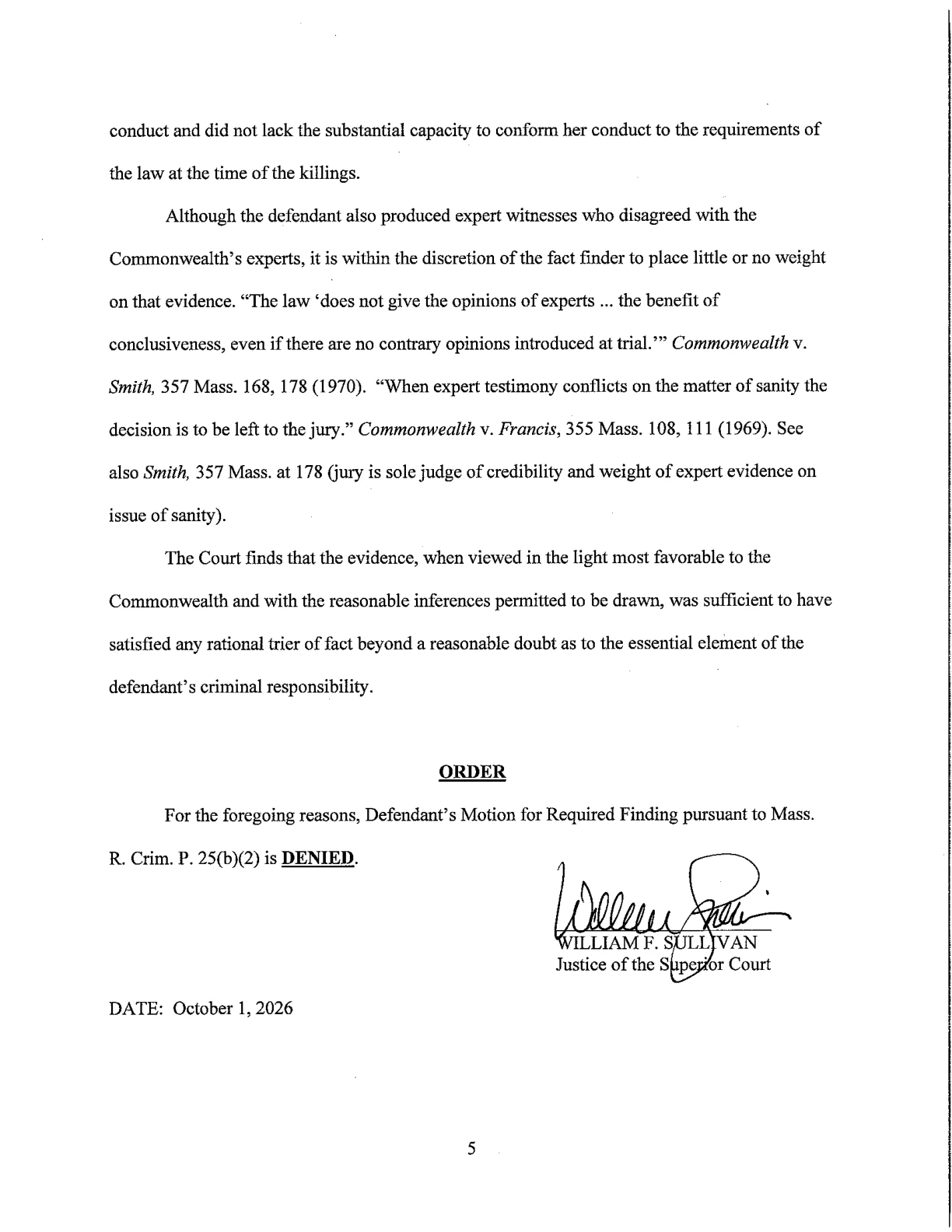
The defense renewed its request under Massachusetts Rule 25(b)(2). It challenged the sufficiency of the evidence on two issues: who committed the killings and whether Clancy was criminally responsible. The judge addressed both in the five-page October 1 order.
For that motion, Sullivan had to consider the evidence and reasonable inferences in the light most favorable to the prosecution. He identified physical and circumstantial evidence supporting the murder charges, then addressed the conflicting expert opinions. He concluded that a rational fact-finder could find the necessary elements beyond a reasonable doubt.
That test leaves room for a jury to reject an inference or disbelieve a witness after weighing the competing accounts. It also explains how the October ruling can coexist with the September deadlock: the judge decided the evidence was sufficient for a jury to consider, while the first jury failed to agree after considering it.
Sullivan left the expert credibility disputes for a jury and refused to enter a not-guilty finding. You can see the denial on the final page, beneath the explanation of the evidence standard and above his signature and the October 1 date.
Can there be another trial?
A properly declared mistrial following a hung jury generally permits retrial. The United States Supreme Court explained in Richardson v. United States that failure to reach a verdict does not end the original jeopardy. The fact that the first jury was divided does not itself prevent another jury from hearing the charges.
Clancy’s defense is pursuing a double-jeopardy challenge, alongside other post-trial requests. A case-specific motion needs its own ruling. The general rule and the existence of that motion should be read together, without assuming either that retrial is guaranteed or that it has already been barred.
The prosecution also has decisions to make about pursuing the case and the charges. Scheduling depends on the court, pending motions and the parties’ readiness. November 2 is the announced next hearing, where those questions can move forward. Treating it as the opening day of a new trial would give it a meaning the current record does not support.
How can you make sense of courtroom videos?
A complete question and answer tells you more than a dramatic isolated sentence. Notice whether a witness is describing something personally observed, recounting what someone else said or offering an expert opinion. Then consider whether the answer survived cross-examination and how it relates to the legal issue the jury had to decide.
The same care helps with objections. A sustained objection limits what the jury can consider; a lawyer’s statement during argument does not automatically become evidence. Opening statements describe what a party intends to prove, while closing arguments ask the jury to interpret the evidence already received.
Clancy did not testify at the first trial. That choice does not permit an inference of guilt. Her statements entered the record through other testimony and exhibits, with the relevant evidentiary limits. A compilation of appearances cannot replace those rules or establish a psychiatric diagnosis from her expression.
The next useful update will identify what Sullivan decides on the remaining motions, whether prosecutors pursue another trial and any date the court actually sets. Until then, the completed first trial, the September mistrial and the October sufficiency ruling remain separate parts of an unfinished proceeding.
Seen a new order or hearing date in the Lindsay Clancy trial? Send the published source and tell us what changed. Keep private medical records and personal documents out of the form.
Send a court update