Lindsay Clancy case: the evidence, trial and hung jury
Follow the Lindsay Clancy case from treatment and early hearings to bifurcation, expert testimony, the hung jury, Patrick’s interviews and the latest order.
The Lindsay Clancy case began in Duxbury, Massachusetts, where three children died: Cora, Dawson and Callan Clancy. At their mother’s trial, the defense conceded that Lindsay had killed them but argued that she was too ill to be held criminally responsible. Prosecutors disagreed. As the case unfolded, people watching online also began questioning Patrick, the children’s father, sometimes making accusations the evidence did not support.
If you’ve seen a few clips and wondered how this happened, there’s a much longer story behind them. It starts with Lindsay’s worsening health, follows Patrick’s errands and the first hearings, and ends with a jury that couldn’t agree. Along the way, we’ll look at what the witnesses actually said and why the lawyers argued so much about how to hold the trial.
Short version
The first Lindsay Clancy trial ended in a mistrial on September 4, 2026. The reported jury division was 11–1 in favor of a finding of no criminal responsibility, but there was no unanimous verdict. On October 1, Judge William Sullivan refused the defense’s request for a required finding of not guilty. That order left the murder charges unresolved.
The last time we checked was October 6, 2026. We read the signed October 1 order and the reporting on the September 29 hearing. The next reported hearing was set for November 2. The lawyers still had motions to argue and a possible second trial to discuss. We haven’t found a confirmed date for that trial.
The Lindsay Clancy trial brought the acts alleged, the medical opinions and criminal responsibility before one jury because Sullivan declined to split the proceedings into two phases.
This article discusses suicide and the deaths of children. The videos include distressing testimony; none plays automatically.
Before January 24: a family and a worsening illness
Lindsay was a labor and delivery nurse and Patrick’s wife. Their daughter Cora was five, Dawson was three, and Callan was eight months old when they died. People later asked why a nurse who worked around childbirth hadn’t recognized what was happening to her. Her job alone can’t answer that. Knowing about an illness and recognizing it in yourself while you’re unwell are different things.
At trial, witnesses described Lindsay becoming unwell over several months. Dr. Jennifer Tufts, a psychiatrist who treated Lindsay, testified that their appointments began in September 2022. She described anxiety, depression and changes in medication as Lindsay continued to struggle. Court TV’s August 7 report described prescriptions including sertraline, sold as Zoloft, and later lorazepam, sold as Ativan. Other providers became involved in her care.
Patrick’s mother, Susan Clancy, told the jury what she had noticed at home. She described Lindsay as a devoted mother who became increasingly anxious, struggled to sleep and lost her appetite. By November 2022, Susan was trying to connect her with help through people she knew in maternity care. Susan had seen these changes before the children died. Her account gave the jury something to compare with the doctors’ later assessments.
In early January, Lindsay was admitted to McLean Hospital. Associated Press reporting on the treatment testimony described a five-day stay. Prosecutors pointed out that the treatment records did not describe psychotic symptoms. The defense questioned whether the doctors had understood how ill she was. That left the jury with a difficult question: what did those appointments tell them about her condition on January 24, weeks later?
Knowing how the story ends can make every earlier moment look like a warning. But the jury also heard about ordinary days with the children, alongside Lindsay’s distress and attempts to get help. Taking a child to an appointment or making a snowman doesn’t tell you that someone is well. Being unwell doesn’t, on its own, settle whether they can be held criminally responsible.
January 24: the errands and Patrick’s return
On January 24, Patrick went to CVS for medication for Cora and to collect takeout from a restaurant in Plymouth. In the October 1 order, the judge wrote that Lindsay ordered the food and asked him to pick up the medication. She was alone at home with the three children while he was away. The jury saw videos from the businesses. The judge later wrote that they matched Patrick’s account of those stops.
Court TV’s July 29 account of Patrick’s testimony described a call from CVS about the medication. He called Lindsay, then received a callback. He didn’t describe anything during the call that made him think there was a crisis. When he got home, the house was quiet. At first, he thought the children might be busy somewhere else in the house.
Patrick then found a locked bedroom door, blood and an open window. Outside, Lindsay lay injured below it. According to his testimony, she said she had tried to kill herself and told him the children were in the basement. The district attorney’s 2023 announcement put his emergency call at 6:11 p.m.
After responders arrived, Patrick went downstairs and found the children. Medical examiners later testified that Cora and Dawson died from asphyxia and Callan from complications of mechanical asphyxia. Callan initially survived and died after treatment in hospital. Lindsay survived with severe injuries.
Patrick saw what was left afterward; he hadn’t seen the killings. If you hear him describe what he believed had happened, keep that difference in mind. The jury had to consider what he found alongside the physical evidence and the conclusions prosecutors drew from it.
It’s easy to lose that difference when following true crime: hearing someone describe a scene can leave you thinking they saw the events themselves. You can take their account seriously and still ask which parts they witnessed. The Lindsay Clancy verdict question turns on a different distinction: testimony heard by a jury is not a verdict returned by that jury.
The first hearings and the murder charges
Lindsay’s first arraignment took place on February 7, 2023, while she remained hospitalized. She appeared remotely before Plymouth District Court Judge John Canavan. The district attorney announced murder, strangulation and dangerous-weapon assault charges at that early stage. Even then, the defense was asking the court to consider her psychiatric condition and the treatment she had received.
A grand jury returned an indictment on September 15, 2023. On October 26, she was arraigned through Superior Court while at Tewksbury State Hospital, pleaded not guilty and was held without bail. If you’ve seen several arraignment dates, that’s why: the same case moved from District Court to Superior Court.
Before the 2026 trial, the prosecution dropped the three strangulation counts as duplicative, according to Boston 25’s July 10 report. The murder counts remained. The prosecutors removed charges they regarded as overlapping. They weren’t saying that the children had not been strangled. So the six counts listed in the earlier indictment shouldn’t be described as six charges still before the trial jury.
More than three years passed before the trial. Some witnesses had known Lindsay before the deaths, some assessed her soon afterward, and others evaluated her much later. As you compare their accounts, it helps to ask when each person saw her and what information they had.
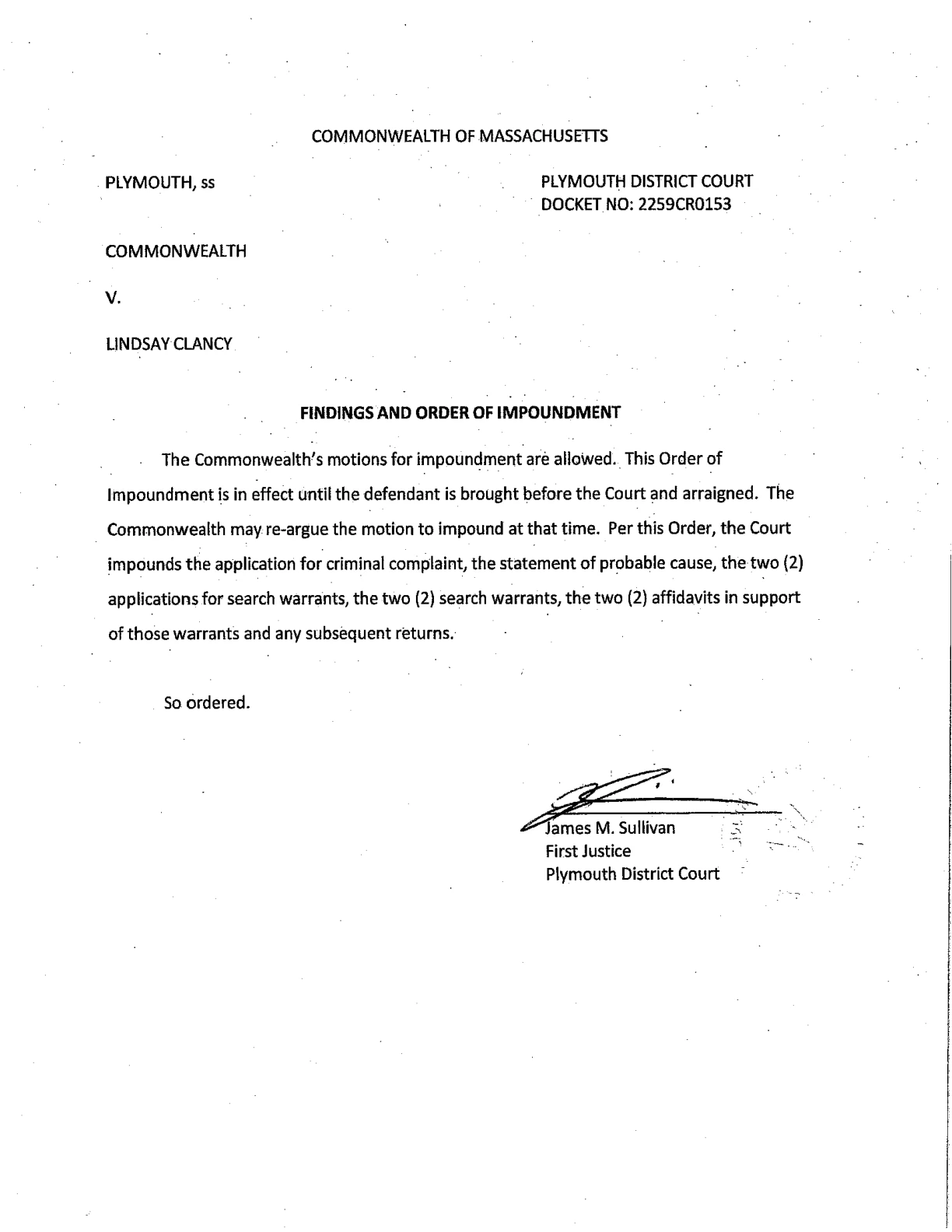
The early warrant records also show why some information was initially unavailable to the public. Judge James M. Sullivan ordered the complaint, probable-cause statement, warrants, affidavits and returns impounded until arraignment, with the prosecution able to ask again then. The order below comes from the publicly released warrant bundle. It concerns access to those early records; it tells us nothing about the later jury decision.
What Massachusetts asks about criminal responsibility
The jury had to decide whether Lindsay could meaningfully understand that her actions were wrong or criminal, and whether she could keep her actions within the law. Those are the two abilities described in Massachusetts’ criminal-responsibility instructions.
Under that standard, a mental disease or defect can exclude responsibility if it causes a sufficiently serious loss of either ability. Once the defense raises the issue with supporting evidence, the Commonwealth, meaning the prosecution, must prove criminal responsibility beyond a reasonable doubt. Lindsay did not have to prove the opposite.
That explains why so much of the trial focused on small, practical actions. Did a phone call or a travel-time search show that Lindsay could plan and understood what she was doing? Prosecutors argued that it did. The defense argued that someone could do those things and still lose a legally required ability during a psychotic episode.
A diagnosis alone couldn’t answer the question either. In fact, the October 1 order says experts on both sides described some form of serious mental illness. They disagreed about what Lindsay could understand and control when the children died.
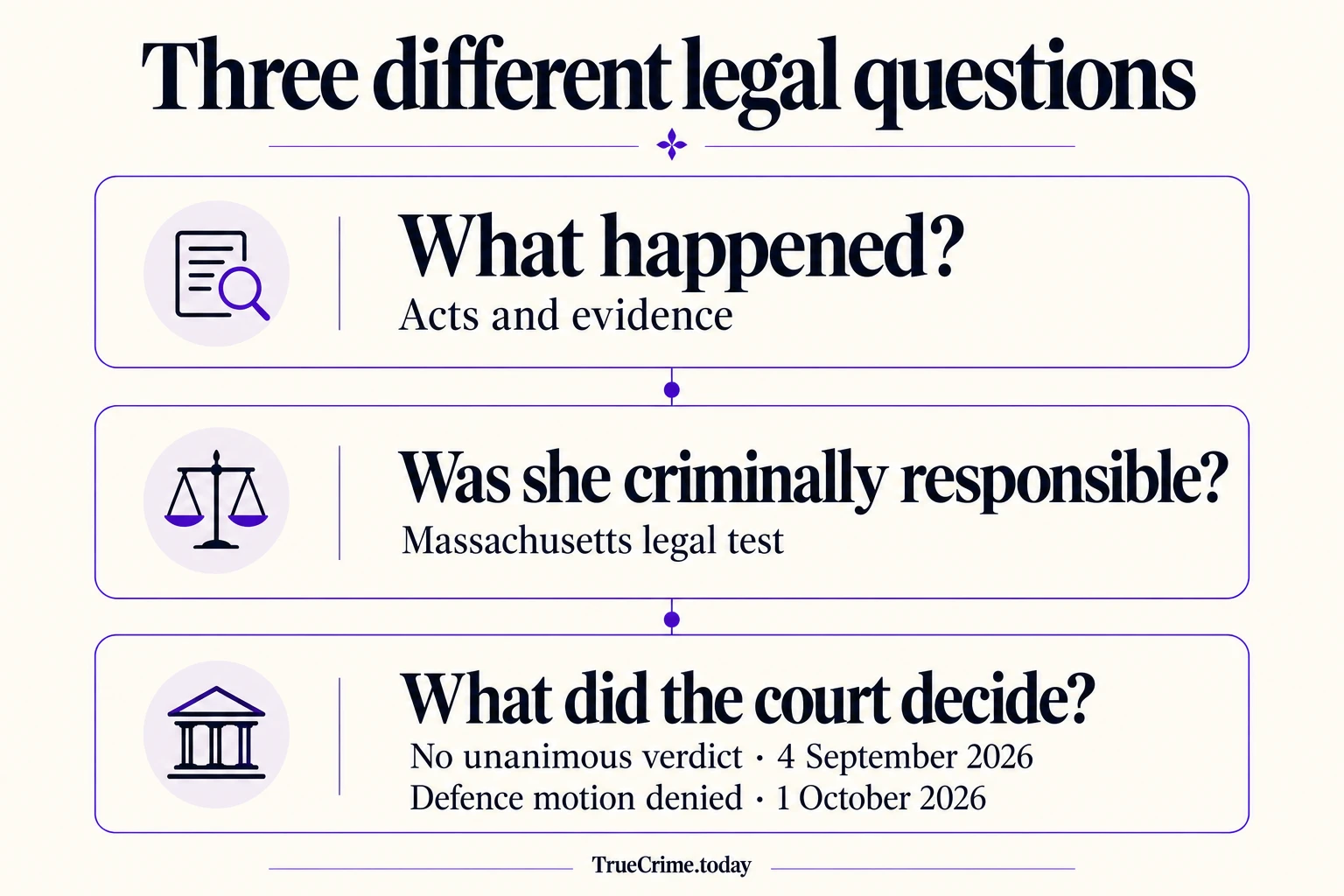
These are three separate questions. What happened? Could Lindsay be held criminally responsible? And what has the court actually decided? The answers don’t always arrive together.
Bifurcation: why the defense wanted two trial phases
Before the jury heard any evidence, Kevin Reddington, Lindsay’s criminal lawyer, asked to split the trial. This is called bifurcation. The jury would first consider the alleged crimes, then consider criminal responsibility in a second phase. That would change when jurors heard some of the psychiatric evidence.
Court TV’s March 31 account reported Sullivan’s refusal. The judge said the evidence couldn’t be neatly divided. Many of the same witnesses would have to testify twice about much the same material. He also said statements from court-ordered psychiatric examinations could be used to answer the defense’s case once it raised criminal responsibility.
The defense then offered a written stipulation, an agreement acknowledging Lindsay’s involvement in the deaths. Court TV reported the proposal on April 3. Reddington wanted the trial to focus on responsibility and avoid some of the distressing evidence about how the children died. The prosecution opposed it.
This is where the terminology gets confusing. Asking for two phases, offering an agreement about facts and conceding the killings during the trial were three different steps. The court hadn’t necessarily accepted an agreement just because the defense offered it. And conceding the acts while arguing no criminal responsibility wasn’t a guilty plea.
After the mistrial, this argument came back. Reddington said the psychiatric defense had put him in a difficult position: he had conceded the acts so he could argue responsibility. Prosecutors questioned how he could then say they hadn’t proved that Lindsay committed the killings. We’ll return to that exchange at the September hearing.
July: choosing the jury and protecting private evidence
The jury was selected over four days. Court TV’s July 23 report described an initial panel of 18, comprising 12 jurors and six alternates. The alternates were there to replace a juror who couldn’t continue. Only 12 would deliberate and decide the verdict.
Before opening statements, Patrick’s lawyer, David Meier, sought limits on broadcasting sensitive material, including the emergency call and images involving the children. He wanted to limit what the public saw and heard, while allowing the jury to hear the evidence. Reddington supported the request. Prosecutors argued that the material was relevant and that some of it was already public.
So if the sound disappears while you’re watching a recording, it doesn’t mean the jury heard nothing. Some material was kept out of the public broadcast. We’ve also left out graphic images of the children; you don’t need to see them to understand the case.
Opening statements began on July 27. The prosecution presented the killings as deliberate acts committed by someone who remained criminally responsible. The defense presented a severe psychiatric crisis and a loss of the capacity the law requires. At that point, the lawyers were telling jurors what they expected the evidence to show.
You can hear both sides in Court TV’s opening-statements recording below. As you listen, remember that the lawyers were making their arguments. The witnesses would still have to give their evidence.
Patrick’s testimony: what he knew and what he could not see
Patrick testified over two days during the opening week. He described family life, Lindsay’s health, the errands and what he found when he got home. When the emergency call was played for jurors, the court paused amid the distress in the room, according to Court TV’s report.
Police and other responders also told the jury what they found. Their accounts gave jurors a way to check parts of Patrick’s story against other witnesses. None of that changed the fact that Patrick hadn’t seen the killings.
It’s hard to watch this testimony without reacting to Patrick’s distress. But if you’re trying to understand the sequence of events, the calls, business records and other witnesses tell you more than deciding whether he cried enough. People don’t all show grief the same way, and an expression can’t prove whether someone is telling the truth.
The Court TV recording below contains Patrick’s testimony, including his account of finding the children. It is distressing. Parts of the broadcast may be muted even though the jury heard them.
What Lindsay’s doctors told the jury
Tufts testified that Lindsay appeared depressed at their final appointment on January 23, the day before the deaths, but did not report hearing voices or a plan to harm herself or the children. Prosecutors relied on that appointment because it was so close to the deaths.
Reddington pressed Tufts about how much those appointments could tell her. Court TV’s August 10 report described Tufts acknowledging that she had never met Lindsay in person. Their appointments were remote. You may have heard that the appointments lasted 17 minutes. That figure referred to the therapy part of an appointment. Court TV reported that whole appointments lasted roughly 25 to 30 minutes.
Tufts was also questioned about not obtaining hospital records and not knowing about two crisis-hotline calls. She disputed the criticism of her care. The defense argued that important information had been missed or never reached Tufts. Prosecutors pointed to the repeated appointments and what Lindsay had said during them.
A note saying there were no reported psychotic symptoms tells you something about that appointment. It doesn’t tell you everything that happened afterward. Missing information also leaves a question open; it doesn’t prove the defense’s answer.
Dr. Donald Condie, a defense psychiatrist who reviewed records, criticized aspects of the assessment and documentation. He hadn’t examined Lindsay in person. His criticism came from reading the records, which is worth keeping in mind when you compare his opinion with Tufts’ account.
What the searches and journals showed
The phone and computer records gave the lawyers plenty to argue about. Prosecutors relied on travel-time searches to argue planning around Patrick’s absence. The defense offered a different interpretation of the surrounding circumstances. The search showed that someone had looked up the journey. Why they did it was the disputed part.
For one computer search, there was another question: who had made it? Court TV’s August 13 report described a search following an inquiry about singer Tom Hall on a Surface Pro belonging to Patrick. Cross-examination established that Lindsay was at an appointment for Dawson when the search was made at home. Finding a search on someone’s computer doesn’t tell you who typed it or why.
Records from Lindsay’s phone included searches about psychiatric symptoms and a journal expressing distress about motherhood and medication. Prosecutors emphasized resentment; the defense emphasized her wish to feel connected to her children. The jury also heard about a snowman photograph from January 24 and Patrick’s affectionate response. That showed another part of the day, without answering what happened later.
If you see one of these entries shared online, look for the rest of it. When was it written? Which device did it come from? Do we know who wrote it? A few words from a search or journal can look very different when you see what came before and after them. They can’t diagnose the writer.
Why the defense experts believed Lindsay was psychotic
Dr. Paul Zeizel, a psychologist, assessed Lindsay soon after the deaths. Court TV’s August 19 report described his February 4 hospital visit and a February 6 telephone conversation between Lindsay and Patrick that Zeizel heard. He testified that she described a male voice telling her to kill the children and herself.
Zeizel also described her belief that other people could hear her thoughts. He believed she was psychotic and said the symptoms could come and go. Prosecutors asked whether abilities such as remembering Patrick’s phone number pointed to a different explanation. Zeizel said someone could remember a number and still have serious symptoms.
Zeizel saw Lindsay soon after the deaths, which made his account important. But he still had to work backward to January 24, partly from what she told him. The jury had to decide how much weight to give those reports and his interpretation of them.
The Court TV segment below presents Zeizel’s testimony. As you listen, notice when he’s describing something he saw himself and when he’s describing what Lindsay told him. His opinion draws on both.
The defense also called Dr. Phillip Resnick. Court TV’s August 21 report described a three-hour assessment in May 2023, along with review of records and family information. He concluded that reported command hallucinations and beliefs about being controlled supported a loss of criminal responsibility. He explained that psychosis need not be present continuously throughout a day.
Resnick was answering a question that kept coming up: could Lindsay behave normally earlier in the day and become severely ill later? He said that was possible. Prosecutors challenged the symptoms she reported and what they meant for her ability to understand or control her actions. The jury didn’t have to accept an opinion simply because an expert gave it.
Susan Clancy’s testimony provided family context alongside the experts. A prosecutor’s question about murder as a mortal sin prompted the judge to tell jurors to disregard it. People criticized the exchange, but jurors had been told to disregard the question. It wasn’t evidence they could use to decide Lindsay’s responsibility.
Why the prosecution experts disagreed
The Commonwealth called three experts whose opinions supported criminal responsibility. Their diagnoses weren’t identical. So even within the prosecution’s case, there wasn’t one single explanation of Lindsay’s illness.
Dr. Avram Mack disputed the defense’s psychosis explanation. During cross-examination, Reddington challenged his knowledge of postpartum terminology and questioned earlier criticism of his work. Court TV’s August 24 report described disagreements over how that criticism was characterized. To judge that exchange, you need to ask what each challenged answer changed about Mack’s opinion. A tense moment on video won’t tell you that by itself.
Psychologist Kirk Heilbrun discussed bipolar II disorder, depression and dissociation while supporting retained legal capacity. Court TV’s August 25 report described his acknowledgment of adverse reactions to prescribed medication. He agreed that medication had caused problems. He still disagreed with the defense about whether Lindsay could be held criminally responsible.
Dr. Gregory Saathoff also acknowledged mental illness while concluding that Lindsay retained the required capacities. He pointed to her actions, including the calls and errands, and when they happened. The defense questioned his reading of those events and why he hadn’t interviewed Lindsay’s mother. Associated Press reporting also described his challenge to the reported duration and disappearance of the voice.
The phrase altruistic filicide appeared in the expert discussion. In this context it describes a proposed belief that children should die with a suicidal parent to spare them suffering or abandonment. It does not excuse the deaths or establish that the belief existed. The lawyers disagreed about what such thinking would mean: had illness left her unable to understand or control her actions, or did she still have those abilities?
When the experts disagree this much, it’s tempting to pick the one who sounds most convincing. Try asking what each had to work with instead. When did they see Lindsay? Who did they speak to? Which records did they read? And how did they get from a diagnosis to an opinion about criminal responsibility?
Closing arguments and the hung jury
Lindsay did not testify. Associated Press reporting on August 26 described more than 70 prosecution witnesses and ten defense witnesses. That’s a lot of testimony, but having more witnesses doesn’t necessarily make a case stronger. What they could actually tell the jury mattered more than the head count.
Closing arguments took place on August 27. Assistant district attorney Jennifer Sprague argued the Commonwealth’s case; Reddington argued the defense’s. The jury then had to decide the case using the evidence and the judge’s instructions. The closing speeches were the lawyers’ arguments about that evidence.
The deliberations continued into September. Court TV’s September 3 reporting described complaints about one juror and a defense request to remove that juror. Sullivan questioned jurors individually and returned to the legal instructions. The defense wanted the juror removed. That didn’t mean the judge had found misconduct. A juror can disagree with everyone else without refusing to follow the law.
By September 4, the jury remained unable to agree. The defense tried to get a higher court to intervene before the mistrial took effect, but that effort failed. Sullivan declared a mistrial on the seventh day of deliberations.
The reported 11–1 division favored a finding of no criminal responsibility. The defense saw that division as important. The jury still needed to agree unanimously on a verdict. Eleven votes couldn’t acquit Lindsay, and one couldn’t convict her.
Court TV’s recording below captures the mistrial announcement and the dispute surrounding it. You’ll hear why the first trial ended. The question of responsibility, and the arguments about another trial, were still unresolved.
September 29 and October 1: what the judge actually decided
At the September 29 hearing, Reddington attacked both the investigation and the sufficiency of the evidence. Court TV reported his criticism of DNA, fingerprinting and the prosecution’s chronology. Prosecutor Shanan Buckingham pointed to the evidence already heard. She questioned how the defense could concede the killings during the trial and then argue that the prosecution hadn’t proved them.
Sullivan said he would consider the request. He also pressed the lawyers to discuss a possible trial date, but neither committed to one. November 2 was set for further motions and scheduling. When a lawyer says they can’t be available before a certain month, that doesn’t mean a trial has been scheduled for that month.
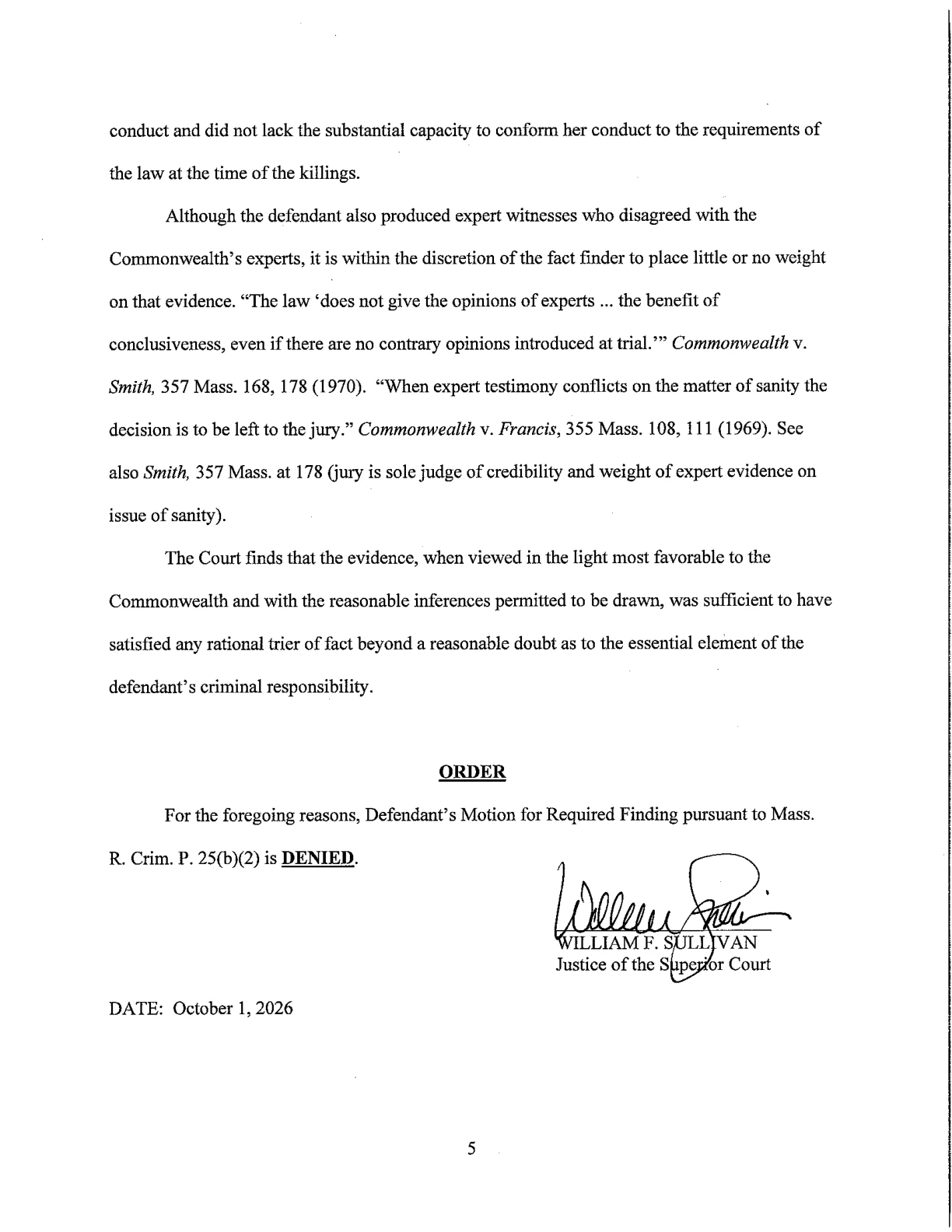
The signed October 1 order addresses two issues separately: evidence identifying who committed the killings, and evidence of criminal responsibility. Sullivan found the physical and circumstantial record sufficient on the first and the Commonwealth’s evidence sufficient on the second, under the rule requiring him to view it favorably to the prosecution.
For this motion, Sullivan had to ask whether a reasonable juror could find the prosecution had proved its case beyond a reasonable doubt. He wasn’t deciding which side he personally believed, and he wasn’t turning the reported 11–1 vote into a verdict.
The judge referred to the errands, business videos, Patrick’s return, the scene, medical findings and other exhibits. On responsibility, he referred to the circumstances and the Commonwealth’s three experts. The defense experts disagreed with the prosecution experts. The judge said it was for a jury to weigh those opinions; the disagreement didn’t require him to enter a not-guilty finding.
So the charges remained, but Lindsay hadn’t been convicted. Other arguments about a retrial and the juror dispute still needed their own decisions. The October 1 order didn’t settle all of them.
Here is the final page of the October 1 order, including the denial, the judge’s signature and the date. The reasoning above it explains why conflicting expert opinions were for the fact finder to weigh. You can compare this page with the full signed order linked near the start of this article.
Patrick’s interviews: forgiveness, grief and public judgment
Patrick spoke publicly before the trial as well as after it. Eren Orbey’s October 2024 New Yorker profile described his life after the deaths. He spoke about the woman he had known and his belief that she had been profoundly ill. That didn’t fit neatly into the arguments online, where some people seemed to expect him either to condemn her completely or to say she hadn’t killed the children.
A later 60 Minutes interview aired in September 2026. Patrick said: “I think I did the best I could with what I had at the time.” Associated Press coverage described his discussion of panic attacks, suicidal thoughts and forgiveness. He was talking about his own grief and how he had kept going. He wasn’t giving a medical opinion about Lindsay.
In his extended 60 Minutes interview, Patrick talks about living with the loss of his children. You can compare that personal account with his courtroom testimony, where lawyers questioned him about the events and the evidence.
If something in an interview seems to differ from the testimony, it’s fair to ask why. Look at the question he was answering and whether the clip was edited. Remembering a day and piecing it together later from records can also produce different accounts. You still need evidence before deciding what caused the difference.
Patrick’s forgiveness doesn’t settle whether Lindsay was criminally responsible. And judging how he looks or sounds won’t tell you who committed the killings. You can listen to his story without treating his reaction as a test of either person’s guilt.
The online questions and accusations against Patrick
The investigation gave people real questions to argue about. The nightstand drawer, the prescription bottles and the shared computer all came up in court. Some online discussions followed those exchanges closely. Others turned a gap in the record into an accusation against Patrick. To understand where those theories came from, we need to look at the details people were building on.
The drawer and the medication bottles
During Patrick’s cross-examination, Reddington brought a nightstand drawer into court and displayed empty prescription bottles, an Apple Watch and a sleep mask. He said police had overlooked its contents. That gave viewers something concrete to question: if medication was central to the case, why hadn’t investigators taken those bottles themselves?
The prosecution relied on partly used prescriptions to question whether Lindsay had followed her treatment. Patrick said the bag he handed over contained discontinued prescriptions that clinicians had told him to discard. He also acknowledged that he hadn’t watched her take every dose. Empty bottles, partly filled bottles and a changing prescription history need to be considered together. A pill count alone can’t tell you which treatment was active or when someone last took it.
The January 25 warrant return lists four medication bottles and paperwork, with the amounts of tablets unknown. Lt. Joseph Rabbitt later testified that Patrick handed over additional prescriptions in February. Those are different collections, separated in time. The drawer dispute matters because missing a group of bottles could leave investigators with an incomplete picture of treatment. It doesn’t establish that Patrick hid evidence or that every medicine found later was being taken on January 24.
What was collected, and what the fingerprint tests showed
Claims that police collected almost nothing run into the warrant return itself. The inventory includes cameras, a baby monitor, a storage device, journals, hospital paperwork, tablets, laptops, two separately described pink iPhones, exercise bands, a belt, a knife, clothing and stain swabs. It records swabs from the bedroom floor, mirror, windowsill, nightstand and backyard. Each entry tells us an item was taken under that warrant. It doesn’t tell us the result of every test or account for every later collection.
At trial, Trooper Jonathan O’Loughlin testified that the knife and three exercise bands yielded no fingerprints useful for comparison. That limits what fingerprint evidence could establish about who handled those objects. It also means the objects underwent examination. Calling the result “no usable fingerprints” keeps the distinction between an unsuccessful comparison and a test that was never done.
Bob Ward’s August 4 courtroom updates for Boston 25 reported that forensic scientist Maureen Hartnett swabbed both ends and the center of each of the three bands. That answers one narrow question about collection. It doesn’t settle the online claims about whose DNA was present or absent. For those, we’d need the laboratory reports, the sampled areas, the comparison profiles and the analyst’s explanation. We haven’t verified that complete set of records.
NIST’s review of DNA mixtures explains why a tiny trace can be difficult to interpret: DNA can transfer between surfaces, several people’s DNA can mix, and a sample may contain too little material for a useful comparison. In this case, “no usable fingerprint,” “no DNA match” and “no sample taken” describe different problems. Swapping one phrase for another can make a theory sound much stronger than the evidence behind it.
The later collection of exterior stains
There was also a delay viewers could point to. Hartnett testified that she returned on June 15, 2023, to collect additional samples from exterior shingles near the bedroom window. The killings happened on January 24. Boston.com’s August 4 account reported that investigators had requested further testing of those stains.
That timing deserves attention because the exterior evidence fed the argument over how Lindsay left the window and how seriously she was trying to harm herself. The records raise questions about what police documented in January, what they left in place, and why they returned months later. The date alone doesn’t tell us whether the later samples had changed or become contaminated. Answering that would require the collection notes, photographs and laboratory evidence.
The January inventory already includes windowsill and backyard swabs, so the later visit doesn’t mean police ignored all exterior evidence. It shows why a single collection list can’t answer every question about the investigation. You need to compare the original photographs, the first samples and the later samples before deciding what was lost.
The shared computer, the phones and the timeline
The Surface Pro exchange gave online suspicion another foothold. A suicide-related search on a shared device could sound like evidence against Lindsay until the defense asked who was using it and where she was. Patrick denied searching for suicide methods; he acknowledged looking up the singer whose death preceded the website visit. The authorship question was raised in court, and the defense challenged the prosecution’s interpretation.
People then used that dispute to question other searches, calls and device locations. Those are fair questions to ask of a timeline. A search belongs to a device before it can be confidently attributed to a person. A call log can show a connection without telling us everything said. And an item listed as a pink iPhone needs a matching device identifier before we can connect it to an extraction or a particular owner.
The inventory’s two pink-phone entries are a reason to check those identifiers, rather than assume they describe one handset. The return doesn’t name the owner of each phone. A January 27 warrant elsewhere in the bundle identifies a pink iPhone in police evidence as Lindsay’s and authorizes its search. That establishes a documented search step for her phone. It leaves questions about the other entry and the complete set of device records. We haven’t verified the claims that Patrick’s phone records were sealed, withheld or never investigated.
Some posts treat unexplained gaps between calls, business footage and Patrick’s return as evidence that he was involved. A timeline needs the original timestamps, their time settings and a reason to put each event at that moment. If two records don’t seem to line up, first check whether they measure the same event. We haven’t found verified evidence establishing the online accusations that Patrick killed the children or staged the scene.
How quickly police focused on Lindsay
Another online criticism is that police settled on Lindsay too quickly and built the investigation around that decision. The warrant chronology gives us a way to test the timing. The house-search return records a search at approximately 4:50 a.m. on January 25. A later affidavit says police obtained the arrest warrant at approximately 3:45 p.m. that day. It also records the hospital trace-evidence examination starting at approximately 6:21 p.m.
On that account, police had searched the house before obtaining the arrest warrant, and some evidence collection continued afterward. An arrest warrant requires probable cause; it doesn’t require a completed investigation or establish guilt. To assess whether investigators dismissed another possibility too soon, we’d need their interviews, leads, comparison work and reasons for excluding those leads. The early affidavit explicitly says it leaves out some information known to investigators. Its silence about a question can’t tell us that nobody asked it.
Why the defense’s criticism matters, and what the judge decided
Reddington brought these concerns back to court on September 29. He attacked the DNA work, fingerprinting and timeline while asking for a required finding of not guilty. Buckingham answered that the trial record supported Lindsay’s involvement and pointed to the defense’s earlier concessions. Those arguments gave the online debate a real courtroom basis, even when people online went further than either side’s evidence.
The October 1 decision helps explain what followed. Judge William F. Sullivan reviewed whether the prosecution had presented enough evidence for a rational fact finder to reach the required conclusions. He denied the motion. His order discusses circumstantial evidence and the competing psychiatric opinions; it doesn’t audit every collection choice or declare the police investigation flawless. The jury had already failed to reach a verdict, and the judge’s refusal to dismiss didn’t supply one.
That leaves room to question the drawer, the later sampling and the way a search was attributed without turning Patrick into a substitute defendant. Jessica Winter’s August 22 New Yorker report described how the online discussion had also spread accusations against him and AI-altered interpretations of business footage. Before relying on an enhanced frame, compare it with the original. Software can add an apparent detail that the camera never captured.
People following a case online can help by spotting a detail others missed and showing where they found it. Then everyone can check it for themselves. The most useful next step here is to match each criticism to a specific item, collection date, test or testimony. That gives us a way to see which questions the investigation answered and which remain open.
The civil cases and questions about care
There is also litigation about the care Lindsay received. Court TV’s January 26 report described Lindsay’s malpractice action and a separate wrongful-death action filed by Patrick. Both raise questions about her diagnosis, how her care was managed and whether different treatment could have prevented the deaths.
Those lawsuits will need evidence of their own. A doctor being criticized during the murder trial doesn’t mean negligence has been proved, and denying wrongdoing doesn’t end a claim. The civil courts will consider what care was owed and whether any failures caused harm. That’s a different question from Lindsay’s criminal responsibility.
With several providers involved and medication changing, it’s reasonable to ask who was keeping track of the whole picture. The records and civil proceedings will matter here. Counting prescriptions won’t answer that question, especially if a list doesn’t tell you which drugs were taken together.
A finding of no criminal responsibility would also not mean automatic release. Massachusetts provides a separate possible commitment process, subject to legal conditions and judicial review. We aren’t saying the court has made such an order in this case.
What to look for next
What happens next depends on the remaining motions and whether prosecutors announce a retrial. A new trial date or a verdict would also change where the case stands. As of the coverage we checked on October 6, November 2 was the next reported hearing date. That date may change.
When a new headline appears, ask what has actually happened. Has the judge ruled on something, or has a lawyer asked for it? Is a witness describing what they saw, or is someone interpreting their words? That small pause can save you from mistaking an argument for a decision.
At the center of all this are Cora, Dawson and Callan. You can want answers about their deaths, question the evidence and follow the court proceedings without sharing graphic images or going after their family online.
If the story feels close to home
A story about suicide and severe distress after childbirth can bring up fears about your own household. You don’t have to decide whether your situation resembles Lindsay’s before asking for help. Postpartum psychosis is a medical emergency; an article cannot assess whether someone is experiencing it.
For readers in the United States, call 911 when there is immediate danger. Call or text 988 for suicide or mental-health crisis support. The National Maternal Mental Health Hotline, 1-833-TLC-MAMA (1-833-852-6262), offers support around pregnancy and after birth; it is not an emergency-response service. If you’re outside the United States, contact the services where you live.
You can stop a video or leave a discussion whenever you need to. You don’t have to watch every distressing moment to understand the case.
Have a question about a hearing, testimony or claim discussed here? Tell us which one and its date. Keep medical records and other personal documents out of the public form.
Ask about the case