True crime on Netflix: find the right film and know what you’re watching
Choose true crime on Netflix by format, footage and viewing time. Find documentary titles, check regional access and separate acted scenes from recordings.
Finding true crime on Netflix gets easier when you know what you want from the film. Do you want recordings from a real investigation, interviews with people involved, or an acted story about a case? Search results can put all three next to each other, even though they give you different things to watch and different reasons to trust a scene.
You also need a title that plays in your own account. A recommendation from someone in another country can be perfectly sincere and still leave you staring at an empty search result. The examples below help you choose a format and check what is available where you live.
TL;DR
Search by the exact title and year, identify documentary or drama, then confirm access and language options in your account. American Murder: The Family Next Door uses firsthand footage; When They See Us is an acted limited series. Both concern real events, but an actor’s dialogue is not an interrogation recording. Check the length and content information before settling in, and keep a film’s interpretation separate from the court record.
What counts as true crime on Netflix?
True crime is storytelling about real offences and the people affected by them. Netflix uses the theme across different formats. Its true crime documentary collection groups nonfiction films and series, while its broader crime collection can reach beyond that format. A category helps you find a subject; the individual title card tells you more about how it is presented.
That distinction matters when you want to understand a case rather than watch an actor perform it. The meaning of true crime starts with the real-world subject, but the way someone tells that story still shapes what you hear. You can enjoy the suspense and keep asking where a claim came from.
A documentary and a drama can tell the same kind of story
A documentary can include archive recordings, present-day interviews and reconstructions. Those materials serve different purposes: an interview gives someone’s account now; a recording preserves something captured then. Editing brings them together into a story.
A drama based on real events casts actors and stages scenes. It can raise serious questions about an injustice or a family’s experience. If you want to quote what was said during a real interview, though, you need that interview or its transcript rather than the script.
When a scene persuades you that someone meant a particular thing, separating case evidence from interpretation gives you a useful next question: what recorded words, document or testimony supports that conclusion? It helps you follow the story without treating every convincing moment as a finding of fact.
Three titles that show the difference
These are examples of formats, not a ranking. Their public title cards and production descriptions establish their identity; playback still depends on your account. The last time we checked those details was October 13, 2026.
American Murder: The Family Next Door: recorded material
Netflix identifies American Murder: The Family Next Door (2020) as a documentary about the disappearance of Shanann Watts and her children, using firsthand footage. It is a useful starting point for noticing the difference between material recorded during events and an explanation supplied afterwards.
A piece of recorded footage can answer what was visible at that moment. It does not automatically answer what happened outside the camera’s view. Keep that gap in mind when the story moves from an image to a conclusion. The subject includes the deaths of a woman and children, so decide whether that is what you want to spend your evening with.
When They See Us: an acted retelling
When They See Us (2019) is Ava DuVernay’s four-part drama based on the Central Park case. Actors portray the people involved. A courtroom or interrogation scene belongs to that retelling, even when the underlying events were real.
Its public episode card showed 63, 71, 73 and 88 minutes: 295 minutes, or about 4 hours 55 minutes, added from the displayed times. That is a planning estimate, not a measurement of the video files. Four episodes can mean a much longer evening than one documentary film, and an acted scene requires a different kind of source check.
Trust Me: The False Prophet: access inside a group
Trust Me: The False Prophet (2026) is Rachel Dretzin’s four-part documentary about the group around Samuel Bateman. Its production account describes access through Christine Marie and Tolga Katas, and says artificial intelligence changed minors’ faces and voices to protect identity.
That alteration matters if you are tempted to analyse a tiny facial movement as a clue. A protected face is not the unaltered image you would need for that claim. The series involves abuse of minors; the access described by its makers does not make it an easy watch.
Why your friend can find a film that you cannot
Country rights, release timing and profile settings can affect what appears. A title can also leave the service. Searching under a different profile language can change the visible results, and a maturity restriction or a blocked title can explain a missing film.
Check those possibilities before assuming a recommendation was invented. Match the full name and year, then search in your own Netflix account. If you are travelling, account for where you are watching. Netflix’s public service information says it operates in more than 190 countries and regions, with libraries that vary; it lists Russia among the places where the service is unavailable.
A web title card is useful for identifying a work. It does not establish that you can play it, in the language you need, from your current location. The same applies to a search-engine snippet or a picture of someone else’s viewing screen.
Make room for the language you actually want to hear
Netflix’s audio and subtitle options are title-specific; streaming shows the available language choices, while downloads display the two most relevant languages. A shorter offline menu does not by itself tell you that the original track is unavailable when streaming.
If your question concerns someone’s delivery, choose the original audio when available. A dub lets you follow the words through another performer’s voice. Subtitles also help you follow the story, but a translated line can lose a qualification or shorten an exchange. Accessibility and comprehension matter; just be clear about which part of the conversation you are assessing.
A few words on the title card are worth slowing down for
Limited series tells you about the programme’s format, not whether every question in the case has been resolved. Archive footage means pre-existing material; you still need its date and context. A reconstruction recreates an event rather than recording it as it happened.
Dubbing replaces the voices you hear with another language performance. SDH, subtitles for the Deaf and Hard of Hearing, can include sound and speaker information as well as dialogue. Ordinary subtitles can contain less of that context. These labels help you decide how to watch before you begin drawing conclusions about tone or timing.
Four checks before you press play
- Match the work. Keep the name and year together, especially when a familiar title has several versions.
- Confirm the format. Look for the documentary or drama label and the cast or production description.
- Check your access. Find the work in your account and confirm it is playable where you are.
- Choose the language and time. Confirm audio, subtitles, episode length and the subject warnings that matter to you.
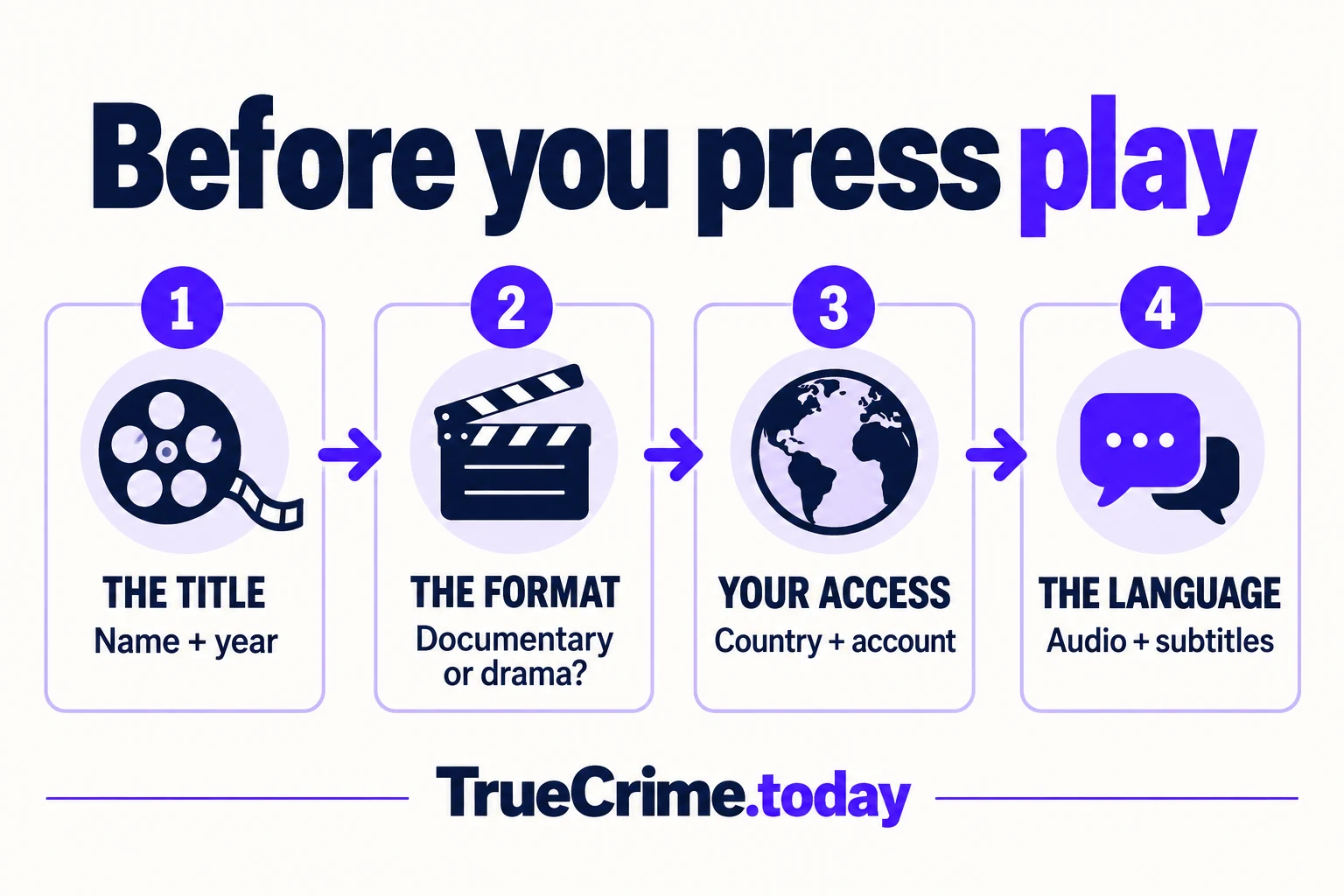
The order saves you from solving the wrong problem. If you have the wrong film, changing subtitle settings will not help. Once the title and access are right, you can decide how much time and attention to give it.
Try one scene without turning it into a verdict
Choose a scene that caught your attention and write one sentence about what you actually saw or heard. “The film shows a message dated Tuesday” is easier to check than “This proves the person planned everything.”
Then identify the material. Is it a filmed message, an interview recalling the message, or an actor reading it? If the date is visible, note whether it belongs to the original material or a label added by the film. You now have a question you can investigate rather than a conclusion built from the mood of the scene.
You do not need to do this throughout the film. Trying it once can show how readily a soundtrack, a reaction shot or a later explanation changes your first impression.
What a screenshot leaves out
A screenshot can preserve words but cut away their date, speaker and surrounding exchange. A caption on social media can then supply an interpretation that was never part of the footage.
Suppose a post says an interviewee “laughed when asked about the victim.” Before repeating it, find the exchange and establish what question preceded the reaction. If all you have is the cropped image, leave the interpretation open. Avoid sharing private details or turning uncertainty into an accusation against someone in the case.
Choose the format that suits your evening
A single documentary film gives you a bounded viewing session. A series can return to the same event through several people’s accounts, but episode count does not measure how thoroughly the investigation was done.
An acted drama gives you performances and scenes shaped by a script. That can be moving and worth discussing. Decide whether tonight you want that experience, recorded case material, or interviews that revisit events. Checking the format helps you choose without requiring every programme to do the same job.
When the story stays with you after the credits
If you want to learn more, keep the question that bothered you and search for its underlying material: the complete interview, a dated court document or reporting that identifies its sources. Note the film’s release year so you can spot later developments.
On your next watch, pay attention to one other thing: whose experience is missing? A persuasive interview may deserve attention without speaking for everyone affected. That question adds depth to your viewing without making you responsible for solving the case.
Questions before choosing a Netflix crime title
Do genre codes reveal every film?
No. Numbers such as 81050 identify a category, and 108820 identifies a broader true crime collection. They are browsing shortcuts, not a promise that every title is visible or licensed in your country. Account settings still matter.
Is a Netflix documentary proof of what happened?
Its individual recordings and documents can contain evidence worth examining. The finished film is also a selection made by its creators. To establish a contested claim, identify what supports it and whether later records change the picture.
Are subtitles a word-for-word record?
Do not assume that. Translation and readable subtitle length affect the wording. For a disputed phrase, distinguish the translated subtitle from the original speech and from an official transcript, if one exists.
Can I watch these titles for free?
We have not verified free full-film access for the examples. A public trailer or title card is not the full work. Check your existing subscription and current local terms before paying for another service.
What should I do if a film has disappeared?
Confirm the exact work, profile settings and local availability first. A former listing does not establish present access. Avoid relying on an old “watch now” recommendation as the reason to buy a subscription.
Keep one question for your next film
Pick a title whose format and subject suit you, then keep one question about a scene you want to understand. You can enjoy a gripping story and come back to its sources afterwards. Knowing what kind of material you watched makes that conversation much better.
Have a question about a film’s format, title or language options? Send the public title link and the detail you mean. Do not send passports, contracts, bank details or other personal documents.
Ask about a Netflix title