False confessions: why someone admits to a crime they did not commit
Why false confessions happen, how crime details enter an account, what sleep research shows and why independent evidence matters when assessing a confession.

You hear someone confess on a recording. They describe the room, the object used and where it was left. It is hard to imagine an innocent person giving that account. False confessions force a closer question: how did those details reach the person, and what confirms the account independently? A confession can contain accurate information while being wrong about who committed the crime. Understanding that possibility means looking at the conversation that produced it, not only the moment someone finally said yes.
TL;DR
People can falsely confess to escape pressure, obtain a perceived benefit, protect someone else or because they become uncertain about their own memory. A signed, detailed or recorded statement still needs checking. Investigators must trace the source of its details, test it against independent evidence and examine the conditions in which it was obtained. Experiments show mechanisms of risk; they do not supply the percentage of all police confessions that are false.
A detailed confession still needs an explanation
A detail can be genuine knowledge of an event. It can also come from a news report, a photograph shown during questioning, a suggested answer or an earlier conversation. The difference matters most when someone says the information was known only to the perpetrator.
When you assess evidence in a true-crime case, ask which explanation has actually been checked. Specificity makes a statement worth investigating. It does not, by itself, establish the source of the speaker’s knowledge. A persuasive account and a supported account are not automatically the same thing.
What makes a confession false?
A false confession attributes criminal responsibility to someone who did not commit the admitted act. The claim can concern the whole event or a consequential part of it. That is different from admitting an act but disputing whether it was unlawful, and different again from accepting a plea for reasons that require their own legal analysis.
A contested confession is not necessarily false. A person may retract a truthful account, and a false account may remain unretracted for a long time. The classification has to rest on evidence about what happened. Discomfort, a later denial or an expert’s description of a risk factor cannot settle that factual question alone.
How a detail can travel into an apparently convincing account
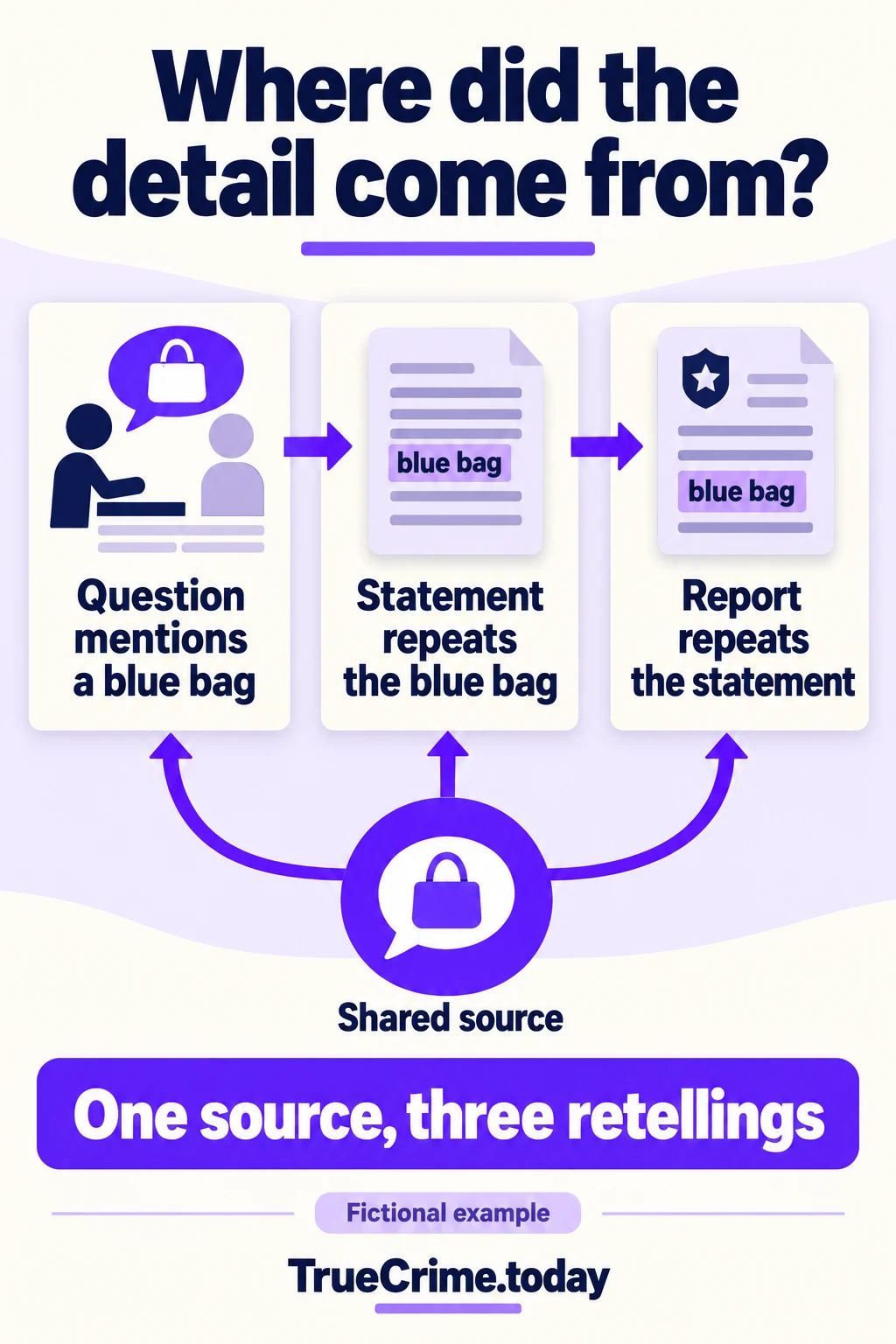
Imagine a fictional burglary at a marina tool store. Before a recording begins, an interviewer asks whether the tools were carried in a blue bag. Later, the person repeats the blue-bag detail in a signed statement. A report then summarizes the statement as evidence that the person knew the container’s colour.
There are three appearances of the detail, but they share an information source. The later statement cannot independently establish that the person knew about the bag before the question. The same point would apply if the information first came from publicity rather than an interviewer.
This is where forensic linguistics can help clarify the language record: a question can introduce information that a later answer repeats. Reading the answer without the preceding question changes what you think the speaker supplied. It remains necessary to compare the words with other evidence about the event.
What the case-record research actually found
Brandon Garrett’s 2010 study of the substance of false confessions identified 40 false confessors among the first 250 U.S. DNA exonerations. He obtained trial or pretrial material for 38 of those 40. In 36 of the 38 documented cases, confessions reportedly contained specific details about the crime. These are three different denominators, not an interchangeable set of percentages.
The accounts show why detail alone cannot authenticate a confession. They do not establish how every detail was learned or what each officer intended. The study also cannot estimate the prevalence of false confessions among all suspects: DNA exonerations are a selected group of discovered wrongful convictions, with records available for only part of that group.
What one night without sleep changed in a laboratory
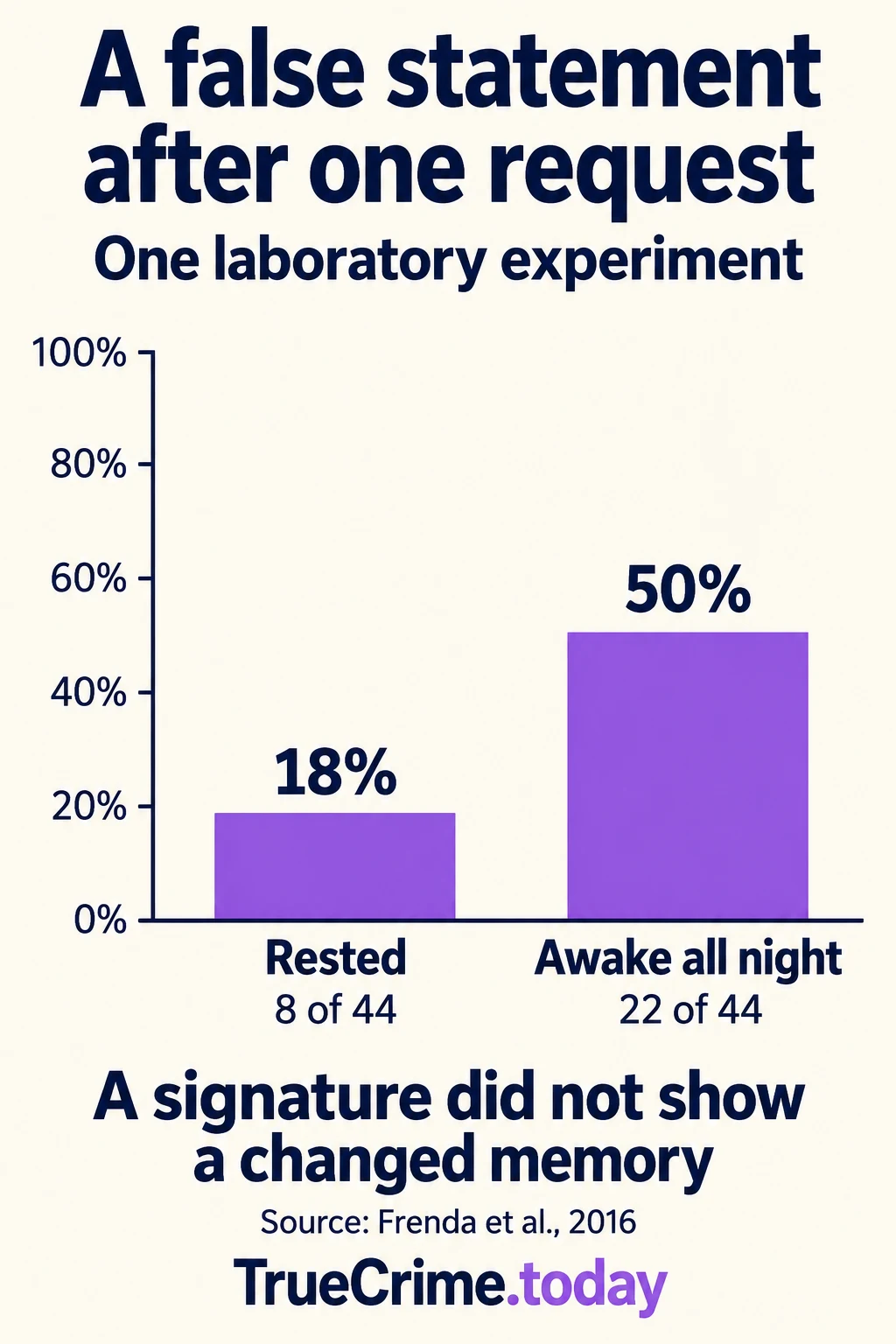
In Frenda and colleagues’ 2016 sleep experiment, 88 participants completed laboratory tasks. One group slept overnight; the other remained awake. Participants were then asked to sign a statement falsely saying they had pressed a prohibited Escape button. After the first request, 8 of 44 rested participants signed, compared with 22 of 44 sleep-deprived participants: the paper reports 18% and 50%.
That is evidence about false signing under those conditions. It is not a criminal-interrogation rate, and the participants did not produce the detailed postadmission narrative found in many criminal confessions. The study did not test true-confession performance either. Those limits matter when deciding what a laboratory result adds to a discussion of real questioning.
Why 4.5 times the odds is not 4.5 times the probability
The experiment reported an odds ratio of 4.5 after the first request. You can reproduce it from the counts. The sleep-deprived group had 22 signers and 22 non-signers, giving odds of 22 ÷ 22 = 1. The rested group had eight signers and 36 non-signers, giving odds of 8 ÷ 36. Dividing 1 by 8/36 gives 4.5.
The ratio of signing probabilities is different: (22/44) ÷ (8/44) = 2.75. The difference between the proportions is (22 − 8) ÷ 44 × 100, about 31.8 percentage points. These are calculations from the same small experiment, measuring different things. None is a multiplier you can apply to a particular suspect’s chance of giving a false confession.
Three pathways to an admission of something untrue
Researchers distinguish several psychological pathways. A voluntary false confession can arise without police elicitation, when someone tries to protect another person. The label describes how the statement arose; it is not a court ruling that the statement was legally voluntary or true.
A compliant false confession involves accepting responsibility while privately knowing it is untrue, perhaps to end a frightening situation or obtain an expected benefit. An internalized false confession involves coming to doubt one’s memory and accepting the possibility or belief that the act occurred. Saying the words, believing them and remembering an event are separate questions. One recording cannot reveal all three automatically.
When ending the interview starts to feel like the immediate goal
A person can understand that a confession is dangerous and still focus on the next few minutes. Exhaustion, repeated accusations, isolation and a perceived promise of relief can change the decision they think they are making. They may imagine that the facts will clear everything up later.
This explains a possible mechanism, rather than proving it occurred in a particular interview. A sympathetic tone can coexist with a misleading suggestion about consequences. Conversely, a difficult conversation is not sufficient evidence that a confession is false. The actual words, duration, breaks, understanding and alternatives need examination.
Why age and communication needs change the situation
A child may understand an immediate reward more readily than a distant legal consequence. Someone with an intellectual disability, a language barrier or serious psychological difficulties may need questions and safeguards adapted to their understanding. These concerns involve the interaction between a person and a situation, not a simple category of people whose statements should always be dismissed.
The relevant questions are concrete. Was the person able to explain the question in their own words? Were they agreeing to avoid disagreement? Was an interpreter or appropriate support available where needed? A diagnosis alone does not establish that an admission was false, and the absence of a diagnosis does not establish immunity to pressure.
What the 2025 exoneration figures can tell you
The National Registry of Exonerations’ 2025 annual report, published on April 6, 2026, recorded 97 individual U.S. exonerations occurring in 2025. Nineteen included false confessions. Dividing 19 by 97 gives about 19.6%, which the report rounds to 20%.
The denominator is recorded exonerations, not all convictions, interviews or confessions. The report’s separate group-exoneration records are another dataset. Cases may also be discovered and added later. This is evidence that false confessions contribute to documented miscarriages of justice; it does not establish that one in five confessions is false or that a change in annual percentages measures a national trend.
Independent evidence means more than another retelling
Return to the marina. A report, a witness summary of the report and the final statement may look like three confirmations. If all depend on the same suggested blue bag, they do not independently establish prior knowledge. Counting documents is different from counting independent information.
A more informative test would involve evidence whose origin can be checked separately: a location first supplied by the person before disclosure, an object recovered there, or an independently timed record. Even then, consider other pathways by which the information could have been learned. A failed prediction or a mismatch deserves attention alongside the details that fit.
What corroboration means in U.S. federal law
A legal safeguard and a scientific reliability question overlap without being identical. In Opper v. United States, 348 U.S. 84 (1954), the U.S. Supreme Court required independent evidence sufficient to support the trustworthiness of the relevant extrajudicial statement. The supporting evidence need not independently prove every element without the statement; the admitted facts and other evidence together must support guilt beyond a reasonable doubt.
That is a U.S. federal corroboration rule, not a description of every state’s law or every country’s procedure. Whether a statement was obtained lawfully, whether it is reliable and whether the whole case proves guilt remain distinct questions. A confession’s admission in evidence does not give a viewer a scientific guarantee that its contents are true.
A full recording answers questions the final confession cannot
A recording that starts after the first admission may preserve a detailed account while missing how it developed. In Garrett’s documented sample, 22 of the 38 cases had recordings, but those covered only portions of the questioning. The existence of a recording and the completeness of the record are different safeguards.
A fuller record can show questions, disclosures, denials, corrections, breaks and changes in the people present. It can support or undermine an allegation about interview conditions. It still does not reveal everything that occurred outside the recorded period. The strongest review identifies gaps rather than filling them with confidence.
What an information-gathering interview changes
The UN’s 2024 investigative-interviewing manual emphasizes an open account, careful clarification, alternative hypotheses and non-coercive questioning. Its aim is to gather accurate information, rather than make an admission the sole measure of success. It also supports recording the whole interview and meaningful safeguards. The manual is guidance within its stated international and UN policing context, not an automatically enacted domestic rule.
An interviewer can test contradictions without supplying the desired story. Keeping track of undisclosed details helps later reviewers assess what the person genuinely introduced. Recording supports that work; it does not replace legal assistance or make every subsequent inference correct.
Why nervousness, confidence and polygraphs cannot settle it
A calm confession can be mistaken or rehearsed. A distressed denial can be truthful. The question is not whether someone looks like the person you expect to confess. It is what explains the statement and how it fits independently established facts.
The same caution applies to a polygraph result. A physiological response does not supply the missing history of a detail or establish who committed an act. If an apparent test result was mentioned during questioning, that disclosure is part of the interview circumstances to examine, not a substitute for corroboration.
How an admission can reshape the rest of an investigation
Once an account is treated as the answer, ambiguous material can be interpreted around it. A mistaken timeline may be repaired in the narrative instead of being investigated as a contradiction. Someone reviewing later evidence may also know about the confession and approach a comparison with that expectation.
That possibility does not prove misconduct in every case. It gives the review a further task: separate information that existed before the admission from conclusions reached after it. Preserving alternative leads and the original uncertainty makes it easier to see whether the confession guided a useful investigation or narrowed it too soon.
From disputed statements to testable research
The idea that an innocent person can confess long predates modern experiments. Researchers developed categories of false confession, while documented wrongful convictions made the content and production of statements available for closer study. Laboratory tasks then allowed some influences to be varied under controlled conditions.
Each approach answers a different part of the problem. Experiments can isolate an influence under restricted conditions. Case records show consequences and investigative sequences but may contain gaps and selected samples. Treating either as a complete account of every confession loses what makes the evidence useful.
What a reliable review should reconstruct
Start with the account’s earliest available version. Identify what the person said before being told relevant facts, what questions introduced, how later versions changed and which claims led to genuinely new findings. Keep contradictions and omissions in view rather than collecting only successful matches.
Then examine conditions, understanding and legal safeguards within the actual jurisdiction. The outcome may remain uncertain. A well-supported conclusion can distinguish an established false statement, a plausible risk of contamination and a gap the available record cannot resolve. Those are more informative than forcing every disputed confession into one category.
Questions after a confession clip
Two reactions can pull a viewer in opposite directions: treating the original admission as decisive or treating a later withdrawal as decisive. Neither avoids the need to examine the underlying evidence.
Does retracting a confession prove it was false?
No. A retraction gives a reason to examine why the accounts changed. It needs to be compared with the recording, other statements and independent facts. The same standard applies to an admission that was never withdrawn.
Can a person believe a false confession?
Yes, internalization is a recognized psychological pathway. That does not mean every person who signs a false statement has changed their memory. Agreement, belief and a recollection of an event must be distinguished when interpreting both experiments and individual cases.
The question to keep asking about the details
A confession deserves careful attention, including when it is convincing. Ask what the person introduced, what came from elsewhere and what the investigation established independently. In the marina example, repeating the blue-bag detail does not establish who knew it first. The next question is whether anything independently connects that person to it.
You can ask about a research result or how a confession was assessed. Do not send private case files, personal statements or identifying information.
Ask about confession evidence