How to analyse a true-crime case: check claims, records and evidence
Learn how to analyse a true-crime case: trace claims to public records, separate allegations from findings and test timelines without guessing guilt.
If you want to analyse a true-crime case, start with the claim that made you stop scrolling. A video says the suspect confessed. A thread says the police ignored a witness. A headline announces an acquittal. Before you decide what to believe, find out who said it, what record supports it and whether a later decision changed the story.
The appeal of true crime comes partly from following a real story as its details emerge. That also means you can meet an accusation long before the evidence has been tested. You need a way to keep track of that difference while still enjoying the documentary, podcast or discussion.
Short version
Choose one claim, find its earliest available record and identify the kind of document you are reading. Separate what a person alleges from what a witness reports and what a court decides. Trace retellings back to their sources, check the dates and try an explanation that challenges your first impression. If the public record leaves a question open, keep it open in your account.
What are you trying to establish?
Give yourself a question small enough to answer. “What really happened?” asks for the whole case. “Did the judge dismiss this charge?” asks for a particular decision. You can check the second without pretending to have solved the first.
Write the claim in one sentence and keep its original wording nearby. Then record the person’s name as it appears in the case, the court or agency, the document date and the date you checked it. A notebook or plain text file is enough. Save the public address and a page number or video time so you can find the passage again.
Allow time for the records to decide the pace. One signed order can settle a question about a motion; a disputed timeline can require several documents. A missing record can stop the check. There is no honest fixed time for finishing a whole case.
Where can you find the original record?
The location and kind of proceeding determine where you search. The U.S. Courts’ instructions for finding a federal court case describe PACER and courthouse access. Those instructions concern federal courts. A prosecution in a state court requires that court’s records system or clerk; a university hearing has another record again.
Before searching a person’s name across several websites, identify the court and case number if they are available. Names repeat. A matching surname, photograph or town can send you into someone else’s history. Confirm the parties, place, dates and proceeding before using a document.
Keep the full public document rather than a crop of its most dramatic line. A docket is the court’s list of filings and events; it helps you locate the next document, but its short descriptions cannot replace that document. Older matters can require an archive or paper record, so a failed online search tells you very little about what survives elsewhere.
Can you tell whether someone is lying from the clip?
A face can make your first impression feel settled before you have checked anything. In Bond and DePaulo’s 2006 deception-judgment research, a synthesis of 206 research documents involving 24,483 observers found average unaided lie/truth accuracy of 54%. That is four percentage points above a 50% chance baseline in those study tasks. It gives you no probability that the person in your video is lying.
Record something observable, such as a pause before a question is answered. Keep “the pause proves deception” separate as your interpretation. The camera angle, editing and preceding question can change what you think you saw. A clip also gives you no basis to diagnose psychopathy or a psychiatric condition.
The research is historical and concerns particular judgment tasks, without special aids or training. It does not settle every method used in interviews. It does give you a reason to demand evidence for an analyst’s claimed accuracy before letting their confidence decide a case for you.
How do you work through a case without losing the thread?
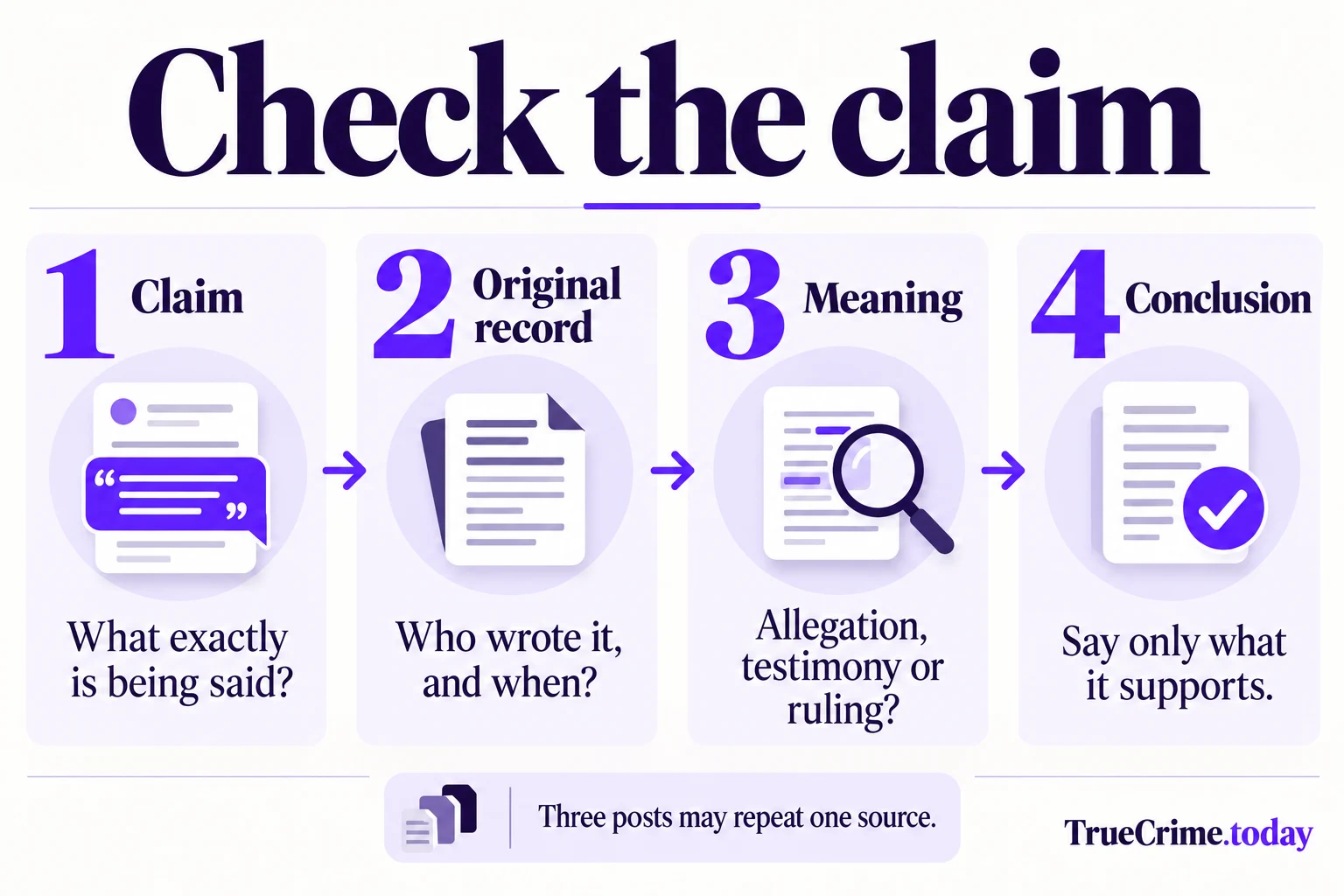
Use the same checks on material that supports your view and material that troubles it. The order below keeps an arrest announcement, testimony and a court decision from merging into one supposedly settled story.
1. Identify what the document is doing
A complaint sets out a party’s allegations. A witness statement records an account. A motion asks the court for an action; an order tells you what the court decided on that request. All can be authentic documents while serving different purposes.
Under each claim in your notes, name the speaker and the document’s job. “The prosecutor alleged…” preserves something that “the court found…” would change. If a filing quotes a witness, you have the filing’s account of that statement. Check whether the original statement or transcript is also available before treating the quotation as complete.
2. Match your conclusion to the actual decision
The Lindsay Clancy case shows how a court decision can be retold as a verdict it never supplied. On October 1, 2026, Judge William Sullivan denied a defense motion for a required finding of not guilty. The ruling concerned whether the prosecution’s evidence was legally sufficient to go to a jury. It did not supply the guilty verdict missing after the first jury deadlocked.
We last checked that order on October 7, 2026. For this exercise, the conclusion is narrow: the judge denied that motion. A headline saying the judge “refused to acquit” needs that context. You also need to know which motion the order addressed before assuming it settled every objection raised by the defense.
3. Count independent accounts, not retellings
Here is a made-up exercise. A police statement reports that a vehicle left at 9:15. A newspaper repeats the statement, a podcast quotes the newspaper and a thread summarises the podcast. You have three retellings and one underlying account of the time.
An interview with a person who saw the vehicle leave would add a different source chain. A separately obtained camera record would add another, although you still need to check its clock and what it shows. Two accounts can agree because both are correct, because one borrowed from the other or because both made the same mistake.
Draw the chain in your notes: post, podcast, newspaper, statement. Then ask each new source where its information came from. The number of people repeating a sentence becomes much less impressive when you can see the shared starting point.
4. Separate events from the dates of their records
Keep at least two kinds of date: when something allegedly happened and when someone recorded or reported it. A witness interviewed on Friday can describe a Tuesday event. A document filed next month can contain that interview. Putting every date into a single sequence without explaining the difference can create a contradiction that never existed.
Use the vehicle exercise again. A camera appears to show 9:12 and a witness remembers 9:15. Before alleging a false statement, ask whether the camera’s clock was checked and whether the witness claimed an exact time. The three-minute gap needs an explanation. Its size alone tells you neither which account is correct nor why they differ.
What would show that your check worked?
Try explaining the claim to someone who has seen none of your tabs. Can you say who made it, identify the exact passage and explain what it supports? Add what remains unresolved and which later record would change your account. If your explanation needs “everyone knows,” return to the missing evidence.
Next, remove the source’s reputation from your notes for a moment. Ask what the passage itself establishes. A respected reporter can accurately quote a disputed allegation. A lawyer can publish an authentic exhibit alongside an argument you do not accept. Treating the document and the interpretation separately lets you assess both fairly.
You have succeeded when another reader can repeat the check and see where your conclusion came from. Agreement with your favourite theory is a different outcome.
What if the record is missing, sealed or paywalled?
Write down the limit precisely: “I could not access the interview,” or “the public filing refers to an exhibit I have not seen.” Avoid turning either into “the interview never happened” or “the police never collected the exhibit.” The public file and the investigators’ file can contain different material.
A screenshot can help locate a document. Look for the court, case number, filing stamp, document title and page number. Then compare it with the full public copy if you can. Text recognition can misread a name or a negative; search results can join fragments that appeared far apart. If you cannot establish the image’s origin, leave its authenticity unresolved.
A paywall also creates a reporting limit. You can describe an accessible excerpt and attribute it, but you cannot claim to have checked the surrounding article. Another writer’s summary does not give you access to the missing part.
How do you test a theory you already believe?
Write the strongest competing explanation that fits the available facts, then name the evidence that would distinguish the two. Keep that explanation realistic. A gap in the timeline does not justify inventing an unknown person, an undisclosed affair or a conspiracy.
Suppose you think an omitted witness proves a poor investigation. Separate the possibilities: the witness was never interviewed, the interview exists outside the public file, or the account was considered and disputed. Your next question is which records distinguish these possibilities. If none are available, you can identify the gap and ask why it exists without pretending to know the answer.
For a historical case, add another check: was the account written at the time or years later? A memoir can preserve details missing from an official record, while also reflecting memory and hindsight. Identify that difference before putting the two accounts into competition.
What belongs in a public discussion?
Share the question, the public evidence and the uncertainty you can explain. Leave out home addresses, children’s identifying details and private medical information that the argument does not need. A document being obtainable does not make every personal detail worth spreading.
Do not contact a juror, witness or family member to test a theory from a thread. A reader’s record check can end with an unanswered question. If you find information that appears relevant to an active investigation, use the authority’s public reporting channel rather than organising an online search for a person.
Accountability depends on keeping the accusation accurate. Strong criticism of a documented failure can name the failure and its evidence. Adding an unsupported allegation makes it harder for other readers to tell which part deserves attention.
Questions that come up during a check
Does an official source settle the truth?
It tells you where a statement or decision came from. You still need to identify what was tested, what remains disputed and whether the record was later corrected or overturned. The source’s official status cannot answer those questions by itself.
Should every theory get equal space?
Give space according to evidence and relevance. A documented challenge to an investigation deserves explanation. An anonymous accusation with no verifiable support does not deserve equal standing just because it is dramatic. You can say why a claim lacks support without repeating identifying details.
Can an AI summary save time?
It can help you organise a public document, but check names, quotations, page references and conclusions against the document yourself. A fluent summary can mix the party’s argument with the court’s finding. Never let an invented citation become the foundation for your next paragraph.
What should you check next?
Choose the claim that would most change your understanding of the case. Locate its record, note the precise passage and write one sentence that the evidence supports. Then add the strongest remaining question. This gives you a useful next check without requiring you to solve the entire story.
Can you explain the case without overstating it?
A good account lets the reader see how you reached it. You can tell a gripping story, challenge an official explanation and care about the people affected while keeping allegations, evidence and findings distinct. When the next record arrives, that distinction makes it easier to change your account honestly.
Checking a public claim about a case and unsure whether the record supports it? Send the public link and the specific question. Do not send witness contact details, medical files or other personal documents through the form.
Ask about a case claim