Voice and lie detection: what pitch, pauses and stress can tell you
Can you hear a lie? Examine voice stress tests, pitch, pauses and response timing, with research showing the difference between sounding honest and being honest.
TL;DR
You cannot establish a lie from a shaky voice, a long pause or a fast answer alone. Acoustic research can find differences between conditions, but the direction and usefulness of those differences depend on the task. A model that predicts whether listeners trust a voice is answering a different question from whether the speaker told the truth.
For a recorded interview, keep the question, the full answer and the factual claim together. Pitch and timing can be measured. The reason for a change still needs checking.
That pause sounds suspicious. What did you actually hear?
You replay the answer. There it is: a small silence before “no,” followed by a voice that sounds tighter than it did a moment ago. Once someone points it out, it can feel impossible to hear the clip any other way.
But several things have already been bundled together. You heard a delay, interpreted tension, and then attached a motive. Only the first of those is directly available in the recording. Even that delay depends on where the clip starts and whether you heard the complete question.
This is a particular problem with lie detection: noticing a change and identifying its cause are separate jobs. If you want to judge an interview fairly, the next question is what else could produce the same sound, including a truthful answer to an awkward question.
The research below looks at listening judgments, acoustic measurements and tests against an independent reference. These are different kinds of evidence. The last time we checked this research was October 19, 2026.
Five measurements hiding inside one impression
When someone says a voice “went up,” do they mean higher pitch, greater loudness or a rising sentence ending? Those descriptions can refer to different measurements.
F0, the frequency of vocal-fold vibration, concerns vocal-fold vibration and is measured in hertz. It relates to perceived pitch. Intensity concerns the strength of the acoustic signal. A louder voice is not automatically a higher-pitched voice. Pitch range describes variation across a stretch of speech; it is different from the average pitch of that stretch.
Speaking rate needs its own definition. Counting syllables per second across an entire answer includes silences. Counting only while someone is speaking gives a different result. Two analysts can disagree about whether a person “slowed down” because they counted different parts of the same recording.
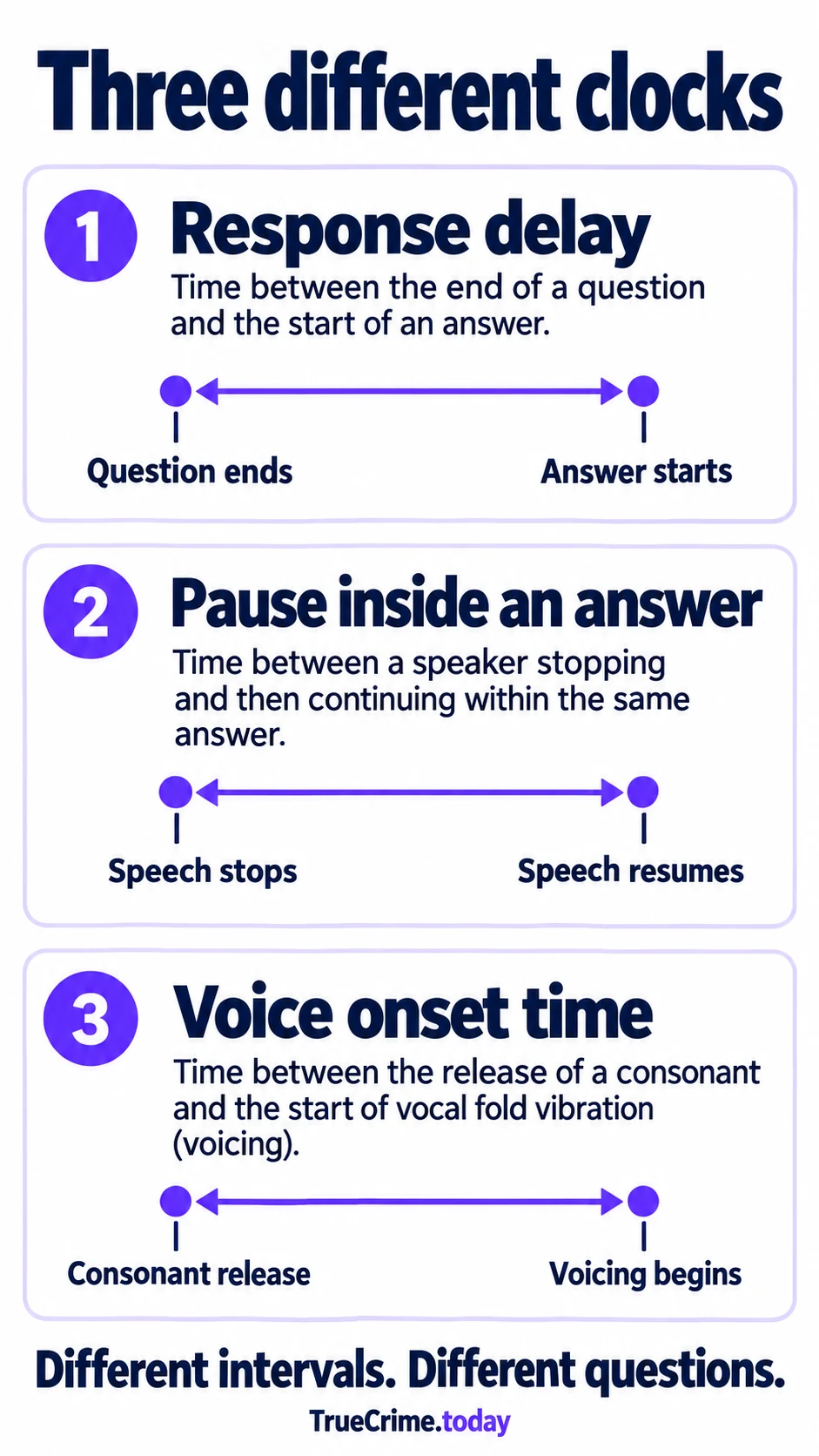
Then there is response timing. The gap after a question, a pause halfway through an answer and voice onset time, a phonetic interval around a consonant’s release and the beginning of voicing, are different clocks. A positive finding about one does not establish a rule about the others.
A voice can sound trustworthy without being truthful
A clear, fluent answer can be easy to believe. That makes it worth asking whether a study measured truth or the impression of truth.
In their 2020 study of deception and trust, Xi Chen and colleagues collected judgments on 5,340 spoken answers, with three ratings per answer and 431 annotators. Human accuracy at identifying the answers’ assigned truthfulness was about 50%. Their computational model achieved an F1 score of 66.1% for predicting listener trust, which was a different target.
F1 combines precision and recall; it is not simply the percentage of answers classified correctly. More importantly, a system can learn which voices people believe without learning which statements are true. That distinction matters when a voice-analysis demonstration plays a confident answer and announces a persuasive-looking score.
The content needs its own examination. If you are assessing a disputed account, forensic linguistics raises questions about wording and meaning, including what exactly was denied. Those questions can help identify a claim to check; they do not turn polished delivery into corroboration.
What happened when voice stress met a field test
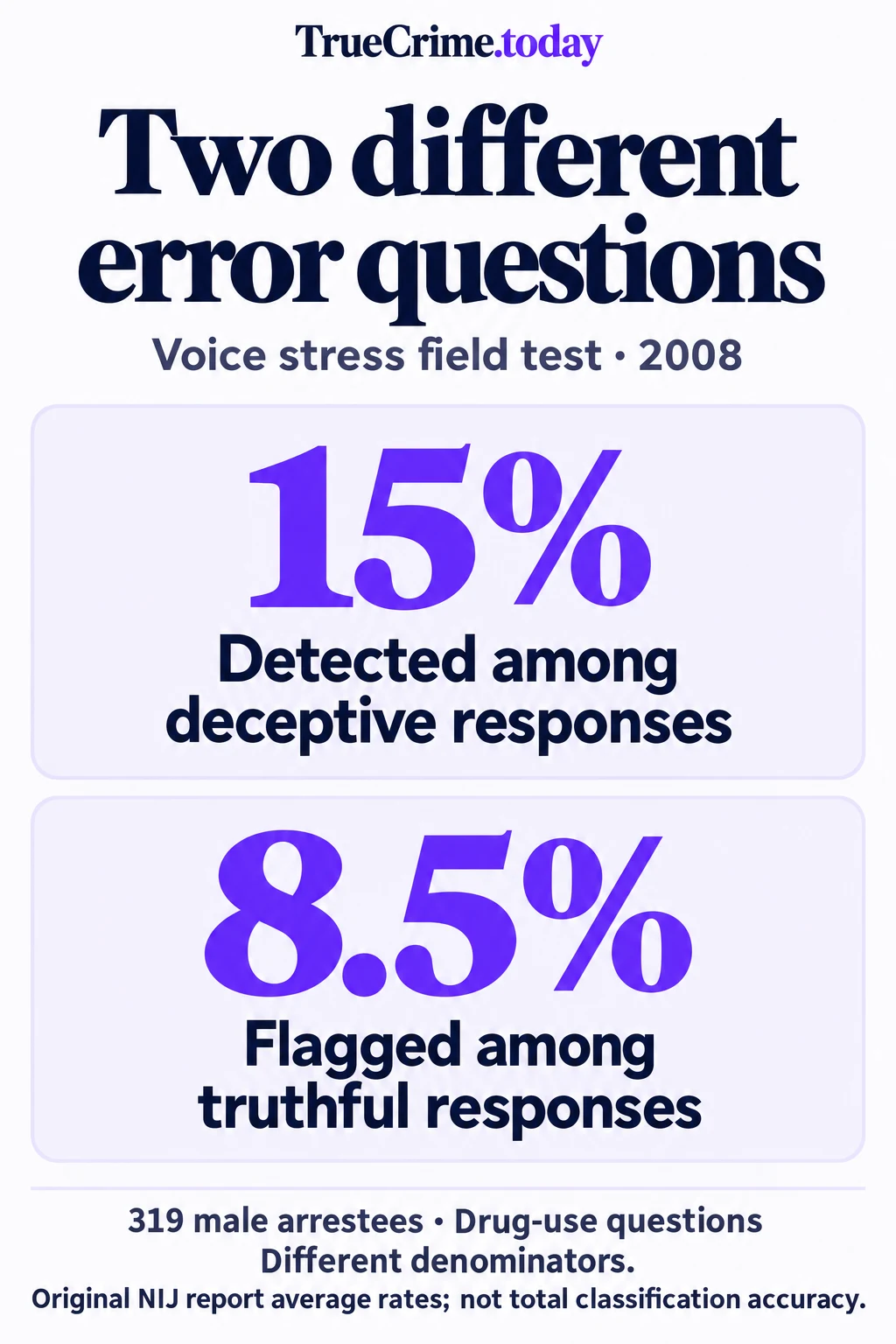
A useful test needs a reference that does not come from the examiner’s impression. A 2008 voice-stress field evaluation involved 319 recently arrested men in an Oklahoma jail and compared drug-use answers with urine-test results. Across the two systems, the reported average detection rate among deceptive responses was about 15%; the false-positive rate among truthful responses was about 8.5%.
Those percentages have different denominators. Detecting few deceptive answers and rarely flagging truthful ones can happen together. Neither figure means “the machine is right 15% of the time.” The reference also had limits: drug detection windows and question timeframes had to be considered.
These were historical systems and a specific kind of question. The result cannot settle the performance of every later voice-analysis product. It does show why a graph of vocal stress needs an independent accuracy test before anyone treats it as a truth reading.
Why a slower answer is not a rule
A delay can fit a plausible story about lying: someone needs time to invent an answer, suppress the truth or keep an account consistent. But plausibility is not enough to establish which way a measured difference will go.
Mapala, Warmelink and Linkenauger’s 2017 experiment recruited 40 students for a virtual-airport task involving questions about luggage. Within the group assigned to lie, the reported average response delay was 0.84 seconds for deceptive answers and 0.95 seconds for truthful control answers. Subtracting those rounded means gives 0.11 seconds, or 110 milliseconds. Here, the deceptive answers came sooner.
That was a comparison within the assigned-lying group. It does not establish that all liars answer faster than truthful people. The between-group comparison did not meet the study’s threshold for a reliable difference. Nor was this a test of actual travellers facing a real airport investigation.
The point is more useful than another timing trick. Preparation, the expected question and the effort involved in a truthful answer can change the comparison. If you hear “too slow means lying” and “too fast means rehearsed,” ask what result would count against the claim. A rule that treats either outcome as confirmation cannot help you decide.
Pitch changes are real. Their meaning is the problem
A microphone can capture a change without explaining why it happened. A person may speak differently when a question is upsetting, when they need to be heard or when they are concentrating on an unfamiliar word. None of those possibilities establishes whether a particular statement is false.
Sporer and Schwandt’s 2006 meta-analysis considered nine paraverbal behaviours. Its abstract reports reliable associations for two behaviours in the sample-size-weighted analysis and four in the unweighted analysis, with small, heterogeneous effects and important differences between study conditions. That is a much narrower finding than a universal vocal tell.
An association across conditions also leaves room for overlap. You could measure two group averages that differ while many truthful and deceptive answers fall in the same range. Without a tested decision rule and its errors, you cannot convert the average into a cutoff for the person in a recording.
A personal baseline helps answer whether something changed. It does not explain the change. Comparing a relaxed introduction with a question about a traumatic event changes the subject matter as well as the presumed truthfulness. A fairer comparison needs to account for what the person was being asked to do.
The small Russian experiment that complicates the picture
A native-language study gives another reason to name the measurement precisely. In 2023, Marina Agafonova and Allegra Kulygina reported acoustic work with seven students playing Mafia and eight taking part in prepared interviews. These were small experimental settings, not a diagnostic test on criminal suspects.
In the interview material, average pitch was reported as 177.1 Hz for truthful speech and 169.9 Hz for insincere speech. But pitch at the beginning of an utterance went the other way: 169 Hz versus 172.3 Hz. The average speaking rate was 4.2 syllables per second in both conditions.
Those figures do not provide three competing ways to catch someone. They show how “pitch rose” can hide a choice between the start of a phrase, its overall average and its range. Small samples and variation between participants further limit what follows. The paper did not establish a blind, externally validated accuracy rate for deciding whether a new person’s answer was a lie.
What newer positive results deserve
It would also be a mistake to say that sound contains no useful information. Researchers continue to find patterns worth testing.
Xiu and colleagues’ 2024 indexed abstract describes a mock-crime experiment with 62 young adults and a positive result involving voice onset time. It reports an area under the ROC curve of 0.888. That is not 88.8% correct classification: ROC area describes discrimination across thresholds. It does not tell you the false-alarm rate at the threshold someone would actually use. The abstract alone cannot establish performance in a new population.
A 2026 paper by Capra, Gomies and Zhang examined Golden Balls game-show speech and the Real-life Trial corpus. Its published abstract reports that voice models beat benchmarks, while vocal markers varied between settings and transfer was limited. That supports further research, while leaving the performance of a new recording unresolved.
There is a further question for courtroom datasets: how was each utterance labelled true or false? A case outcome does not, by itself, verify every sentence spoken during that case. The steps from an acoustic pattern to a dependable factual label needs scrutiny at both ends.
How an edited clip changes the question
Before interpreting a pause, you need to know whether it survives in the original recording. Cutting out a repeated question can make an answer appear immediate. Starting a clip during an answer can make an internal hesitation look like a delay before answering. A cut is not proof of manipulation, but it changes what can be measured.
The distinction showed up in the 2020 trust study’s design. Raters heard answer segments alongside written questions, rather than hearing the complete spoken exchange and its original pre-answer gap. Their experience was different from sitting in the interview room. You should not treat a judgment from one listening format as though it tested the other.
Sound-processing settings matter too. Praat’s own documentation explains that pitch settings and the selected sound region affect voice measurements. A pitch contour is an estimate produced with particular settings, not a direct display of intention.
For a creator or commentator, the fair presentation preserves the recording context and identifies cuts. For a listener, it means holding back from timing claims when the necessary beginning or end is missing. If you cannot tell where the question finished, you cannot measure that question-to-answer delay reliably.
A missing camera and a very confident replay
Imagine a fictional workplace interview about a missing camera. Someone asks, “Did you take it home on Friday?” The reply is a quick “no,” followed by a pause before “I left it in the equipment room.” A commentator replays the pause and says the second sentence was invented.
There are at least two separate checks to make. First, what happened in the exchange? Perhaps the speaker paused after hearing an interruption outside the clip. Perhaps they were deciding which equipment room the question meant. Perhaps they were inventing an account. The sound alone leaves those possibilities open.
Second, what happened to the camera? An inventory entry, a dated checkout record and an account from someone who received it might bear on that claim. Each also needs interpretation: a checkout under a person’s name is not automatically proof of who physically carried the equipment.
Now suppose an uncut recording contains the same pause, while a receipt supports the return. The pause has not disappeared. Its meaning has changed because you know more about the event. That is why a useful investigation can retain an accurate acoustic observation while abandoning the accusation built around it.
What a convincing independent test would need
For a new system, the central question is how it performs on people and recordings it was not developed on. Separating clips from the same speaker between training and test sets can let a model learn a person’s voice rather than a general pattern of deception. A strong design needs to address that possibility.
It also needs independently established labels, a stated threshold and separate error counts for truthful and deceptive speech. The costs are different. Missing a lie can matter; flagging an honest answer can also steer questioning and public suspicion in the wrong direction.
Language, recording conditions, question type and preparation belong in the test design. A result in short English answers does not automatically cover spontaneous Russian accounts or a compressed phone recording. Testing those changes is part of establishing the proposed use, rather than an optional detail after a high headline score.
Finally, a useful report says what the comparison was. Beating the most-common-label baseline, beating untrained listeners and improving an existing investigation are three different achievements. You need the result that matches the claim being made.
What to keep when you listen again
Start with the words and the exchange that produced them. Identify the claim, preserve the question and check whether the recording is complete. Then describe the sound in terms someone else can examine: a pause at a particular point, a measured pitch change or a change in rate over a defined stretch.
Keep the explanation open until something distinguishes the possibilities. A suspicious-sounding answer may contain a checkable contradiction. It may also be a difficult truthful answer. The most useful next step is the one that could tell those apart, including evidence that would clear the person.
Voice research is worth following because speech is rich, measurable behaviour. Its value will depend on reliable labels, honest error reporting and tests beyond the original setting. In the meantime, you can listen closely without pretending that a waveform tells you what someone intended.
You can ask about a vocal measurement, a response-timing study or a claim made for voice analysis. Do not send private recordings, passports, contracts, bank details or other personal documents.
Ask about voice research