Deception detection: can you really spot a lie?
What research says about lie detection, body language, microexpressions and cognitive interviewing, with accuracy figures and worked examples.
Deception detection sounds straightforward until you watch an interview and try to decide what a pause means. The speaker looks down, takes a breath and changes a word. A commentator calls it a lie. You can see the movement, but how much does it tell you about the statement?
TL;DR
No gesture, facial expression or hesitation reliably proves that someone is lying. Research on structured questioning offers more promise than watching for nervous behaviour, but its results depend on the task, the observer and how accuracy is measured. For a true-crime viewer, the most useful question is what can independently confirm or contradict the specific claim.
What does deception detection actually test?
Deception means deliberately trying to mislead another person. A factual mistake can mislead someone without being deliberate. That distinction becomes important when an interviewee gets a time wrong: you still need to establish what happened and whether the person knew the statement was false.
Researchers often assign participants to tell a truth or a lie. That supplies ground truth, the answer against which a judgment can be checked. In a public interview, you usually lack that answer. A comment saying “I knew it from the beginning” may describe a correct guess, a later reinterpretation or a selective memory of earlier guesses.
A 2006 meta-analysis of deception judgments brought together 206 documents and 24,483 judges and found 54% average accuracy without special aids or training. Participants correctly identified 47% of lies and 61% of truths. Those are results for different groups of statements; the 54% figure is not your personal chance of being right about a suspect.
The result was above chance, so dismissing it as exactly random would be inaccurate. But on a balanced truth-versus-lie task, a four-percentage-point advantage over 50% leaves plenty of mistakes. A modest average advantage gives you very little reason to accuse one person on the strength of a clip.
In true crime, that uncertainty is easily lost when a documentary shows an interview immediately before revealing the outcome. Once you know the ending, an awkward smile can seem more revealing than it did to someone watching without that knowledge.
Does body language reveal a liar?
Looking away, folding your arms and touching your face have many possible explanations. Even when a behaviour occurs more often in one research group than another, the groups can overlap a great deal. Knowing the group average does not tell you why this particular speaker moved.
Vrij, Hartwig and Granhag’s 2019 review described the nonverbal deception cues identified in the literature as weak and unreliable. That finding concerns the leap from behaviour to truthfulness. Body language can still help describe an interaction: someone turns away, interrupts or takes a long time to answer. The explanation needs additional evidence.
Think about a fictional witness who looks down when asked to describe a difficult conversation. The movement might accompany remembering, discomfort or avoiding the interviewer’s gaze. A camera angle cannot choose between those explanations. If the witness says the conversation happened on Tuesday, a dated message may help resolve that claim.
That is why case analysis separates what a recording shows from what someone infers about it. “Looks down before answering” is an observation you can check. “Invents an answer” adds an explanation that the movement alone cannot establish.
Do eye movements give a lie away?
The familiar claim is that looking up to one side means inventing an answer, while looking to the other means remembering. It comes from neuro-linguistic programming, usually shortened to NLP. It sounds testable, and researchers have tested it. Be careful with left and right in demonstrations: the claim refers to the speaker’s sides, which a camera can reverse for you.
Wiseman and colleagues’ 2012 paper ran three studies: 32 right-handed interviewees, 50 viewers given or not given the NLP rule, and 52 public-appeal videos. They found no support for the predicted eye-direction pattern. Teaching the rule did not improve viewers’ accuracy. The appeal videos added a different setting, but testing this direction rule does not settle every possible eye measure.
Blinking asks another question. Leal and Vrij’s 2008 experiment involved 13 people assigned to lie and 13 assigned to tell the truth. Relative to their truthful baselines, liars blinked less during the target answer and more just after it. Truth-tellers’ pattern differed. That is already a problem for the advice that a liar simply “blinks more”: when you count matters.
With only 26 participants in that controlled task, the result needs more than a memorable demonstration before you apply it to someone else. A clip that starts halfway through an answer may omit the comparison period entirely. Counting its blinks cannot recreate the experiment.
Walczyk and colleagues’ 2012 study took a third approach. Its 145 participants watched crime videos and gave truthful, rehearsed deceptive or unrehearsed deceptive answers. An infrared eye tracker accompanied measures of response time and answer consistency. The researchers reported classification of those three groups at up to 69% using combined measures. That was not an eye-only score, or a verdict about a real suspect.
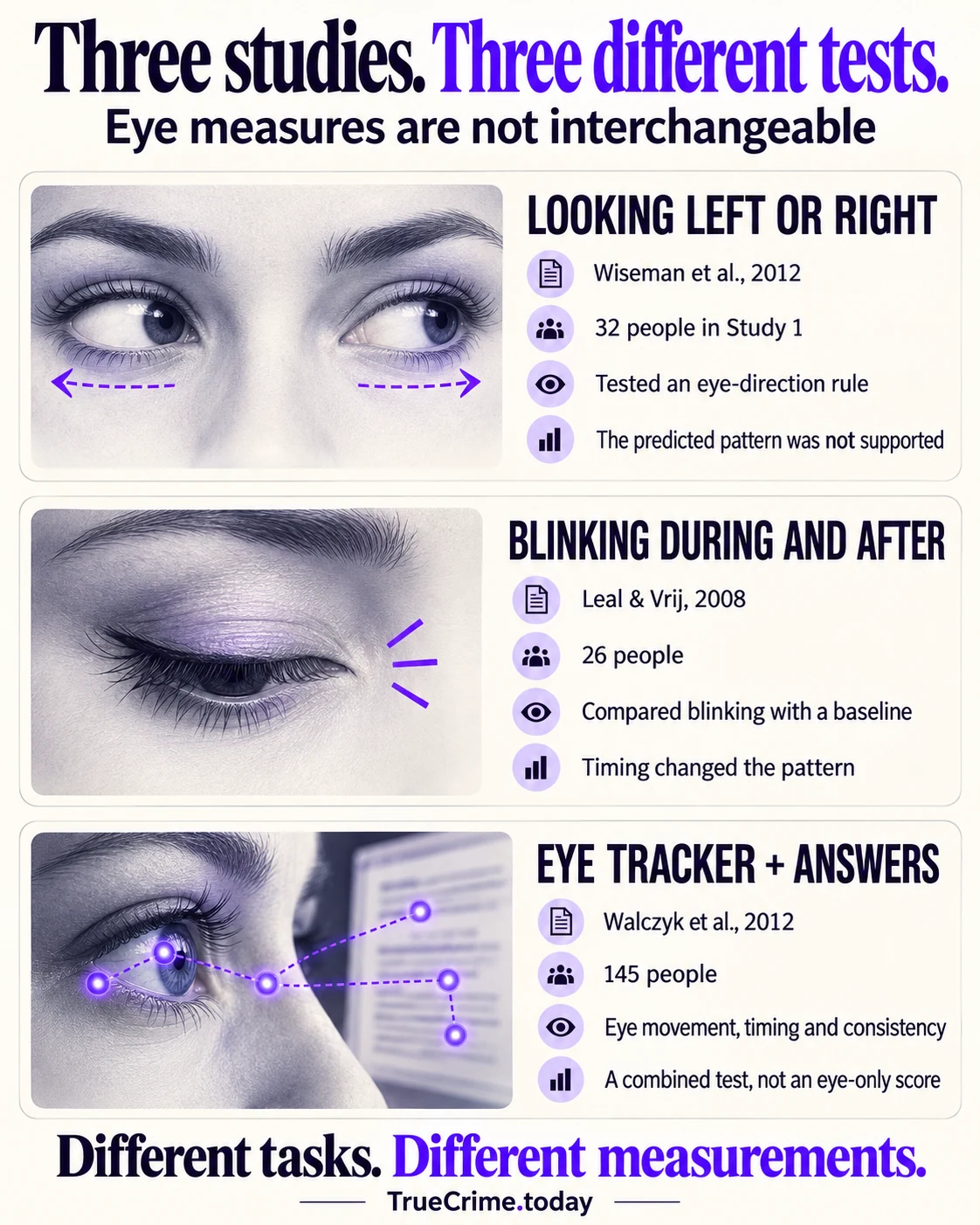
These findings are compatible. An unsupported left-versus-right rule can coexist with differences in blinking under a particular task. A combined laboratory model can also produce a useful research result without making an ordinary video clip a lie detector. Before accepting a percentage, ask which measure produced it and whether the test worked on people outside the sample used to develop it.
Can better questions improve the results?
Structured interviews let researchers ask for more information and test claims under defined conditions. They can encourage a fuller account, ask questions the speaker did not anticipate or introduce an additional mental task. These approaches differ from silently replaying a recording and searching for a suspicious gesture.
A 2021 meta-analysis of cognitive interviewing reported 60% overall observer accuracy, falling to about 55% after its publication-bias correction. The corrected 95% confidence interval ran from 48.83% to 61.16%. Observers told which cues to examine performed better than uninformed observers, but study differences and publication bias limited the conclusions.
Those results give us a reason to study interviewing carefully. They also make “cognitive interviewing is 60% accurate” an incomplete promise. Which questions were asked, what the observers knew and how the studies were selected all affect the number.
For you as a viewer, the practical question is whether an interviewer actually obtained information that could be tested. Asking someone to describe a journey may produce names of roads, stops or other people. Each detail gives an investigator a possible check. A longer answer by itself still does not establish honesty.
What do microexpressions tell us?
Microexpressions are brief facial expressions. Researchers have used different duration thresholds, which means two studies can use the same word while counting different events. A system that identifies facial muscle movements also answers a different question from a system that correctly identifies deception.
The Facial Action Coding System, or FACS, describes facial actions through defined units. Coding an action is a description of movement. An interpretation of emotion adds another step, and an interpretation of truthfulness adds another. Those steps each need evidence.
Porter and ten Brinke’s 2008 experiment examined 697 facial expressions across 104,550 video frames while participants displayed or concealed emotions. Microexpressions appeared in 2% of expressions and in 21.95% of participants. Those denominators matter: neither figure is a percentage of lies detected. Much of the emotional leakage lasted longer than their narrow definition allowed.
Does changing the duration change the result?
In Matsumoto and Hwang’s 2018 study of 77 people, negative expressions at 40–200 milliseconds did not distinguish the truth and lie groups; broader cutoffs did. At up to 400 milliseconds, mean counts were zero for truth and 0.35 for lie. These were expression counts, not detection percentages. The task concerned concealing future mock-crime intent.
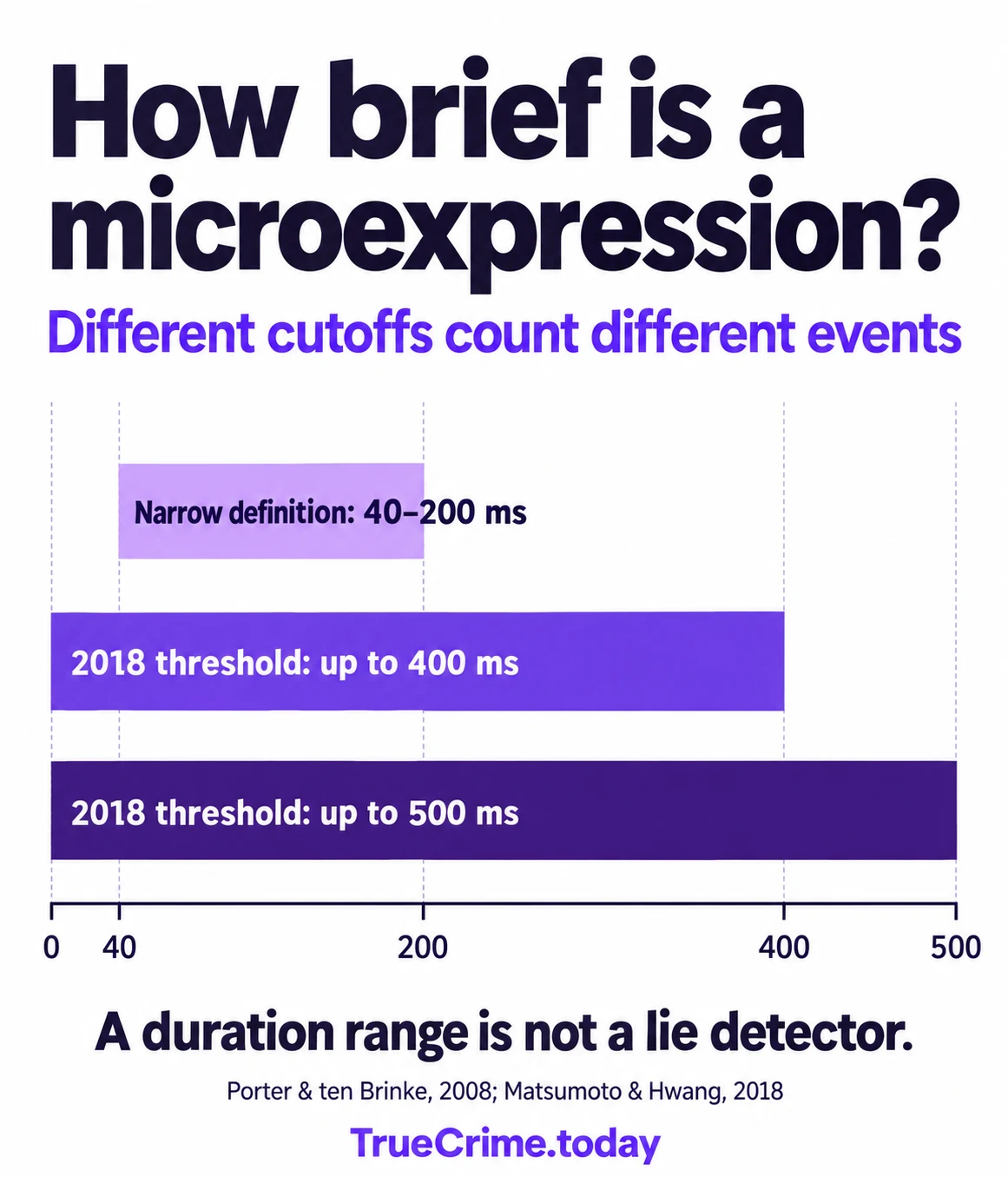
A 350-millisecond expression falls outside the narrow definition but inside both broader cutoffs. The picture makes that counting decision visible. Expanding a window changes the events admitted to the analysis; it does not simply make a camera better at finding the same events.
Why do these findings fall short of a courtroom test?
The results offer something more interesting than a simple yes or no. Very brief expressions were rare in the emotional-display experiment, while a broader definition produced group differences in the mock-crime study. The tasks, emotions and cutoffs differed. Treating them as identical tests would hide the reason their results differ.
That also leaves a separate question about training. Learning to name a fleeting expression tests emotion recognition. To show that the training improves deception detection, you would need a study that checks truthfulness independently and counts mistaken judgments as well as correct ones. Successfully spotting an expression is not that study.
The difference between groups in that screening experiment does not supply a rule for diagnosing a defendant in courtroom footage. Participants knew their assigned task; researchers coded defined interviews. A viral close-up comes with different questions, camera choices and missing context.
Imagine a person briefly showing fear before answering. Even if the expression genuinely reflects fear, it leaves the cause open. Fear of being disbelieved and fear of being caught can produce the same question for an observer: what else would distinguish the explanations? Slowing the video changes what you can notice, without automatically resolving that question.
Why can an accurate-looking test produce false accusations?
An overall accuracy figure can hide the errors you most need to understand. Sensitivity is the share of lies a test flags correctly. Specificity is the share of truths it clears correctly. You also need to know how common lies are in the group being tested.
Here is an imaginary test, with deliberately chosen assumptions rather than measured performance. Out of 100 statements, suppose 10 are lies and 90 are truths. Assume the test flags 80% of lies and clears 90% of truths.
It catches eight lies and misses two. Among the 90 truthful statements, it clears 81 and wrongly flags nine. That produces 17 warnings, of which nine are wrong. The test gets 89 of the 100 statements right overall, yet fewer than half its warnings identify a lie.
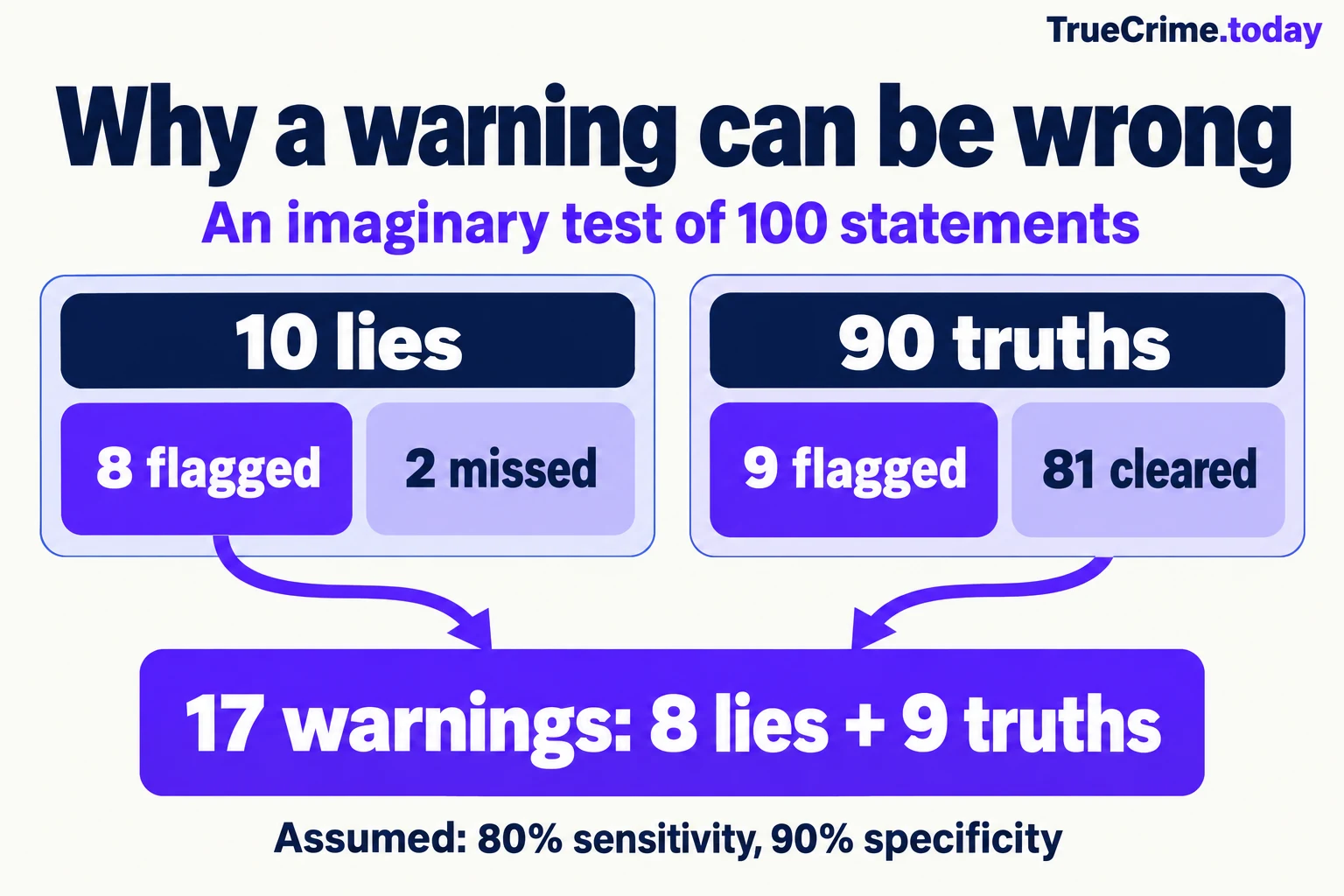
You can reproduce the calculation: 10 × 0.8 = 8 correctly flagged lies; 90 × 0.1 = 9 falsely flagged truths; 8 ÷ 17 ≈ 47% correct warnings. The proportion of lies was an assumption in this example. We do not know that proportion in an arbitrary set of online interviews, and these figures are not a performance claim for a real tool.
The example explains why “89% accurate” leaves an important question unanswered. If a warning prompts an accusation, you need to know how often that warning is wrong. Counting all the easy correct decisions can make a test look reassuring while concealing the consequence that matters.
Does cognitive overload make lying easier to spot?
Inventing and maintaining an account can take mental effort. But recalling an event, interpreting a question and speaking in a less familiar language can also be demanding. Adding another task may burden both truthful and deceptive speakers.
Verschuere and colleagues’ 2018 meta-analysis examined 21 reaction-time studies with 792 participants, including 11 unpublished studies. Added cognitive load did not widen the timing difference between truth and lie responses. It reduced that difference, partly by slowing truthful responses. These were reaction-time tasks, so the finding should not be stretched into a verdict on every interviewing technique.
The question remains active. In an April 2026 study, Brennan and Hutchison examined paired participants answering autobiographical questions under different cognitive-load conditions. Attentional control was associated with response times when lying, but not with deception detection; cognitive load was not associated with the measured outcomes. This experiment gives another reason to test the proposed mechanism rather than assume it works in every setting.
Suppose an interviewee hesitates while reconstructing last month’s journey. The pause could reflect retrieving a real memory, deciding how much detail the question requires or forming a false answer. Without a valid comparison, timing alone cannot tell you which process occurred.
Can a baseline settle the question?
A baseline is a comparison with the same person in another condition. The appeal is obvious: if people behave differently, comparing someone with themselves sounds fairer than comparing them with an imagined “normal” witness.
The difficulty is making the conditions comparable. An easy conversation about lunch and an accusation about a death differ in topic, stakes and emotional demand. A change between them leaves several explanations open. Baseline research distinguishes these casual small-talk comparisons from comparisons involving similar questions and known truthful accounts.
For a fictional interview about a journey, consider comparing two descriptions of familiar journeys under similar questioning. That would remove some differences that a lunch conversation introduces. You would still need to establish which comparison account is truthful, and whether any change reliably distinguishes lies from truths. “Different from earlier” is only the beginning of that investigation.
Can a polygraph or AI read the truth?
A polygraph records physiological responses, including breathing and cardiovascular activity. Its interpretation depends on the questions and testing procedure. The National Research Council’s 2003 review examined important limitations, particularly for screening. The instrument does not directly observe whether an event happened.
AI systems introduce their own measurement questions. Facial landmarks, voice features or word patterns can be inputs to a classifier. The important test is how well that classifier works on new people in the intended setting, with truth established independently. Performance on clips from people also represented in training can give a misleading impression of how it will handle a new speaker.
In the 2021 Russian study by Barabanschikov and Zhegallo, 11 components explained 99.7% of variation in facial coordinates. That percentage described the representation of movement, not successful lie detection. The study examined relationships with observers’ credibility judgments. A precise number attached to a technical system needs its original measurement before you can interpret it.
What should you do with a suspicious interview?
Choose one factual statement before judging the whole person. “I arrived before the meeting” can potentially be checked against records or other accounts. “He has a deceptive face” has no similarly clear test. A statement can also be partly true, so an overall label may conceal the disputed detail.
Keep your description separate from your explanation. Write down the exact words and question, then ask what would support or contradict the claim. If the recording omits part of the exchange, keep that gap visible. A contradiction deserves attention, but establishing deliberate deception requires more than noticing that two accounts differ.
This approach also lets you keep an interesting question without turning it into a public accusation. You can say that an account conflicts with a timestamp and explain the conflict. You can say that a facial interpretation remains uncertain. Those statements give other people something concrete to examine.
We last checked the research discussed here on October 8, 2026. If a new study claims a breakthrough, ask how truth was established, who was tested, what errors occurred and whether the result held up on new people. Those questions will tell you more than a slow-motion replay of someone’s eyes.
Have a question about a lie-detection claim? Send the public research or recording and the specific statement. Please leave out private messages, medical records and other personal documents.
Ask about a lie-detection claim