5 best true crime books: choose a story worth your time
Choose from five best true crime books for history, victim stories, wrongful convictions and cold cases, with honest limits and edition checks.

If you’re searching for the best true crime books, you probably want a story that gives you more than the documentary you just finished. Maybe you want to know how investigators followed the money, what happened to a wrongly convicted person, or who the victims were before anyone called them victims. Those questions lead to different books.
These five recommendations cover English-language nonfiction about the United States, Victorian London and Northern Ireland. They’re a starting shelf, ordered by the reading choices explained below. You can move a book straight to the top if its subject is the one you care about.
TL;DR
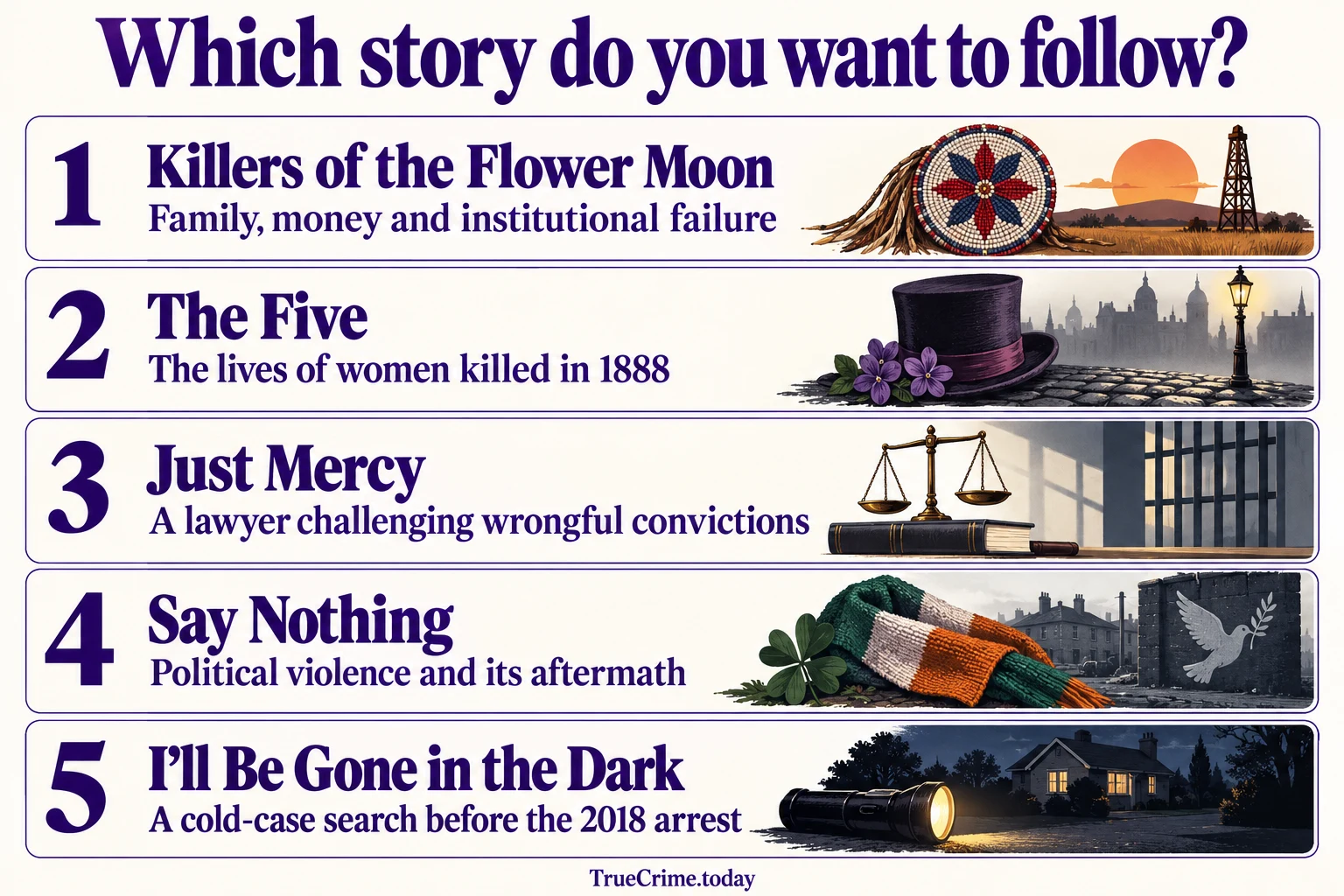
Killers of the Flower Moon is our first pick for a broad introduction: an investigation rooted in a family, a financial motive and institutions that failed the people they should have protected. Choose The Five for women’s lives before their murders, Just Mercy for wrongful convictions, Say Nothing for political violence, or I’ll Be Gone in the Dark for a cold-case search. All five deal with distressing events; their focus and narrative style differ.
Which of these five books suits your next read?
You don’t need to buy the whole list. Pick the question you most want answered, then sample that book’s opening chapter.
-
Killers of the Flower Moon, David Grann. Grann’s account of the Osage murders follows killings in 1920s Oklahoma and the investigation into them. Choose it for a family story that opens into a much wider system of exploitation.
-
The Five, Hallie Rubenhold. Rubenhold’s biographies of five women killed in 1888 put their lives at the centre of the book. Choose it if you want Victorian social history and people you can remember by name.
-
Just Mercy, Bryan Stevenson. Stevenson’s account of defending people facing severe punishment includes Walter McMillian’s case. Choose it for the work of challenging a conviction and the consequences of getting one wrong.
-
Say Nothing, Patrick Radden Keefe. Keefe’s investigation of Jean McConville’s disappearance opens into the Troubles and their aftermath in Northern Ireland. Choose it if political loyalties, family memory and silence interest you.
-
I’ll Be Gone in the Dark, Michelle McNamara. McNamara’s search for the Golden State Killer draws on interviews, case material and online research. Choose it for the experience of pursuing an unresolved case; the original book appeared before the 2018 arrest.
What earns a place on this list?
A recommendation should tell you what you’re signing up for. The starting point is true crime as nonfiction about real events: a gripping scene can still raise questions about where its details came from. For this selection, we favoured clearly identifiable nonfiction, a useful reader question and enough published information to explain the book’s focus and limits.
We checked publisher records, available excerpts, author material and relevant archival or official accounts. That supports a researched shortlist. It doesn’t amount to a full close reading of every book, a survey of every title on the market, or a finding that every reconstructed conversation is exact. No reader-star averages or numerical quality scores decide the order.
That distinction matters especially when an investigation becomes a neat success story. The FBI’s account of forensic genetic genealogy describes identifying the Golden State Killer through relatives in 2018. McNamara helped keep attention on the case, but the identification involved police work and DNA evidence. Her book’s narrative and the eventual identification need separate explanations.
You can ask the same question of any convincing passage: how does the author know this? Our approach to analysing case evidence separates what records establish from interpretation. That habit helps when a book moves between documents, interviews and a person’s remembered experience.
Five true crime books, ranked for a first reading shelf
The order below puts a broad investigative history first, then offers four different directions. Each entry explains both the attraction and the reason it might be the wrong book for your next read.
1. Killers of the Flower Moon, by David Grann
Best for: following a family story into money, violence and institutional failure.
Grann’s account begins with the Osage community in Oklahoma, where oil wealth created fortunes and people were killed for access to them. Mollie Burkhart’s family gives the historical investigation a human centre. The financial interest in someone’s death becomes a question you can follow through relationships and records.
It ranks first here because that combination gives a newcomer several ways into the genre: personal loss, a traceable motive and the broader conditions that allowed the crimes. The reader’s question grows from who hurt this family to how so many people could benefit from harm around them. Our recommendation follows that breadth of subject, rather than the film’s popularity.
The attraction: historical reporting connects an intimate story to the machinery of exploitation. The trade-off: you need patience with names, family connections and the organisation of oil wealth. If you mainly want a contemporary police procedural, this may take you further into history than you intended.
The original US hardcover, published in 2017, has 352 pages. That count describes a particular edition. A film tie-in, ebook display or adapted version can look different, so check that you’re choosing the adult book you wanted.
2. The Five, by Hallie Rubenhold
Best for: learning about women’s lives when the killer has already taken up too much of the conversation.
Rubenhold follows Polly, Annie, Elizabeth, Catherine and Mary Jane through the conditions of Victorian life. Employment, housing and family ties belong in the story because they shaped the choices open to these women. Their murders in London in 1888 become part of lives with a past, rather than the first thing you learn about them.
That approach earns the second position on this shelf. It gives you a useful change of focus after killer-centred documentaries and suspect lists. The book also makes a practical reading choice clearer: wanting to understand victims and wanting a theory about the killer are different interests.
The attraction: biography and social history give the women attention often withheld from them. The trade-off: this isn’t a solution to Jack the Ripper’s identity. Rubenhold’s account of source gaps also deserves attention; historical reconstruction depends on what survived and what the records can support.
For the UK Black Swan paperback, 432 pages and ISBN 9781784162344 identify the edition checked here. The length includes a much wider setting than a brief retelling of five murders. Take a sample chapter if you want to find out whether that historical approach suits you.
3. Just Mercy, by Bryan Stevenson
Best for: understanding the human cost of a conviction and the effort involved in challenging it.
Stevenson writes as a lawyer who represented people facing severe punishment. Walter McMillian’s case is a central example of the gap between a criminal accusation and reliable grounds for a conviction. A legal memoir lets you follow the work through the practitioner’s perspective, including the people and obstacles that a short account of an outcome can leave out.
It comes third because it changes the question from finding the offender to checking whether the system punished the right person. If that is already your main interest, it can easily be your first choice. Strong accountability depends on getting the evidence and the defendant’s identity right.
The attraction: the lawyer’s position gives you a close account of representation and the effects on clients. The trade-off: you’re reading an advocate’s memoir, with his experience and argument shaping the account. It won’t give every participant equal space or read like a neutral court transcript.
Choose the adult memoir if that is what you intend to read. There is also an adaptation for young adults; similar covers and titles can hide that difference. The original book appeared in 2014, so treat contemporary legal questions as separate from its historical account.
4. Say Nothing, by Patrick Radden Keefe
Best for: following political violence through family life, memory and a peace that leaves questions behind.
Jean McConville, a mother of ten, was abducted in Belfast in 1972. Keefe uses her disappearance to examine the Troubles in Northern Ireland and the people whose lives crossed that conflict. The questions widen as you read: who could speak, what could be remembered publicly, and what happened to families living with an absence.
The fourth position reflects the extra historical context this reading asks of you. It belongs higher if you already want political history. A motive here can involve allegiance, fear and ideas about betrayal, with consequences that continue long after the original act.
The attraction: one family’s loss opens a history of competing loyalties and memory. The trade-off: names, organisations and changes over decades require attention. The author’s conclusions about responsibility should remain attributed to his reporting; a book’s conclusion doesn’t itself establish a criminal conviction.
The checked US 2019 hardcover has 464 pages, while the 2020 paperback has 560. Page layout and edition choices affect that difference. You can’t use the larger number to conclude that one version contains a better investigation.
5. I’ll Be Gone in the Dark, by Michelle McNamara
Best for: seeing how a cold-case search moves between survivors, investigators, documents and online discussion.
McNamara spent years pursuing the offender known as the Golden State Killer. Her account is also about the pull of an unresolved case: a detail that might matter, an interview that changes a question, and the difficulty of stepping away. She died before finishing the manuscript; colleagues helped complete the published book.
That unfinished context is why it comes fifth on a first shelf. It’s a useful choice for this particular interest, but you should know what kind of ending you’re buying. The original publication belongs to the period before the 2018 arrest, rather than a retrospective account of every later proceeding.
The attraction: the search brings together different kinds of information and shows the personal cost of sustained attention. The trade-off: the account involves sexual violence and may be especially difficult for some readers. If you want a complete account through the final legal outcome, you will need a later account as well.
Online participation is part of this history, and it deserves a careful reading. A community can help organise public material and keep a question alive. A theory still needs evidence, and an arrest requires more than a compelling thread.
Choose the kind of question you want to follow
If your interest is history and power, put Grann and Keefe next to each other. Grann follows financial exploitation; Keefe follows political violence and its long aftermath. Similar suspense can carry very different explanations of motive.
If you’re tired of knowing more about offenders than the people harmed, choose The Five. If you’re most interested in whether a conviction can be undone, choose Just Mercy. If you want to understand a persistent search before its decisive breakthrough, choose I’ll Be Gone in the Dark.
For a first nonfiction book in the genre, our default is Grann. For a reading group, Rubenhold offers a focused question about whose lives receive attention. For someone already comfortable with complex historical accounts, Keefe offers a longer thread through political change. These are reading matches, rather than levels you have to pass.
What the page count can tell you before you buy
A page count can help you plan space in your week, provided you’re comparing actual editions. The 352-page Grann hardcover and 432-page Rubenhold paperback are specific records, with different layouts and subjects. They don’t measure difficulty or the number of hours you’ll need.
Price needs the same care. Paperback, ebook, audiobook and library loan are different routes to the same work, and prices vary by country and shop. We haven’t ranked these books by a worldwide price comparison. If your library holds an edition, borrowing it can make sense before buying your own copy; digital borrowing depends on its catalogue and licences.
For audio, check whether reference material is supplied and how easy it is to find a name again. For print or ebook, check whether notes and photographs remain accessible in that format. The cheapest offer may be perfectly suitable, but an abridged or adapted version may give you a different reading experience.
Where In Cold Blood belongs
Truman Capote’s In Cold Blood, published in 1966, deserves attention if you’re interested in literary crime writing. It follows the murders of the Clutter family in Kansas and helped popularise the nonfiction novel. We kept it outside this five-book starting shelf because the other choices offer the particular reading directions above.
The University of Delaware’s archival exhibition documents the work of Sandy Campbell, who checked the New Yorker serialisation against correspondence and other material. That is evidence of reporting and editorial work. It also gives you a worthwhile question to carry into Capote: when a scene feels unusually complete, what supports its detail?
A classic can reward reading for its influence, style and reporting history while still asking you to examine its claims. You don’t have to settle every argument about the genre before reading it. You can simply keep the literary experience and the evidence question in view together.
Try a chapter before committing to the whole book
Before paying, check the author, full title, format and edition. Then read a sample that includes ordinary narrative, rather than relying entirely on the opening’s strongest moment. Ask whether you want to spend a whole book with that voice and subject.
Look at the contents and notes too. Do they help you find the sources for a claim? Are different periods clearly separated? Can you tell when someone is recalling events, when a document supplies a detail, and when the author makes an inference?
You can try a small exercise: mark one vivid statement, find its note if there is one, and ask what the cited material actually establishes. If the connection is unclear, keep the question open. You can enjoy a book while checking how its account was assembled.
Questions you might have before choosing
Are these the best books published in 2026?
This is an evergreen selection of older nonfiction, checked on October 11, 2026. It isn’t a ranking of new 2026 releases. Publication year, later edition date and the date of a recommendation mean different things, which matters when a case develops after the original book appears.
Can a book prove who committed a crime?
A book can present documents, report findings and argue for a conclusion. Its reasoning may be strong, but publication doesn’t replace a court’s finding. Keep track of whether a passage describes a conviction, an allegation, an author’s inference or an unresolved question. That distinction matters even when the story feels certain.
Choose one book and keep one question in mind
If you’re still undecided, choose Killers of the Flower Moon and follow the money as you read. If you already know you want the women’s stories, choose The Five. Let the question you care about make the decision, and give yourself permission to stop if the subject or style feels wrong for you.
The first chapter can tell you whether you want to keep reading. A little attention to the notes can tell you what else to ask.
Have a question about a book, its edition or a claim it makes? Send the title and a public link. Please keep passports, contracts, bank details and other personal documents out of the form.
Ask about a true crime book