Criminal psychology and personality: what the labels mean
What criminal psychology studies, how psychopathy differs from other personality concepts, and what an assessment can tell us about a crime.

A documentary calls someone a narcissist. The comments call them a psychopath. Before long, those words seem to explain the whole crime. But what has anyone actually established about that person? Criminal psychology gives us ways to ask better questions about behaviour, motives and personality, without pretending that a label solves a case.
TL;DR
Criminal psychology studies the psychological processes involved in offending. Personality is one part of that picture, alongside circumstances, development, relationships and decisions. Psychopathy, antisocial personality disorder and narcissistic personality disorder describe different concepts. A disturbing act, an interview clip or an online checklist cannot establish a diagnosis. An assessment also cannot tell us, by itself, who committed a particular crime.
What does criminal psychology study?
It asks how people come to offend, what happens around the offence, and what helps explain repeated behaviour or a change in it. That can mean examining threats before an assault, decisions within a group, impulsivity, or the way someone justifies harming another person. The question is about a process, not a single personality type called “the criminal mind”.
Think of two hypothetical thefts. One person takes an unattended phone during an argument. Another plans repeated thefts and recruits someone to sell the phones. The offence category gives us a starting point, but it does not tell us whether the same psychological explanation fits both. We would need to know what happened before, what each person expected to gain, and whether this was an isolated event or a pattern.
This is also where the discipline differs from the genre. True crime tells stories about real offences and their investigation; criminal psychology asks questions that can be studied across people and situations. An absorbing story can suggest a question, but the story alone cannot establish how common its explanation is.
Is forensic psychology the same thing?
The fields overlap, but forensic psychology concerns the use of psychology in legal settings, including civil disputes as well as criminal proceedings. A forensic psychologist’s work can involve assessing a person or addressing a defined question for a court. It does not necessarily involve tracking an unknown offender or producing a profile.
That distinction matters when a programme introduces someone as a forensic expert. Ask what they are doing in this instance. Have they assessed the person? Reviewed records? Conducted research on a relevant population? Or are they commenting on edited footage? Those activities give them different kinds of evidence, even if the screen uses the same job title for all of them.
Our case-analysis method makes a similar distinction between a recorded fact, an attributed account and an interpretation. A psychologist’s explanation belongs to the last category unless the article identifies the assessment or evidence behind it. The explanation deserves to be heard, but its source still matters.
What separates a personality trait from a disorder?
A trait describes a tendency: being impulsive, needing admiration, or finding another person’s perspective difficult to consider. A disorder involves a broader, enduring pattern of difficulties that requires clinical assessment. The presence of a trait in one situation does not establish that pattern.
NICE’s antisocial personality disorder assessment guidance, written for services in England, includes behaviour, functioning, coexisting conditions, circumstances and information beyond the person’s own account. That wider picture can change the explanation of an episode. A clip gives you only the part that was recorded and selected.
Narcissism makes this distinction easy to miss. Someone can boast, seek attention or react badly to criticism without that episode proving narcissistic personality disorder. The American Psychiatric Association describes NPD through persistent difficulties involving grandiosity, admiration and empathy, with presentations that can include vulnerability as well as outward confidence. It is not a medical synonym for being unpleasant.
A clinician also has to consider context. What looks like a stable characteristic in a short clip could have another explanation, and a public appearance tells us little about functioning elsewhere. The WHO’s 2024 ICD-11 clinical manual is written to guide qualified assessment. Its purpose is not to let viewers classify a defendant from a television scene.
Do personality traits change as people get older?
Yes, and that makes a difference to the way we tell someone’s story. In a 2024 review of longitudinal narcissism research, Ulrich Orth and colleagues brought together 51 samples involving 37,247 people, aged 8 to 77. Narcissistic traits declined on average with age, although people who scored above their peers tended to remain comparatively high. Most samples came from North America and Western Europe; this was not a study of convicted offenders or diagnosed NPD.
Imagine two runners who both slow down. One can still be faster than the other. In much the same way, someone’s score can fall while their position relative to other people stays similar. “Traits change” and “differences persist” can both be true. Neither sentence tells us whether a particular person will stop threatening a partner or start respecting boundaries.
The trend is about age, not a year-by-year increase or decrease in crime. A feed full of videos about narcissism cannot tell us whether a disorder is becoming more common. More discussion, changing diagnostic practice and a change in the underlying condition are different things to measure. To claim an increase, we would need comparable measurements over time, rather than a count of posts using the word.
Can a risk assessment predict the next crime?
This is where a psychological explanation can turn into a much bigger promise. It is one thing to describe behaviour that has happened; predicting what someone will do next requires evidence about the prediction itself. What event counts, over what period, and how many warnings turn out to be wrong?
A 2012 BMJ review of risk-assessment tools examined 73 samples overall. Its 30 violence-prediction samples produced a median positive predictive value of 41%: among people assessed as moderate or high risk, that was the median proportion who later offended violently. For the low-risk group, the median proportion without later violent offending was 91%. The middle half of sample results ranged from 27–60% and 81–95%, respectively.
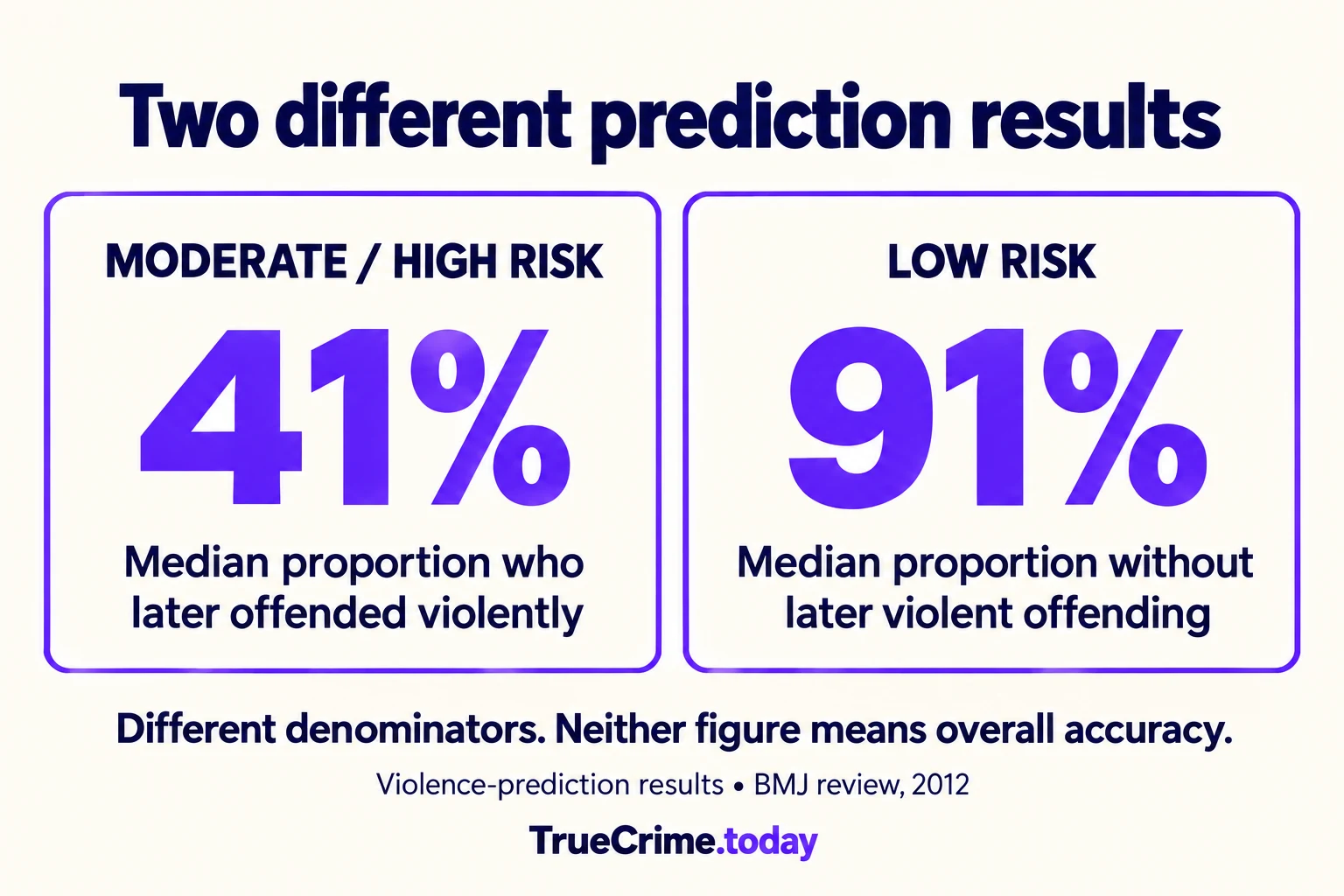
These are medians across samples, not two results from a single group of people. The review is also historical, with varied settings, instruments and follow-up periods; it is not a performance score for every tool in use today. The authors did not support using such assessments alone to decide detention, sentencing or release.
Think about what each number is asking. The first starts with people given a warning: how many later had the event? The second starts with people assessed as low risk: how many did not? Calling either figure “accuracy” hides who was counted. That matters when a headline turns a professional estimate into “they knew this person would offend”.
An assessment can inform support, supervision and further questions without guaranteeing an individual outcome. It should tell us what evidence would change the estimate, too. New threats, changed circumstances or better information deserve attention; a dramatic percentage cannot do that work on its own.
Are psychopathy, sociopathy and antisocial personality disorder interchangeable?
No. The distinction between an assessment and a prediction also makes it worth checking which personality concept is being discussed. Psychopathy research examines a combination of interpersonal, emotional and behavioural features. Antisocial personality disorder is a clinical diagnosis with criteria concerning a persistent pattern of disregard for other people’s rights. They overlap, but one cannot be substituted for the other without changing the claim.
“Sociopath” is less precise. It is used in popular discussion and in differing theoretical accounts, rather than naming a consistently separate assessment category. The familiar claim that a psychopath is “born” while a sociopath is “made” is too tidy to explain a person’s development. It also invites readers to treat an uncertain distinction as settled biology.
Why do estimates of psychopathy differ so much?
Researchers disagree about how to define and measure psychopathy. A 2021 review of adult psychopathy prevalence by Sanz-García and colleagues combined 15 studies, covering 16 samples and 11,497 adults, and reported a pooled estimate of 4.5%. In its PCL-R-family subgroup, the estimate was 1.2%.
Those samples included community participants, university students and people recruited from organisations. They were not a worldwide census. The difference between the estimates shows why the instrument and sample belong beside the percentage. It does not mean that 4.5% of people around you are offenders, nor that the lower estimate reveals their “true” number.
How do professionals assess someone?
They gather information that can support or challenge an account over time. Interviews, records and information from other sources can reveal things that a single appearance cannot. They also need to consider other difficulties, the person’s functioning and the question the assessment is meant to answer.
The Hare PCL-R illustrates the gap between that work and an online quiz. Pearson describes a 20-item professional instrument involving an interview and collateral information. The number of items does not make it a checklist for rating a public figure. Access to selected videos is not equivalent to the information used in a professional assessment.
Can you recognise a psychopath by their face or body language?
A face does not provide a personality assessment. Neither does the absence of tears, an awkward smile or an apparently calm interview. The footage can show a visible movement; it cannot establish the person’s emotional life, history or diagnosis.
Suppose a commentator says, “They smiled, so they felt no remorse.” There are several claims hidden inside that sentence. Was it a smile? What was happening at that moment? Was the scene edited? Even if everyone agrees on the visible expression, the conclusion about remorse still needs support. A description of a movement is a narrower claim than an explanation of why it happened.
The same applies to confident claims about lying. Knowing that a person lied on one documented occasion tells us something about that occasion. It does not supply an entire personality profile. A useful analysis keeps the observation and the proposed explanation separate, so another explanation can still be considered.
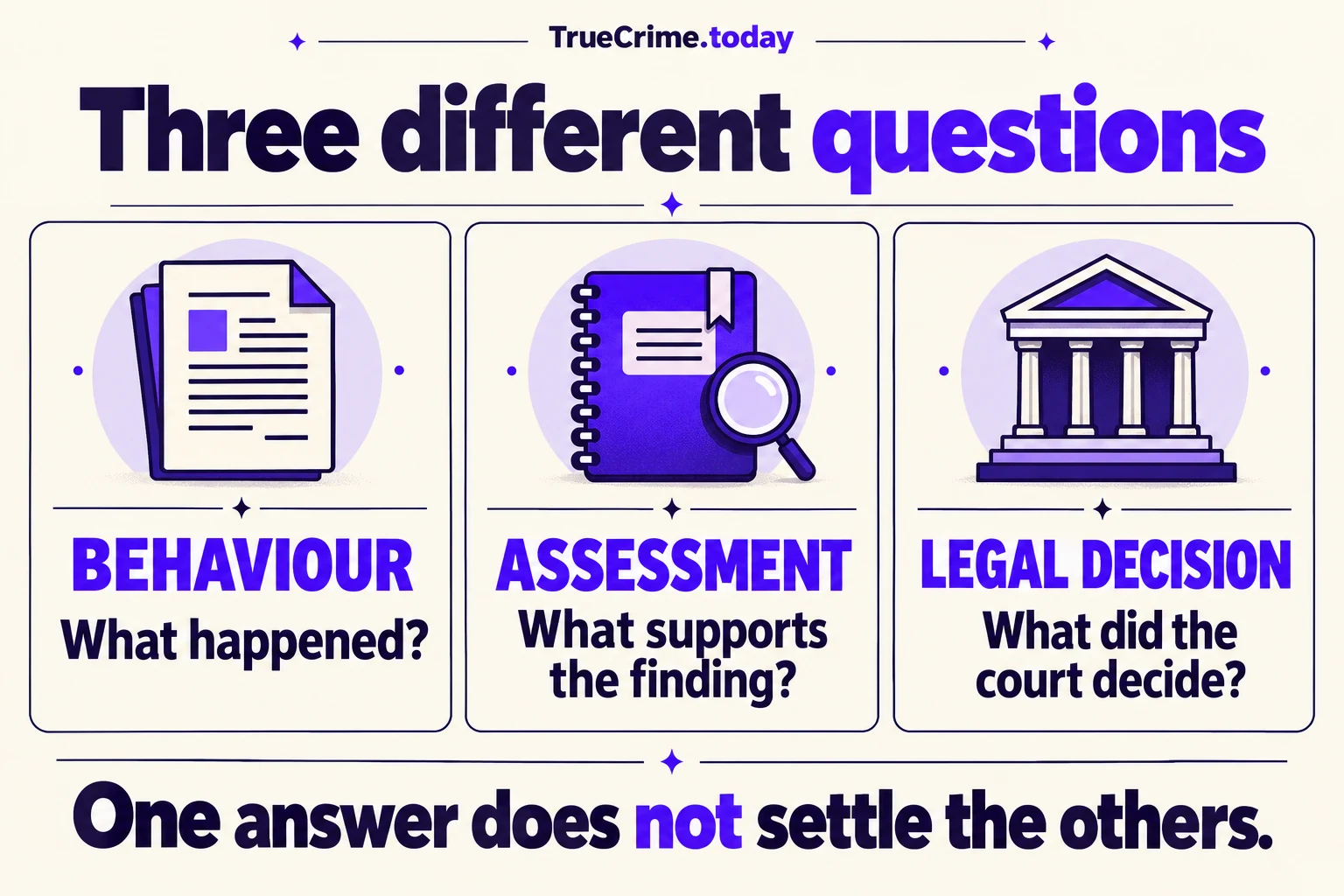
The three cards ask about different kinds of evidence. A finding in one does not fill the gaps in the others. A criminal allegation needs evidence about the alleged act; a clinical claim needs an appropriate assessment; a court decision needs its actual wording and scope.
Does a mental disorder explain violence?
A diagnosis is not a complete explanation of an offence. You still need to examine what happened, the circumstances and evidence of the person’s state at the relevant time. The word “psychological” should not turn every act of violence into proof of mental illness.
Psychosis and psychopathy are different concepts despite their similar beginnings. Psychosis can involve difficulties distinguishing what is real, including hallucinations or delusions. Psychopathy concerns personality features. Switching those words changes what is being discussed.
The US National Institute of Mental Health states that most people with schizophrenia are not violent. Its guidance also discusses the importance of treatment and coexisting substance use when considering risk. That is a more specific account than a story that presents diagnosis as a warning sign of inevitable violence.
How do motives, development and circumstances fit together?
A motive concerns what someone wanted to achieve in an event. A trait concerns a tendency across situations. A developmental explanation concerns how a pattern emerged. These can inform one another, but they are not the same answer.
Return to the hypothetical repeated phone thefts. Wanting money describes a proposed motive. Planning the thefts tells us something about behaviour. Neither establishes a personality disorder. To examine the explanation, we would want evidence about the person’s opportunities, relationships, decisions and earlier conduct, while considering accounts that disagree with the first story we heard.
The same care is needed with childhood experiences. A history of adversity is worth understanding; it does not tell us that an adult offence was inevitable. An explanation can identify harm a person experienced without excusing harm they later caused. It can also expose the limits of what the available record tells us.
What should you ask when a crime story uses a psychological label?
Start with the exact claim. “The witness described threats” and “the defendant has a personality disorder” require different evidence. Then ask who made the claim, what they reviewed and whether they considered information that disagrees with it.
You do not have to settle someone’s diagnosis to take threats, coercion or violence seriously. Describing the conduct precisely can be more useful than arguing over a label. It also keeps attention on the person harmed and the evidence needed for accountability.
The last time we checked the sources discussed here was October 8, 2026. If a story leaves you with a psychological question, write down the claim and what would help answer it. “What assessment supports this?” gives the discussion somewhere to go. “They are obviously a psychopath” closes it before the evidence has been examined.
Is a psychological claim in a crime story unclear? Send the public source and the exact sentence you want explained. Please leave out private medical records, personal messages and identifying details about people seeking help.
Ask about a psychological claim