Cornell 7 case: Jane Doe, the evidence and the new reviews
The Cornell 7 case explained: Jane Doe’s account, separate sanctions, the hearing, disputed evidence, New York consent law and the October 6 review.
Short version
The Cornell 7 case concerns a former student’s allegation that members of the Chi Phi fraternity sexually assaulted her in October 2024, and the handling of her report by Cornell and local prosecutors. Her September 2026 civil lawsuit brought the case to national attention. The seven men faced different allegations and different university sanctions. Two were expelled; the widely repeated claim that everyone only had to write an essay leaves out much of the record.
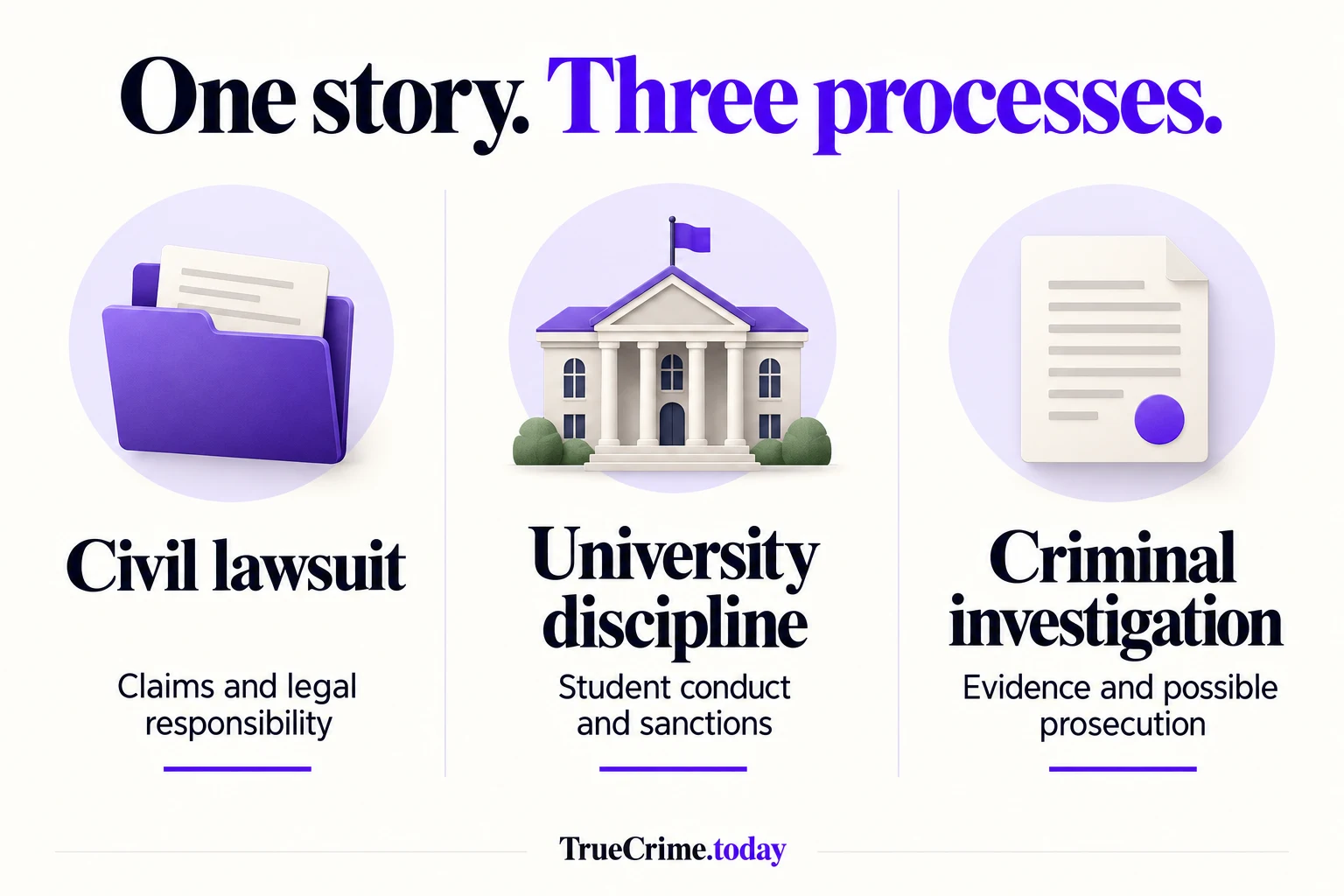
On October 1, Governor Kathy Hochul put New York Attorney General Letitia James in charge of the criminal investigation. On October 6, Cornell’s trustees announced a separate review led by former Deputy Attorney General Sally Yates. Neither appointment decides whether a crime occurred or whether any defendant is guilty.
The last time we checked the developments was October 7, 2026. The latest official announcement concerns Yates’s review; October 6 reporting also describes a police tip alleging pressure on potential witnesses. The reports we examined had not announced criminal charges. A university finding and a civil complaint cannot substitute for a criminal verdict.
Why the case became known as Cornell 7
If you’ve been trying to piece together the Cornell 7 case from short clips, you’re probably seeing several different disputes compressed into one story. There is the woman’s account of the night, the university’s disciplinary hearing, the prosecutor’s original decision and the question of whether investigators handled the evidence properly. Keeping those apart makes the troubling details easier to assess.
Cornell University is in Ithaca, New York, in Tompkins County. Cornell College, in Mount Vernon, Iowa, is a different school. Chi Phi is a fraternity with a national organization and local chapters; the allegations concern its Cornell chapter. Cornell says that chapter was closed in 2024 and remains barred from campus.
Jane Doe is a name used to protect the plaintiff’s identity. Her civil complaint names Matthew Ingalls, Johnathan Newell, Winston Lee, Gillio Lopes, Diego Sarabia, Scott Norris and Scott Kretzschmar, alongside Cornell, fraternity entities and other defendants. “Cornell 7” identifies that group of seven men. It does not tell you that each man was accused of the same act or received the same finding.
The distinction matters whenever true crime becomes a story about people whose cases are still unfolding: an accusation, a disciplinary decision and a conviction carry different meanings. The defendants deny wrongdoing, and the public record contains disagreements about consent and individual involvement.
Two new reviews, with different powers
Hochul’s October 1 executive order superseded the Tompkins County district attorney for the matters covered by the order. James can investigate and, if the evidence warrants it, prosecute. The order responds to concerns about the earlier investigation; it does not announce charges or direct a guilty verdict.
Cornell’s October 6 announcement gives Yates and her team a different job. The independent university review will examine the response to Jane Doe’s allegations, evidence-sharing with police and prosecutors, discipline, appeals, survivor support and fraternity oversight. It will also examine oversight by the trustees themselves.
Yates, now a partner at King & Spalding, will report directly to a special committee of the board. Cornell says the team will have access to relevant records and personnel, subject to legal and privacy limits. The board intends to share findings and recommendations. It has not given a completion date or promised to release every underlying file.
That leaves a fair question about independence: will the review examine the decisions of the people who commissioned it, and will the published findings let readers understand what went wrong? The announced scope includes board oversight. Whether that promise is met will become clearer when the report appears. Defense lawyer Andrew Miltenberg welcomed an independent review in October 6 CNN reporting, showing that scrutiny of Cornell’s handling is also being sought from the defense side.
The night Jane Doe describes
The civil complaint places the alleged assault on the night of October 19 into October 20, 2024. Jane Doe was a 20-year-old undergraduate. She describes drinking at a sorority gathering and bars before arriving at the Chi Phi house to see Ingalls, whom she knew. Her account includes alcohol, pressure to take ketamine and marijuana, unwanted sexual contact and a later period when she says she could no longer communicate or resist.
The accusation develops over the course of the night. She describes men entering a room while she was exposed, attempts to push hands away and further sexual acts after she became more impaired. Her complaint also alleges that Sarabia forcibly kissed her. These are allegations in a pleading, rather than findings that every act occurred as described.
The released university hearing report makes a different finding about the start of the encounter: its panel treated the initial sexual activity with two men as consensual. That conflicts with the civil complaint’s account of incapacity and coercion from the outset. The panel’s assessment of the beginning also does not settle what happened later, with other people or after her condition changed.
This is where an account reduced to “she consented” or “none of it was consensual” can hide the dispute. Consent must be considered for the particular act, person and time. The parties disagree about those facts. A prior agreement does not decide whether a later act was permitted.
The Snapchat messages and the calls afterward
The public hearing report describes a fraternity Snapchat group with more than 40 members and messages between roughly 1:42 and 2:27 a.m. It discusses invitations to come to the room and observations about the encounter. The civil complaint attributes the first 1:42 message to Newell. ABC’s later reporting describes invitations from Ingalls as well. Those accounts concern separate messages; treating them as one message can put the wrong person’s name on it.
The way investigators received the exchange also matters. A sworn affirmation by Cornell hearing chair Lauren Branchini says an anonymous source supplied a video scrolling through the conversation in early February 2025. That is later than the original November 2024 review by prosecutors. A screenshot discussed in that earlier review and the later scrolling video are different pieces of material.
Jane Doe also recorded calls with Ingalls as she tried to understand what had happened. In October 5 reporting, ABC describes a disagreement over his suggestion that she had said she was sober, questions about why other men entered, and explanations about the room’s door. Such calls can show what someone said afterward and which explanations were challenged. They cannot, by themselves, establish every event that happened in the room.
Ingalls’s position, reported by ABC, includes a claim that he was too intoxicated to consent and that she assaulted him. That counter-allegation must be attributed to him. It has not become an established fact merely because it appears in an email or a news report. The same distinction applies to statements made on Jane Doe’s behalf.
Why the consent rules are different
New York’s affirmative-consent law for colleges requires knowing, voluntary and mutual agreement. Silence or lack of resistance is insufficient. Consent to one act does not establish consent to another, and agreement can be withdrawn. Intoxication can leave someone unable to consent, including when alcohol or drugs were taken voluntarily, depending on the person’s condition.
Criminal law asks whether the elements of a particular offense can be proved. Under the New York Penal Law in force in October 2024, the definition of mental incapacitation includes an intoxicant administered without the person’s consent, or another act done without consent. That narrower definition helps explain the controversy over voluntary drinking.
It does not mean that a person who drank voluntarily has agreed to sex. The law separately addresses physical helplessness, including unconsciousness or being physically unable to communicate unwillingness, and forcible compulsion. Evidence of resistance, coercion, a communicated refusal or a later loss of ability to communicate may change the legal analysis.
Section 130.35 makes rape by forcible compulsion or against a physically helpless person a class B felony. Section 130.30 addresses, among other circumstances, mental incapacitation and is a class D felony. Those are possible legal categories, not charges we are assigning to the seven men. Prosecutors must connect evidence to the elements of an offense and to each person’s alleged conduct.
Cornell’s hearing used the preponderance of the evidence standard, meaning more likely than not. A criminal conviction requires proof beyond a reasonable doubt. A university sanction can stand even when prosecutors have not brought a charge, while an absence of charges does not decide whether the university followed its rules.
The twelve-day hearing and the separate sanctions
Branchini’s sworn account dates the formal university complaint to November 22, 2024, with later amendments. The disciplinary hearing ran over twelve days in May 2025. Parties could be represented, testify, question witnesses and present material. Its transcript ran to 1,732 pages. The panel issued its report on August 18, 2025.
The Cornell Daily Sun’s October 5 examination of disciplinary records reports these different outcomes:
- Matthew Ingalls and Johnathan Newell: expulsion.
- Winston Lee: a two-year suspension, with probation after return.
- Gillio Lopes: a three-semester suspension and two years of probation.
- Diego Sarabia: a three-year campus ban; he had graduated before the decision.
- Scott Norris and Scott Kretzschmar: no-contact restrictions, educational requirements and reflective writing.
Some sanctions included additional restrictions or requirements. These were university penalties, not prison sentences. A campus ban imposed after graduation also differs from revoking a degree.
The public copies redact parts of the hearing record, so the names attached to the complete sanction list rely on the Sun’s document-based reporting. Cornell’s own September 28 statement confirms expulsions and suspensions and says essays were not anyone’s sole consequence. That correction still leaves room to ask whether the lighter sanctions were proportionate to the findings made against those individuals.
What the September court decision actually decided
One respondent challenged his disciplinary finding in Tompkins County Supreme Court. The September 23 decision identifies him as John Doe; reporting identifies the respondent as Kretzschmar. Cornell’s panel had found him not responsible for sexual assault or completed sexual exploitation, but responsible for attempted sexual exploitation. His internal appeal was denied on January 14, 2026.
He then used an Article 78 proceeding to argue that Cornell had imposed a finding for an attempted offense without adequate notice. Article 78 lets a court review matters such as lawful procedure, legal error and abuse of discretion. It is not a new criminal trial. The judge dismissed the petition, accepting that notice of the underlying conduct and possible additional policy violations was sufficient in this dispute.
The decision also discusses a panel member’s participation while driving for about 45 minutes of witness testimony. That issue understandably attracted attention online. The court notes that it was raised in the petition but was not pursued as a ground for relief in the briefs or oral argument. A footnote says that even if considered, the episode did not establish an abuse of discretion, pointing to the length of the hearing, the testimony covered and the unanimous decision.
Two points can be true together: readers can find a panelist listening while driving unacceptable, and the court can find that the legal challenge presented did not justify overturning this respondent’s result. The ruling did not decide Jane Doe’s civil lawsuit or acquit the group of a criminal offense.
The evidence-transfer dispute
The most consequential criticism concerns what reached the prosecutor in 2024. District Attorney Matthew Van Houten’s September 28 statement describes a six-page sworn account reviewed by prosecutors, who concluded that it did not establish an offense they could prosecute. He defended that assessment and later reopened the case after the civil lawsuit became public.
WSKG compared successive versions of Cornell’s FAQ. An initial claim that all investigatory information had been shared was removed; later wording referred to a sworn statement and Snapchat screenshot. Reporting also distinguishes that short statement from a much longer interview transcript. A later acknowledgement that prosecutors had received a screenshot does not resolve whether they received the interview or other material.
ABC’s October 3 reporting adds a second question. A November 25 police note says investigator Jeffrey Northrup offered additional interviews to the district attorney’s office, which declined further material after its assessment of the statement. That complicates a story in which every omission is attributed to the university alone.
The documents needed to resolve this dispute are concrete: records of what police sent, when prosecutors received it, what was offered afterward and why it was declined. The contents of a summary also need comparison with the underlying interview. Without those records, a claim that Cornell concealed everything or that the prosecutor reviewed everything goes beyond what has been established.
Missing phone evidence and the cover-up allegations
Online discussions ask whether investigators obtained phones, secured the whole Snapchat exchange or allowed evidence to disappear. CNN reported preliminary November 15, 2024 letters to Verizon and T-Mobile asking for data preservation and referring to a forthcoming warrant. The published account did not establish whether the letters were sent, whether carriers complied or whether warrants followed.
That distinction is practical. A preservation request seeks to keep data available; a warrant or another lawful demand may be needed to obtain it. Possessing a preliminary letter does not prove that an account was preserved or examined. Equally, the absence of a public forensic report does not prove that no digital work occurred.
Jane Doe’s civil lawyer Thomas Giuffra has publicly argued that the investigation failed to secure evidence and has said he believes material was deleted. In his October 4 CNN interview, he described himself as a civil lawyer, rather than a criminal lawyer. His criticism deserves examination alongside the documents. Belief that evidence was destroyed still needs supporting recovery logs, retention information, device examinations or testimony before it can be treated as a finding. Van Houten rejected Giuffra’s allegation of a cover-up.
October 6 ABC reporting describes an anonymous tip that fraternity leaders sought to keep potential witnesses quiet. Police interviews examined whether members had tried to agree on an account. One witness described efforts to get everyone on the same page; another described a routine weekly meeting where the situation was discussed. A tip warrants follow-up, and differing witness accounts warrant comparison. They do not yet establish a coordinated conspiracy.
The defense’s objections and the risk of public accusations
Defense lawyers dispute both alleged involvement and the way the case has been presented. Jeremy Saland, representing Norris, has said his client’s participation in offensive Snapchat messages did not mean that he witnessed or participated in an assault. The separate university findings make that distinction worth addressing rather than treating every denial as identical.
Miltenberg also sought James’s recusal after public comments expressing support for Jane Doe. Hochul expressed confidence in James, and James later said her work would follow the facts and law. Whether a prosecutor can act impartially is a legal question; a request for recusal does not itself establish bias or remove the prosecutor.
Public scrutiny can bring neglected records to attention. It can also harm people when a name, photograph or family connection is guessed from a search result. No verified record we examined establishes the social-media claim that influential families arranged an agreed cover-up. A similar name, a relative’s job or a deleted profile cannot supply that missing proof.
The comparison with Promising Young Woman helps explain why the story resonates: the film deals with sexual violence, social protection and accountability. It supplies no evidence about this case. Supporting Jane Doe does not require identifying her or targeting someone believed to be connected to a defendant.
The wider problem students are raising
Students’ anger concerns safety and trust as well as this single case. The October 5 protest and subsequent meetings put pressure on President Michael Kotlikoff and the trustees. October 6 reports described a proposed faculty no-confidence vote for October 14 and a seven-hour sit-in planned for October 7. Those announcements should not be mistaken for completed votes or events.
Cornell’s March 2026 task-force report gives the concerns a wider context. In its 2025 survey, 52% of responding undergraduate women affiliated with Greek organizations reported sexual assault during their time at Cornell, compared with 29% of those not affiliated. That is a 23-percentage-point difference among respondents.
The undergraduate response rate was only 13%, down from 34% in 2023. The report itself warns that this limits interpretation. The figures cannot show that fraternity membership caused an assault or establish an exact prevalence for every student. They do explain why students want prevention, reporting and fraternity oversight examined rather than receiving assurances about one completed hearing.
What would change the story next
A charging decision would need the alleged offenses and each defendant’s role stated clearly. A grand jury decision to indict would authorize prosecution; guilt would still have to be proved at trial. If prosecutors decline charges, their reasons and the evidence reviewed will matter, especially after the dispute over the original assessment.
Yates’s findings should answer a different set of questions: whether Cornell followed its policies, supported Jane Doe, handled evidence properly and gave the trustees enough information to supervise the response. A report that identifies errors should explain who will correct them and how the changes will be checked.
Jane Doe’s civil claims ask for compensation and responsibility from the people and organizations sued. The complaint includes claims about safety obligations, alleged negligence and broken promises. Those issues will turn on proof of a legal duty, breach, causation and harm, or the requirements of each other pleaded claim. Filing a lawsuit does not establish that every defendant owed the same duty or caused the same injury.
If you’re following the case, the next court filing, prosecutor’s statement or review report will tell you more than another claim that all seven received one punishment. Violence against women must bring strong lawful accountability when offenses are proved. That requires a serious investigation, protection for the complainant and fair examination of each allegation. The unresolved questions in the Cornell record are reasons to demand that work, not reasons to replace it with an online verdict.
Have a question about the Cornell hearing, a disputed message or the consent rules? Tell us which claim and date you mean. Do not send private witness records or documents identifying Jane Doe.
Ask about the Cornell case