Lindsay Clancy verdict: mistrial, court order and what comes next
Has Lindsay Clancy been acquitted or convicted? Court footage, the October ruling and public discussions explain why the case still has no jury verdict.
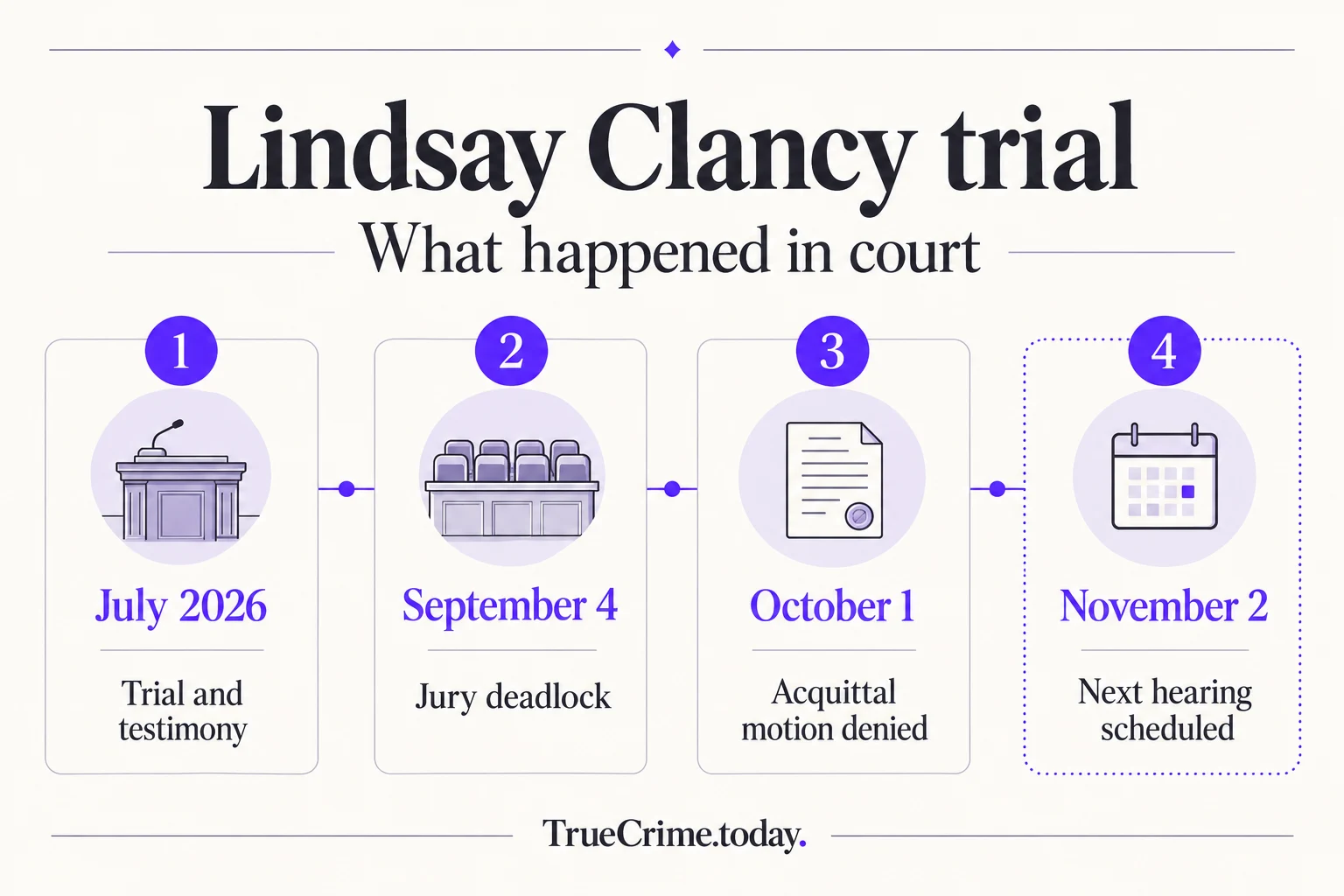
If you searched for the Lindsay Clancy verdict, the answer is that the jury did not return one. Eleven jurors reportedly favored finding her not guilty because she lacked criminal responsibility; the panel could not reach the unanimous decision Massachusetts requires. The judge declared a mistrial on September 4, 2026.
The last time we checked the court’s October ruling and subsequent reporting was October 7, 2026. The charges remained unresolved. November 2 was the next scheduled hearing, with no confirmed date for another trial.
Short version
Clancy has neither been convicted nor acquitted in this prosecution. The deadlocked jury ended the first trial without deciding the charges. On October 1, Judge William Sullivan rejected a defense request to enter a finding of not guilty because of insufficient evidence. That ruling allowed the case to continue; it did not supply the missing jury verdict. The next hearing concerns remaining motions and possible trial scheduling.
Did the Lindsay Clancy case end with an acquittal?
No. A jury that cannot agree leaves the charges undecided. An acquittal would resolve them in the defendant’s favor. That distinction matters if you have seen posts saying Clancy was “cleared” because most jurors sided with the defense.
The Lindsay Clancy case concerns the deaths of her children, Cora, Dawson and Callan, after they were strangled at the family’s Duxbury home in January 2023. The prosecution alleges murder; the defense argues that her mental condition prevented criminal responsibility at the time. The first jury did not reach a verdict on those allegations.
The children’s deaths are undisputed. Deciding whether Clancy is criminally responsible for them requires the legal test, the trial evidence and a valid court outcome. Your reaction to the tragedy does not settle that question, and neither does sympathy for someone who sought psychiatric help.
Why didn’t eleven votes count as a verdict?
Massachusetts requires a unanimous criminal jury verdict. Under Massachusetts Rule 27, a verdict is returned in open court and recorded; if jurors cannot agree, the judge can declare a mistrial on the unresolved charges. A reported split during deliberations cannot replace that procedure.
The reported 11–1 division was in favor of a finding of not guilty by reason of lack of criminal responsibility. That tells you where most jurors stood. It does not establish a verdict, give eleven votes the legal force of twelve, or tell you what a different jury would decide.
The jurors deliberated over seven days. Sullivan gave further instructions and allowed discussion to continue before declaring the panel deadlocked. The length of that effort helps explain the mistrial; it cannot be converted into a score measuring how strong either side’s evidence was.
The Court TV recording places that deadlock back in the courtroom. The judge has to decide what to do with a jury that cannot agree; the defense wants to keep the possibility of an acquittal alive. The footage contains an argument about procedure, and it ends with the first jury’s work unresolved. Listen for the difference between declaring a mistrial and announcing a finding of guilt.
Did the October 1 ruling find Clancy guilty?
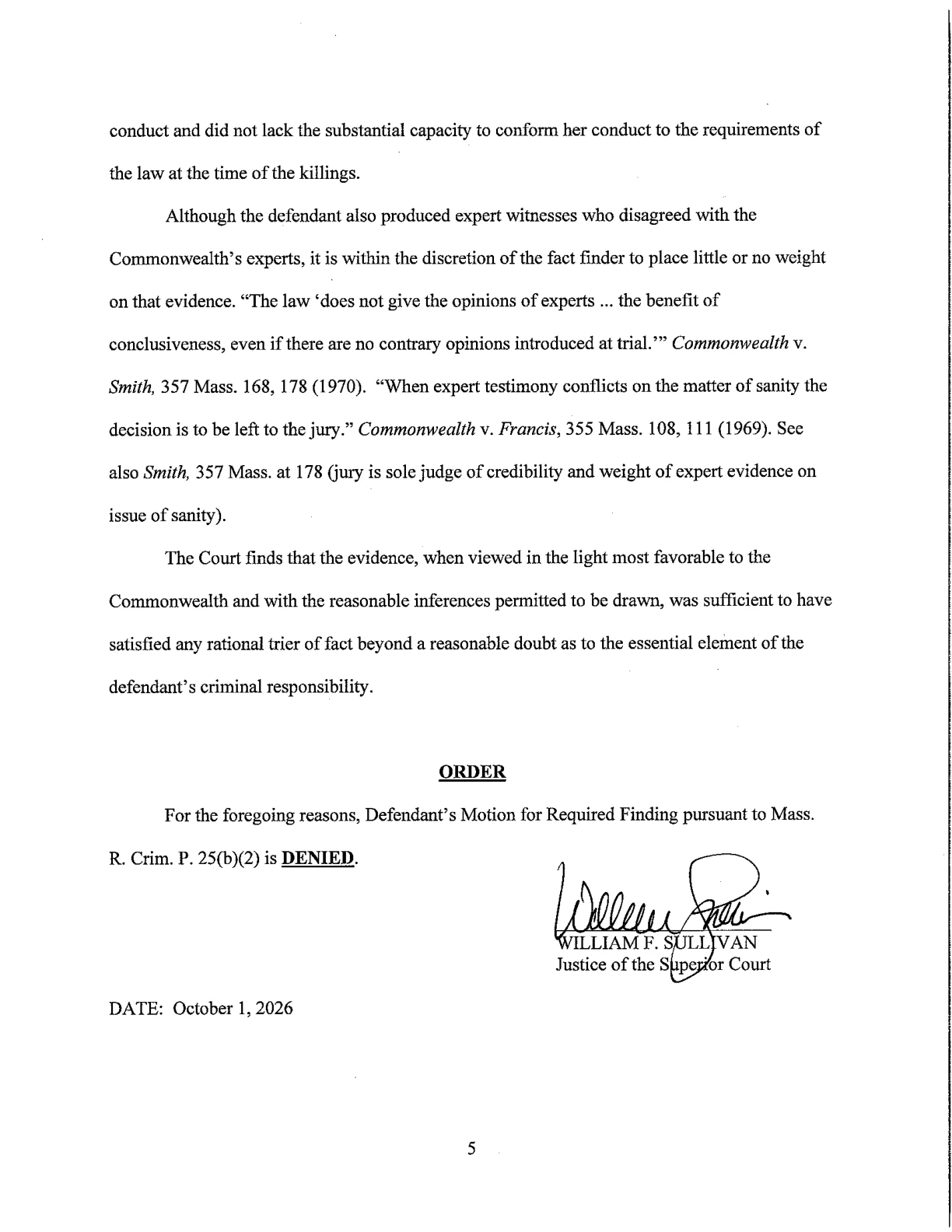
No. The judge was deciding a different question: whether the prosecution’s evidence was legally sufficient to let a jury decide the case. The defense had asked him to enter a finding of not guilty under Rule 25(b)(2).
In the October 1 court order, Sullivan considered the trial record in the light most favorable to the prosecution and denied the motion. He identified evidence supporting the alleged acts and expert testimony supporting retained criminal responsibility. He did not select a winning side after weighing credibility as a jury would.
There is room between “the evidence is too weak to submit to a jury” and “the evidence proves guilt beyond a reasonable doubt.” The ruling addressed the first question. It did not answer the second for a future jury.
If you followed the Lindsay Clancy trial through testimony clips, the competing psychiatric opinions help explain that gap: experts disagreed about her condition and legal capacities, while the October motion required a narrower review of the evidence. A judge’s refusal to end the prosecution does not erase that disagreement. When a headline treats that dispute as settled, checking the claim against the court record helps you see who made the statement and what the judge actually decided.
The final page of the signed order identifies exactly what was refused: the defense motion for a required finding. The date and signature matter because this is a decision the court actually issued. The word DENIED refers to that request; it does not turn the document into a conviction.
What would a finding of no criminal responsibility mean?
It would be an acquittal on that basis, rather than a murder conviction followed by a lighter sentence. The legal question concerns Clancy’s capacities at the time of the deaths, not whether she had ever received a psychiatric diagnosis or whether she needs treatment now.
Massachusetts asks whether a mental disease or defect deprived a defendant of meaningful ability to appreciate the wrongfulness of the conduct or to obey the law. Either kind of loss can support a lack of criminal responsibility. Once the issue is raised, the prosecution must prove criminal responsibility beyond a reasonable doubt.
Those questions explain why both sides spent so much time on records, reported symptoms and retrospective expert assessments. Evidence that someone planned an errand can support the prosecution’s account, but organized behavior alone does not resolve every question about psychosis. A diagnosis also cannot tell the jury, by itself, whether the legal test was met at the relevant moment.
Court TV’s recording of psychologist Paul Zeizel’s testimony shows the kind of evidence the jury had to assess. His account belongs to the defense’s presentation; the prosecution called experts with a different view. An excerpt can help you understand a witness’s reasoning, while the legal conclusion still depends on the admitted record and instructions.
An acquittal on mental-illness grounds would not guarantee immediate release. Massachusetts General Laws, Chapter 123, Section 16 provides a separate process for examination and possible psychiatric commitment, with court findings and review. A murder sentence and a psychiatric commitment have different legal grounds. Neither outcome should be described as “getting away with it,” and no such acquittal has been entered here.
Was the lone juror found to have broken the rules?
The defense has made allegations about the juror’s conduct, including a refusal to apply instructions. Those allegations need a court’s assessment. They are separate from the fact that one juror disagreed with the other eleven.
A juror is allowed to hold a different view of the evidence. A claim that a juror ignored the law, used outside information or acted improperly raises another question, which requires evidence of that conduct. You cannot establish it simply by counting the votes.
The September 3 Court TV report described a jury note and the defense’s request to remove the juror. By the end of deliberations, Sullivan had not replaced the holdout to produce an acquittal. Further juror-related issues were among the matters reported for the November hearing. The October 1 evidence-sufficiency ruling did not decide those allegations.
Be careful with posts that turn a courtroom accusation into “the court found.” A lawyer can argue that something went wrong without a judge having accepted that argument. That applies to both sides, including forceful claims about an inadequate investigation or the certainty of guilt.
What are people arguing about online?
Much of the online argument starts with the same frustration: eleven people apparently agreed, yet the case remains open. Some commenters call the holdout courageous; others say the juror prevented justice. Those opposing reactions cannot tell you whether any instruction was actually disregarded.
In a discussion of the jury deadlock, one commenter paused before judging what happened inside the deliberation room:
“I’m reserving judgement.”
That comment went on to favor a plea deal. It shows why a person’s view of the best next step and their knowledge of the jury’s conduct need to be kept separate. Later juror interviews give more detail than spectators had on September 4; interviews and allegations still need to be assessed against the court’s findings. A claim does not become settled because a clip of it gets shared repeatedly.
A comment about finding another jury captured a different worry after the September hearing:
“Good luck finding 12 unbiased jurors…”
The publicity is real, and the worry is understandable. The comment does not show that every person available for jury service has a fixed opinion. A future court would have to assess actual prospective jurors through its selection process. People posting in a case-focused thread are already interested in the case; their reactions cannot measure the entire jury pool.
Under a post sharing the October 1 order, a comment favoring a judge-only trial proposed changing both the decision maker and the judge:
“I think a bench trial would be better with a new judge.”
That is a preference about how another proceeding should happen. A social-media suggestion cannot establish that Clancy can select a different judge or that a judge-only trial has been approved. Any change would need its own lawful basis and court procedure. The October order decided the evidence motion; it did not adopt this proposal.
These three comments illustrate different questions, rather than a survey of public opinion. They help explain why the same unresolved result gets described as unfair, inevitable or unfinished depending on the discussion. None supplies the missing verdict.
Can prosecutors try the case again?
A deadlocked jury can be followed by another trial. The US Supreme Court’s decision in Richardson v. United States, 468 U.S. 317 (1984), explains why an ordinary hung-jury mistrial does not, by itself, end the original jeopardy and bar further proceedings.
That principle does not decide every motion in Clancy’s case. Her defense is pursuing challenges to a second prosecution, and a court has to address their actual grounds. The defense’s objection to a retrial and the general rule allowing one can both exist while the case remains unresolved.
A new jury would evaluate the admitted evidence under its own instructions. The earlier 11–1 split would not count as eleven votes already secured. Prosecutors would still carry their burden, and the defense could still challenge the proof.
A plea agreement or a dismissal would also have to be established through the appropriate proceedings. Neither is something we can infer from an attorney’s willingness to discuss an agreement, a judge’s scheduling remarks or a social-media prediction.
What will the November hearing decide?
November 2, 2026 was the next scheduled hearing when we last checked. At the September 29 hearing, Sullivan told the lawyers to be ready to discuss a trial date when they returned. That is a scheduling instruction, not an announcement that a retrial will begin on November 2.
Remaining motions can affect what happens next, and a hearing need not resolve every issue on the same day. A date offered by a lawyer is also different from a date adopted by the court. This is why we have not labelled November 2 a “verdict date” or a “retrial date.”
When a new headline appears, you can check what actually changed:
- A returned verdict: identify the finding and which charges it covers.
- A judge’s order: identify the motion decided and the relief granted or refused.
- A scheduled event: establish whether it is a hearing, jury selection, trial or sentencing.
- A party’s statement: distinguish a request or intention from a court decision.
For now, the answer to “Lindsay Clancy verdict” remains no verdict from the first jury, with the prosecution unresolved. A later decision will need its own date, document and explanation.
Have a published court order or hearing update that changes the outcome of the Clancy case? Send its public source and the date. Keep private medical records and other personal documents out of the form.
Send an outcome update