True crime Reddit: communities, rules and better discussions
Find true crime Reddit communities for cases, unresolved mysteries and podcasts. Compare their rules, search older threads and check claims before sharing.
You finish a documentary, search the case on Reddit and find three conversations that seem to describe three different stories. One is about the programme, one follows a court hearing, and one is mostly guesses. Choosing the right conversation saves you a lot of confusion.
TL;DR
True crime Reddit is a collection of separate communities, each with its own purpose and rules. r/TrueCrime covers a broad range of cases; r/UnresolvedMysteries focuses on unresolved stories; r/TrueCrimeDiscussion has strict discussion and sourcing rules; r/TrueCrimePodcasts helps you find and discuss shows. Choose by the question you want answered, then check the original material behind any factual claim. Votes and confident replies cannot tell you whether it is true.
Which true crime subreddit fits your question?
A subreddit is an individual community whose name starts with r/. The same case can appear in several communities because people want different things from it: a news update, a detailed history, a discussion of testimony or something worth listening to. There is no single Reddit true crime editor approving all those conversations.
If you’re still deciding what belongs in the genre, what is true crime includes nonfiction accounts of actual crimes across books, documentaries and other formats. On Reddit, those accounts sit alongside people’s reactions to them. A recommendation can tell you whether a podcast holds someone’s attention without confirming what the podcast says about a suspect.
The last time we checked these communities and their rules was October 12, 2026. The names are useful starting points, but the live rules are what matter when you post. This selection groups communities by purpose; it does not rank their accuracy or moderation.
r/TrueCrime: broad case reading
r/TrueCrime is a general forum for real criminal cases. Its case-write-up rules ask for an original summary of at least 500 characters, reputable third-party sources and a discussion point. The length is a posting minimum, not a test of whether a story is correct.
It also has a recurring media thread for books, shows and podcasts. That gives a listening recommendation somewhere to go without turning every recommendation into a separate case post. Its rules prohibit personal information, naming your own suspects and AI content. Don’t paste an AI-written case summary there.
r/UnresolvedMysteries: older unresolved cases
r/UnresolvedMysteries suits a longer look at an unresolved history. Its current rules require at least 750 characters, credible third-party sourcing and a question or discussion point. Ordinary case posts generally concern cases at least six months old; recent cases have monthly megathreads.
That distinction matters if you arrive after breaking news. The absence of a new standalone post may reflect the community’s format rather than a lack of interest. Its title is also easy to confuse with r/UnsolvedMysteries, which is a different community. Check the name before applying one community’s rules to another.
r/TrueCrimeDiscussion: conversation with firm boundaries
r/TrueCrimeDiscussion welcomes case discussion but restricts what can be posted. Its current entry requirements include 30 comment karma and an account older than two weeks. It requires English, credible original reporting and factual discussion during active trials, and excludes some heavily covered cases.
Those barriers explain why a new account or a familiar headline might not get through. They do not make an accepted post a court finding. Its prohibition on unsupported accusations is especially important when a thread discusses victims, relatives or someone who has not been officially identified as a suspect.
r/TrueCrimePodcasts: choosing your next listen
r/TrueCrimePodcasts describes itself as a place to discuss, discover and review true crime podcasts. It has a weekly listening discussion, asks people to search before posting and confines promotion to a monthly thread.
You can ask whether a show has intrusive ads, a clear chronology or a host who reads documents carefully. Those are listening questions. A listener saying a programme changed their mind is not independent corroboration of the programme’s allegations.
What Reddit can help you find
You don’t need to become an amateur investigator to benefit from a good discussion. Someone may identify the episode you half remember, locate an older news report or notice that a quoted sentence leaves out the next line. The useful part is the material you can then examine yourself.
Good case analysis distinguishes what a document establishes from what someone argues it means. If a commenter links a motion asking for a retrial, the filing establishes that a request was made. You still need the judge’s decision to know whether it was granted.
A question with a clear subject, date and missing detail is easier to answer than “What does everyone think?” The same principle applies to forum discussions: explain what you want to understand and what context the other person needs. In a crime thread, an answer should help you identify a record or resolve a specific uncertainty, rather than collect votes for a favourite theory.
A few Reddit terms worth knowing
OP usually means the original poster. It identifies who started a conversation, not whether they witnessed anything. Flair is a label attached to a post or account; a post marked “Update” still needs a dated source.
Karma reflects voting on an account’s contributions. Comment karma can affect eligibility to participate, but it is not a professional qualification. A megathread collects related discussion in one place. Modmail is the way to contact a community’s moderators about its rules or a removal.
Those distinctions help you read the page without assigning authority to a badge or number. If someone claims to be a lawyer, journalist or relative, examine any verification the community provides and the basis of the particular statement. Even a genuine professional may be speaking outside their knowledge of the case.
Search before you write a post
Reddit’s search features include filters for community, title and flair, as well as searching comments. A search inside a community keeps that community’s name in the search bar; a site-wide search has a broader scope.
Try the surname and a detail you remember, then narrow the results. subreddit:TrueCrimeDiscussion title:hearing is a practice query for hearing-related titles in that community. It is not a claim that every result concerns the same proceeding. Quotation marks help with multiword fields, while AND, OR and NOT are uppercase operators.
Change one thing at a time if the results are poor. A programme may use a nickname while contemporary reporting uses a full name. A post about a hearing may describe it as a motion or use the judge’s name. Before creating a new thread, inspect the community’s rules, recent posts and any relevant megathread.
From a comment to something you can verify
The central question is simple: what would let you check this outside the comment? A date, document title, court name, recording timestamp or reporting outlet gives you somewhere to begin. “Everybody knows” gives you no way to test the claim.
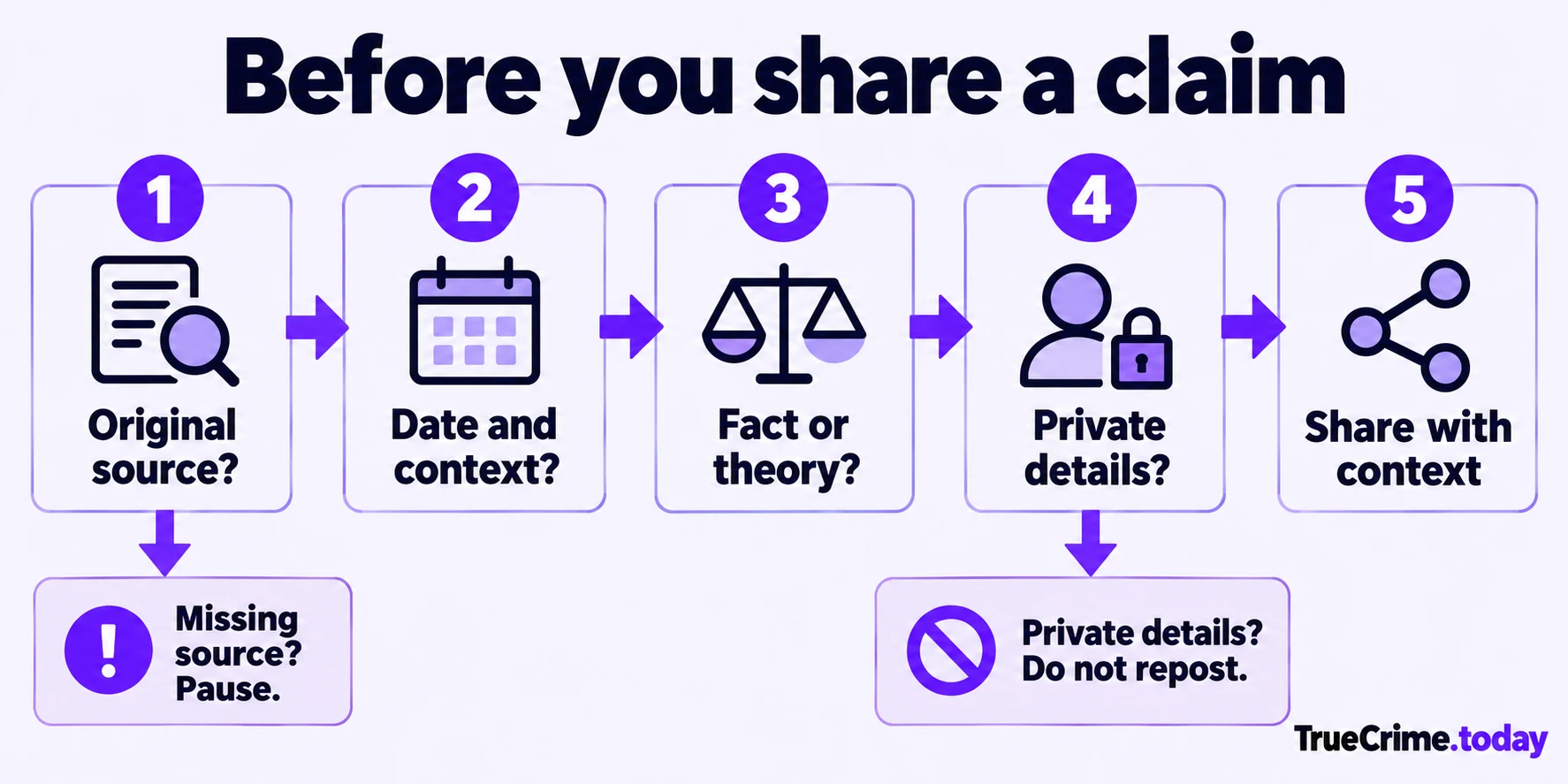
A court document can be authentic and still be misread. A lawyer’s allegation in a motion is not automatically the judge’s conclusion. A screenshot might show the correct words while cropping out who said them, a qualification or a later correction. Find the complete document before you decide how to describe it.
These five checks are a reading habit, not a score that proves a person truthful. A post can have an excellent citation and an unfair interpretation. Conversely, a poorly sourced comment may point toward something real. It needs verification before you repeat it as fact.
Try one small check before joining in
Take one factual sentence from a thread and write down exactly what it asserts. Imagine the sentence is “The court refused to hear the defence.” Ask what kind of record could establish that: a hearing transcript, an order or reporting that identifies the decision. A cropped image of a rejected filing might establish something much narrower.
Next, compare the date of the post with the date of its material. An old order can remain online after a new hearing changes the position. Record the date and scope of what you found rather than treating the first matching result as the current answer.
Finally, compare your wording with the original. “The judge rejected this motion” leaves room for a different motion or appeal. “The defence was never allowed to speak” makes a much larger claim. If you cannot support the larger wording, don’t use it.
When a thread sends you in the wrong direction
Several repetitions can lead back to one source. Two podcasts and a Reddit comment may all repeat the same newspaper error. Count the independent origins, not the number of places where the sentence appears. If you can trace every version to one report, describe it as one report.
The most popular reply can answer a different question. A joke may receive more attention than a careful correction. Sorting changes what you notice; it does not establish reliability. Scan for dated corrections and inspect the relevant evidence rather than stopping at the first confident reply.
A small detail can become an accusation. An unfamiliar vehicle in a photograph or an odd facial expression does not identify a perpetrator. Don’t crowdsource the identity, address or workplace of a private person to test a theory. The people in the photograph may have nothing to do with the offence.
How to disagree and correct a mistake
Ask for the specific support: “Which hearing is that from?” or “Is there a later order?” That keeps the conversation about the material. You can disagree with an interpretation without making claims about the commenter’s motives.
If you discover an error in your own comment, correct the factual statement and explain what changed. An edit that says “The date should be March, not May; the order refers to the earlier hearing” helps later readers. Quietly removing a qualification can leave people responding to a statement that no longer exists.
If a post contains personal details or threats, report it under the relevant rule. Reposting the same details to condemn them extends their reach. Moderators can handle a community-rule question; they are not a substitute for the authority responsible for an actual investigation.
Questions people ask about true crime Reddit
Does a popular comment count as evidence?
It shows that people responded to the comment through Reddit’s voting system. It does not show that they independently checked it. Use the comment to identify something you can verify, and keep preference, interpretation and documented fact separate.
Why was my post removed?
Possible reasons include an unsuitable topic, a duplicate, missing source information, account restrictions or a prohibited format. Read the removal explanation and the current rules. If the explanation is unclear, ask the moderators about that rule rather than reposting to evade it.
Can I share my own experience or advertise a podcast?
That depends on the community. Personal involvement is restricted in the general case spaces discussed here, and podcast promotion has designated places where permitted. A public forum is also a poor place to expose private case details. Check the rule for the exact community and type of post.
A better next visit
Choose one community that fits your immediate question. Read its rules, find an existing conversation and verify one factual sentence before adding your own response. Once that feels familiar, compare an older thread with a later update and notice which claims were corrected.
A worthwhile visit can end with a clearer date, a better question or a programme you want to hear. You don’t have to solve a case or join an argument to get something useful from the conversation.
Before you return to a familiar case, keep a small note of the claim, its original date and the document that supports it. That note gives you something to compare with the next update. Otherwise, a discussion you read months ago can leave behind a strong impression and a weak memory of where it came from.
You can also change what you ask of a community over time. A first visit might help you identify an episode. A later visit might help you understand why two reports give different dates. If replies become more heated without supplying better material, stop and return to the record. The next useful answer may come from a quiet correction rather than a longer argument.
Have a question about a discussion rule or the origin of a claim? Send a public link and the passage you mean. Do not send passports, contracts, bank details or other personal documents.
Ask about a discussion