What is the true crime community? Understanding the TCC label
The true crime community includes audiences and discussion groups. Learn why TCC can also mean perpetrator fandom, and what research can actually establish.

You finish a documentary and look for people who have noticed the same unanswered question. Then a headline uses true crime community, or TCC, to describe people who admire killers. Are these really the same community? The phrase is doing two different jobs, and that matters before we start making claims about its members.
TL;DR
The true crime community broadly means people who share an interest in stories about real crimes and discuss them with others. In some security research, TCC has a narrower meaning: online fandom that admires perpetrators. Listening, participating, glorifying an offender and threatening violence are different behaviours. A genre label alone tells us very little about a person.
A simple definition, with an important distinction
A community needs something shared between people: a conversation, a recurring space, a set of interests or expectations. An audience can exist without any of that contact. You can listen to a podcast on the way to work and never post, join a group or identify as a fan.
The genre itself is covered in our explanation of what true crime means. Here the question is what happens between the people who follow it. That could mean comparing accounts of a hearing, discussing how a documentary tells its story, or sharing a reading list. It does not automatically mean admiring the offender.
Audience, community and fandom describe different things
Audience describes consumption. Community describes a connection between people. Fandom adds identification or enthusiasm for an object of interest, which might be a programme, a presenter or a perpetrator. These categories can overlap, but they are not interchangeable.
Consider an imagined group discussing a disputed timeline. One participant reads quietly; another finds a missing date; someone else praises the podcast’s editing. None of those actions shows support for the crime. Change the conversation to celebrating the offender’s cruelty and something important has changed, even if the group name stays the same.
That distinction helps a journalist describe a thread fairly. It also helps a moderator identify the actual problem: a mistaken date needs a correction; harassment needs moderation; a specific threat needs a serious safety response. Calling all three “TCC activity” hides the difference.
What researchers mean when they use TCC
The Institute for Strategic Dialogue makes its scope explicit in its research on perpetrator fandom. Its use of TCC concerns admirers of high-profile killers, rather than everyone interested in cases or criminal psychology. The report examines how notoriety and status can become rewards within that narrower environment.
This is a real concern, not a reason to dismiss harmful behaviour as mere entertainment. But observations of selected networks cannot tell us how common those behaviours are among all true-crime listeners. Nor do they turn three letters in a profile into a reliable prediction of individual violence. The last time we checked the report’s definition and scope was October 12, 2026; its latest displayed update was April 6, 2026.
How a group’s behaviour changes the meaning
A group’s description tells you what it claims to be. Its rules and everyday responses show more. Are corrections welcomed? Are unsupported accusations removed? Is an offender treated as someone to understand, someone to celebrate, or someone to imitate?
Community guidelines describe what a group welcomes, limits or removes. Written rules are only a starting point: enforcement matters, especially when a popular member breaks them. Watch what happens to a calm correction or a complaint about harassment, rather than treating a polished introduction as proof of a healthy discussion.
A useful group can make room for disagreement without making people into targets. That is a practical standard for participation, not a clinical test of its members.
What audience numbers can and cannot tell you
Pew Research Center reported that 34% of US adults who had listened to a podcast in the previous year regularly listened to true-crime podcasts. Its 2023 account of the survey uses data collected December 5–11, 2022, from an overall sample of 5,132 US adults. That total is the full survey sample, not the number of true-crime listeners.
The finding establishes widespread interest within a particular podcast audience. It does not count community members, measure admiration for perpetrators or describe the whole world in 2026. Turning “34% listen” into “34% belong to TCC” changes the question after the answers have been collected.
When a community discussion moves from audience figures to a specific case, our methods for analysing a case explain another necessary separation: what the record establishes, what a participant alleges and what remains speculation. The same habit helps here. Keep each source attached to the question it actually answers.
Why the phrase has more than one history
The words describe an ordinary social fact: people gather around a genre. In the research discussed above, the abbreviation also names a narrower online subculture. That change in scope explains why a podcast listener and a security researcher may hear different meanings in the same phrase.
We do not have verified evidence of a single first coinage, founder or date when everyone adopted the term. It would be misleading to invent an origin story just to make the definition tidy. When reading an older post, check how its author used the expression at the time, rather than importing the meaning of a later report.
Three conversations that should not be lumped together
Imagine three posts about the same unnamed case. These are illustrations, not quotations from real accounts.
- “The documentary gives Tuesday, but the dated court document gives Wednesday.” This is a checkable disagreement about evidence.
- “The offender looks heroic in this edit.” This shifts attention towards admiration; the surrounding content matters when deciding what is being celebrated.
- “I intend to hurt someone.” This concerns a threat, regardless of whether the profile mentions true crime.
The first needs a source check. The second calls for a closer look at the framing and group response. The third cannot be reduced to a debate about genre taste. These distinctions help us describe what we have actually seen without treating every participant as interchangeable.
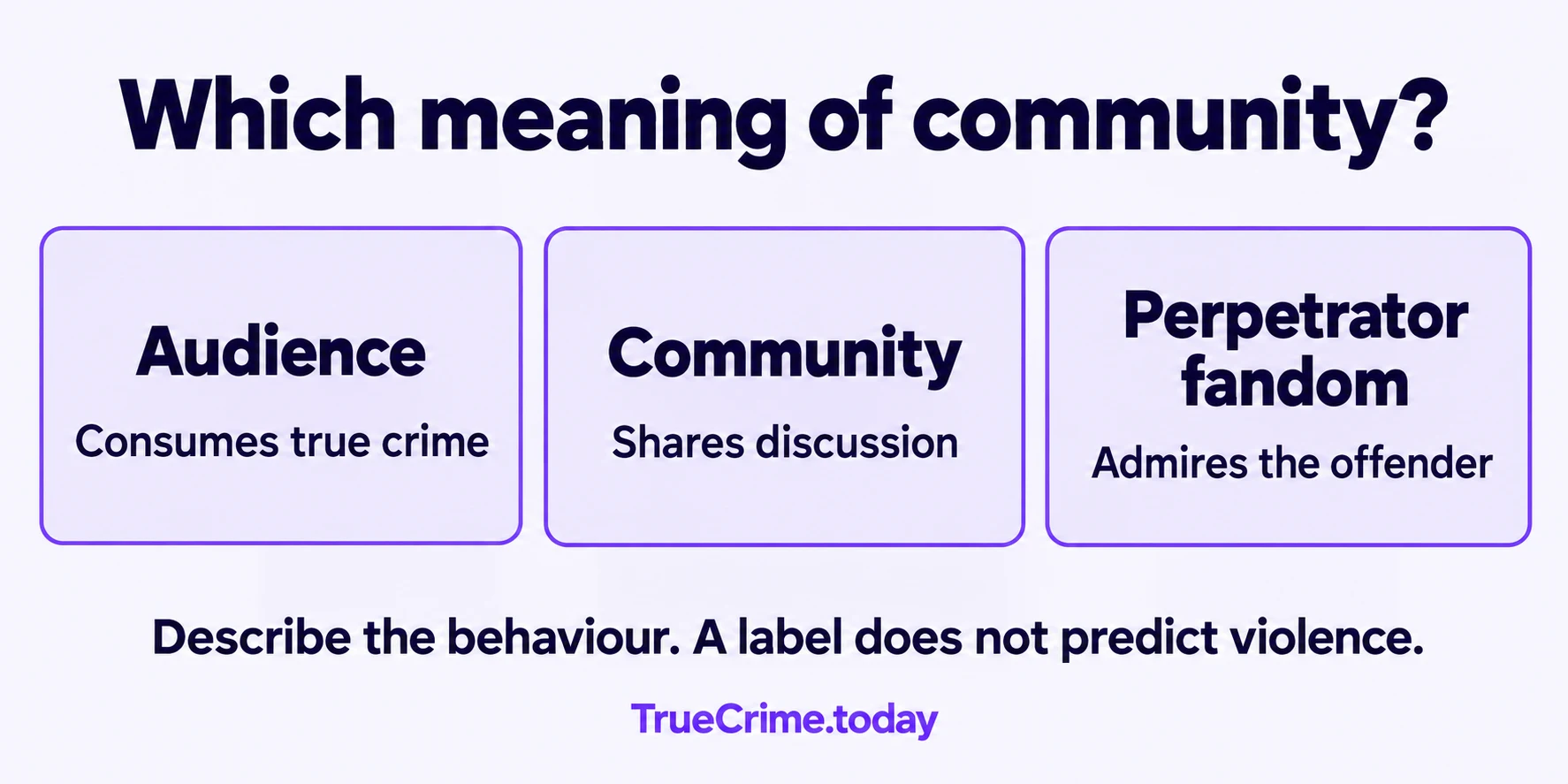
The diagram separates meanings, not stages. A person does not inevitably move from listening to admiration or violence, and the boxes are not a risk score.
Understanding a case without celebrating its perpetrator
You can ask why someone committed a crime without treating their explanation as an excuse. You can study manipulation, investigate an investigative failure or question a conviction while keeping the people harmed in view. The question is what the discussion does with that interest.
An analysis might compare an account with the record and explain where the account fails. A celebratory edit might remove the harm and turn the offender into an attractive character. Both use details from a crime, but their purposes are different. Looking at what was left out often tells you more than arguing over whether the creator calls it “research”.
That also matters for publishers. Choosing a dramatic photograph, thumbnail or title affects who becomes the centre of the story. A community may challenge that framing rather than pass it on unchanged.
Why belonging can help and mislead
Other readers can notice a missing qualification, explain an unfamiliar term or point out that an old report has been superseded. A good exchange leaves you with a clearer question and a better account of what is known. You do not have to become an amateur investigator to benefit.
The same sense of belonging can make disagreement harder. If a favourite account is treated as the group’s identity, correcting it can feel like disloyalty. A member may then defend the story instead of checking it. This is a possible pattern in a group, not a finding that every community behaves that way.
A simple boundary helps: loyalty to people should not require loyalty to a mistake. A correction that changes the group’s account is a sign of learning, even if it makes yesterday’s confident comment awkward.
What we can measure, and what remains uncertain
Before accepting a statistic about “the community”, ask who was counted. Listeners, active posters, followers of selected accounts and participants in a particular network are different populations. A large number of posts may also come from a small number of people.
A representative survey can estimate an answer within its sampled population. Interviews can examine experiences in depth. Observing a selected harmful network can document its behaviour. None automatically supplies the missing denominator for the others. Counting threats in a selected network does not give the probability that a randomly chosen listener will threaten someone.
We also lack a verified global membership register or a single agreed boundary around the term. That uncertainty should narrow a claim, not erase documented harm. “This report found this behaviour in these spaces” can be both serious and accurate.
A small test for reading a claim about TCC
Take one headline and open the underlying report, rather than trying to map the whole internet. Search the text for its definition of TCC, then find the methods and dates. Does it describe ordinary audiences, a selected fandom or people already involved in harmful activity?
Next, compare the headline with one claim in the report. Has “some accounts” become “the community”? Has an observation become a prediction? Note the population, period and behaviour in a sentence of your own. You can use a browser’s find function and a short note; you do not need to save strangers’ profiles or collect private information.
If the report supports the claim, keep the relevant qualification when sharing it. If the headline overstates it, explain the mismatch. This is a better first step than joining a group just to confront its members.
Questions about the true crime community
Does listening make me a member?
It makes you part of an audience. Whether you belong to a community depends on connection and participation, and on how you understand that connection. You do not acquire an obligation to post, investigate or defend strangers because you enjoy a genre.
Is TCC one organisation?
The sources discussed here do not describe a single organisation encompassing all true-crime audiences. The label can cover different spaces and, in some research, a narrower subculture. Treat claims of a common leader, belief or purpose as claims needing evidence.
Does concern about violence justify treating every fan as dangerous?
No. Concern should follow the evidenced behaviour and context. Glorification, harassment and threats deserve attention; ordinary listening does not establish any of them. Being precise helps us take real harm seriously without accusing people on the basis of an interest.
Keep the people and the evidence in view
The next time you see “true crime community”, ask what the writer means before accepting the rest of the sentence. Is it an audience, a conversation or a perpetrator fandom? What behaviour supports the claim?
You can then choose a discussion space with a clearer purpose: one that welcomes questions, keeps the record in view and can correct itself. Shared interest should help people understand a story, without making the people harmed disappear from it.
Have a question about a community claim or a research definition? Send the public source and the sentence you mean. Do not send passports, contracts, bank details or other personal documents.
Ask about a definition