True crime in Brazil: cases, court records and the bigger picture
Understand true crime in Brazil through the Evandro case, Boate Kiss and Vladimir Herzog, with Brazilian court terms, original records and crime-data limits.
True crime in Brazil can take you from a disappearance in a small coastal town to a crowded nightclub, then back to a journalist’s death under the military dictatorship. If you arrived through a documentary, the first question is simple: where does the programme leave the story, and what happened afterwards?
Short version
Brazilian true crime includes individual crimes, disputed investigations, institutional violence and the long effort to establish responsibility. This introduction uses three different entry points: the Evandro case, the Boate Kiss fire and Vladimir Herzog’s death. Their records raise different questions about evidence, sentencing and historical accountability. Keep the place, period and court decision beside each account. A famous case tells you about those people and proceedings; national crime statistics answer a broader question.
What belongs under true crime in Brazil?
The geographical connection matters more than the language of the programme. A Brazilian case can appear in an English podcast, a Portuguese documentary or a translated news report. Its setting, participants and legal history remain Brazilian.
If you enjoy following evidence rather than guessing an ending, this is a rich subject. You encounter local reporting, federal and state institutions, appeals and archival records. The range also challenges the familiar idea that true crime must revolve around a serial killer. A fatal fire or a state cover-up can demand just as much attention to responsibility and proof.
The broader definition of true crime includes factual storytelling about crime and its consequences, so the genre can follow survivors, wrongful convictions and the justice process as closely as the original offence. That matters here because a later decision can change the meaning of a well-known story.
An American courtroom programme can give you the wrong expectations for a Brazilian hearing. Under the Brazilian Code of Criminal Procedure, seven jurors form the deciding council for a jury session, and decisions use majority voting. Articles 447 and 489 set out those rules. You should not expect every Brazilian jury story to turn on twelve people reaching unanimity.
Which Brazilian cases offer a useful starting point?
The Evandro case concerns the death of a child in Guaratuba, Paraná, in 1992. It is a starting point for understanding how an investigation’s account can unravel. In September 2025, the Superior Tribunal de Justiça, or STJ, upheld the acquittals of four people after finding that the convictions relied on illegal evidence obtained through torture. The court’s account concerns those acquittals; it does not identify a different killer. Keep that distinction when a retelling promises to “solve” the story.
Boate Kiss concerns a nightclub fire in Santa Maria, Rio Grande do Sul, in 2013. Here, the useful question is how courts handle responsibility for a mass-fatality event and the punishment that follows. In its September 15, 2026 notice, the STJ described a sentencing appeal that paused after the reporting judge’s vote. Another judge requested time to examine the case. That proposed outcome was still a vote in an unfinished deliberation in the notice, so a headline about increased sentences needs careful dating.
Vladimir Herzog takes you to São Paulo in 1975, during the military dictatorship. The National Archives’ account describes his torture and killing in military custody, the suicide story authorities originally circulated, and the later correction of his death certificate. It also records the Inter-American Court’s 2018 finding concerning crimes against humanity. This is an entry point into the evidence behind an official cover-up and the different forms of accountability pursued afterwards.
These examples are selected for their different questions, rather than ranked by how shocking they are. If one interests you, retain its Portuguese name while searching. Caso Evandro, Boate Kiss and Vladimir Herzog will help you match later reporting to the right subject.
When you compare a programme with a later ruling, checking claims against court records helps you separate the narrator’s reconstruction from the finding the court actually made. Write down the exact proposition you want to check, such as “the sentence increased,” rather than collecting everything with the same case name.
Can crime statistics put these stories in context?
Yes, provided you keep the measure and year attached. The Atlas da Violência 2026, produced by Ipea and the Brazilian Public Security Forum, reports 42,590 officially recorded homicides in 2024, compared with 45,747 in 2023. It reports a 20.1 per 100,000 rate for 2024 and warns that worsening data quality complicates interpretation of the decline. The report’s publication year and the deaths’ reference year are different.
The change in those recorded counts is 3,157 fewer deaths: 45,747 minus 42,590. Dividing that difference by the 2023 count gives approximately 6.9%, matching the report’s rounded decline. That calculation describes the recorded series. It cannot establish that the underlying risk fell by exactly the same amount when classification quality changed.
Nor can you turn that national rate into a person’s risk on a particular street. Places, populations and types of violence differ. Likewise, the cases that reach international streaming services were selected for a story; they were never a random sample of Brazilian crime.
Why do different Brazilian crime datasets disagree?
The Ministry of Justice’s Sinesp system collects police-recorded categories, while the Atlas draws on health-system mortality records. Police reporting and death registration answer related questions through different systems. Their definitions, recording dates and later revisions need to be examined before comparing totals.
An apparent disagreement can begin with the category. A count of intentional homicides, a count of deaths during robbery and a mortality-based homicide series need not cover identical events. Before calling a chart misleading, ask what its label includes and excludes.
If the accompanying text does not tell you the geography, reference year, unit and data source, pause the comparison. A screenshot containing one impressive number gives you very little basis for judging a trend.
Which Portuguese court terms change the meaning of a headline?
The terminology matters too. Pronúncia is a judge’s decision that sends an accusation forward to a jury when the statutory evidential conditions are met. Article 413 concerns evidence that the event occurred and sufficient indications of authorship or participation. A report that somebody was “pronunciado” needs that procedural meaning; it does not announce the eventual finding of guilt.
Two other words help you follow the next stages. Condenação refers to conviction. Absolvição refers to acquittal. A recurso is a challenge to a decision, and its subject determines what the reviewing court is being asked to change. A sentencing challenge and an attempt to overturn a conviction can lead to very different headlines.
What does a later court decision actually change?
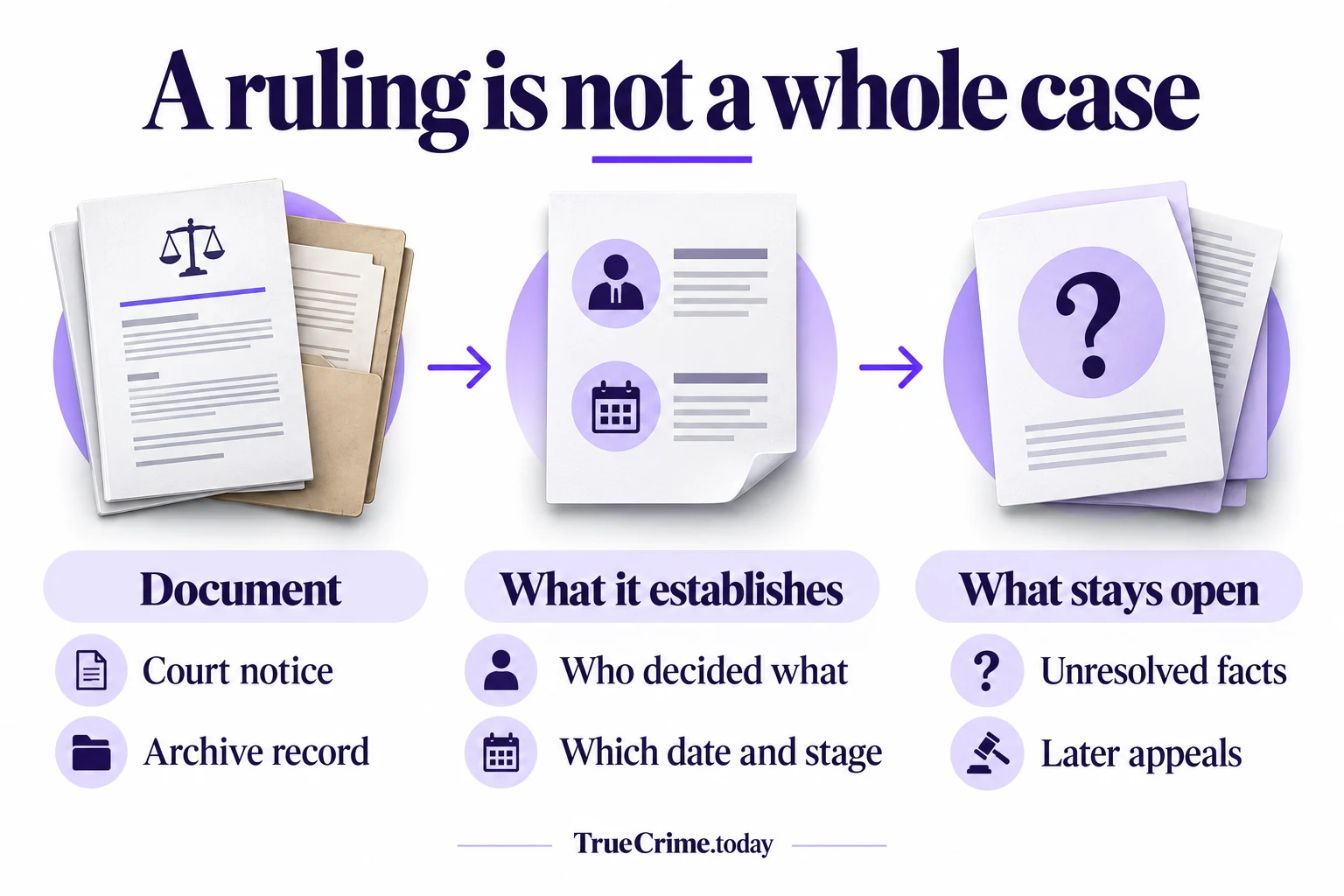
Start with the question the court had to answer. If lawyers disputed the sentence, find the punishment the court adopted and its reasons. If the challenge concerned illegal evidence, establish which material was excluded and what happened to the conviction. If one judge delivered a vote and the sitting paused, keep the collective result open.
That distinction explains why “the case is back in court” is too vague to tell you much. The people involved can remain the same while the legal question changes. You need the document’s date, court, scope and outcome before connecting it to an older documentary.
How do you find the record behind a Portuguese headline?
Keep the original case name and add one concrete detail: the city, court or year. A person’s name alone can bring up unrelated proceedings. Court acronyms help narrow the search. TJPR refers to Paraná’s state court; TJRS to Rio Grande do Sul’s. STJ and STF name different national courts, and their decisions require their own context.
Once you find a result, distinguish the court’s communications page from the actual decision. A court notice can accurately describe an outcome while leaving out the full reasoning and procedural record. A prosecutor’s announcement explains that prosecutor’s position. A documentary can supply interviews and chronology. Each has a use, but they do not establish every assertion equally.
For a historical story, an archive or truth-commission record can be more useful than the current criminal docket. Herzog’s case makes that particularly clear: the original official account itself became part of the problem that later evidence challenged.
What should you look for in a documentary or podcast?
First, identify its cutoff date. Then ask whether it distinguishes an allegation, an established event and a court finding. Interviews can reveal experiences that a judgment summarises briefly. Editing can also hide a question, compress a timeline or leave a later appeal outside the story.
Look for enough attribution to retrace important claims. “Investigators believed” tells you who held a theory. “The court found” should correspond to an identifiable decision. Anonymous narration that moves between those phrases makes an account harder to evaluate.
You can still enjoy the programme while leaving a question unanswered. The missing ending is particularly important in a disputed investigation: accepting that a prosecution failed does not require adopting the next theory circulating online.
What is worth keeping in mind before you share a theory?
Keep the victim and affected families in view. Their lives extend beyond the details selected for a programme. An old accusation, copied without its later acquittal, can continue to harm somebody long after the original case changed.
If you share a claim, give its date and identify whether it comes from a participant, an investigator or a court. Avoid contacting private individuals, circulating addresses or treating appearance and demeanour as proof. A strong question about an evidential gap is more useful when another reader can follow the same record.
The last time we checked the legal and statistical material discussed here was October 7, 2026. For your next Brazilian case, keep four things together: the original name, the place, the dated decision and the question still unanswered. They will help you follow the story when the next episode or headline arrives.
Have a question about a Brazilian case name, court term or statistic discussed here? Send the public link and date. Do not send personal documents, witness contacts or private case files.
Ask about a Brazilian case record