True crime in France: cases, courts and the records behind them
Read about true crime in France through Dreyfus, Outreau and the Klaus Barbie trial. Understand French court terms, historical archives and documentary claims.
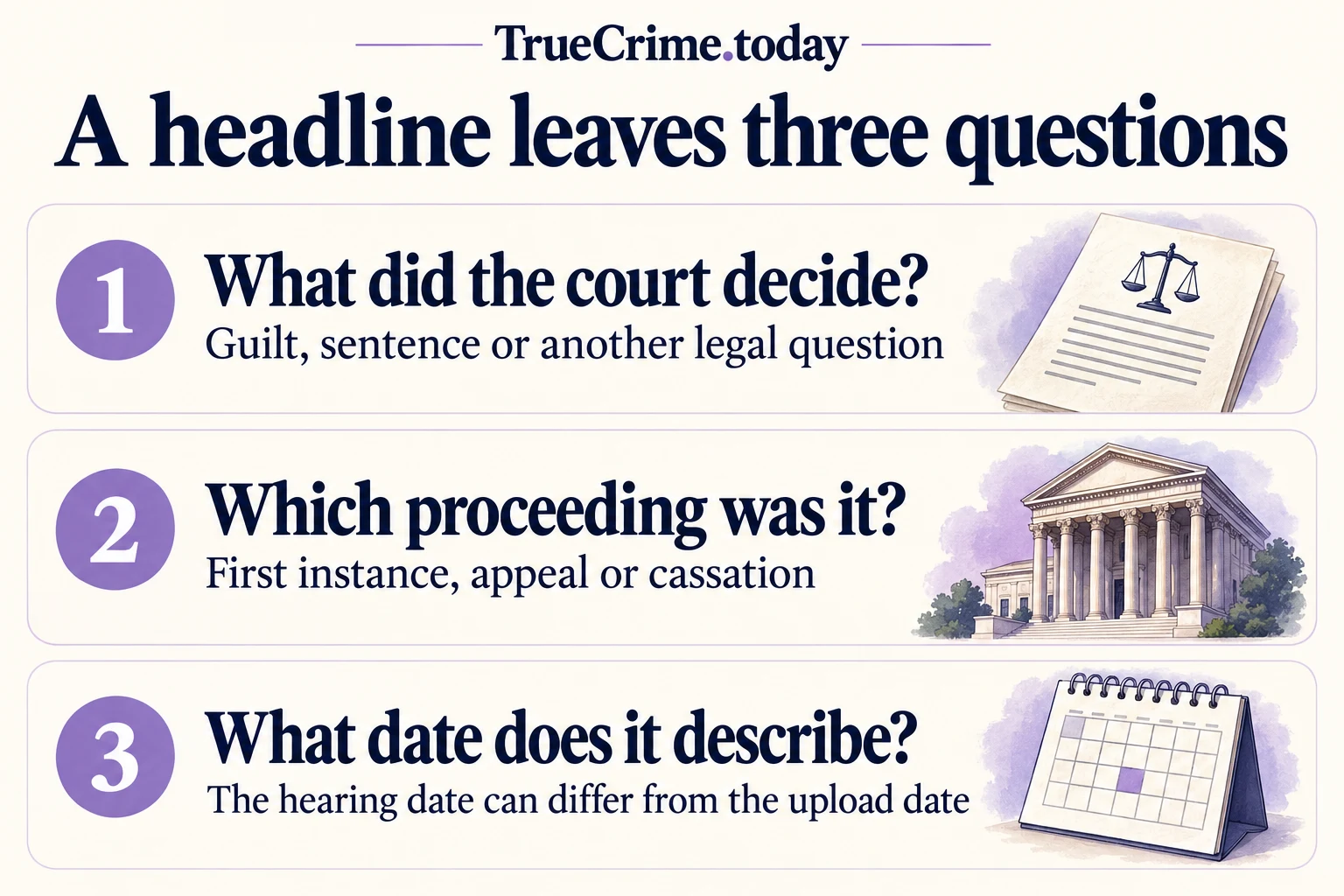
You finish a French crime documentary and search for what happened next. One result says the conviction was overturned; another still calls the person guilty. Before choosing which account to trust, you need the date and the decision behind each headline. True crime in France gives you plenty of gripping stories, and their court records often change how you understand them.
TL;DR
Start with the Dreyfus affair for wrongful conviction, Outreau for investigative failure and the Klaus Barbie trial for historical accountability. Keep the French case name when searching. Then check which court spoke, what it decided and when. A documentary, a parliamentary hearing and a criminal judgment can all tell you something important, but they answer different questions.
What counts as true crime in France?
The country belongs to the events and proceedings. A French filmmaker can investigate an American prosecution; an English-language documentary can follow a French one. If you are searching by country, that distinction saves you from a surprisingly muddled collection of recommendations.
The broader meaning of true crime includes accounts of investigations, victims, prosecutions and miscarriages of justice. That leaves room for a nineteenth-century espionage accusation as well as a modern murder inquiry. You can follow the people and the evidence without needing every story to have the same kind of ending.
Which French cases should you start with?
The Dreyfus affair: Alfred Dreyfus, a Jewish French army officer, was wrongly convicted in a case shaped by antisemitism. The Court of Cassation annulled the Rennes conviction without sending it back for another trial on July 12, 1906. Start here if you want to examine how an accusation survives challenges to its evidence, and what finally changes an official account.
Outreau: the child sexual-abuse proceedings produced thirteen acquittals and four convictions against defendants who did not appeal. The 2006 parliamentary inquiry into Outreau examined how the justice system failed the people wrongly accused. Those acquittals belong alongside the abuse established against the convicted defendants. Leaving either part out changes the story and harms the people involved.
The Klaus Barbie trial: the 1987 proceedings in Lyon addressed crimes against humanity associated with the former Gestapo chief. The trial was filmed, and the recording became a judicial archive. Start here for testimony, historical responsibility and the question of what a court can establish decades after the acts it examines.
These are three entry points with different evidence problems. They are not a sample from which you can calculate how often French courts get things wrong.
What does “the conviction was overturned” actually mean?
First ask whether you are reading about an appeal, cassation or revision. An appeal can lead to the case being heard again within the scope of the appeal. In a criminal case, a challenge can concern the sentence without challenging guilt. That scope matters before you describe a defendant as cleared.
Under the official explanation of cassation in French criminal proceedings, the Court of Cassation checks the application of law and procedure rather than examining the facts all over again. An annulment may lead to another hearing. You need the operative part of the decision to know what happens next.
Révision concerns a final conviction and a new fact or previously unknown element capable of establishing innocence or raising doubt about guilt. Asking for revision and obtaining it are different events. A headline announcing an application cannot tell you that the conviction has been annulled.
How do you find the record behind the retelling?
Keep the original spelling of the person’s name, the court and the place. Combine them with the French term you need: arrêt for a court decision, appel for appeal, or révision for revision. A search for Outreau plus rapport 3125 leads to the parliamentary inquiry rather than another documentary recap.
The habit behind careful case analysis is to give each claim a source that can actually support it. A judgment tells you what the court decided. A parliamentary report examines institutions. A witness’s interview tells you what that person recalls or describes. Compare them where they address the same event, and keep their different roles visible.
Try it with one sentence from a programme: “The court accepted the evidence.” Which court, in which proceeding, and was it ruling on admissibility, guilt or something else? Once you can answer those questions, the sentence becomes much easier to check.
Why might a serious-crime trial have no public jury?
France uses more than one criminal court. A cour criminelle départementale consists of five professional judges. Its first-instance jurisdiction includes adults accused of crimes carrying fifteen or twenty years’ imprisonment, subject to conditions including legal recidivism and the eligibility of co-defendants.
A cour d’assises includes professional judges and citizen jurors in ordinary cases. Specially constituted courts have different arrangements. When you see the word “court” in a caption, find its full name before importing expectations from an American courtroom video.
The absence of a public jury needs an explanation of the court’s jurisdiction. It cannot, by itself, establish that officials quietly removed the jury from a particular case. The same care applies to older trials: today’s court structure does not explain every historical proceeding.
What can the three cases teach you about evidence?
Dreyfus gives you an unusually clear historical endpoint: the 1906 annulment without remittal. A new commemoration of that decision can bring the affair back into the news without changing its legal outcome. Separate the date of the article you are reading from the date of the judgment it describes.
Outreau asks you to hold two difficult facts together. People were wrongly accused, and children were abused by people who were convicted. A serious account needs to examine how particular allegations were tested, how detention decisions were made and what the eventual judgments established about each defendant. “Everything was invented” erases the children’s experiences; repeating discredited accusations injures the acquitted people again.
Barbie brings another problem: an authentic recording can still reach you as a short edited extract. Check who is speaking and where the clip sits in the hearing. A survivor describing an event, a lawyer asking a question and a defendant answering it each have different roles. A few seconds of someone’s expression cannot settle the truth of an allegation.
Where do you look for historical material?
Court websites and Légifrance are useful for identifiable decisions. The National Archives, departmental archives and the INA catalogue help you find historical documents and audiovisual records. A catalogue entry may describe an item that you need to request or consult under access conditions.
In 2017, the French justice and culture ministries announced the opening for research of records relating to the Barbie trial held by the National Archives and the Rhône/Lyon archives. The INA catalogue also identifies the trial recording and its deposit in 1987. Those records help you establish that footage exists and where it belongs.
Research access does not automatically give you permission to republish a document or upload an extract. Check the item’s consultation and reuse conditions. For your own reading, even the catalogue description can help distinguish courtroom footage from a later reconstruction.
Do these stories tell you how dangerous France is?
They tell you about the people and events they cover. To examine frequency, you need a dataset with a defined population, period and offence category.
The French statistical service SSMSI’s publication about recorded crime in 2025 uses eighteen main police and gendarmerie indicators. It also consolidates figures to account for reclassification during criminal proceedings. That explains why a later official series can differ from an early news report without either number having been invented.
A police-recorded offence count depends on reporting and recording. A victimisation survey asks a sampled population about experiences, including some that were not reported. Their differences deserve explanation before you compare them. Neither a dramatic case selection nor a changing documentary catalogue measures your personal risk.
What should you check after watching a documentary?
Write down its release date and the latest event it covers. Then search the original case name with the court and the relevant proceeding. An old programme can contain useful interviews while missing a later appeal; a new upload can still recycle an old film.
The last time we checked the French procedure and archive sources used here was October 8, 2026. Service Public had updated its cassation explanation on October 1. For any individual case you follow next, check its own later decisions rather than treating a general explanation as a current case update.
If you want to discuss a disputed point, bring the exact claim, date and public record. That gives other people something they can check with you, and it keeps the conversation anchored to the people and proceedings the story is about.
Have a question about a French court term, archive entry or case date discussed here? Send the public link and the claim you want checked. Do not send personal documents, private case files or witness contact details.
Ask about a French case record