True crime in Germany: cases, court records and the numbers behind the headlines
True crime in Germany through Hinterkaifeck, the NSU and Hanau: court records, German procedure and what the 2025 police figures can tell you.

True crime in Germany can take you from an unsolved Bavarian farm killing to a modern terrorism judgment. If a documentary has left you wanting the original records, start with the place, the person and the decision it describes. Those details will save you from treating a police announcement as the final word on a case.
TL;DR
German true crime covers real cases in Germany, across different periods and legal settings. Hinterkaifeck, the NSU and Hanau offer very different starting points: an unresolved historical killing, convictions with later appeal decisions, and an attack followed by an investigation into possible additional involvement. German police statistics count recorded offences, while courts determine individual cases. Public hearings generally do not come with a public video feed or an unrestricted case file.
What belongs in true crime in Germany?
A German setting gives you a location to investigate. You still need to know whether the story follows a trial, an unresolved investigation or a historical account assembled much later. A film can move between all three without telling you when the evidence changes.
If you are choosing a programme, the nonfiction boundary of true crime matters most when a reconstruction supplies dialogue or a suspect’s thoughts. Ask which parts come from a document, which come from an interview, and which the filmmakers invented to make the scene work.
Germany also has regional authorities. A Bavarian archive and a court in another Land, or federal state, can hold different kinds of records. A national search that finds nothing may simply be looking in the wrong collection. Keep the original town and court name alongside the English spelling.
Which German cases offer a place to begin?
Hinterkaifeck is a useful starting point for historical-source questions. Six people were found dead at the Bavarian farm on April 4, 1922. The Bavarian State Archives describe unsuccessful investigations and surviving police records. A retelling that names a likely killer needs evidence beyond the archive’s account of the unresolved crime.
The NSU case takes you into racist terrorism and individual criminal responsibility. The National Socialist Underground murdered victims across several cities. The Federal Court of Justice’s August 2021 announcement concerns three defendants and their particular convictions; it cannot answer every question about the network or the agencies that failed its victims.
Hanau raises another distinction. After the racist attack of February 19, 2020, federal prosecutors investigated possible involvement by other people. Their December 2021 announcement ended that investigation for lack of sufficient factual indications of additional participation. That decision was a prosecutorial outcome, rather than a court acquittal.
These examples let you choose a question before choosing a theory. You might want to understand an archive gap, a defendant’s legal responsibility, or how investigators handled a lead. Our methods for case analysis help you keep those questions separate when several claims arrive in the same episode.
What do Germany’s 2025 crime figures tell you?
A famous case can make an entire country feel dangerous. To test that impression, you need a wider measure, with a definition and a year. You also need to know what it leaves out.
The federal government’s 2025 police crime summary, published on April 20, 2026, reports about 5.5 million recorded offences, down 5.6% from 2024. Recorded violent crime fell 2.3%. Those are changes in police-recorded cases; neither percentage measures the chance that a particular person will be attacked.
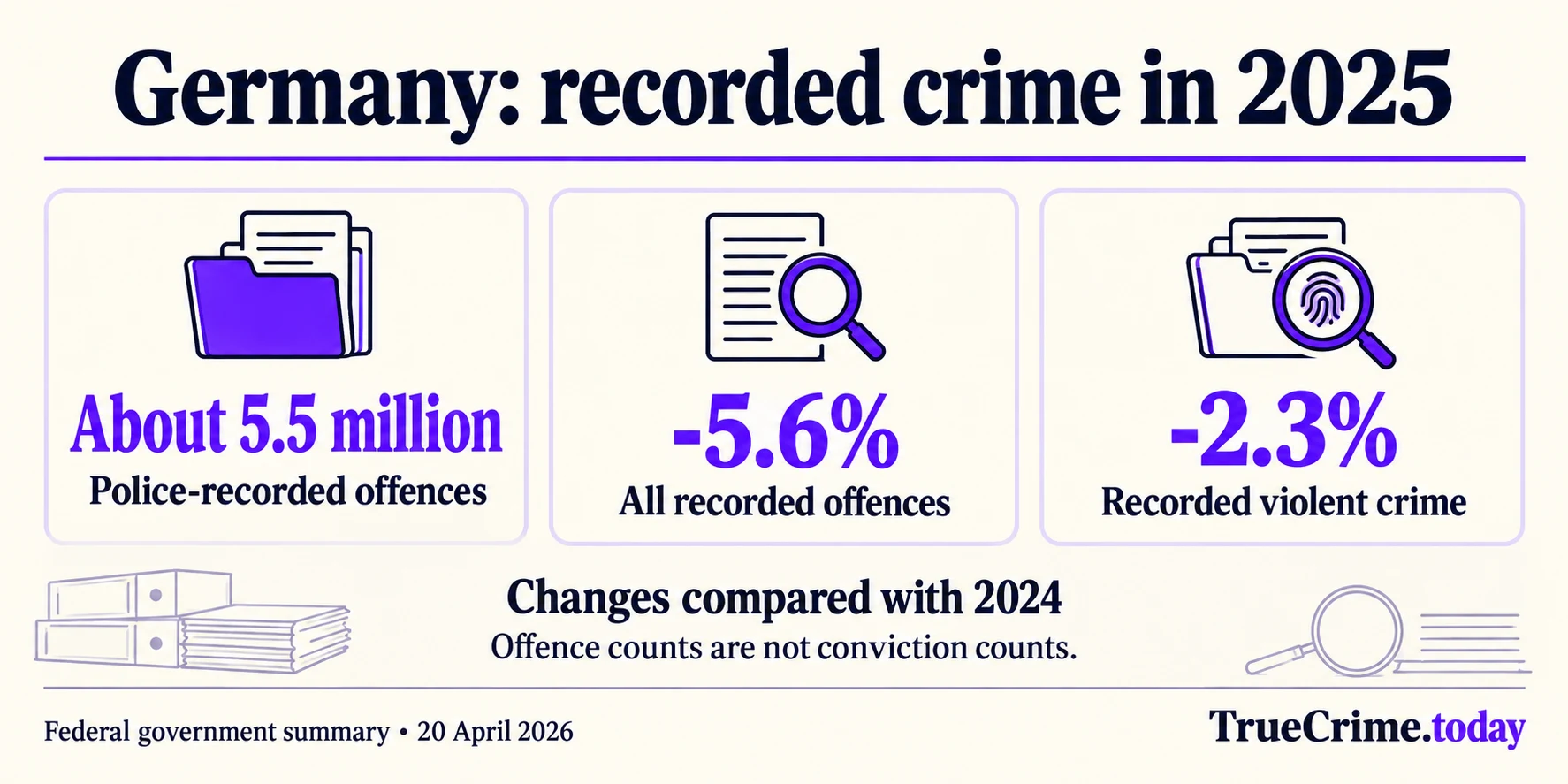
The graphic uses the government’s rounded total and keeps the reporting period visible. A fall in the overall total can coexist with increases in some categories. Changes in reporting, police activity and criminal law can also affect what enters a recorded series.
Destatis explains another trap: police cases and suspects are different units from people convicted by courts. Some offences remain unsolved, some suspects are never charged, and some proceedings end without conviction. Police and court statistics also have different coverage.
Imagine a fictional dataset with 100 recorded offences and another with 20 convicted people in the same year. Dividing 20 by 100 gives you 20%, but you have not calculated the probability of conviction. One person might face several offences, and a judgment might concern events from an earlier year. The dates and the units must match before a ratio can mean what you want it to mean.
How does a German case reach a verdict?
You may be able to attend a hearing, yet find no recording afterward: section 169 of the Courts Constitution Act makes hearings public while generally prohibiting sound and film recordings intended for publication. That difference explains why a documentary may rely on a reporter’s notes rather than courtroom footage.
The public prosecutor investigates whether there are grounds to bring charges. Section 160 of the German Code of Criminal Procedure, the StPO, requires investigation of both incriminating and exonerating circumstances. Section 170 distinguishes bringing public charges from ending the investigation when sufficient grounds are absent.
The court then makes its own decision about opening the main proceedings. Under section 203, that requires sufficient suspicion arising from the preliminary investigation. Opening a trial does not establish guilt. The court evaluates the evidence presented during the hearing as a whole under section 261.
Why can’t you watch every hearing online?
If you follow American televised trials, that missing footage can feel like a missing piece of evidence. In a German case, first ask what the cameras were allowed to record. Arrival footage, pictures taken before proceedings and a reconstructed exchange serve different purposes.
The recording rules contain specific exceptions. Courts can permit recordings for scientific or historical purposes in proceedings of outstanding contemporary historical importance. Special permission can also cover certain Federal Court of Justice decision announcements. Neither exception creates a general right to stream ordinary testimony.
So a dramatic courtroom scene needs a plain explanation of its origin. Was a camera present during the actual exchange? Was an actor reading a documented passage? Or did the production reconstruct the scene from a journalist’s recollection? A convincing performance cannot resolve that distinction for you.
Where can you find a decision rather than a retelling?
Start with the issuing authority and the document identifier. For a court decision, save the court, date and Aktenzeichen, the case number. For a police announcement, keep the police authority and publication date. For a prosecutor’s release, note whose investigation it describes.
The NSU example shows why dates matter. The Munich Higher Regional Court delivered its judgment on July 11, 2018. The Federal Court of Justice issued the relevant revision decisions on August 12, 2021, and announced them on August 19. A headline from the announcement day describes a later review of particular defendants’ convictions, not a new trial of every event in the story.
A press release can help you find that decision, but it usually gives a shorter account. If the written reasons are available, they may answer a question the announcement barely mentions. If they are unavailable to you, say which document you have rather than filling the gap with a summary from another channel.
Defence rights to inspect a case file under section 147 StPO also do not give every viewer access to the same material. A public hearing, a published decision and the complete investigation file are separate things.
What changes when you read a historical case?
Historical investigations used the institutions, technology and legal rules of their period. Before judging an old omission, find out what the surviving collection actually contains. A modern archive catalogue can identify a file without reproducing everything inside it.
At Hinterkaifeck, the archive account says the weapon was found during demolition in 1923, after the bodies were discovered in 1922. It also describes more than 100 unsuccessful investigations by 1930. That tells you about the sequence and the scale of the investigative effort. It supplies no mathematical probability that a popular suspect committed the crime.
The archive’s 2026 exhibition ran from March 17 to April 10. Its description remains a useful starting point after the exhibition has closed. Keep the dates straight: a recent exhibition about an old case is a new presentation of historical material, not necessarily a new breakthrough.
Does a final decision settle every question?
A final conviction fixes a particular legal outcome. It can leave broader questions about official conduct, other people’s knowledge or victims’ treatment unresolved. To ask those questions fairly, identify which finding you accept and which additional issue you want examined.
The reverse matters too. The Hanau prosecutor’s decision about possible additional participants cannot be turned into a blanket judicial endorsement of everything authorities did. A criminal investigation has its own subject and evidential threshold. Other scrutiny can ask different questions.
You can demand strong lawful accountability for proven offences and careful attention to survivors without treating every unresolved criticism as a fresh accusation against a named person. Give a criticism the strongest available evidence, then describe its actual reach.
How should you compare two accounts?
Suppose two programmes disagree about when investigators recognised a connection. Put the competing statements side by side in your notes. Ask who said each one, when, and whether both programmes rely on the same interview.
Then identify the disputed event. Recognition by one officer, a formal change in an investigation and a public announcement can happen on different days. A disagreement may concern the meaning of “knew” rather than the date itself.
A useful account helps you separate those events and gives you enough detail to check them. Repeated certainty without a document, an attributable witness or a clearly explained inference gives you little to work with, even when many channels repeat it.
What should you keep from your next episode?
Keep one claim worth checking, the authority closest to it and the exact document or quotation it depends on. That small set of notes will do more for your understanding than a long list of suspects.
The last time we checked these sources was October 10, 2026. The figures above concern 2025 police records; the brief case examples point to particular archive and legal records. If a new announcement appears, ask which part of the story it changes before rewriting your view of the whole case.
Have a question about a German case record or a figure used here? Send the public source and the exact claim. Please keep passports, contracts, bank details and private case documents out of the contact form.
Ask about a German source