True crime in Italy: cases, appeals and the stories behind the numbers
True crime in Italy through the Meredith Kercher, Talpis and Matteotti cases: court outcomes, Italian appeals and the limits of homicide statistics.
A documentary ends with a verdict. Then you search the case and find another verdict, a different court and an argument about what the police did years earlier. Italian true crime can feel like that: the story carries on after the episode has told you it is over. The first question is whether those decisions even concern the same accusation.
TL;DR
True crime in Italy includes disputed murder prosecutions, violence inside families and political killings, alongside organised crime. Start with the case’s location and the decision you are reading. A first-instance judgment, an appeal and a human-rights ruling answer different questions. Italy recorded 327 homicide victims in 2024, but a national total cannot tell you how safely a particular person lives.
Where should you start with true crime in Italy?
Choose the question that interests you, then follow the documents. If you want to understand a contested prosecution, the murder of Meredith Kercher leads into appeals and the handling of evidence. If you want to know what authorities owe someone reporting abuse, Elisaveta Talpis’s case raises the question of protection before a fatal attack. For a historical story, the killing of Giacomo Matteotti takes you into political violence and the records a dictatorship leaves behind.
These are starting points, rather than a ranking of the most shocking deaths. Each gives you a different way to read an Italian case. Our explanation of what true crime is helps with that first choice: a real event is the subject, but the account you encounter has an author, a selection of sources and a point of view.
Keep the victim’s name in the picture as you follow the legal argument. An international series may put its best-known defendant on the cover. That tells you who attracts an audience; it does not tell you whose life was lost or which findings the court actually made.
Why does the Meredith Kercher case have more than one ending?
Different proceedings can produce different answers about the same people. Meredith Kercher was killed in Perugia in 2007. In March 2015, Italy’s Court of Cassation set aside the murder convictions of Amanda Knox and Raffaele Sollecito without sending those charges back for another trial. That outcome matters when an older episode ends with their conviction.
But the murder charge was not the only issue involving Knox. Her accusation against Patrick Lumumba led to separate proceedings for calunnia, a false accusation of an offence. In its 2019 account of Knox v. Italy, the European Court of Human Rights described violations involving access to a lawyer and interpreting assistance during questioning. It was examining rights in those proceedings, rather than delivering another verdict on Kercher’s murder.
There is another distinction inside that judgment. The court found a failure to investigate Knox’s allegations of ill-treatment, while it did not find the alleged ill-treatment itself established. “The complaint was not properly investigated” and “the alleged acts were proved” are different findings. A retelling that drops that distinction can give you a much stronger conclusion than the judgment supports.
What can an Italian appeal actually change?
Find out whether the court upheld, changed or set aside the earlier decision. Italy’s national procedure guide on the European e-Justice Portal describes first-instance proceedings, appeal and Cassation. That does not mean every case passes through all three stages. The guide also describes special procedures, and a judgment can become final when the time to challenge it expires.
On appeal, an earlier judgment may be upheld or changed, in whole or in part. Cassation reviews challenges on grounds specified by law. Its possible outcomes include rejecting a challenge, setting aside a judgment without referral, or setting it aside and referring the case back. “The Supreme Court overturned it” leaves out the part you most need to know: what happened next?
Our method for analysing a case uses the same document check: identify the court, the date, the person and the issue before comparing two conclusions. An appeal about one defendant or one charge cannot safely be treated as the outcome for everyone in the story.
What do Italy’s homicide figures measure?
They describe recorded intentional killings, not everything you might call crime. Istat’s report on homicide victims in 2024 uses police information from the Interior Ministry’s criminal-police database. It reports 327 victims, compared with 334 in 2023: a fall of seven, or about 2.1%.
The report puts the 2024 homicide rate at 0.55 victims per 100,000 residents. That rate gives the population size alongside the count. It is not a measure of theft, sexual violence, stalking or fraud, and it cannot tell you whether a specific threat has been taken seriously.
There is a useful check on the familiar mafia picture, too. The report places 21 victims, all men, in the organised-crime homicide category. That is about 6.4% of the 327 victims, calculated as 21 divided by 327. It does not measure organised crime’s economic reach, intimidation or nonfatal offences. It does show why a guide to Italian killings needs room for stories beyond organised crime.
Does a low homicide rate mean everyone is equally safe?
No. The overall rate can conceal very different relationships and circumstances. Of the 116 female homicide victims recorded in 2024, 62 were killed by a current or former partner. Dividing 62 by 116 gives about 53.4% of female homicide victims. Keep that denominator in mind: this is not the percentage of Italian women killed by partners.
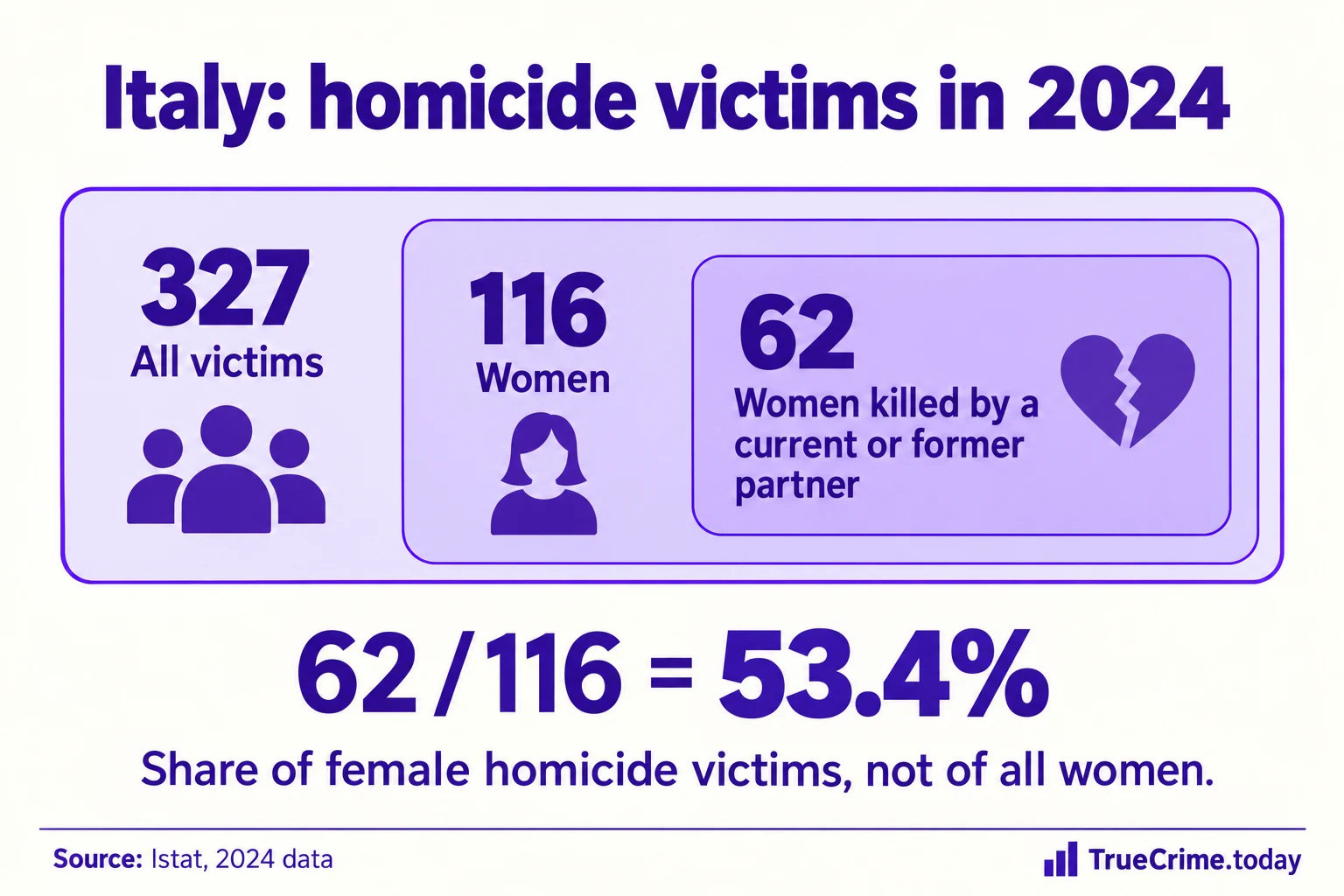
The diagram keeps those groups inside one another so that the calculation has a visible meaning. A small national homicide rate and a large partner-related share among women killed can both be true. They answer different questions.
That matters when you hear “Italy is safe” used to brush aside an account of abuse. A population statistic cannot assess the danger in a particular home. It also cannot show how many people survived an assault or lived with threats that never appeared in the homicide figures.
What does the Talpis case add to the picture?
It asks what happened before the killing, when protection was still possible. In its account of Talpis v. Italy, the European Court of Human Rights described a formal complaint in September 2012 and questioning that did not take place until April 2013. In November 2013, Talpis’s husband killed their son and attempted to kill her. The court’s release records his life sentence in January 2015.
The Strasbourg judgment followed in March 2017. It found failures by the Italian authorities to protect Talpis and her son, alongside other Convention violations. The husband’s punishment and the state’s responsibility were separate questions. Putting someone in prison after an attack does not, by itself, answer whether earlier warnings were handled properly.
That is why strong lawful accountability needs both parts: punishment for proven offences and effective protection when authorities know about a serious threat. The Council of Europe’s follow-up account describes reforms after the events. Those changes deserve attention, but a new rule on paper is not proof that every later complaint receives an adequate response.
How does a historical case change the reading?
You need to know when a source was created and why it exists. Giacomo Matteotti, a socialist deputy and opponent of fascism, was abducted in Rome on June 10, 1924, and murdered. A Senate commemoration in 2014 describes the abduction on Lungotevere Arnaldo da Brescia and the discovery of his body two months later.
That official speech is a useful way into the history. It is also a commemoration written ninety years afterwards. It is not an eyewitness account from 1924, a police interview or a judgment setting out responsibility for every part of the crime.
For a historical claim, ask what kind of document sits behind it. A contemporary newspaper may reveal what could be publicly said at the time. A later archive description may help you locate surviving records. Neither automatically resolves who knew what before the murder. Political pressure and gaps in the record belong in the explanation, rather than being filled with a neat television ending.
Who sits in an Italian assize court?
A Corte di assise combines professional and lay judges. The Rome court’s glossary describes two professional judges and six giudici popolari, or lay judges, who participate in reaching the decision with equal voting rights. This court hears certain serious offences at first instance; it is not the composition of every Italian criminal court.
If you are used to American trial footage, that changes what you should expect. The lay members do not form a separate jury delivering a verdict apart from the professional judges. Calling them simply “the jury” can hide how the court is organised.
It also gives you a reason to resist reading guilt from a face in the courtroom. A pause, a glance or a tense expression does not tell you how any member assessed the full evidence. The explanation in the judgment is a much better place to look for that answer.
How can you check the story when the documents disagree?
First check whether you are comparing the same question at the same stage. Imagine one account says a defendant was convicted and another says the conviction was set aside. Before choosing which narrator to trust, put the two decision dates next to each other. Both descriptions might accurately report different stages.
Then read the operative part, the passage that states the court’s decision, alongside its reasons. Did the ruling concern guilt, sentence, an evidential question or a procedural right? Was the case sent back? Did it affect one charge while leaving another question untouched?
Finally, check where the text came from. A legal publisher can reproduce a real judgment, but its introductory summary is the publisher’s work. A court release can establish an outcome while giving only a short account of the reasoning. If the full document is unavailable, say what you could verify from the shorter source and leave the missing detail open.
What should you look for in your next Italian case?
Keep one question beside the episode: which document would answer this? For a disputed outcome, that might be the later judgment. For a claim about ignored warnings, it might be the dated complaint and the record of the response. For a historical allegation, it might be an archive reference whose origin you can trace.
The last time we checked these sources was October 10, 2026. The homicide figures discussed here cover 2024; the later publication dates do not turn them into 2026 crime figures. The case examples explain particular recorded decisions, rather than every subsequent development involving the people named.
If a source changes what you thought you knew, keep both the old claim and the new document in view. That is often the most interesting part of Italian true crime: finding exactly where a confident story ran ahead of what its evidence could support.
Have a question about an Italian court decision or a number used here? Send the public source and the sentence you want checked. Keep private case files and personal documents out of the form.
Ask about an Italian source