True crime in the Netherlands: cases, court records and misleading numbers
Dutch true crime through Lucia de Berk, Peter R. de Vries and the De Witt brothers: court records, homicide data and the questions behind the headlines.

True crime in the Netherlands gets easier to follow when you can match a gripping story to the decision behind it. A documentary gives you names and a sequence of events; a published Dutch judgment can give you bracketed identities, unfamiliar court names and a result that belongs to one defendant. If you want to know what the court actually decided, those details matter.
TL;DR
Dutch true crime offers three very different starting points: Lucia de Berk’s wrongful homicide conviction, the killing of Peter R. de Vries, and the De Witt brothers’ deaths in 1672. Published judgments have identifiers called ECLIs, and privacy rules replace many names with roles. CBS recorded 103 homicide victims in 2025, a provisional count published in August 2026. Keep the year, the person and the question being answered attached to every claim.
Where should you start with true crime in the Netherlands?
Choose the question that keeps bothering you after an episode. If you want to understand a wrongful conviction, Lucia de Berk’s case raises questions about medical evidence and statistical assumptions. Peter R. de Vries’s killing takes you into a prosecution with several defendants and different outcomes. The De Witt brothers bring you into political violence and the problems of interpreting centuries-old records.
These stories share the promise of true crime: an account of real events that you can question against the evidence. That promise puts some responsibility on the storyteller. A scene that makes you certain someone looks guilty needs more support than music, a close-up or a narrator’s confidence.
Keep that in mind when you move from an episode to a judgment. The document can answer a narrower question than the programme, and that is exactly where the story becomes interesting.
How do you find the exact Dutch court decision?
Look for an ECLI, the European Case Law Identifier. The Dutch judiciary’s ECLI rules explain its five parts: the identifier label, country, court, decision year and a code that distinguishes the decision. The year tells you when the court ruled, which can be years after the crime.
Take ECLI:NL:GHAMS:2025:3312. The de Vries court hub associates it with Kamil E.’s appeal judgment. NL identifies the Netherlands, GHAMS the Amsterdam Court of Appeal, and 2025 the decision year. The final number identifies that document. Other defendants in the same prosecution have their own decisions.
When a post says “the court acquitted them,” pin down which person and which charge. A search result about one defendant cannot settle the outcome for everyone named in a documentary.
Why do names disappear from published judgments?
The published version protects personal identities. Rechtspraak’s privacy guideline, last revised on September 30, 2025, replaces names and identifying details with bracketed roles such as [verdachte], meaning accused person, or [getuige], meaning witness. It also protects people who have died. Some professional names remain, including those of judges and lawyers, with exceptions for particular occupations.
Those brackets describe what the publisher changed. They give you no reason to assume the court did not know who the witness was. Resist turning a protected identity into a guessing game; the question worth answering is what the evidence established.
Careful case analysis keeps a witness’s account, a lawyer’s argument and a court’s finding separate. A judgment contains all three, so finding a sentence in a court document does not automatically make it the court’s conclusion.
What changed in the Peter R. de Vries proceedings?
De Vries was shot in central Amsterdam on July 6, 2021, and died on July 15. The case became a prosecution involving several alleged roles, rather than a single defendant with a single outcome.
The Amsterdam court hub records 28-year sentences for Delano G. and Kamil E. in the first-instance judgments of June 12, 2024. The appeal court imposed 27.5 years on each on December 11, 2025. Both numbers belong to real decisions. If an older video reports 28 years, its date explains the difference.
The appeal court’s own announcement also separates murder, complicity and participation in a criminal organisation. Some findings changed between stages. You need that charge-by-charge reading before saying an acquittal cleared someone of every allegation. The hub also lists a separate tenth defendant’s proceedings at a preparatory stage; the nine appeal decisions do not dispose of that case.
What do the latest Dutch homicide numbers count?
CBS, the national statistics office, reported 103 victims in 2025, compared with 120 in 2024. Its homicide collection methodology includes crimes committed in the Netherlands affecting both residents and non-residents. Forensic death certificates and court files contribute to the count.
The 2025 figures are provisional. The release appeared on August 27, 2026, so a headline about that release describes deaths in 2025, not a completed total for 2026. The combined category covers intentional killing with and without premeditation; CBS says pending judgments prevent it from consistently separating those categories or treating suspects as convicted perpetrators.
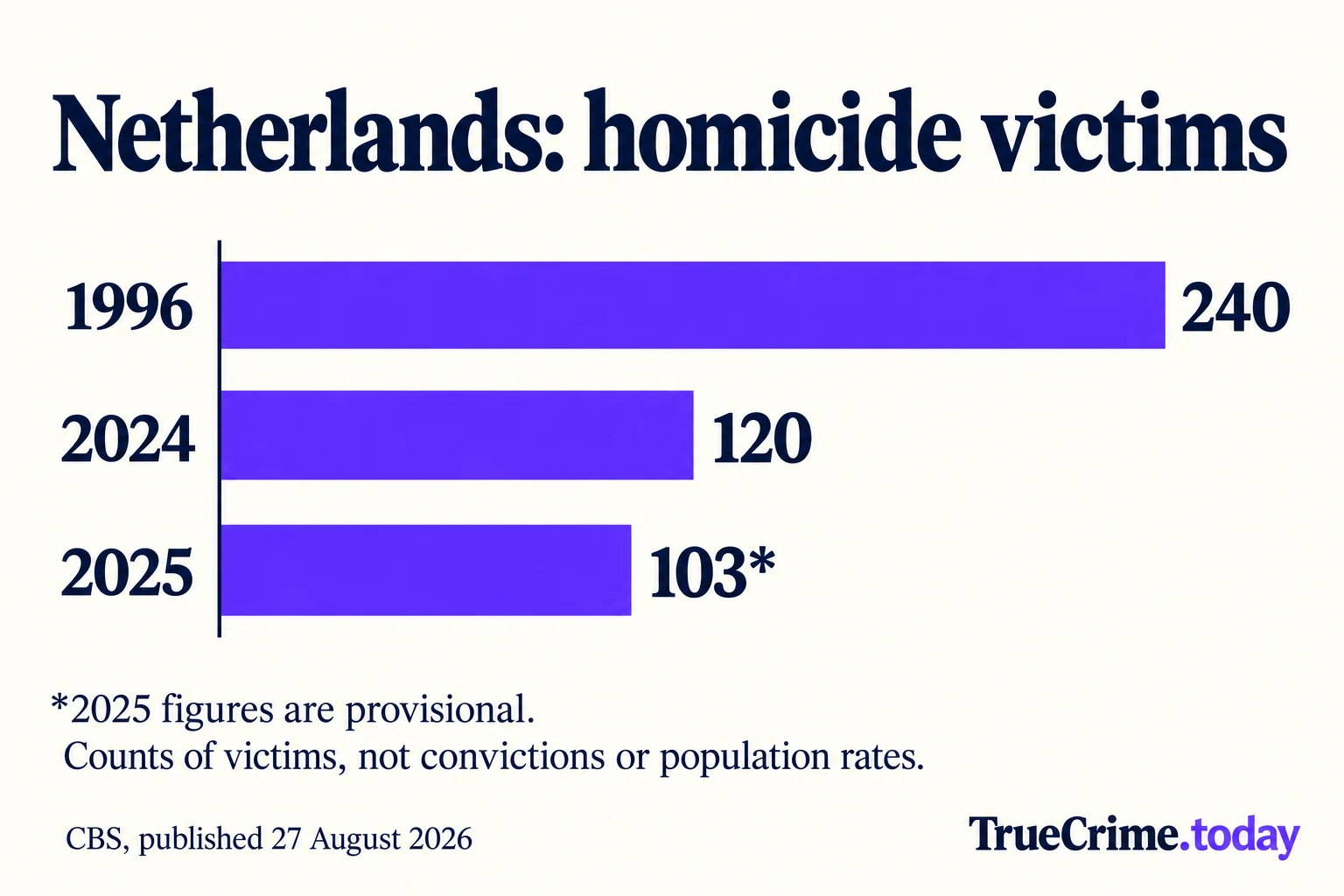
The fall from 120 to 103 is 17 victims, or about 14.2%. Compared with 240 in 1996, the count is 57.1% lower. Those calculations compare totals. A claim about population risk needs a population denominator as well.
Can a falling total hide harm within families?
An overall decline can coexist with continuing violence between people who know each other. In CBS’s pooled 2021–2025 relationship figures, a current or former partner was the suspected perpetrator for 50.2% of female homicide victims. The group being described is female homicide victims across five years.
That percentage tells you neither the likelihood that a woman will be killed nor how many women experienced nonfatal abuse. It also preserves CBS’s distinction between a suspected perpetrator and a person convicted by a court. Losing either the denominator or that qualification changes the claim.
If you are asking whether a particular person received protection, a national total takes you only so far. You need the reports, warnings, response and chronology for that person’s case. A favourable national trend cannot answer what happened inside one home.
Why does Lucia de Berk’s case belong in true crime?
De Berk, a Dutch nurse, received a life sentence after courts accepted allegations that she had killed patients. The judiciary’s own explanation describes medical conclusions and statistical reasoning reinforcing each other, including schakelbewijs, evidence from one alleged offence used in assessing others.
Following reopening, the Arnhem Court of Appeal acquitted her of the alleged homicides and attempts on April 14, 2010. The judgment’s reasoning distinguishes a death whose cause remains unexplained from a death shown to have a criminal cause. The judiciary says she spent 6.5 years wrongly detained. Keep the homicide acquittal distinct from unrelated convictions that lay outside the reopened review.
A story about an alleged serial killer changes profoundly when you begin with that outcome. You can then ask how the suspicion grew, which medical conclusions were revisited and why a pattern acquired more authority than its underlying evidence deserved.
How did a statistical result become so misleading?
Richard Gill, Piet Groeneboom and Peter de Jong examined the calculations in their paper Elementary Statistics on Trial. They describe a reported probability of one in 342 million and an alternative calculation of about one in 49, using the same original incident data while allowing incident rates to differ between nurses.
Neither figure gives the probability that de Berk was guilty or innocent. Each concerns events under a model. The alternative calculation also depends on assumptions, so replacing the dramatic number with the friendlier one does not finish the argument.
The authors separately question how the data were gathered, including incidents omitted outside her shifts and changing classifications. That problem comes before choosing a formula: if you count events differently depending on who was present, the resulting comparison already favours the suspicion. Ask whether the counting rule applied to everyone, and whether the medical evidence established a crime at all.
What can the De Witt brothers tell you about historical sources?
On August 20, 1672, a crowd killed Cornelis and Johan de Witt in The Hague. Nationaal Archief places the killings amid war, political pamphlets and hostility towards the brothers. Its account describes members of the civic militia, charged with maintaining order, siding against them and dragging them outside.
The archive holds nearly 35,000 letters from Johan’s correspondence. That collection offers evidence about his political life; it does not give you 35,000 eyewitness accounts of the killings. A letter written before August 20 answers different questions from a later painting or a modern archive summary.
For a historical episode, ask when its most dramatic detail first appears. A hostile pamphlet tells you what someone wanted readers to believe. To treat the accusation as established, you need supporting evidence and an explanation of the author’s position in the conflict.
How do you keep a Dutch case story up to date?
Save the decision’s identifier, date, defendant and outcome together. Then write the claim you believe it supports in one sentence. That habit makes a later correction manageable: you can identify the changed finding without throwing away everything you know about the case.
The last time we checked the Dutch court hub, privacy rules and CBS releases was October 10, 2026. The de Vries appeal decisions discussed here date from December 2025; the homicide figures concern 2025 and remain provisional. The hub does not replace a complete search for later cassation proceedings.
Carry one question into your next episode: what evidence would change your mind about its most persuasive claim? De Berk’s case gives that question real weight. Once a convincing story starts treating doubts as obstacles, the person at its centre can pay for the mistake.
Have a question about a Dutch judgment or a statistic used here? Send the public document address and the sentence you want checked. Keep personal documents and private case files out of the form.
Ask about a Dutch case record