True crime in Poland: cases, missing evidence and court decisions
Polish true crime through Tomasz Komenda, Iwona Wieczorek and Grzegorz Przemyk: verified court outcomes, investigation failures and police figures.

If a Polish true crime episode has left you wondering how anyone missed the evidence, there are three very different stories to follow. Tomasz Komenda spent years imprisoned for a crime he did not commit. Iwona Wieczorek’s disappearance exposed failures in the collection of CCTV. Grzegorz Przemyk’s death raises the harder question of what happens when the state obstructs the search for the truth.
Those cases also give you a way into Poland’s records. A court decision, a police appeal and an audit each answer a different question. Knowing which one you are reading helps you follow the people in the story without turning every unanswered question into an accusation.
TL;DR
Start with Tomasz Komenda for wrongful conviction, Iwona Wieczorek for missing evidence, and Grzegorz Przemyk for political violence and failures of accountability. Komenda received a 25-year sentence and spent 18 years in prison before his release and eventual acquittal in 2018. Polish police recorded 503 homicide offences in 2024 and 505 in 2025. Those are offence counts; they do not give you a count of convicted killers or homicide victims.
Which Polish true crime cases are worth starting with?
Choose the question that makes you want to keep listening. In Komenda’s case, it is how investigators and courts accepted an accusation that later evidence excluded. With Wieczorek, it is how a young woman disappeared and how recordings that might have helped were lost. Przemyk takes you into communist-era Poland, where people entrusted with protecting the public were implicated in violence and its concealment.
All three fit true crime, because the story concerns real people and events that can be checked. The attraction of an episode might be its atmosphere or an unsettling detail. Once you start discussing responsibility, the evidence needs to carry the claim.
You can enjoy a documentary and still ask what supports its most memorable scene. That question becomes especially important when the film offers a suspect’s reaction as the moment you should decide their guilt.
What happened to Tomasz Komenda?
Komenda was convicted over the rape and killing of a 15-year-old girl in Miłoszyce. His eventual sentence was 25 years. After 18 years in prison, he received conditional early release on March 15, 2018. He was still waiting for the decision that would clear him.
On May 16, 2018, Poland’s Supreme Court acquitted Tomasz Komenda after reopening the proceedings and quashing the earlier convictions. The court said the new evidence unequivocally excluded him as the perpetrator. Its announcement identifies the decision as V KO 26/18 and says the acquittal was final.
Keep the two dates separate when you follow his story. Release changed whether he remained in prison. Acquittal changed the outcome of the criminal case. Neither date returns the years he lost, and neither makes the girl’s murder any less important to investigate.
How did investigators get Komenda’s case wrong?
The Polish ombudsman’s torture-prevention team identified specific problems in its May 2018 statement. It described scent traces collected without a specialist and new examinations of physical evidence that excluded Komenda. It also reported his account that police violence had produced a confession. That account requires clear attribution; it cannot establish the criminal liability of every officer involved.
For you as a viewer, the confession creates an obvious temptation: someone admitted it, so why keep asking? The circumstances of the admission matter. You need to know what the person said, whether the account changed, and whether independent evidence supports the details. A confession can become the centre of a story while the evidence that contradicts it receives much less attention.
That is why case analysis asks how evidence was obtained and what it actually establishes. Here, a closer look at the collection and testing of traces helped overturn the accepted story. Looking at a suspect’s expression would not answer those questions.
What does the Iwona Wieczorek audit actually show?
Wieczorek disappeared in July 2010. Poland’s Supreme Audit Office, known as NIK, later examined police searches for missing people. Its audit of the search for Iwona Wieczorek described an incorrect search category under the rules then in force and delays in collecting CCTV along her likely journey between Sopot and Gdańsk Jelitkowo.
According to the audit, officers collected recordings seven days after the disappearance. Some hotels had already overwritten their footage because they retained it for only hours or days. This gives you a documented reason to question the investigation: material that could have been checked was no longer available.
You can press that criticism without inventing what the cameras would have shown. Lost footage leaves an unanswered question about her movements and possible encounters. It cannot tell you who harmed her, whether she appeared on a particular camera, or whether prompt collection would have solved the case.
What has the police appeal added to Iwona’s story?
An official Warsaw police appeal dated January 17, 2026, renewed interest in a white Fiat Cinquecento. Police said it appeared near Gdańsk’s Reagan Park at 5:07 a.m. on July 17, 2010, and described its movement towards Rumia, Reda and the Puck area. The appeal asked for information about a possible connection to the disappearance.
That wording matters. A request to identify a driver gives the public a task; it does not establish that Wieczorek travelled in the car or that the driver committed a crime. If a video turns “police want information” into “police found the killer,” the conclusion has outrun the record.
An older prosecutor announcement, from December 2022, described a charge of obstructing the investigation. Obstruction and murder are different allegations. That dated announcement also gives no basis for asserting a later conviction. Following a case means keeping track of what each new development adds, rather than treating every arrest as an answer to the disappearance.
How many homicide offences does Poland record?
The police overview of 2025, published on January 16, 2026, gives 505 recorded offences under Article 148, the homicide category. It gives 503 for 2024. The difference is two offences, or about 0.4% when compared with the 2024 total.
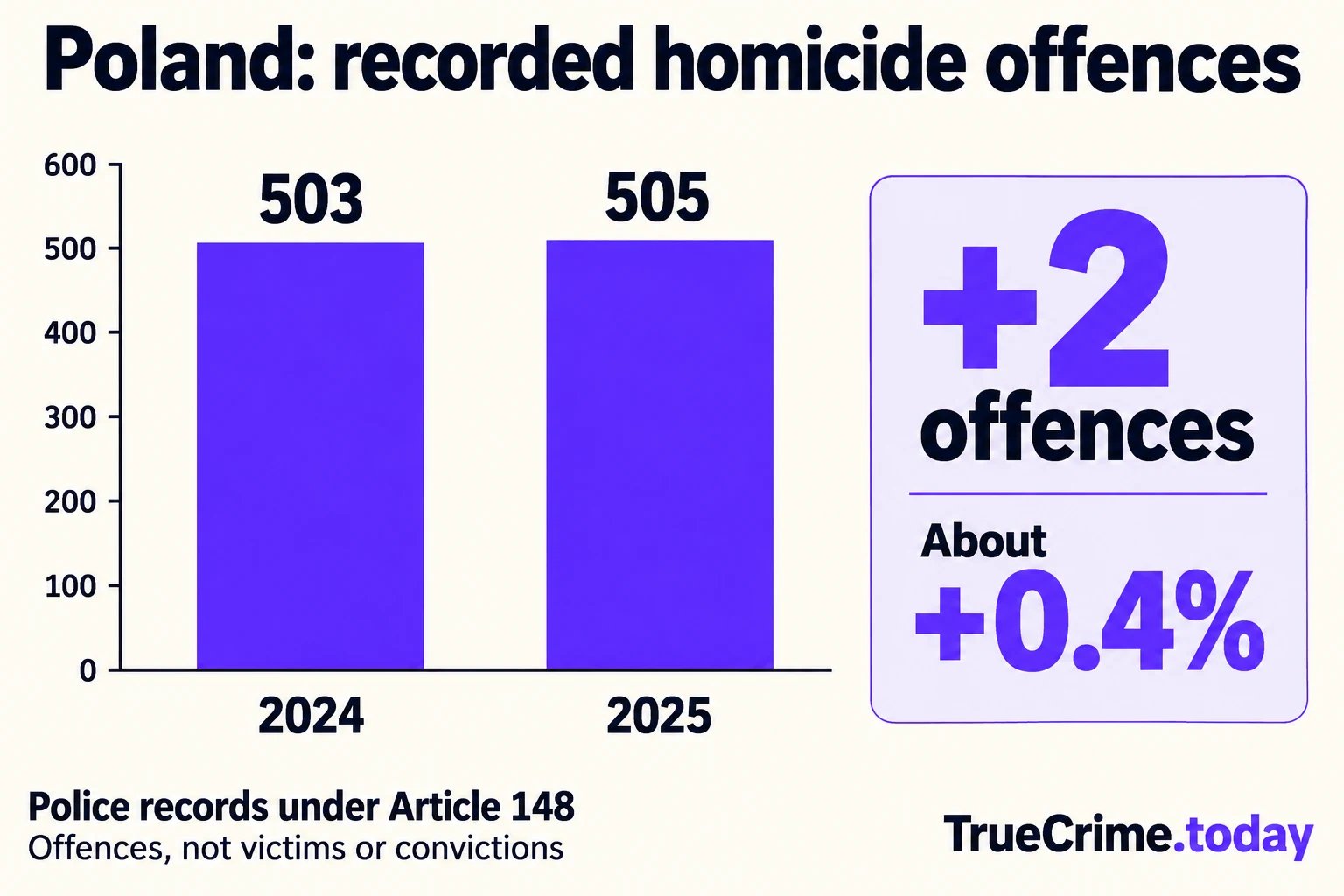
That small annual change describes this particular police series. The chart’s bars begin at zero so the two extra records do not look like a sudden surge. A dramatic cropped axis could make almost equal totals seem far apart.
To compare your risk with another country, you would need consistent definitions and population rates. To discuss violence against women, you would also need victim characteristics and relationships. These two national totals cannot answer either question by themselves. And a recorded offence does not tell you whether a court has convicted someone.
Can missing-person figures tell you the chance of being found?
The same police overview lists 13,553 missing-person searches and 13,677 closed cases for 2025. Closures can include cases opened in earlier years, so the groups do not match. Dividing one total by the other would not tell someone’s family the chance of finding a person reported missing that year.
There is also an arithmetic problem worth flagging. The overview calls the result 106%, but 13,677 ÷ 13,553 × 100 gives approximately 100.9%. The police magazine repeats the figures and percentage. We could not establish a different denominator that explains 106%, so we are leaving that percentage unverified.
This discrepancy does not show that searches were fabricated or that officers concealed a particular case. It shows why a published percentage needs a calculation you can reproduce. Before using a recovery rate in an argument, ask which cases were opened, which were closed and whether the same people appear in both groups.
Why does Grzegorz Przemyk’s death still matter?
For an older Polish case, start with Grzegorz Przemyk, an 18-year-old who died in Warsaw on May 14, 1983. Poland’s Institute of National Remembrance describes his detention and beating by the militia on May 12. Its historical account also describes the attempt to blame ambulance workers.
Those dates place the events in communist-era Poland. The institutional names and political conditions belong to that period, so a modern police label can blur the story. You also need to distinguish the original violence from the later effort to determine responsibility.
That second story lasted decades. It brings the question from the opening back into view: what happens when the authorities responsible for investigating a death fail the family seeking an answer?
What did the European court decide about Przemyk?
In Przemyk v. Poland, application 22426/11, the European Court of Human Rights found a violation of the procedural obligation under Article 2, the right to life. The judgment dates from September 17, 2013, and became final on December 17. It concerns Poland’s failure to conduct an effective investigation.
The court criticised repeated remittals and delays. The proceedings against one accused officer eventually ended because of the limitation period. An ending like that differs from a finding that the evidence proved the person innocent. Equally, the Strasbourg judgment did not impose a new criminal conviction on individual officers.
The distinction leaves room for two questions that a documentary can easily merge: who bears responsibility for the death, and did the state properly investigate it? A human-rights ruling can answer the second while the first remains painful and contested.
How can you check a Polish case without guessing?
Start with the claim that bothers you most. For Komenda, it might be whether “25 years” describes his sentence or time served. For Wieczorek, ask whether a criticism comes from an audit or from someone’s reconstruction of missing footage. For Przemyk, identify the court and the question its judgment decided.
Polish terms can help you find the relevant result. Uniewinnienie means acquittal; umorzenie means discontinuance of proceedings. They describe different outcomes, so a search snippet containing one should not be casually rewritten as the other. Keep the person, charge, court and date with the term.
The last time we checked these records was October 11, 2026. We verified Komenda’s final acquittal, the 2015 audit, the January 2026 police appeal and annual figures, and the European judgment. We have not established a complete later procedural record for Wieczorek, and the unexplained police percentage remains open to correction.
These stories reward the extra question. What evidence made the first conclusion convincing? What changed it? What disappeared before anyone could check? You can follow a gripping case and still leave room for an answer the first version missed.
Have a question about a Polish case record or one of these police figures? Send the public document address and the sentence you want checked. Keep personal documents and private case files out of the form.
Ask about a Polish case record