True crime in Russia: cases, court decisions and evidence
Russian true crime through Politkovskaya, Chikatilo and Dyatlov: what court decisions, scientific models and official crime figures can tell you.

You can watch three documentaries about Russia and come away with three very different kinds of certainty. A murderer has been convicted. A journalist’s killers have been sentenced, but questions about the person who hired them remain. A scientific paper offers a possible explanation for nine deaths in the mountains. Those conclusions do not rest on the same kind of evidence.
True crime in Russia becomes more interesting when you ask how a story reached its ending. Here are three starting points, followed by the court decisions, scientific limits and counting questions that help you judge what you hear.
Short version
Start with Anna Politkovskaya for the difference between convictions and a completed investigation, Andrei Chikatilo for the challenge of checking a sprawling historical record, and Dyatlov Pass for the limits of reconstruction. The Dyatlov deaths should not be presented as a proven murder case. Russia’s reported 11.8% decline in murders and attempted murders in 2025 concerns a combined police category, not the number of people killed. Read each conclusion with its source, date and unit of measurement.
Which Russian true crime cases should you start with?
Choose the question you want answered. Politkovskaya’s case asks how far an investigation into a contract killing must go. Chikatilo’s asks what a surviving institutional account can tell you about a long series of killings. Dyatlov asks whether a physical explanation fits known conditions without claiming to recover every person’s final movements.
Our explanation of true crime treats the genre as stories about real events that readers can check, which matters when a mystery programme quietly turns an attractive theory into an established fact.
These examples also span different periods. The hikers died in 1959, in the Soviet Union. Chikatilo’s 1992 sentence followed crimes spanning the late Soviet period. Politkovskaya was killed in Moscow in 2006. A modern Russian legal term or statistic cannot be pasted over all three histories and expected to mean the same thing.
You do not need graphic descriptions to understand the stakes. What matters here is what happened to people, what investigators or courts established, and which questions the available record leaves open.
Why did Politkovskaya’s convictions leave questions unanswered?
Anna Politkovskaya, a journalist who reported on Chechnya and human-rights abuses, was shot dead in her Moscow apartment building on October 7, 2006. The later proceedings produced convictions for participants in the killing. A jury found five defendants guilty in May 2014; sentences followed in June, including two life terms.
The 2018 Mazepa judgment records those outcomes while examining a different question: whether Russia had properly investigated who commissioned the killing.
That distinction matters whenever a crime involves a chain of people. Proving that someone carried out a paid killing does not, by itself, tell you who paid for it. Calling the whole case “solved” can hide that second question. Calling it “unsolved” without mentioning the convictions erases results that were obtained.
Keep both parts in view. You can recognise the convictions and still ask whether the investigation followed the evidence far enough. Neither requires naming an unproven suspect as the person behind the murder.
What did the European court find wrong with the investigation?
The European Court of Human Rights found a breach of the investigative duty under Article 2, by five votes to two. It criticised the enquiry into the person who commissioned the killing and its prolonged course. The judgment did not convict a suspected commissioner or decide that a named political leader ordered the murder.
A demand to investigate an allegation is not a finding that the allegation is true. If someone says the court “proved” a popular theory, ask which paragraph contains that finding. A court can fault investigators for failing to test a possibility while leaving the possibility unproved.
The two dissenting judges disagreed with the majority’s assessment, pointing to investigative work and the difficulty of the case. That disagreement deserves a place in the story. An effective investigation has to take reasonable steps; it cannot promise a conviction regardless of what the evidence shows.
There is also a date boundary. Russia ceased to be a party to the European Convention on September 16, 2022; the European court retained jurisdiction over earlier acts and omissions. The 2018 judgment helps explain this historical investigation. It should not be offered as instructions for taking a newly arising 2026 incident to that court.
Can an avalanche model explain the Dyatlov deaths?
Nine hikers died in the northern Urals in 1959. The case became famous partly because the circumstances seemed difficult to fit into one account. That is a reason to test explanations carefully, rather than assume a puzzling death must have been a murder.
In their 2021 slab-avalanche study, Johan Gaume and Alexander Puzrin examined whether a snow slab could have released above the tent after a delay, given a snow cut, wind loading and a weak layer.
Their calculations produced a possible delay of 7.5–13.5 hours under the model’s assumptions. Those are calculated hours, not a time interval recorded by a witness. The paper offers a mechanism worth taking seriously; it does not let you assign an exact historical time to every movement that night.
The authors also identify questions their work does not explain, including reported radiation on clothing and what happened after the hikers left the tent. A film that says the study settled every detail goes beyond the paper. So does a dismissal that treats any unanswered detail as proof that a small slab could not have released.
A useful follow-up question is: which input would change the conclusion? Snow depth, wind loading and slope conditions affect the model. You can examine those assumptions without inventing an attacker or treating every gap as a conspiracy.
What can you establish about the Chikatilo case?
Our method for analysing a case distinguishes a court’s historical summary from a full verdict, a difference that matters when a long case is condensed into a film.
The Rostov Regional Court’s museum history describes Chikatilo’s 1992 death sentence and an investigation comprising 231 volumes. It attributes 53 murders to the case and records his execution on February 14, 1994. This is an official retrospective account, rather than our own reconstruction of every count and appeal.
That is especially useful for a case repeatedly retold in films and podcasts. A confession, an accusation, a trial finding and an appeal can refer to different sets of incidents. Before repeating a victim total or a story about an investigative mistake, identify which document supports that particular statement.
The museum’s summary provides a firm starting point for the sentence and the court’s own account. It does not give us every page of the 231 volumes. We have not independently verified the full operative judgment and appellate record, so we do not claim to have reconciled every number circulating about the case.
The volume count also raises a question about storytelling. Hundreds of files do not fit neatly into a single dramatic breakthrough. A detailed account needs to show how evidence connected incidents, which claims were tested and what the court accepted. Those steps matter more than a narrator’s confidence.
Did Russia record fewer murders in 2025?
The Interior Ministry’s release of January 29, 2026 reports that registered murders and attempted murders combined fell 11.8% in 2025 compared with 2024. It also reports a 7.3% decline in registered offences overall. These are changes in recorded categories, not a national count of deaths.
To make the first comparison easier to see, set the 2024 combined-category figure to an index of 100. An 11.8% decline then gives 88.2 for 2025. The graphic below shows the two index values in equal-sized cards. It does not invent an absolute offence total.
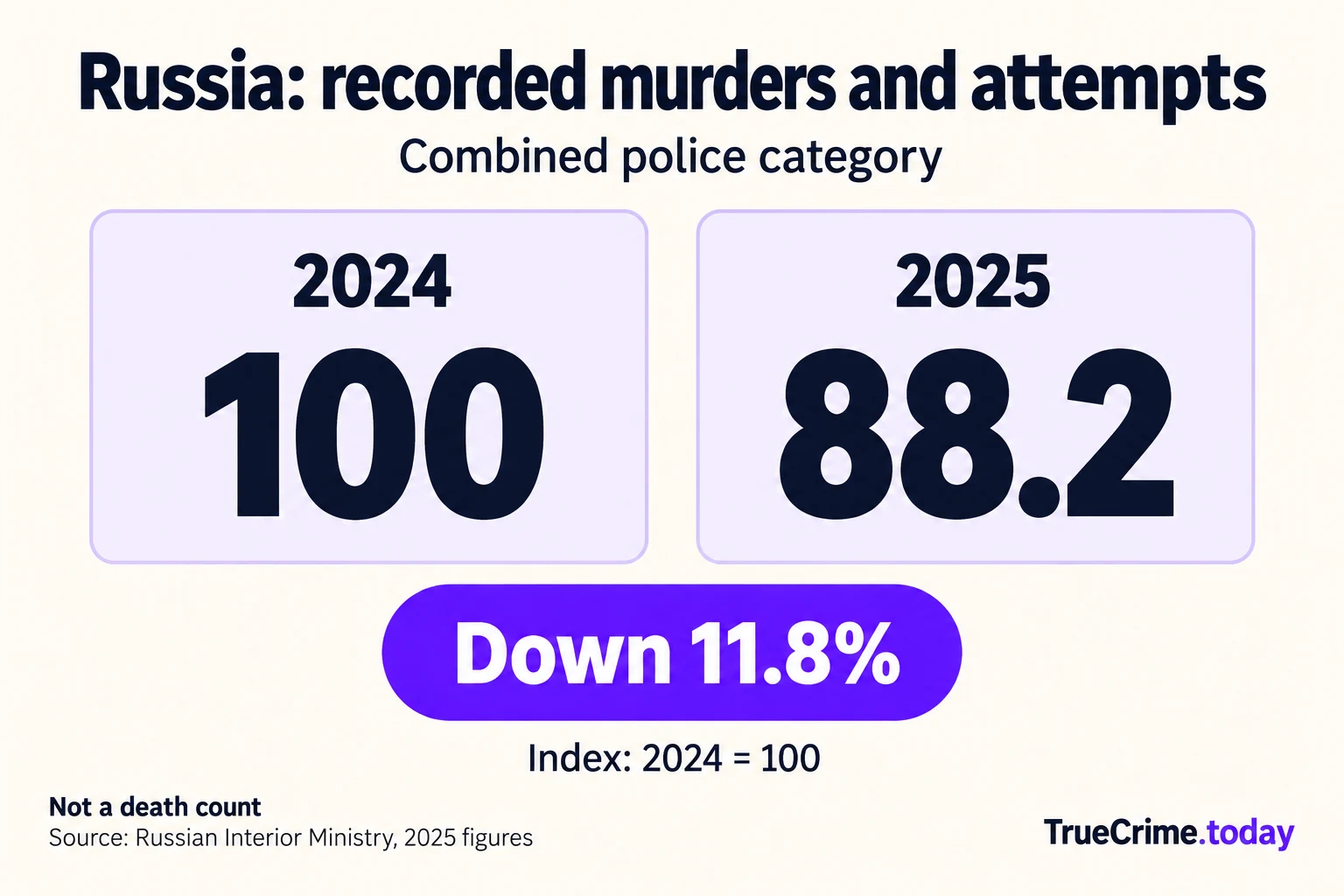
Basis: Russian Interior Ministry, 2025 statistical release. Index calculation by TrueCrime.today: 100×(1−0.118)=88.2. Both years refer to the same combined category.
An attempted murder can be recorded even though nobody died. A murder record is also not the same unit as a victim or a conviction. You cannot turn the 11.8% figure into “11.8% fewer people were killed” without separate victim data.
Nor does the percentage establish why the recorded category declined. The ministry credits prevention, but the release alone cannot isolate that effect from recording practices or other changes. The sensible conclusion is narrower: the official recorded category decreased in that comparison. Its causes and relationship to all violence need further evidence.
What does Russian law say about accusations and victims?
Article 49 of Russia’s Constitution ties guilt to a lawful, final guilty verdict. Article 52 protects victims’ rights and provides for access to justice and compensation. The Ministry of Justice’s published text is the basis for these general principles.
Those duties belong together. Protecting a person from an unproved accusation does not mean ignoring a survivor’s account. Seeking strong punishment for a proven offence does not remove the need to establish who committed it. A responsible account asks what was reported, what was investigated and what a court actually decided.
This helps when a headline uses “detained,” “charged” and “convicted” as though they describe one event. They describe different stages. Check whether the reported judgment is final and whether an appeal changed it before presenting the outcome as settled.
Historical cases need their own legal dates. The 1993 Constitution is not a description of the procedure followed in 1959. The general principles above explain present-day reading of accusations; they do not supply a retroactive legal ruling on Soviet proceedings or advice about a person’s own case.
Can you read every historical case file online?
Sometimes you can find a catalogue entry without being able to read the document itself. The Presidential Library lists an 1878 indictment concerning Vera Zasulich as two leaves, with access limited to its electronic reading rooms. That entry establishes where a document is catalogued; it does not reveal every sentence on those leaves.
This is an easy mistake to make when researching older cases. A search result may show a title, an archive reference and a date. A retelling then treats the material as if someone had read it. Before quoting it, check whether there is a scan, a transcription or only a description.
An inaccessible file is a limit on what you can establish. It does not prove that the file supports a favoured theory, that its contents were deliberately concealed, or that the document never existed. Keep the catalogue reference so another researcher can pursue access without filling the gap with guesswork.
How do you check a Russian case when sources disagree?
Ask a few specific questions. Does the court passage establish someone’s guilt, criticise an investigation or recount a party’s allegation? Does the scientific figure show a measurement or a calculation? Does the statistic count offences, attempts, victims or convictions? Much confusion disappears when you identify what the sentence is actually about.
Next, check the date and the stage of proceedings. A 2018 judgment is not an update on an investigation in 2026. A museum account is not the full appellate file. An article published this year can still be relying on an older document, so look at the document’s date too.
The last time we checked the sources used here was October 11, 2026. We verified the 2018 European judgment, the official court history, the 2021 scientific paper and the ministry’s 2025 figures. We have not verified a complete current docket for the search for Politkovskaya’s commissioner, and we will not give an old procedural statement a new date.
These three starting points offer different reasons to keep reading: accountability beyond the person who pulled the trigger, the evidence behind a long criminal case, and the difference between a plausible reconstruction and a complete explanation. Follow the question that interests you, and keep asking what would be needed to answer it.
Have a question about a Russian case record or statistic? Send a public document address and the specific claim you want checked. Keep private documents and personal information out of the form.
Ask about a Russian case record