True crime in Spain: Asunta, Wanninkhof and what the courts decided
Spanish true crime through Asunta Basterra, Rocío Wanninkhof and Marta del Castillo, with appeal decisions, jury rules and 2025 crime figures.
If a Spanish crime series leaves you arguing about who did it, true crime in Spain gives you plenty to investigate beyond the ending. Start with Asunta Basterra, Rocío Wanninkhof and Marta del Castillo. Their cases take you from Galicia to Andalusia, and each asks a different question about what a court can establish.
TL;DR
The Asunta convictions survived an appeal that changed part of the account of the killing. Dolores Vázquez’s conviction for killing Rocío Wanninkhof was annulled, and another man was later convicted. The Marta del Castillo proceedings produced a conviction while leaving the family’s search for answers unfinished. Spanish jury rules and police crime figures add context, provided you keep their different jobs clear.
Which Spanish true crime cases give you a useful starting point?
Choose the question that stayed with you after watching. In the Asunta case, it might be how two parents could receive the same sentence when an appeal rejected an inference about one parent’s presence. With Wanninkhof, it is how a woman could be convicted before the case turned towards someone else. With Marta, it is how a prosecution can secure a murder conviction without giving a family every answer it needs.
That curiosity is part of what true crime is: an account of real events whose claims can be checked against records outside the telling. The more persuasive the telling, the easier it is to remember a reconstructed conversation as something a witness actually heard. Keep that distinction in mind when the camera follows someone into a room where no witness was present.
The Asunta Case, released by Netflix in 2024, is a dramatised investigative thriller. Netflix’s own programme information describes it that way. Actors, recreated conversations and the order in which a series reveals clues help tell a story. A judgment has a different job: explaining the findings that support a legal result. You can enjoy the series and still ask which document supports a scene you want to discuss as fact.
What did the Asunta appeal actually change?
Asunta Basterra was 12 when she was killed in 2013 near Santiago de Compostela, in Galicia. Her parents, Rosario Porto and Alfonso Basterra, were sentenced to 18 years each in 2015. The appeal is worth examining because it shows how much can change beneath a headline saying the convictions were upheld.
The Asunta appeal judgment rejected the inference that placed Basterra in the car and at the house where Asunta was killed. The jurors had reasoned partly from being unable to rule out his presence. The appeal judges said that insufficient visibility and an unconvincing explanation of his afternoon did not establish that he was there.
They upheld his conviction, finding that the killing formed part of a joint plan and that his contribution supported liability alongside Porto. The distinction matters: correcting an unsupported claim about physical presence does not automatically remove the other findings on which a conviction rests. The Supreme Court’s rejection of the parents’ appeals was announced in October 2016.
When you challenge that account, you need to separate what was observed, what was inferred and what the court decided. Editorial methods for case analysis keep those questions separate when a compelling explanation starts doing more work than the evidence supports.
How did the Wanninkhof conviction unravel?
Rocío Wanninkhof was killed in 1999 in the Málaga area. Dolores Vázquez was convicted in September 2001 and sentenced to 15 years and one day. In February 2002, the Andalusian appeal court annulled both the conviction and the jury’s verdict because their reasoning was inadequate. A new trial was ordered. That was a procedural decision with enormous consequences for someone already imprisoned.
The judicial record of Vázquez’s compensation claim sets out what happened next: the proceedings against her were provisionally dismissed in 2004, and Tony Alexander King was sentenced to 19 years for Wanninkhof’s murder in December 2006. The record lets you follow separate decisions rather than compressing them into one dramatic moment of vindication.
A 2012 compensation judgment then rejected Vázquez’s claim under the legal interpretation applied at the time. It was issued by the Audiencia Nacional, a national court, and included a dissent. That refusal concerned the requirements for compensation; it did not restore the cancelled murder conviction. Spain’s Constitutional Court later removed restrictive wording from the relevant compensation provision in 2019, while preserving limits on reopening final proceedings and expired claim periods.
A person’s reputation and the proof of a crime deserve separate scrutiny. The case is often discussed because descriptions of Vázquez’s personality and sexuality became part of the public accusation. Those descriptions cannot tell you who committed a killing. The same caution applies when you dislike someone’s manner in an interview: your reaction may explain your suspicion, but it cannot establish their actions.
Why is Marta del Castillo a different kind of unresolved case?
Marta del Castillo’s case, in Seville, creates another temptation: assuming that a conviction closes every question, or that an unanswered question makes the whole conviction meaningless. The family’s need to know what happened to her body and the court’s decision about criminal responsibility are connected, yet one does not guarantee the other.
In its 2013 annual report, Spain’s prosecution service describes the Supreme Court’s judgment 62/2013, dated January 29, 2013. It added a conviction for an offence against the parents’ moral integrity and required payment of part of the search costs. Contemporary reporting recorded an additional 15 months on top of Miguel Carcaño’s 20-year murder sentence, producing 21 years and three months.
The extra offence addressed the harm caused by changing accounts of the body’s whereabouts. It did not reveal those whereabouts. The same Supreme Court decision also required part of another defendant’s possible involvement to be reassessed. A direction to reassess evidence is not itself a conviction, so a discussion that treats every person mentioned in an appeal as guilty has already gone too far.
The 2013 records describe the body as unfound at that stage. We last checked those decisions and reports on October 11, 2026; they do not establish the outcome of every later search. If you encounter a fresh claim that the case has been solved, check what “solved” means there: a new location, an identified suspect, a charging decision or a final judgment.
How do Spanish juries reach a verdict?
Spanish jury procedure can surprise you if American courtroom television is your reference point. Under Organic Law 5/1995, a jury court includes nine jurors and a professional judge who presides. Seven votes are required for a finding of guilt, and five for a finding of not guilty. The rules also distinguish votes on facts adverse or favourable to the accused.
Those thresholds do not mean that seven out of nine jurors makes someone 77.8% likely to be guilty. A vote records a juror’s decision under the procedure. It cannot be turned into a measured probability of what happened. Nor does reaching the threshold excuse a verdict from explaining its evidential basis.
The jurors give their verdict, and the presiding judge issues the judgment, incorporating the findings and addressing the evidence required for a conviction. The Wanninkhof appeal makes the need for reasons tangible: a guilty verdict existed, yet its explanation was inadequate. These jury rules also do not describe every Spanish criminal trial; many proceedings are heard by professional judges.
What do Spain’s 2025 crime figures measure?
Famous cases give you names, places and experiences. They cannot tell you how common an offence is across a country. For that, Spain’s Ministry of the Interior publishes police-recorded crime figures. Its full 2025 annual balance compares January through December 2025 with the same months of 2024.
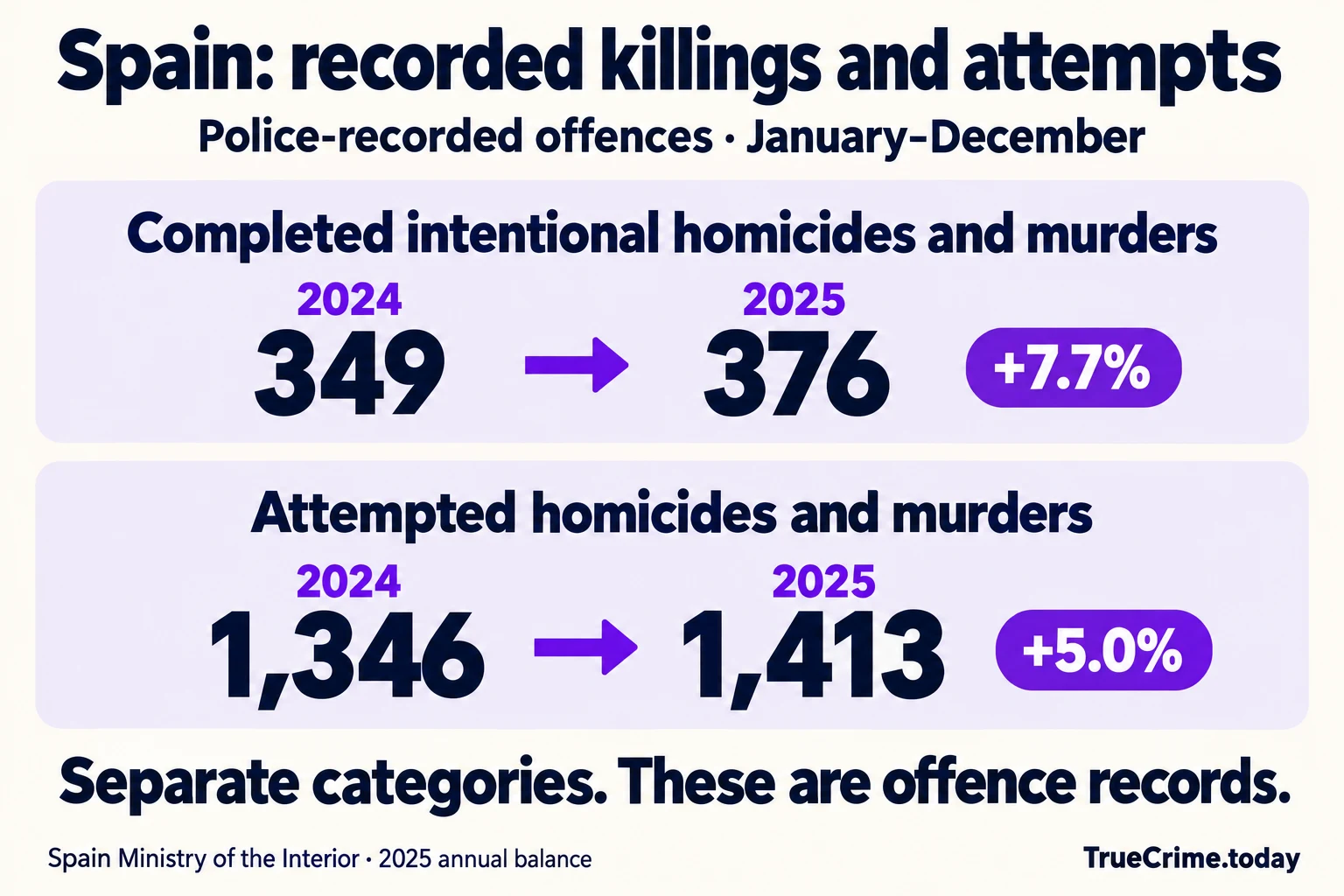
The national category for completed intentional homicides and murders rose from 349 to 376 recorded offences. That is 27 more records: 27 divided by 349, multiplied by 100, gives 7.7% when rounded to one decimal place. Attempted homicides and murders appear separately, increasing from 1,346 to 1,413, or 5.0%. Combining them and calling the result a death toll would change what the figures measure.
Across all recorded offences, the total rose 0.8% to 2,474,156. Conventional crime fell 0.2%, while recorded cybercrime grew 5.3%. That combination explains how a national total can rise even when one broad category falls. It also shows why a headline about “crime increasing” needs a closer look before you apply it to homicide.
These are administrative offence records assembled from police forces. They are not a count of convictions, a victim survey or your personal risk of being attacked. The comparison covers 2025, not an entire 2026 that has yet to finish. Reporting, detection and classification affect recorded crime, and one annual change does not explain its own causes.
Where can you check Spanish court decisions?
For a Spanish case, the name of the court helps you place a document in the sequence. An Audiencia Provincial is a provincial court. A Tribunal Superior de Justicia is the higher court for an autonomous community, such as Galicia or Andalusia. The Tribunal Supremo is Spain’s Supreme Court. Which court reviews which issue depends on the proceeding; these names do not mean that every case moves through an identical ladder.
Look for the court, decision number, date and final order before relying on a quotation. A judgment’s opening pages may repeat the original sentence so the reader understands what is being appealed. Later pages can change the findings. Copying the opening passage alone can leave you describing a conclusion the appeal court subsequently rejected.
CENDOJ, the judiciary’s decisions database, and court press releases can help locate decisions. Published judgments may anonymise names or use initials, while reporting uses the participants’ public names. Match the court, date, case number and circumstances rather than assuming a different name means a different case. A court-file copy hosted by a newspaper also needs its document identity checked.
The public record is rarely the entire investigation. An unavailable interview, an unverified screenshot and a reference to an exhibit do not give you the exhibit’s contents. When an account depends on a missing item, keep that question open instead of filling the gap with what would make the story more satisfying.
How can you challenge a case account fairly?
Start with one claim you can put into words. “The appeal changed the finding about his presence” is checkable. “Everything was corrupt” combines too many accusations to test at once. Identify the document, the relevant passage and the conclusion it actually supports, then compare that conclusion with the account you heard.
Keep alternatives in view. A corrected inference can coexist with an upheld conviction, as in Asunta. A cancelled conviction and a later conviction of someone else can expose a grave error, as in Wanninkhof. A sentence can punish proven conduct while leaving a family without an answer it urgently needs, as the Marta records show.
Strong lawful accountability for proven violence and careful treatment of evidence belong together. Naming someone online because a scene felt convincing risks adding another person’s suffering to a case. You can ask hard questions about investigators and courts while keeping each accusation tied to something you can verify.
Have a question about a Spanish judgment or crime figure? Send the public document address and the claim you want checked. Keep private case files and personal information out of the form.
Ask about a Spanish case record