True crime in the United Kingdom: cases, courts and wrongful convictions
Stephen Lawrence, Sally Clark and Andrew Malkinson: British cases, wrongful convictions, Scottish verdicts and what homicide figures actually count.

If you watch true crime from the United Kingdom, you soon run into stories where the first verdict was only the beginning. Sally Clark’s convictions collapsed after fresh medical evidence emerged. Andrew Malkinson spent seventeen years in prison for a rape he did not commit. Stephen Lawrence’s family fought for justice while the investigation itself became the subject of a public inquiry. Their stories raise different questions about how evidence reaches a court, and what happens when the people responsible get it wrong.
TL;DR
British true crime becomes easier to follow when you keep the case, the court and the date together. Clark, Malkinson and Lawrence offer three starting points for examining expert evidence, wrongful convictions and police accountability. England and Wales, Scotland, and Northern Ireland have separate legal systems. Scotland removed the not proven verdict from new criminal trials in January 2026. Crime figures need the same care: the latest detailed Homicide Index analysis covers England and Wales, rather than the whole UK.
Which British cases change how you read the evidence?
Clark’s story asks what happens when an expert’s certainty outruns the evidence. Malkinson’s asks why the mechanisms intended to correct a conviction took so long. Lawrence’s asks how prejudice and institutional failures can obstruct justice for a victim. Together, they give you questions to take into another documentary, without suggesting that every criminal case follows the same path.
The question of what true crime is matters here because an account of a real offence still involves choices about what to include. A reconstruction can make a sequence feel obvious. An interview can make you trust someone. Neither settles whether the underlying assertion was tested or challenged in court.
There is also a small naming trap. ITVX uses True Crime UK for a documentary collection. A programme appearing under that label does not establish that every case it covers took place in Britain. When you are looking for a British case, the location and the people involved are a better starting point than the collection name.
In case analysis, a useful question names the evidence you want to understand. “What did the medical result show?” gets you closer to an answer than “Did she seem like someone who would do it?” Clark’s case makes that difference painfully clear.
Why did Sally Clark’s convictions fall apart?
Sally Clark was convicted in November 1999 of murdering her two infant sons. At trial, expert testimony about the rarity of two sudden infant deaths in one family helped the prosecution’s case. The number associated with that testimony, one in 73 million, became so memorable that it can swallow the rest of the story.
The Royal Statistical Society challenged the calculation in October 2001. Multiplying the probability of one death by itself assumes that the two deaths are independent. Children in the same family share circumstances, and that independence had not been established. There was another problem: the frequency of a rare event does not give you the probability that a particular parent committed murder.
The medical evidence mattered too. The CCRC record of Clark’s conviction review describes fresh expert evidence that her son Harry had an overwhelming staphylococcal infection when he died. That evidence had not been available at her trial. It also led to a reconsideration of the evidence about her other son, Christopher.
The Criminal Cases Review Commission, or CCRC, found misleading medical and statistical evidence alongside serious failure to disclose important bacteriological results. It referred the convictions in March 2002, and the Court of Appeal quashed them in January 2003. A retelling centred entirely on a bad calculation leaves out the medical information the jury never had.
For another case involving an expert, the question is whether their conclusion follows from the findings and assumptions they explain. An expert’s testimony deserves examination on that basis. The lesson from Clark is lost if it turns into a reason to reject every medical witness or assume that an unusual death must have one particular explanation.
What did Andrew Malkinson’s case expose?
Malkinson was wrongly convicted of rape in 2004 and spent seventeen years in prison. His case reached the Court of Appeal through a CCRC referral in January 2023, after new DNA evidence. The conviction was overturned that year; the court’s published reasons carry the reference [2023] EWCA Crim 954.
That reference helps separate the court’s decision from the later examination of how institutions handled his case. An appeal asks whether the conviction can stand. A review of the CCRC asks what its staff did, what they failed to do, and what needs to change.
The CCRC’s publication of the Henley review in July 2024 recorded nine recommendations about its handling of Malkinson’s case. The organisation accepted the recommendations and had apologised to him. Parts of the report were redacted to protect ongoing investigative or prosecution work.
Those boundaries matter when people speculate about another suspect. Evidence that helped overturn Malkinson’s conviction and a finding that someone else committed the offence are separate matters. A named person’s guilt needs its own lawful determination. The woman who was attacked also deserves an investigation that establishes responsibility, rather than another public accusation that outruns the evidence.
The CCRC reviews suspected miscarriages of justice in England, Wales and Northern Ireland. It can refer a case to an appeal court, which then decides the outcome. Scotland has its own review commission. Saying “the review body cleared him” can hide both the court’s role and the legal system involved.
How did Stephen Lawrence’s murder change policing?
Stephen Lawrence was murdered in a racist attack in Eltham, south London, on 22 April 1993. The campaigning of his parents, Doreen and Neville Lawrence, helped secure a public inquiry into the investigation. The Macpherson report, published in 1999, identified professional incompetence, institutional racism and failures of leadership, and made seventy recommendations.
This story approaches accountability from another direction. Clark and Malkinson were wrongly convicted. Lawrence’s family faced a failure to bring the people responsible for a real murder to justice. Scrutiny of police work serves both needs: protecting people from false accusations and giving victims an investigation that takes their lives seriously.
Gary Dobson and David Norris were convicted of Lawrence’s murder in 2012. The history includes a change to the rules on trying someone again after an acquittal. In England and Wales, Part 10 of the Criminal Justice Act 2003 allows a retrial for specified serious offences when there is new and compelling evidence, subject to legal safeguards. An unpopular verdict or a fresh wave of online suspicion does not meet that test by itself.
An inquiry also has a different purpose from a criminal trial. Its findings can explain institutional conduct and recommend changes; criminal responsibility is determined through the criminal proceedings. The House of Commons’ 2021 follow-up to Macpherson found continuing problems and uneven progress. Seventy recommendations should not be read as seventy completed repairs.
What changed in Scottish trials in 2026?
The UK contains four countries and three legal jurisdictions: England and Wales, Scotland, and Northern Ireland. That distinction explains why an older Scottish programme can mention a verdict unfamiliar from an English trial.
Scotland previously had three verdicts: guilty, not guilty and not proven. Not proven resulted in an acquittal, even though the wording could leave viewers with the impression that the case remained undecided. The Scottish Government announced its abolition for all new criminal trials from 1 January 2026.
The change also raised the conviction majority to at least two-thirds of the fifteen jurors. With a full fifteen-person jury, that means ten votes. The fraction describes a voting rule; it does not mean the court has calculated a two-thirds probability of guilt.
The last time we checked the Scottish announcement was October 11, 2026. A documentary about an earlier trial still needs the rules that applied then. The reform does not change what an old verdict meant, and its Scottish scope cannot be stretched across the whole UK.
What do the homicide figures actually count?
The cases that make gripping programmes are selected for a reason. They cannot tell you how common similar events are. For that, you need the definition, place and period attached to the figure.
The ONS detailed Homicide Index analysis for England and Wales recorded 522 victims in the year ending March 2025, compared with 566 in the preceding year. It recorded 508 separate incidents. More than one person can die in one incident, so the victim count and incident count answer different questions.
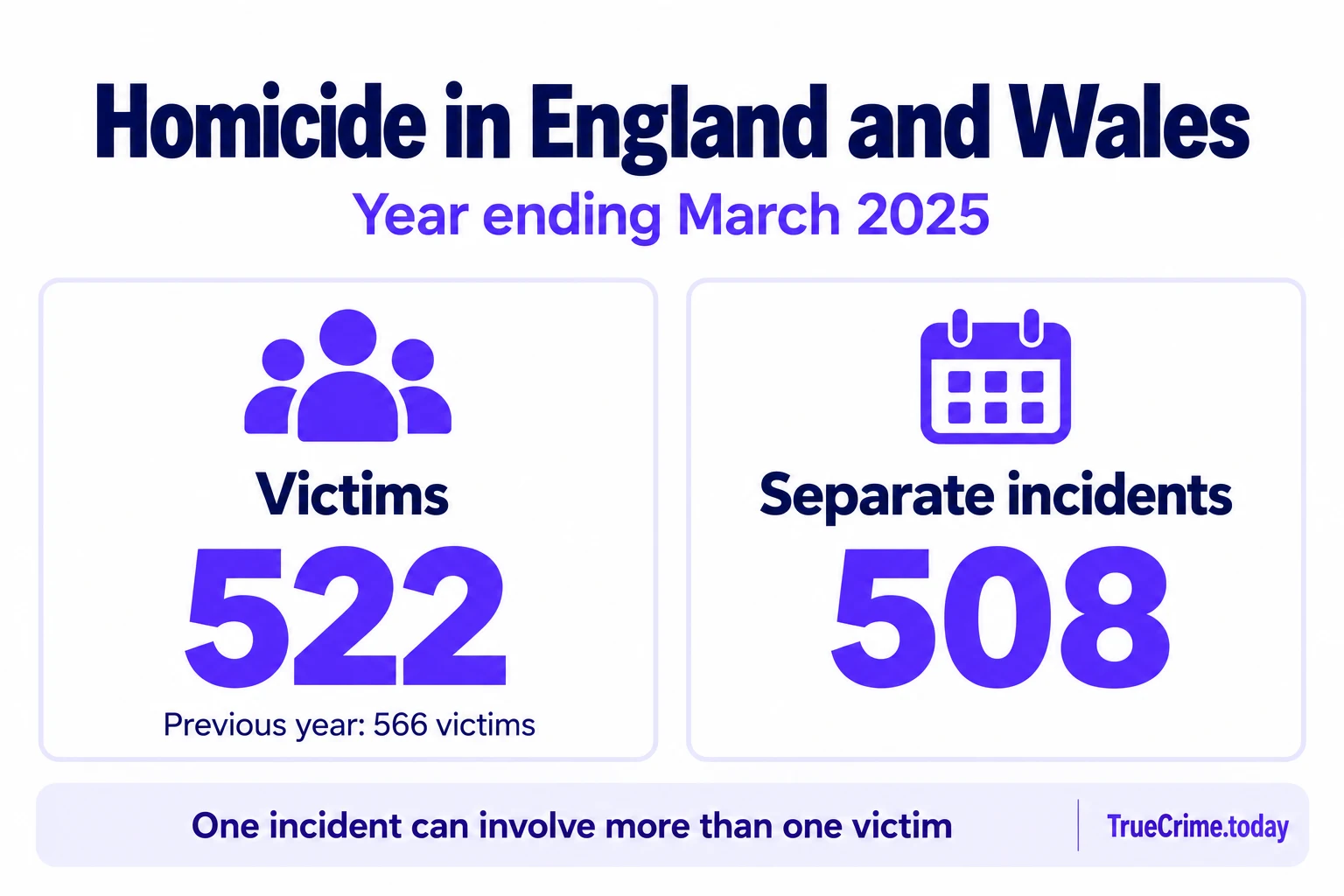
The fall of 44 victims is about 7.8%: 44 divided by 566, multiplied by 100. ONS rounds the change to 8%. These are England and Wales figures, measured by the year an offence was recorded. They describe a particular annual dataset, rather than every death that occurred that year or the latest quarterly police total.
The same analysis recorded 111 domestic homicide victims, including 75 women and 36 men. “Domestic” here concerns a partner, former partner or family relationship; it is not simply another way of saying that a death happened at home. The category helps explain patterns that a programme focused on stranger attacks can miss.
A national decrease does not lessen the loss to a family or establish your personal risk on a particular street. Nor can these figures be relabelled as a UK total: Scotland and Northern Ireland publish their own statistics. Combining different releases requires compatible definitions and periods, rather than adding the first numbers a search returns.
How can you check a British crime story?
Take the sentence that changed your mind and make its claim precise. If a presenter says an appeal “proved the witness lied”, find out whether the court actually made that finding, rejected an identification, or found that evidence had not been disclosed. Those explanations mean different things for the witness and the conviction.
The court name, decision date and final order help keep the chronology intact. A judgment can recount the original prosecution argument before explaining why it failed. An old conviction reported in that opening history should not become the current status of the person involved.
This approach leaves room for strong conclusions. Proven violence against women deserves the full lawful punishment available, and victims deserve protection and meaningful accountability. Clark, Malkinson and Lawrence also show why that demand needs reliable evidence and institutions willing to face their mistakes. The facts that withstand scrutiny give you a firmer basis for that demand than a persuasive edit or someone’s expression on camera.
Have a question about a British court decision or crime statistic? Send the public link and the point you want clarified. Do not send personal documents or private case files.
Ask about a British case