True crime in the USA: cases, courts and the evidence behind the story
True crime in the USA through the Central Park Five, Scottsboro and Emmett Till: understand the cases, court decisions and numbers behind American crime stories.
True crime in the USA can take you from a New York interrogation room to an Alabama appeal or a Mississippi family’s fight to be heard. The stories are gripping, but their endings need care. A conviction can fall apart, a civil lawsuit can settle, and an investigation can close for reasons that have little to do with whether a terrible crime occurred. Start with the people, then ask what the evidence and the actual decision establish.
TL;DR
The Central Park Five, the Scottsboro defendants and Emmett Till offer three starting points for American true crime: wrongful convictions, the right to a fair trial, and racial violence that the justice system failed to punish. Most criminal cases run through state courts; federal involvement depends on the law and the issue. The FBI’s full 2025 release estimated an 18.1% fall in murder and nonnegligent manslaughter offenses from 2024. A separate household survey helps explain how much nonfatal violence never reaches police. Neither a few famous cases nor a national average describes every American community.
Where should you start with American true crime?
Choose a question that will keep you interested after the dramatic reveal. The Central Park Five case asks why an accepted account of a crime survived until new evidence changed the outcome. Scottsboro asks what a defense lawyer must actually be able to do. Emmett Till’s murder asks how a crime can remain publicly known while a later prosecution faces legal barriers.
Those questions widen what true crime means. The genre includes investigations, trials and the people left to live with their consequences. You can enjoy a well-told story while still asking whether an arrest, a verdict and a later reversal are being described accurately.
The three histories span different places and decades. They provide starting points rather than a ranking of the country’s most important crimes. The FBI’s full 2025 crime release measures reported crime across the country rather than choosing its most memorable stories. A selection of famous injustices tells you very little about how frequently a particular error happens. To answer that, you need a defined population of cases and a method for finding errors, including the ones that never become documentaries.
Why does the court’s name matter?
An American criminal case usually begins with a particular state’s law and courts. New York, Alabama and Mississippi each have their own systems. Federal courts hear matters within federal jurisdiction, and constitutional questions can sometimes reach the U.S. Supreme Court. The official comparison of federal and state courts identifies state courts as the setting for most criminal cases.
That makes the court’s name useful information. It tells you which decision you are looking at and which rules to investigate next. A federal agency’s involvement does not automatically turn every related prosecution into a federal case. An appeal to the U.S. Supreme Court can concern a constitutional issue in a state prosecution.
In an analysis of a criminal case, a practical first step is to separate the accusation from the decision about it. Who filed the charge? Which court heard it? Did a later court reverse the conviction, order another proceeding or decide a narrower legal question? Those distinctions stop a dramatic account from compressing several years into “the case was reopened.”
The federal/state distinction is a starting point. Tribal and territorial jurisdictions add further questions, particularly about who may investigate and prosecute. A story involving those jurisdictions needs its own legal research; a rule from an ordinary state prosecution may not fit it.
What changed in the Central Park Five case?
In April 1989, a woman was attacked and raped in New York’s Central Park. Five young men became known as the Central Park Five after the investigation and subsequent convictions. In 2002, Matias Reyes admitted responsibility, and DNA evidence supported his account. On December 19, 2002, Justice Charles Tejada vacated the five convictions on the district attorney’s recommendation.
The distinction between a statement and its corroboration matters here. A confession may sound convincing when it is played on screen. You still need to know what the speaker could have known, how the questioning happened and whether independent evidence supports the account. Reyes’s admission and the DNA connection gave the later review an independent way to test what Reyes said.
The five men also pursued a civil case against the city. New York’s comptroller approved a proposed settlement in June 2014. That civil outcome addressed a separate dispute after the criminal convictions had already been overturned. Describing both events as one “acquittal” loses the chronology and the question each proceeding answered.
Ava DuVernay’s When They See Us brings the five men’s experiences to a large audience. Netflix classifies it as a drama based on real events. An actor’s interrogation scene can help you feel the stakes, but the dialogue, editing and performance belong to the production. A factual claim about the original questioning needs the records behind that scene.
What did Scottsboro change about a fair trial?
The Scottsboro cases began in Alabama in 1931, when nine Black young men and boys were falsely accused of rape. Their prosecutions produced repeated trials and appeals. In Powell v. Alabama, decided in 1932, the U.S. Supreme Court reversed convictions because the appointment of counsel had failed to allow effective assistance in preparing and presenting a defense under the circumstances of that capital case.
That holding makes an everyday distinction concrete: having a lawyer’s name attached to a proceeding is different from giving a lawyer time and opportunity to defend someone. Preparation can mean investigating an account, speaking with the accused, finding witnesses and challenging the prosecution’s evidence. A rushed appointment can leave those tasks undone even though the courtroom appears to have both sides represented.
A later decision, Norris v. Alabama in 1935, addressed the exclusion of Black people from jury service. Together, the cases show why the conditions of a trial affect the reliability of its result. Race and public hostility were part of those conditions, not background scenery to the legal story.
Successful appeals did not give all nine defendants the same immediate outcome. The University of Alabama’s archive describes later trials, dropped charges for some defendants and continued imprisonment for others. So “the Supreme Court overturned the case” needs a follow-up question: which judgment, on what ground, and what happened to each person afterward?
Why did the Emmett Till investigation close?
Fourteen-year-old Emmett Till was murdered in Mississippi in 1955. His mother, Mamie Till-Mobley, insisted on an open-casket funeral in Chicago so people could see what had been done to him. Her decision helped make the violence visible far beyond the place where it happened. That public history and the legal fate of a later investigation require separate explanation.
The Justice Department closed its renewed investigation in December 2021. Its closing memorandum, revised in August 2022, explains limits involving the statutes available in 1955, federal jurisdiction, time limits and the evidence needed to prosecute a living person. It also addresses the discovery of an old state arrest warrant and a state grand jury’s decision not to indict Carolyn Bryant-Donham in 2022.
Those limits help answer why a new prosecution did not follow. They do not make the murder uncertain or establish that every account given in 1955 was truthful. The department also could not prove the alleged later recantation beyond a reasonable doubt. A disputed interview claim should keep its attribution rather than becoming a settled confession in a retelling.
Historical records can still add to public understanding when prosecution is unavailable. The federal Civil Rights Cold Case Records Review Board lists original Till materials, including official memoranda, correspondence and contemporary press. A letter reveals what its writer said or asked for; it needs other evidence before you treat its accusations as findings.
Is violent crime rising in the United States?
The national picture depends on the measure and year. The FBI’s full 2025 crime release, published on August 14, 2026, estimated that murder and nonnegligent manslaughter offenses fell 18.1% from 2024. It put the murder rate at 4.1 per 100,000 inhabitants. We last checked that release on October 11, 2026.
Police figures depend on crimes known to law enforcement and agency reporting. The FBI reported population coverage of 96.2% for the participating agencies in its 2025 release. That coverage describes the population served by those agencies; it does not mean police learned about 96.2% of crimes.
A different source, the Bureau of Justice Statistics’ 2024 National Crime Victimization Survey, asks people about nonfatal victimization, including incidents not reported to police. It estimated 23.3 violent victimizations per 1,000 people age 12 or older, including 11.2 reported to police. The measure includes simple assault and excludes homicide.
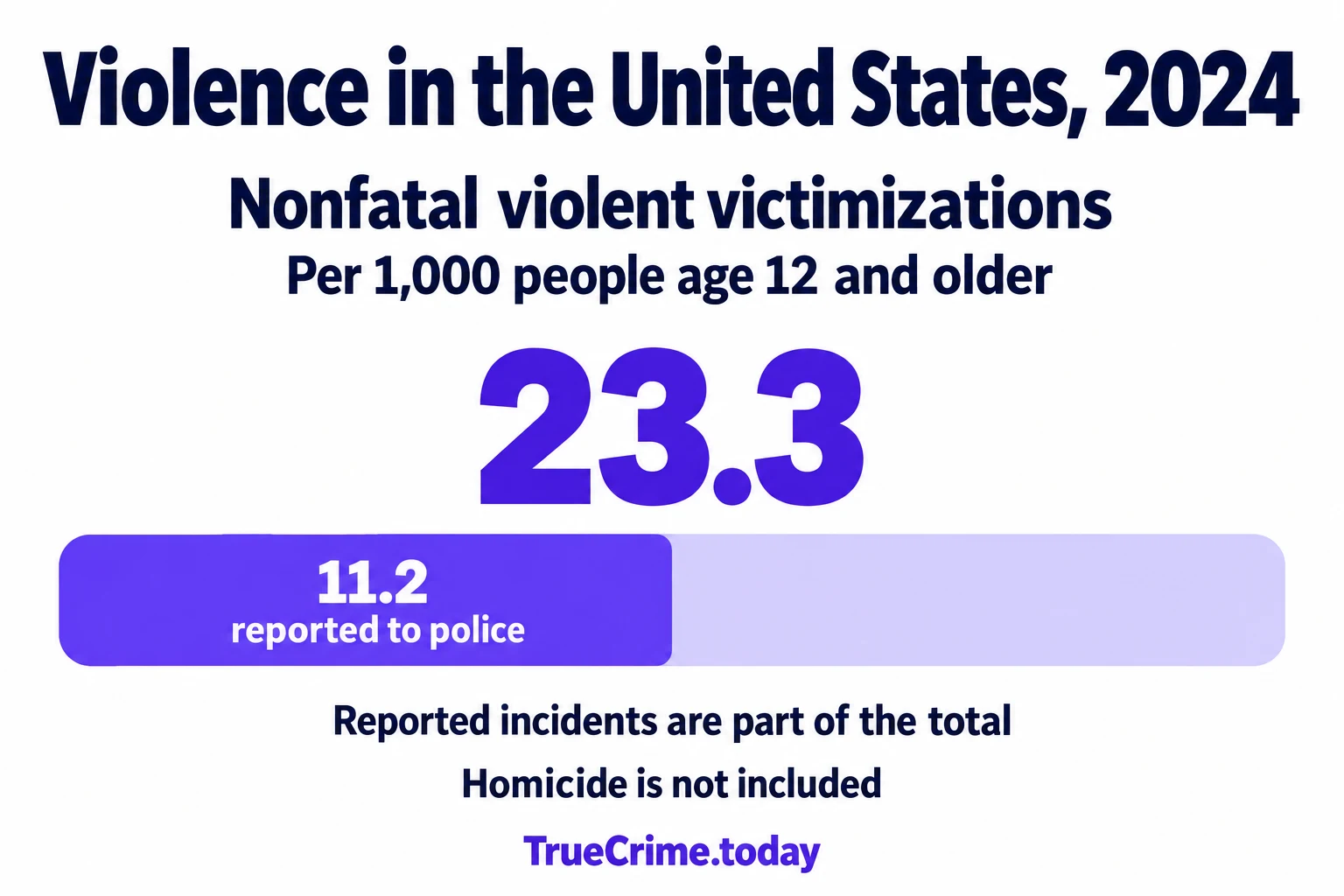
Dividing the two published rates gives 11.2 ÷ 23.3 × 100, or approximately 48.1%. That calculation uses rounded figures to show the size of the reporting gap. It cannot tell you the share of murders reported, the number of convictions or the chance that a particular person will experience violence.
The survey and police series also cover different years here. Treat them as explanations of different measurement methods, rather than a two-point trend. The survey’s 2024 report uses its legacy questionnaire during a redesign, which adds another reason to check methods before joining figures from different releases.
What can a crime story leave out?
A documentary can make an old case understandable by following a person through events. That choice also leaves things outside the frame: unsuccessful appeals, other defendants, the attacked person’s life, or a document that complicates the ending. An omission may come from limited time, unavailable records or a deliberate narrative choice. You need the missing material before deciding which explanation fits.
Try pausing at the sentence that changes your mind. “He confessed,” “they were cleared” and “the investigation closed” each invite a different check. Look for the full interview, the court’s order or the agency’s stated reasons, and notice when they were issued. A statement that accurately described a pending case several years ago can become misleading after the next decision.
Strong accountability depends on proving the right person’s responsibility and allowing the evidence to be challenged. The people harmed by a crime deserve that care, and so do people wrongly accused of it. The American cases above make those interests painfully connected: an accepted story can keep a real crime unresolved while taking someone else’s freedom.
Have a question about an American case or a crime statistic? Send the public link and the point you want to understand. Please keep personal documents and private case files out of the contact form.
Ask about a US case