Best true crime documentaries 2026: five new releases to consider
Five 2026 true crime documentaries compared by story, source material and viewing time, with privacy and streaming limits explained.

You want something new to watch, but a search for the best true crime documentaries 2026 gives you everything from this year’s releases to films that have been around for a decade. This selection sticks to five documentaries first released in 2026, including both single films and short series.
The order favours stories that let you ask a useful question about the material on screen. What was recorded before anyone knew the outcome? Who is remembering it afterwards? Whose account are you hearing? If you want a recommendation beyond “the ending is shocking,” those differences help you choose.
TL;DR
Start with Trust Me: The False Prophet if you want footage from inside a closed religious group and a story about abuse of authority. Choose The Crash for one film that brings together several kinds of case material. The TikTok Killer follows a family’s search through digital traces; A Friend, a Murderer looks at betrayed friendship; Murder in Glitterball City brings community and a troubling recording into the same story. This is a researched viewing shortlist, not a claim that we watched and scored every release.
Five choices at a glance
There are four short series and one standalone film here. They cover stories in the United States, Spain and Denmark. These are international viewing recommendations; the services and language options available to you depend on where you live.
-
Trust Me: The False Prophet. The filmmakers’ account of filming inside the group explains the access behind this four-part Netflix series, released April 8, 2026. Choose it for questions about control and the people living under it.
-
The Crash. Netflix’s account of the recordings and interviews used in The Crash describes a mix of family testimony, phone recordings, surveillance, bodycam and courtroom footage. Released May 15, 2026, the film runs about 95 minutes.
-
The TikTok Killer. The announcement of this two-part Spanish documentary describes a family’s search through messages, videos and other digital traces. Netflix released it March 6, 2026.
-
A Friend, a Murderer. The creators’ description of the Danish series puts friends and a shaken community at its centre. Its three episodes arrived on Netflix March 5, 2026.
-
Murder in Glitterball City. The HBO catalogue entry for Murder in Glitterball City identifies the Louisville, Kentucky, story. The two-part documentary premiered February 19, 2026, on HBO and HBO Max in the US. Choose it for a story that looks beyond a suspect to the surrounding community.
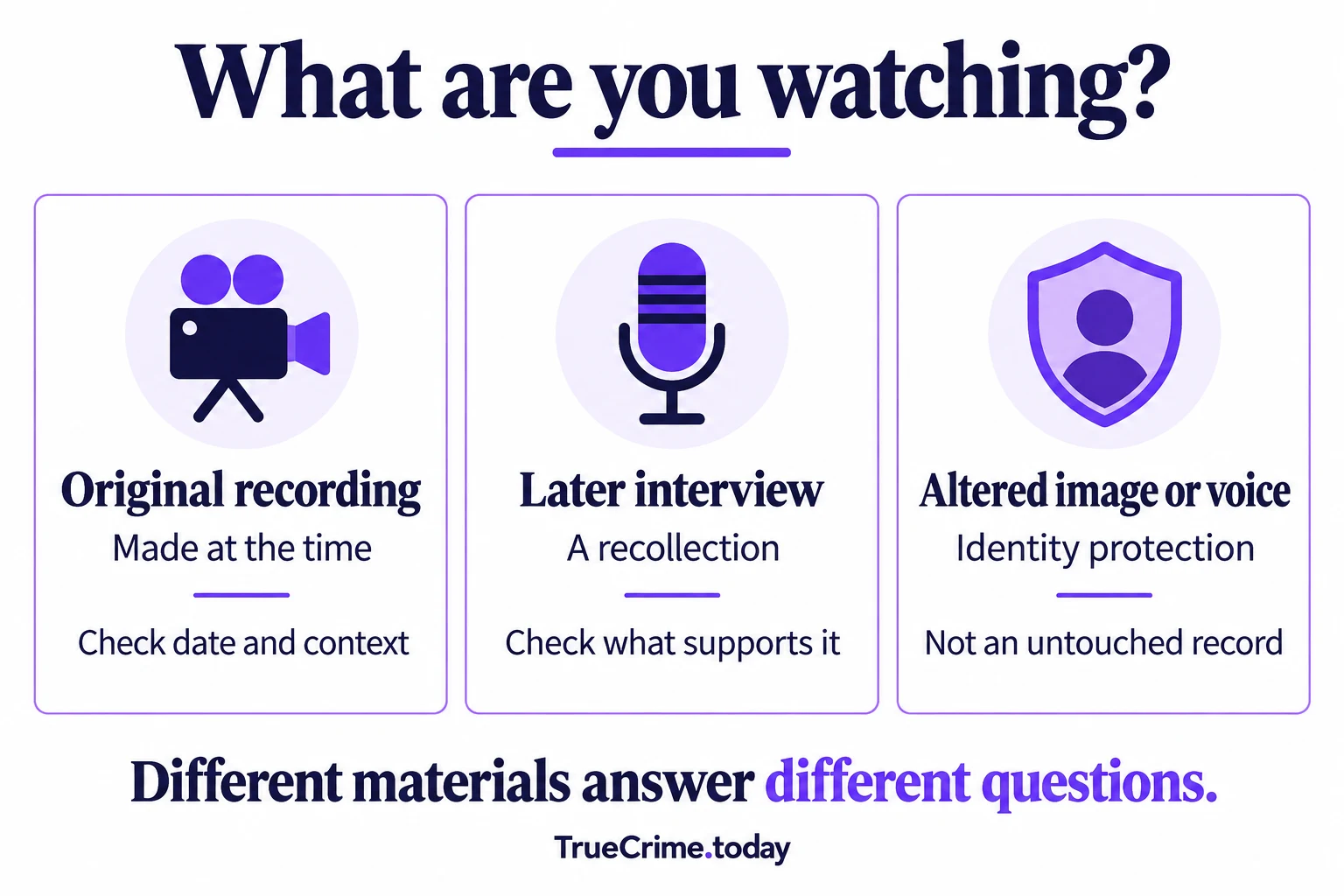
The graphic compares kinds of material, not the reliability of these five films. A later interview can add something important that a camera missed. An original recording can still be cut in a misleading way. An altered face can protect someone while making the image unsuitable for analysing their original facial movements.
What earned these five a place?
For this shortlist, “best” means a strong match between a viewing question and the access described in the production material. We checked release announcements, official catalogue entries and filmmaker interviews. We haven’t watched every film in full, so we aren’t awarding stars for editing, atmosphere or completeness. The last time we checked these releases was October 13, 2026; the year isn’t over yet.
That approach starts with true crime as nonfiction about real events. A film can tell a gripping story without giving you every document in the case. Our selection asks what each documentary offers and what you shouldn’t expect it to settle.
There are two useful questions behind that choice. The Documentary Accountability Working Group’s public description of its ethics framework emphasises care and transparency towards participants. For you, that means asking who has been given a voice and how people who could be harmed by exposure are protected. It doesn’t mean these films have been approved by the group.
The other question concerns the footage itself. The BBC’s published 2019 accuracy guidance explains why reconstruction, editing and archive material should not create a misleading impression. We use that as a viewing question, not as a certification of Netflix or HBO productions: can you tell what kind of material you’re watching?
If you want to follow a disputed claim after the credits, separating case records from interpretation gives you a better starting point than replaying somebody’s expression. That distinction also explains the trade-offs in the ranking below.
Five 2026 documentaries, ranked by viewing fit
1. Trust Me: The False Prophet
Best for: looking at how authority operates inside a closed group. Format: four parts on Netflix.
Rachel Dretzin’s series follows Christine Marie and Tolga Katas, whose cameras gained access around Samuel Bateman. The material includes footage from inside the group and accounts from people affected. That access puts it first in our shortlist: you can consider how a leader speaks and how the people around him respond, rather than relying entirely on an explanation delivered years later.
There’s an important catch. The production team says it used AI to alter minors’ faces and voices to protect their identities. Those changes deserve attention before anyone tries to analyse a tiny facial movement or vocal hesitation. The person may be describing a real experience, while the face or voice presented to you has been changed.
Why choose it: it offers a way into questions about obedience, secrecy and speaking up. Why choose something else: it involves sexual abuse of minors and takes four episodes; it isn’t a light evening watch. Its inside access also doesn’t give you an untouched view of every interaction. Keep the privacy changes and the filmmakers’ selection in mind.
2. The Crash
Best for: comparing several kinds of material within one film. Format: approximately 95 minutes on Netflix.
Gareth Johnson’s documentary concerns the Ohio collision involving Mackenzie Shirilla, Dominic Russo and Davion Flanagan. Its production account describes recordings from before and after the collision alongside interviews with families and the legal teams. That mix makes it our second choice and the easiest format to choose if you don’t want a series.
The distinction to watch is between what a recording captures and what someone later says it means. A remembered argument and a recorded argument are different materials. Neither gives you permission to invent what happened during an unrecorded moment.
Why choose it: the single-film format lets you follow several perspectives without committing to multiple evenings. The trade-off: a compressed narrative can’t replace the trial record. The documentary includes a prison interview with Shirilla, with her lawyer present; an edited interview serves a different purpose from testimony challenged in court. Expect discussion of young people’s deaths and disturbing response footage.
3. The TikTok Killer
Best for: a family search built around digital traces. Format: two parts on Netflix.
Héctor Muniente’s Spanish documentary follows Esther Estepa’s disappearance and her family’s attempts to reconstruct her movements. Messages and videos matter because they can survive when the person who made or received them is no longer available to explain them. The production also describes an extensive social-media archive.
It takes third place for that focus. If you’re interested in language and online self-presentation, there’s a more useful question than whether someone “looks guilty”: what does a post establish about a time, place or contact, and what does it leave out?
Why choose it: a short series gives you a digital trail and the people trying to understand it. The trade-off: a public feed is a selected presentation of someone’s life. It isn’t a complete movement log or an independent check on everything said in it. The subject includes disappearance and violence against women, so read the platform’s content information before starting.
4. A Friend, a Murderer
Best for: the aftermath of discovering that someone close to you committed serious crimes. Format: three episodes on Netflix.
Christian Dyekjær’s Danish series turns towards a group of friends and their community. The creators say they anonymised victims out of consideration for them and their relatives. The question here is about living with a discovery, rather than rewarding viewers for guessing the perpetrator.
That makes it a different choice from the first three. If you’ve ever wondered how people can fail to recognise danger in someone they know, the friends’ accounts offer a starting point. They aren’t a controlled study of deception, and familiarity doesn’t supply a reliable lie-detection test.
Why choose it: you want to hear about trust and the shock that follows its collapse. The trade-off: the friends’ perspective won’t give you the same story as a victim-led account or a full procedural examination. Don’t turn hindsight into an accusation that somebody must have known. The subject includes sexual violence and murder.
5. Murder in Glitterball City
Best for: seeing how a criminal story sits within a community. Format: two parts; HBO/HBO Max US release.
Fenton Bailey and Randy Barbato’s documentary concerns Jamie Carroll’s death in Louisville. In their interview with Out, they describe a project developed over more than four years and explain why the surrounding queer community matters to the film. They also discuss the danger of treating a recorded statement as self-explanatory.
It ranks fifth because it offers a different framing from the Netflix choices, while its regional viewing options require an extra check. That position isn’t a verdict on its filmmaking. If community history is what interests you, it may be your first choice.
Why choose it: you want people and a place to remain part of the story after the recording attracts attention. The trade-off: a filmmaker’s interpretation, including an opinion about who should be punished, isn’t a court finding. Keep those claims distinct. Expect violence and discussion of drug use; we haven’t verified playback or language options outside the US release market.
Which story fits the evening you have?
For a first documentary from this list, The Crash offers a single-film commitment. For a discussion with friends, A Friend, a Murderer opens a question about trust without requiring you to play amateur detective. For a closer look at documentary construction, Trust Me makes privacy and the presentation of recorded people especially relevant.
The subjects also differ. The TikTok Killer puts a family search and digital traces together; Murder in Glitterball City adds the surrounding community to the crime story. You don’t need to follow the numbered order if one of those questions matters more to you.
Before you pay for another subscription
Four choices are Netflix releases. If they’re available in your existing account, you may not need another service. The HBO title belongs to a separate release platform; check the exact film in your local catalogue before paying for access.
We haven’t compared subscription prices across countries or verified a free option for these films. Check subtitles, audio, accessibility features, age information and the full runtime where you plan to watch. A translated catalogue page alone doesn’t establish that a title can be played there.
Another release worth knowing about
Maternal Instinct, directed by Jessica Dimmock, premiered on Netflix June 12, 2026. It concerns Taylor Parker and a claimed pregnancy in Texas. It is another option if a story about deception interests you, but the pregnancy and infant-death subject can be especially distressing.
We left it outside the main five to keep a range of viewing questions, not because we verified that it is worse. We also haven’t ranked future releases or filled the list with older classics carrying a new date. A later recommendation can change as more films and fuller viewing evidence become available.
Questions before pressing play
Are these five the best films of the entire year?
No complete-year claim is possible in October. This is a selection of verified 2026 releases ordered by the viewing needs explained above. It isn’t an exhaustive catalogue or a review score based on watching every film.
Can a documentary tell me whether someone is lying?
It can show you a contradiction or a record that challenges an account. An expression, a pause or an edited reaction shot doesn’t establish deception by itself. In Trust Me, some faces and voices have also been changed for privacy, so they cannot be treated as untouched recordings for that purpose.
Does an original recording settle the story?
Imagine two friends arguing after a documentary. One remembers a phone recording made before the event; the other remembers a later interview explaining it. They may be discussing two different claims without noticing. Start by agreeing which scene you mean and when its material was made.
Then ask what the scene actually supports. Words on a recording can establish that something was said, but context still matters: to whom, in what circumstances, and whether the whole exchange is available. A later account may explain a gap, yet still need support. The distinction makes a conversation more useful without turning film night into a trial.
Start with one question
Pick one title and one thing you want to understand. Before watching, check its availability and content information. Afterwards, name one claim that came from a record and one that came from interpretation. If you can’t tell, that’s a reason to look more carefully at the scene, rather than a reason to become more certain about the people in it.
Have a question about a film title or its source material? Send the public source and the exact passage. Please omit identity documents, contracts, bank details and other personal documents.
Ask about a documentary