Forensic linguistic authorship analysis: how writing is compared
How forensic linguistic authorship analysis compares writing, interprets accuracy figures and handles short texts, shared phrases and alternative authors.

You hear that an anonymous message contains the same unusual phrase as a suspect’s emails. It sounds like a breakthrough. Before deciding what it means, you need to know how the comparison was made. Forensic linguistic authorship analysis examines writing patterns to address questions about who composed a text. Its value depends on the samples, the alternatives and how well the method has been tested for that situation.
TL;DR
Experts can compare vocabulary, grammar, punctuation and recurring combinations of words. A useful analysis examines variation within a person’s writing as well as similarities between people. It needs reliable comparison material and tests that reflect the disputed text. A shared phrase, a nearest match or an overall accuracy figure cannot by itself establish an author’s identity, the truth of a message or responsibility for a crime.
What forensic linguistic authorship analysis can ask
Authorship attribution asks which candidate is the likely writer. Authorship verification asks whether questioned and known writing came from the same person. The distinction matters when a programme says a suspect was the «best match». A method comparing a fixed list can select someone even when the actual writer is missing from that list.
The broader field of forensic linguistics also examines meaning, interactions and language in legal settings. Comparing authors is one part of that work. Determining whether a sentence expresses a threat and determining who wrote it require different evidence.
An analysis may help exclude a proposed author, support one explanation over another or show that the available material is insufficient. Those are different outcomes. «Inconclusive» can be an appropriate result when a method cannot support a stronger statement.
Why the comparison texts matter before the clever phrase
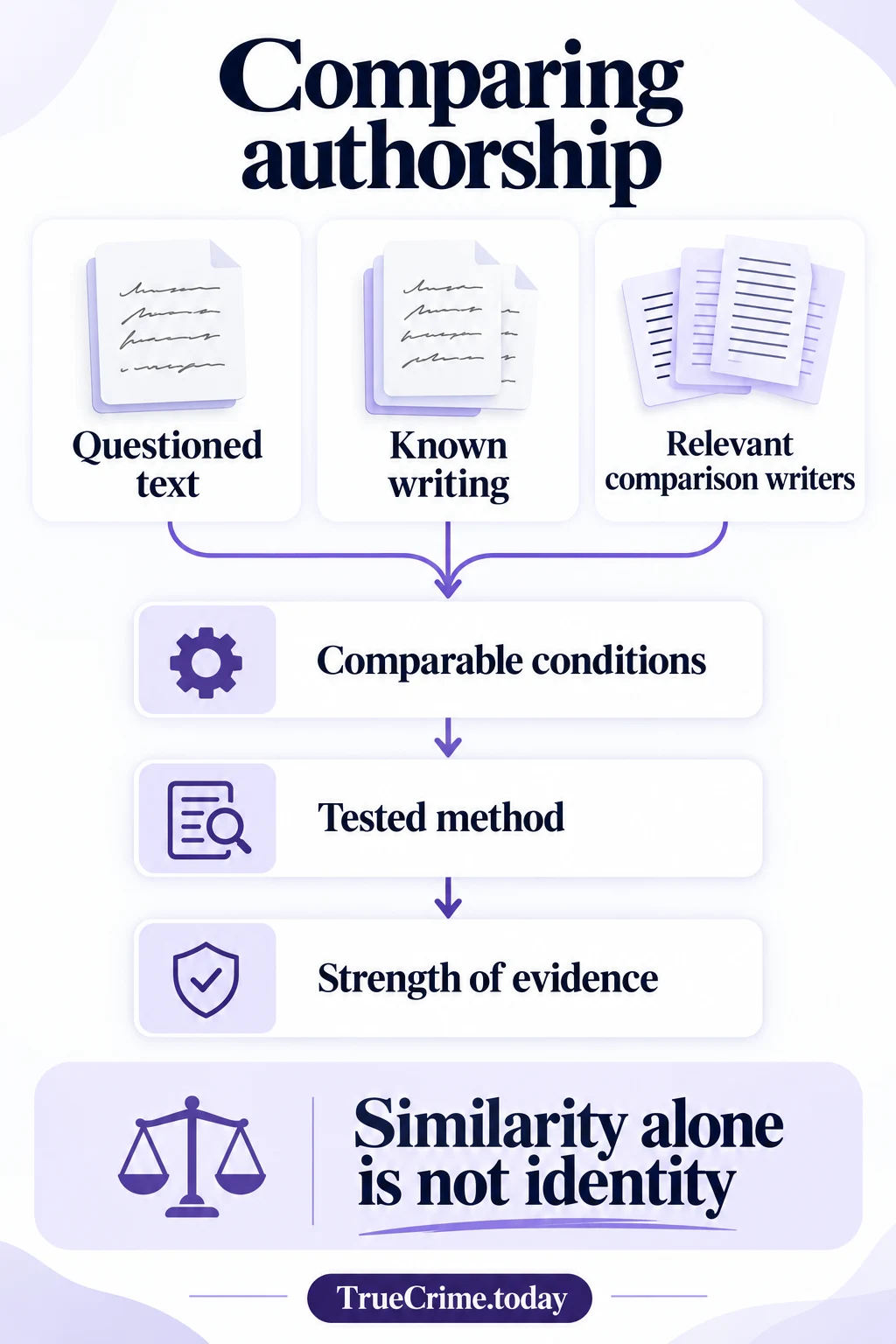
You need known writing whose authorship has been established independently. Collecting posts from an account labelled with a person’s name does not automatically establish that the person composed every post. Shared accounts, quoted material and editing can all matter.
For a company-email comparison, ask whether the samples were written personally or shaped through an AI-assisted writing process. A process that turns someone’s notes into finished copy introduces another source of wording; the final text may not preserve that person’s unaided habits.
Comparability matters too. A formal complaint, a friendly message and an academic article create different choices for the same writer. Relevant samples should help distinguish ordinary changes in situation from differences that genuinely bear on authorship.
From a repeated expression to a measured pattern
An unusual expression can suggest something worth checking. Its importance depends partly on how often other relevant writers use it, whether it was copied and how consistently the proposed author uses it. A phrase circulating in a workplace may reveal the workplace rather than an individual.
The same caution applies when assessing evidence in a true-crime case: a clue can guide a question without settling the answer. If the phrase came from a shared notice, that fact changes its interpretation even though the visible match remains.
An analyst needs more than a display of selected similarities. The comparison should also address differences and explain why the chosen features were examined. Searching until something matches creates opportunities to mistake coincidence for a stable habit.
How accurate is authorship analysis? Start with the task
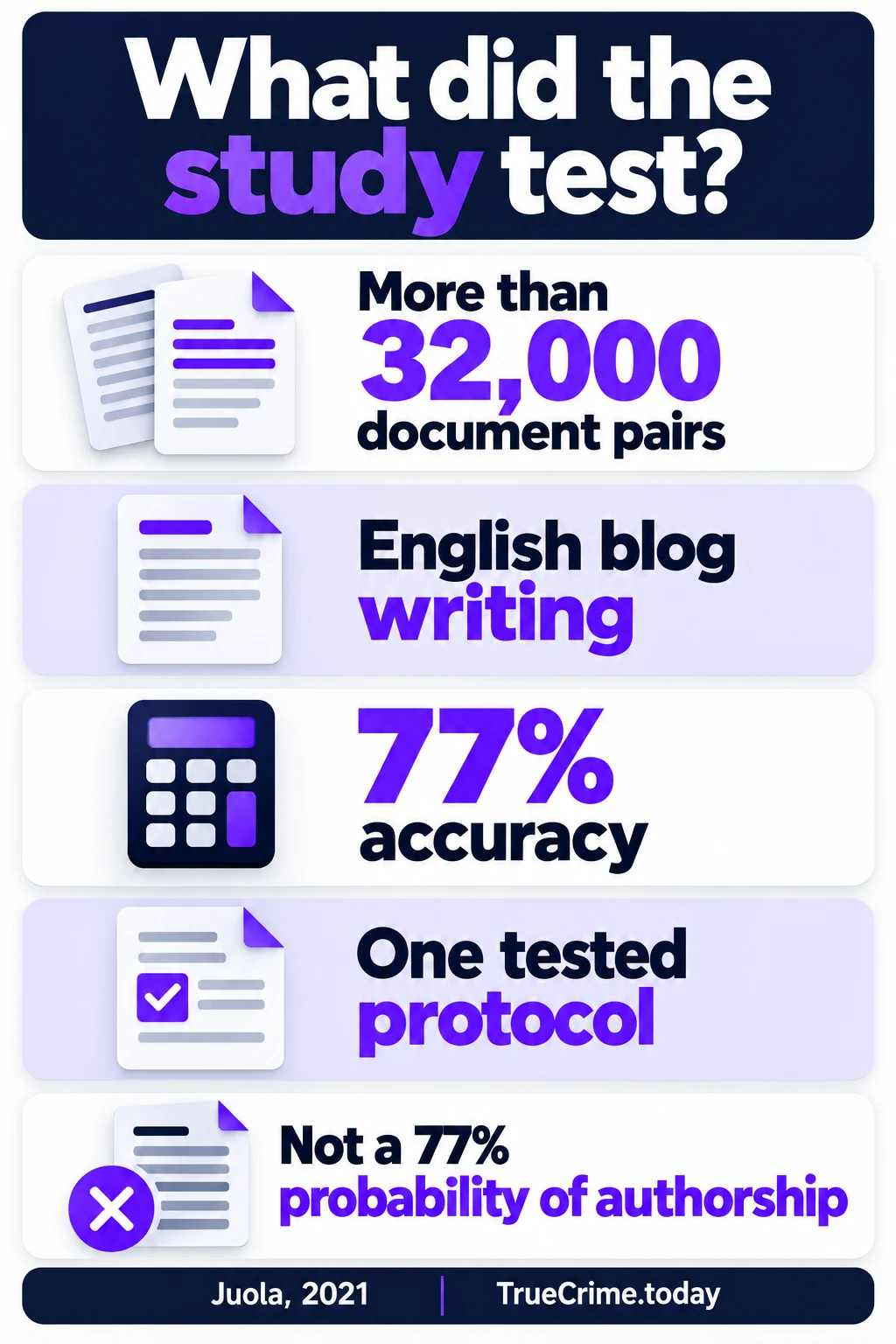
Patrick Juola’s 2021 study of a computational authorship-verification protocol reported 77% accuracy across more than 32,000 document pairs involving English blogs. This is a useful example of a method being tested against known answers. It describes that protocol and experiment, rather than a success rate for all linguistic analysis.
Accuracy combines correct decisions under the study’s conditions. It does not tell you, by itself, how often different writers were falsely treated as the same writer, how often genuine matches were missed or how often the system would decline to answer. Those questions require the relevant breakdown and decision rules.
Nor does 77% mean a person in a particular case has a 77% probability of being the author. That would change a performance measure into a conclusion about one disputed text, without the information needed to make that inference.
Why a test on blog posts may not fit a threatening message
A test becomes more relevant when it reflects the conditions of the comparison being made. Length, genre, topic, time period and language can change the task. An overall score from convenient material may conceal poor performance in the condition that matters to you.
In Ishihara and colleagues’ 2024 text-comparison experiments, topic mismatch illustrated why testing with case-relevant conditions and data matters. The authors compared experimental arrangements that respected or overlooked those requirements. Their concern was the strength assigned to textual evidence, not merely whether some similarity could be found.
This does not mean every comparison across topics must fail. It means success needs to be demonstrated under appropriate conditions. A stronger algorithm may handle some mismatches better, while still needing tests for the specific claims made about it.
Six openings in twenty sentences: a worked example
Imagine an anonymous email about an allotment committee. Someone notices sentences beginning with «please». In an invented comparison, that opening appears in 6 of 20 known sentences and 12 of 40 questioned sentences.
The calculations are 6 ÷ 20 × 100 = 30% and 12 ÷ 40 × 100 = 30%. The second text contains twice as many examples because it contains twice as many sentences. Comparing the raw counts alone would exaggerate the difference.
These numbers are invented to explain normalization. Even the equal rates do not establish common authorship. You would still need variation across other samples, relevant writers and contexts, plus a tested way of interpreting the evidence. Choosing this feature after noticing the match would introduce another concern.
What an analyst compares beyond the vocabulary
Possible features include function words, punctuation habits, spelling patterns, grammatical constructions and short sequences of characters or words. Some features concern the structure of writing rather than the subject being discussed.
A character sequence, often called a character n-gram, is a run of a specified number of characters. Counting many such sequences can capture parts of spelling and punctuation patterns without requiring an analyst to nominate a memorable phrase. The features still need an explanation and an appropriate test.
Several related features may reflect the same underlying habit. Counting them as independent pieces of support can inflate the apparent weight of a match. A long report containing many observations is not necessarily stronger than a shorter, properly tested analysis.
The person who typed it may not have composed it
Authorship, typing and sending are separate activities. A person might dictate, copy, translate or edit someone else’s words. A device or account can show how the message was transmitted without identifying who selected the wording.
That is why the history of the text matters before stylistic interpretation. A transcript with corrected spelling is a different object from the original message. Preserve what was received, how it was obtained and any transformations, so another analyst can understand which features remained available.
What a likelihood ratio means
A likelihood ratio, or LR, compares how probable the observed evidence would be under two specified propositions. In an authorship comparison, those might be that the questioned and known texts have the same author, or that the questioned text comes from another writer in a relevant population.
An LR greater than 1 supports the first proposition relative to the second; below 1 supports the second. The propositions and population matter. The number concerns the evidence under those alternatives, rather than a free-standing probability that the suspect wrote the message.
A software similarity score is not automatically an evidential LR. The relationship between scores and observed outcomes must be assessed. Calibration addresses whether the reported strength is justified; it cannot repair irrelevant comparison data by changing a label.
How 10 can still leave a low probability
Here is a deliberately hypothetical calculation. Suppose an LR is 10 and, independently of that language evidence, the starting odds for common authorship are 1 to 99. Multiplying gives updated odds of 10 to 99, corresponding to 10 ÷ 109, or about 9.17%.
The calculation illustrates why «ten times more likely» needs a clearly stated object. It does not mean a 90% probability of authorship. With different starting odds, the same LR gives a different result.
These are assumed numbers, not findings from a case. Selecting starting odds requires information beyond the text comparison, and the same evidence must not be counted twice. An authorship analyst’s LR alone does not supply that starting point or determine guilt.
Why the reference population changes the question
If a phrase is common among people who use the same company forms, comparing only with unrelated personal blogs could make it appear unusually distinctive. The relevant alternative writers should match the question being asked as closely as the available evidence allows.
There is no automatic rule that everyone on Earth belongs in one undifferentiated comparison group. Equally, narrowing the group to people already suspected can exclude plausible alternatives. The choice and its limitations need to be explained, not hidden behind a precise-looking score.
What newer grammar models have actually tested
A study published in 2026 by Andrea Nini and colleagues examined grammar-based authorship verification across 12 datasets, comparing the method with seven baseline methods. That is a broader test than one pair of texts, but the study was conducted entirely on English.
The authors also identified limitations involving genre differences and language-dependent processing. Twelve datasets do not mean twelve languages, and performance on English does not establish performance on Russian. Promising results justify further testing while leaving those limits in place.
Short texts, translations and changing habits
A brief message provides fewer opportunities to observe recurring choices. Some short texts can still contain useful information; the question is what the chosen method can support with that amount and kind of material. A universal minimum word count would obscure those differences.
Translation introduces another person or system’s decisions. Comparing an English translation with a suspect’s original English writing can confound authorship with the translator’s habits. Even within one language, editing, audience, passage of time and a change of genre can alter the features available.
AI editing and shared wording complicate the picture
When writing has been generated or rewritten, the visible patterns may reflect the person, a model, an editor or their interaction. A confident claim that the text «sounds like» someone does not resolve which contribution produced the similarity.
An AI-detection score answers a different question from human authorship verification. Neither should be treated as proof of the other. The useful starting point is the text’s production history, followed by tests designed for the relevant assisted-writing conditions.
How an analysis can be checked by someone else
A report should identify the material examined, how authorship of comparison texts was established, the features and method used, and the tests supporting the conclusion. It should also make the alternatives and limitations understandable.
Independent checking needs access to an appropriate record of the analysis. Reproducibility does not mean every analyst must choose the same method, but unexplained selection decisions make disagreement difficult to investigate. Differences should lead to questions about assumptions and data, not a contest of confidence.
From literary attribution to forensic questions
Comparing style has a long history in literary authorship disputes. Computational approaches made it possible to count patterns across larger collections. A forensic dispute adds pressures involving limited samples, disputed text origins and a specific proposition about evidence.
A method that works on complete novels may not transfer to a short message. The historical continuity is useful, but the task has to be specified anew. The prestige of a successful literary attribution cannot substitute for a relevant test.
Why a profile cannot identify a person
Profiling asks about characteristics a writer may share with a group. Authorship comparison asks about the source of particular writing. Group-level patterns can suggest possibilities without identifying a unique individual.
Regional vocabulary may circulate among people who moved, learned from others or deliberately adopted it. Inferring a precise age, gender, profession and identity from one message invites several uncertain steps. A profile needs its own evidential basis and must retain uncertainty.
What to ask when a documentary says the language matched
First ask what «matched» describes: a phrase, a feature profile, a nearest candidate or an assessed strength of evidence. Then ask which known texts and alternative writers were used, and how the method performed with comparable material.
You should also be able to see what would count against the preferred explanation. A shared source, editing history or different author missing from the candidate set can change the interpretation. A useful report allows those questions rather than making every difference disappear into the story.
Questions after a comparison
Two questions remain especially important when an analysis moves from a research result to an accusation about a person.
Does the closest writer have to be the author?
No. A comparison can rank the available candidates even when none is the source. Verification and open-set conditions need appropriate testing; winning a restricted comparison does not establish that the restriction was justified.
Can authorship evidence prove that a message is true?
Identifying the composer would not establish the truth of the message. People can write accurate accounts, mistakes, jokes or deliberate falsehoods. Content verification and evidence about events remain separate tasks.
Where the language evidence stops
A meaningful comparison explains its samples, alternatives, testing and uncertainty. It can contribute to an investigation without supplying every missing link between writing, identity and an alleged act. When you encounter a striking match, start with the comparison that produced it and ask what else could produce the same pattern.
You can ask about a writing comparison, an accuracy claim or a worked calculation. Do not send private messages, case files or other personal documents.
Ask about authorship evidence