Historical true crime: what survives, and what gets retold?
Read historical true crime with dates, archive examples and missing-record context. Learn what old trial reports, letters and modern reconstructions can prove.
A candle burns beside the accused. The narrator tells you what she thought, then an actor delivers her last words. It feels like a window into the room. But how much came from a document, and how much came from the script?
TL;DR
Historical true crime examines real accusations, offences and criminal proceedings from earlier periods. Its hardest question is often what survives. A court report can be incomplete, a letter can take sides, and a later retelling can fill the gaps with scenes nobody recorded. Look for the date, the speaker and the kind of document before treating a vivid detail as fact.
What counts as historical true crime?
There is no birthday after which a case becomes historical. A nineteenth-century murder, an early modern prosecution and a twentieth-century investigation can all belong here. The useful distinction is that you need to understand an earlier world, including its records and rules, to make sense of the story.
That still leaves room for a good narrative. Historical true crime is nonfiction, even when its pace resembles a novel. Our explanation of what true crime means draws that boundary: a storyteller can choose which verified details to tell, but invented thoughts do not become evidence because the setting is old.
Not every historical prosecution established that a crime occurred. Some proceedings concerned conduct that would not be an offence today; others recorded accusations we should not accept as descriptions of reality. Naming the accusation and naming a proven act are different jobs. A gripping story needs to keep that difference visible.
Why does an old trial report feel so convincing?
Dates, names and quoted exchanges make a report look solid. They may give you useful information, but they do not tell you how much the publisher left out. A printed account is an account of a proceeding, not automatically every word spoken there.
The London Lives explanation of the Old Bailey Proceedings describes published accounts from 1674 to 1913. It also warns that reports often omitted defence testimony, legal arguments and the judge’s summing up. An accusation could survive in much greater detail than the answer to it.
Imagine reading a detailed witness identification followed by a one-line verdict. You cannot conclude that nobody questioned the identification. The questions may simply be absent from that publication. Equally, the omission does not prove that a powerful person arranged a cover-up. Both conclusions go further than the surviving text.
Before judging the defendant’s explanation, ask whether you actually have it. That small pause changes how you read the whole account: you can describe the prosecution’s claim while leaving room for a reply the report does not preserve.
How much of the Old Bailey record survives?
Many early editions have not survived. The collection’s methodology estimates that approximately a third of the Proceedings are missing for 1674–1714; the surviving published series is continuous after that period. Those are gaps in editions, not a count of undetected crimes.
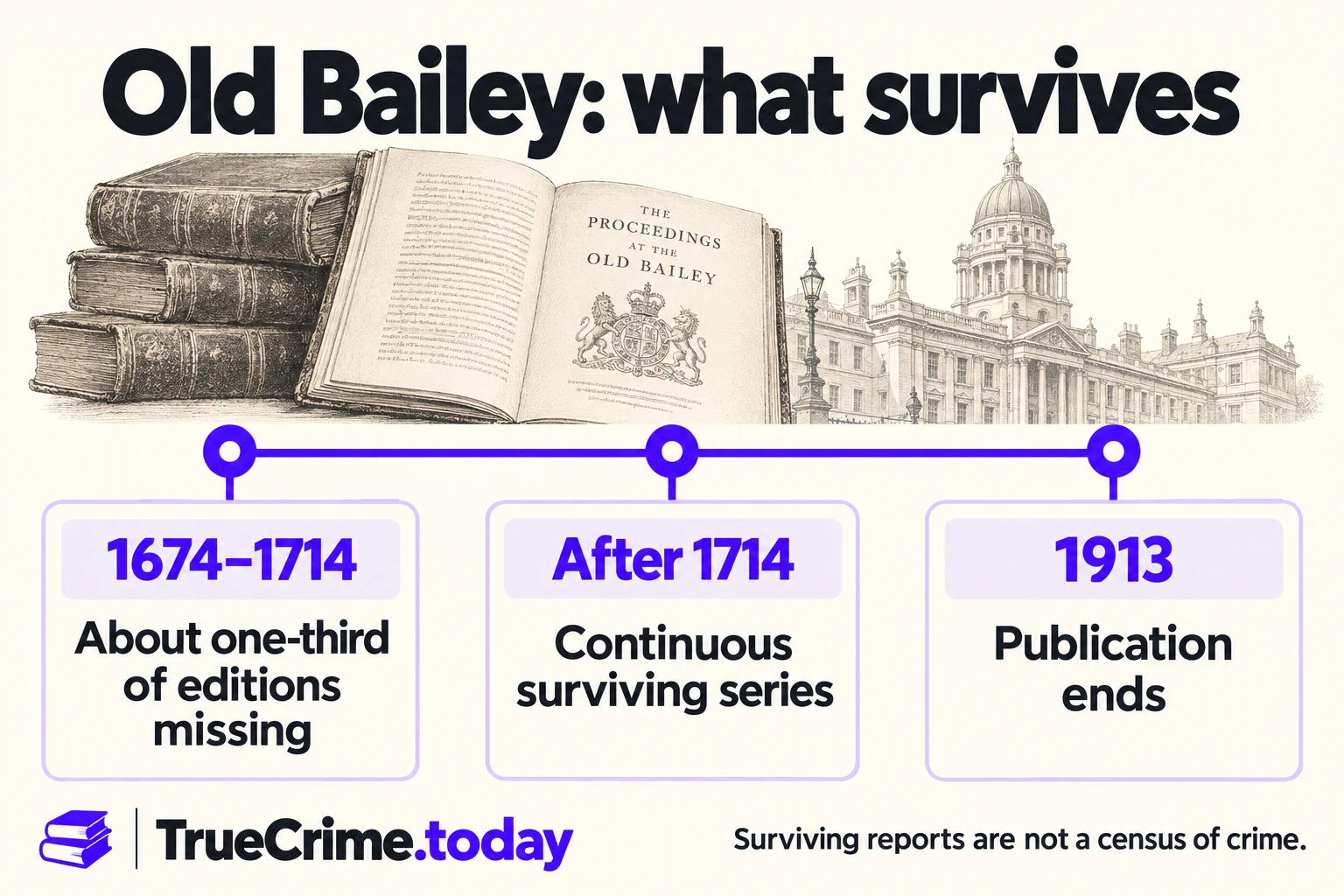
This AI-generated timeline illustrates publication and survival. It does not say that the later accounts contain every exchange, or that every offence in London reached this court. A continuous shelf of reports can still contain selective reporting.
The University of Sheffield’s Old Bailey project description gives a figure of 197,745 criminal trials in its searchable collection. That is a large amount of material about one court. It is not 197,745 crimes committed across Britain, nor a current nationwide crime total.
The scale makes searching tempting: type an offence, count the matches, draw a line. But a result depends on what the collection covers and how its text has been described. Keep that question beside the number, rather than adding it after the conclusion.
Where can you hear a different voice?
A court account does not have to be your only starting point. The University of Virginia’s Salem Witch Trials Documentary Archive separates court records from letters, sermons and a diary, alongside maps. That distinction matters when reading material associated with the 1692 accusations in colonial Massachusetts.
A sermon can show what a preacher urged an audience to believe. A letter can show what its writer said to a particular recipient. Neither automatically proves an allegation in a court document. Read them as different kinds of evidence, rather than collecting dramatic sentences that seem to agree.
Our approach to analysing case evidence asks who made each claim and what supports it. In an old account, add another question: did a later author read separate records, or repeat one earlier book? Three retellings may give you three versions of the same source, rather than three independent witnesses.
That is also why an accusation of witchcraft should remain an accusation when you describe the record. A document’s age does not make its explanation of events true. You can study how people accused, investigated and punished without adopting what they believed.
Do more trial records mean more crime?
More records can mean more recording. They can also mean a wider court jurisdiction, a different prosecution policy, a change in an offence definition or better survival of documents. A rise in a search result needs an explanation before it becomes a social trend.
Here is a deliberately fictional comparison. An archive contains twenty robbery trials for one period and forty for another. That doubling alone cannot tell you whether robbery doubled. Perhaps the court began hearing cases from a larger area; perhaps more reports survived. You would need comparable coverage, a suitable population denominator and a consistent definition before making a rate comparison.
The opposite mistake is just as easy. A thin record of abuse does not establish that little abuse occurred. Reporting barriers, prosecutorial decisions and preservation affect what reaches you. Missing reports leave a question open; they do not supply the answer you prefer.
A useful historical number comes with its unit. Trials, defendants, accusations, convictions and punishments are different counts. Even a sentence imposed by a court is not necessarily the punishment a person actually experienced. Follow the person beyond the verdict if that distinction matters to your question.
How do you check a reconstructed scene?
Start with the scene’s most specific claim. In a fictional documentary, a witness recognises someone under a street lamp at nine in the evening. There are at least three questions: does the record describe a recognition, does it mention the lighting, and does it give that time?
Suppose the report only says the witness saw the accused near the house. The lamp may make a sensible visual setting, but it is still an addition. It cannot settle whether the witness had a clear view. Nor can an actor’s confident delivery tell you how certain the original witness sounded.
Separate what is recorded from what has been reconstructed. A programme can openly use a representative street or an actor reading an attributed statement. Trouble starts when the reconstructed lighting, pause or expression is used to argue that somebody must have known, lied or planned something.
Dialogue needs the same care. Is it a contemporary quotation, a later memory, a paraphrase or a writer’s invention? You can enjoy a scene while refusing to treat its extra details as new evidence. Ask for the source of the detail that changes your judgment, rather than demanding a document for every chair on screen.
Can you judge an old case using today’s labels?
You can condemn violence without pretending that every legal category has stayed the same. The court’s location, the date and the rule being applied belong in the explanation. A familiar word on an old page may not cover the same conduct or require the same proof as it does now.
That matters for acquittals as well as convictions. If a modern narrator says a person “got away with it,” ask what finding the court actually made and what the surviving account lets you establish. A disagreement with an outcome is not a replacement verdict supported by better evidence.
Psychological labels need even more restraint. A polished speech, a portrait or a description written by an opponent cannot establish a clinical diagnosis. It is more informative to describe the documented action and the competing explanations than to attach a modern personality label to someone who cannot be assessed.
This does not make an old case impossible to understand. It gives you a clearer question: what can we say about these actions, using these records, in this setting? That is a better foundation for comparison across centuries than assuming an old offence name means exactly what it means to you.
What if two sources tell different stories?
First find the disagreement. Do the documents give different times, identify different people, or disagree about what a witness could see? A broad claim that “the sources conflict” can hide the one detail that needs checking.
Then check their relationship. A newspaper may have copied another paper; a memoir may recall a proceeding long afterward. Agreement between dependent accounts adds less than agreement between separately created records. Disagreement can also come from different purposes: a court document answers a legal question, while a letter may describe a family’s reaction.
Return to the fictional identification. One account says a person was near a house; another says they were inside. Do not combine those into a confident scene of someone entering. Keep both statements visible, check whether either cites the other, and explain why you cannot yet choose.
Sometimes a stronger source resolves the point. Sometimes the honest result is narrower: the accusation is documented, but that movement is not established. Readers do not need every gap filled to follow a story. They need to know which part rests on a document and which part remains disputed.
Does a forgotten case deserve a new audience?
A new account can recover a victim’s name, explain an unfair proceeding or challenge a story repeated without checking. Those are good reasons to return to the past. Shock alone is a weaker reason, especially when a retelling reduces a person’s life to the manner of their death.
Ask what the new telling adds. Has it found a source, corrected a misquotation or explained an overlooked distinction? A sharper thumbnail is not additional evidence. Nor does public availability mean that every intimate detail deserves repeated attention.
Where living relatives or identifiable descendants may be affected, avoid turning uncertain allegations into family labels. Describe what the record supports and leave unnecessary personal details out. Historical distance changes access to evidence; it does not remove your responsibility for what you say.
Which question should you ask before the next episode?
Try this: Where did the detail that convinced me come from? Pick one claim, find its earliest available source, and check who made it. Then see whether a later author added something that changed its meaning.
You might find a strong account. You might discover that a supposed quotation began as a paraphrase, or that a defence response was missing from the publication. Either result is useful because it tells you what to trust and what still needs checking.
The last time we checked these archive descriptions was October 10, 2026. The numbers above refer to the collections and publication histories described there. They are a starting point for reading an old case, not a measure of how much crime happened in the past.
Have a question about a historical crime account? Send the public source and the claim you want to check, rather than private family papers.
Ask about a historical account