How to assess body-language claims in a true crime video
Examine public interview footage with an observation, context and corroboration method. Learn what gestures and baseline comparisons can establish.

TL;DR
You can check a body-language claim by finding the full exchange, describing the visible action and testing the spoken claim against separate evidence. A smile, pause or glance cannot tell you why it happened. Keep that uncertainty in your notes even when the commentator sounds certain. The aim is to find a question you can investigate, rather than give the speaker a lie score.
Start with the claim the commentator is making
A commentator stops an interview on a smile and calls it pleasure at getting away with a lie. You replay the moment and start seeing the same thing. Before you decide, separate the movement you saw from the reason someone assigned to it. A smile is visible; enjoyment of deception is an explanation that needs evidence.
There is reason to be cautious about that leap. Bond and DePaulo’s 2006 analysis of deception judgments combined research from 206 documents and 24,483 judges, finding 54% correct judgments in the relevant unaided tasks. That historical average describes the tasks studied. It gives you no percentage chance that a person in a particular video is lying.
For a first exercise, choose one short exchange and allow about 15 minutes to find its context and take notes. That is a suggested activity, without a tested time requirement. You need ordinary playback controls and enough understanding of the language to follow the question. You can stop when a missing recording or translation prevents a fair comparison.
The research on body language and deception detection also distinguishes noticing an emotion from knowing its cause. Keep that distinction beside the commentator’s claim: what evidence would show that this smile came from deception rather than embarrassment, tension or a response to something outside the crop?
Keep the original recording beside your notes
Find the earliest identifiable publisher, recording date and longest available version. Keep its URL and the timestamp of the exchange. Put the exact question and answer in your notes before describing the face. A transcript is useful for finding words, but punctuation added by a transcriber can change how an answer sounds.
If the explanation relies on a change from the person’s “normal” behavior, check what is being compared. In a 2019 experiment comparing interview baselines, a comparable truthful account worked better than small talk, with limits on applying the result outside the study. A relaxed greeting and a difficult question about an allegation differ in subject and stakes. The change between them does not isolate deception.
Make three short notes: what the recording contains, what explanations are being proposed and what other material would help you choose between them. You do not need to catalogue every movement. Keeping one claim in view makes it easier to see when the explanation starts answering a different question.
Work through one moment without guessing its cause
Use this fictional example: an interviewee smiles after being asked whether they were at home at eight. A commentator says the smile reveals hidden knowledge. The recording may show the smile and preserve the answer. It cannot establish the proposed mental state on its own.
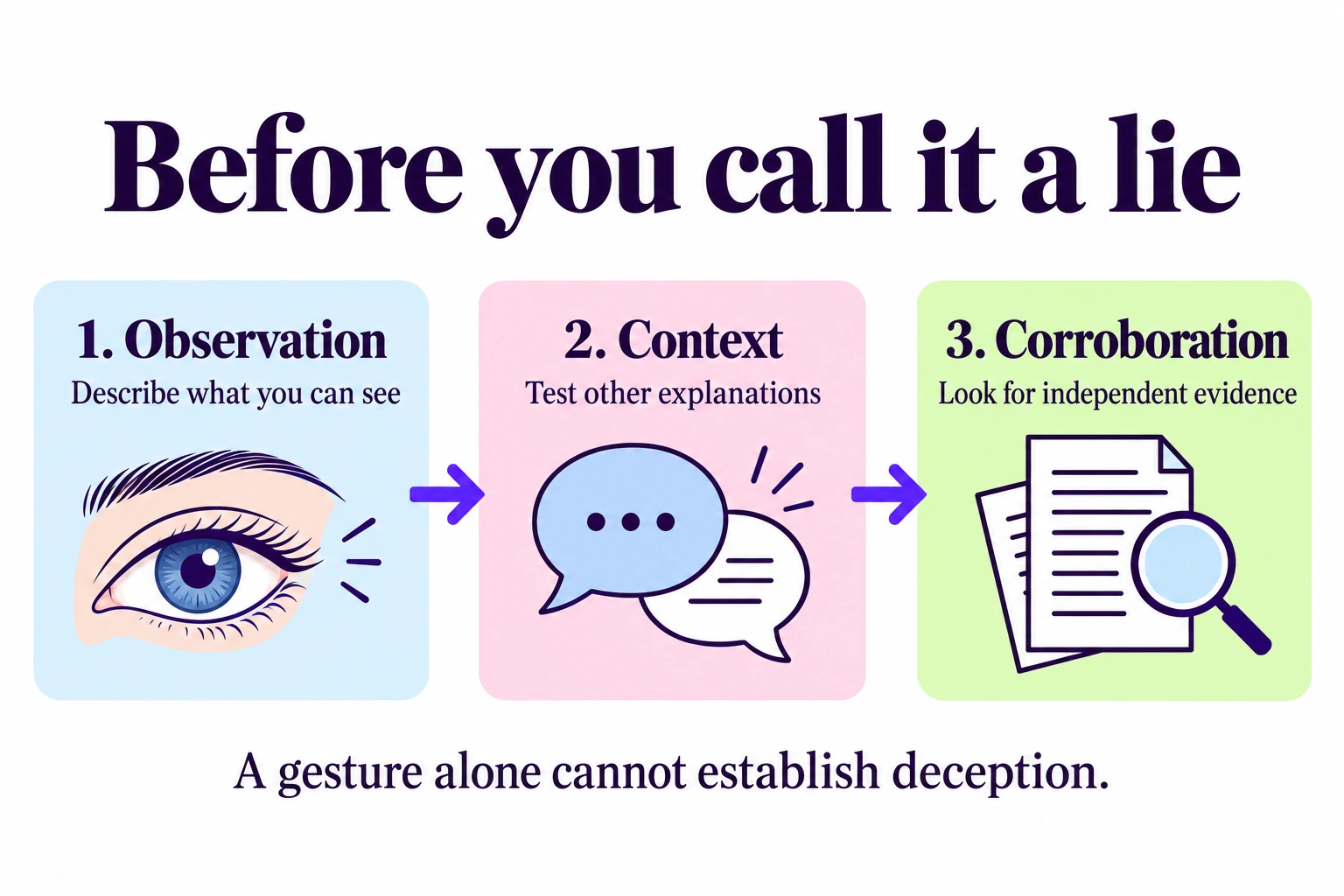
1. Write down what another viewer can check
Start at normal speed with sound. Write: “After the question about being at home, the speaker smiles before answering.” Include the timestamp and the wording of the question. Avoid replacing that sentence with “The speaker enjoys deceiving the interviewer.” That adds a motive which the visible action has not established.
Watch the surrounding exchange. Does the smile begin before the disputed question? Is the speaker responding to a remark, an interruption or someone outside the frame? If the camera cuts away, record the gap. You cannot recover the missing context by looking harder at the face.
2. Keep more than one explanation open
For the fictional smile, possible explanations include embarrassment, nervousness, a reaction to the interviewer or deliberate performance. Listing them does not prove any of them. It prevents the first explanation you heard from silently becoming the only one you consider.
Ask whether the commentator gives a reason to prefer one account. A label such as “duping delight” names an interpretation. Repeating the label over a close-up does not test it. If knowing the eventual outcome makes the same gesture look different to you, note that influence too.
3. Test the spoken claim with separate evidence
The answer about being at home presents a more specific question. A dated record or reliable account from another source may help establish where the person was. Check whether its time, place and identity actually match the statement. A record of a device’s location needs evidence connecting the device to its user at that moment.
Even if the answer turns out to be wrong, the reason for the smile can remain unknown. An inaccurate time can result from a mistake as well as a lie. Evidence that a person knowingly gave a false answer would address intention; the facial movement does not supply that missing step.
Check whether your conclusion survives without the commentary
Read your notes while leaving out the commentator’s explanation. Could another viewer find the same moment and tell your observation from your inference? If the answer depends on the soundtrack, a repeated close-up or the speaker’s reputation, return to the original exchange.
A bounded result for the fictional example would be: “The speaker smiles after the question. The cause of the smile is unknown. A separate record conflicts with the answer about location, but its connection to the person still needs checking.” That leaves a concrete question someone else can examine.
When the full interview cannot be found
Keep the limitation attached to the claim. A short clip can establish that particular words appear in that version; it may omit a qualification, an earlier question or an interruption. Avoid writing that a longer recording confirms something when you have not found it.
Check subtitles against the spoken language when you can. An omitted “that day” can turn a limited denial into a general one. If you cannot assess the translation, seek someone who can or leave that point unresolved. Repetition across reposts does not create a second recording or a second witness.
Why a casual baseline can mislead
A research interview controls aspects of the task that you cannot control while watching a public clip. The interviewer may know which account is truthful, use matched questions and define how accuracy will be measured. You may have an edited sequence, an unknown comparison and information about the case’s outcome.
You can still compare complete accounts to locate a change worth checking. Record differences in topic, question, language and setting before attributing the change to lying. A useful comparison identifies what changed and what else could explain it; it does not establish that every interview technique succeeds or fails.
Keep your notes separate from accusations
A false statement about one detail does not establish responsibility for an entire crime. Keep the person’s procedural position clear, and avoid diagnosing a personality disorder or assigning a hidden motive from the recording.
Discuss the public claim rather than searching for private contact details or approaching relatives. If you share your analysis, include the source, timestamp and unresolved question. Someone should be able to disagree with your interpretation without becoming a target themselves.
Questions about faces and recordings
Does a smile reveal hidden knowledge?
You need evidence connecting the expression to that knowledge. The visible smile alone does not tell you what the person knew, why they smiled or whether their answer was true. A plausible emotional interpretation still leaves its cause to be established.
Can slow motion settle a microexpression claim?
Slowing a recording can help you locate a movement. It changes its duration on screen and may make a brief action seem more deliberate. Return to normal speed and check the original material before describing its timing. Identifying a fleeting expression would still leave the question of why it occurred.
Can a contradiction still matter?
Yes. Two statements about the same event can give you a specific difference to investigate. Check the original questions, dates and scope before deciding they conflict. An explained correction and a knowingly false answer require different conclusions.
Save the question you could not answer
Keep the original URL, recording date, timestamps and the wording of your unresolved question together. If a fuller recording appears, compare what it adds before changing your conclusion. Later commentary should remain separate from material available at the time of the interview.
A useful result can be a smaller claim
You may finish with less certainty about the face and a better question about the evidence. That is a useful change. Another viewer can check a timestamp, compare an answer and examine a dated record. They cannot reproduce a feeling that someone simply “looked guilty.”
This viewing exercise helps you assess an interpretation of recorded behavior. It cannot determine guilt or diagnose a person. Send a question about a method or an uncertainty you noticed; do not send passports, contracts, bank details or other personal documents through the public form.
Ask about a body-language claim