I am Jane Doe: solidarity, family silence and accountability
What I am Jane Doe means, its Cornell connection, public accounts of family abuse, the limits of social posts and ways to offer support.

Short version
I am Jane Doe expresses solidarity with survivors of sexual violence and with the anonymous plaintiff in the Cornell 7 case. If the phrase has appeared in your feed, some people using it are describing their own experiences; others are offering support. You can take a disclosure seriously and respect someone’s privacy without asking them to make their history public.
The discussion reaches beyond Cornell to abuse within families and the pain of telling someone who then protects the person accused. You can listen, help someone reach safety and support a thorough investigation while keeping individual allegations and court findings distinct.
The accounts concern sexual abuse and family responses; graphic descriptions are omitted. The last time we checked the Cornell investigation was October 5, 2026.
Why use the name Jane Doe?
Jane Doe is a name used to conceal a woman’s identity in legal proceedings and other contexts. In the Cornell discussion, it refers to the plaintiff without naming her. When other people write “I am Jane Doe,” they borrow that anonymity to express solidarity. A matching caption does not establish that an account belongs to the plaintiff.
For a reader following true crime, this creates a responsibility: sharing a story can expose a person whose safety depends on privacy. The difference between true crime and fiction matters here because the people behind these accounts continue to live with the consequences of public attention. Leave identifying guesses out of your reposts, even if another account has already published them.
The phrase also names the older documentary I Am Jane Doe, which follows mothers and daughters challenging sex trafficking connected to Backpage. That film and the current Cornell-linked solidarity posts have different histories. A search result using the same title can refer to either.
What connects the movement to Cornell?
The Cornell 7 discussion concerns allegations of a sexual assault in October 2024 involving seven men associated with the Chi Phi fraternity at Cornell University in New York. The plaintiff brought a civil lawsuit under the name Jane Doe. Public solidarity posts in early October 2026 connected her wish for anonymity with other people’s accounts of sexual violence.
On 1 October 2026, New York Attorney General Letitia James announced that Governor Kathy Hochul had appointed her office as special prosecutor to investigate the alleged assault. The announcement establishes that appointment and its investigative purpose. It does not establish a conviction or a verdict against the people accused.
That distinction carries into the wider discussion. A criminal investigation examines alleged offences; a civil lawsuit asks a court to decide civil claims. Your support for someone describing harm need not depend on predicting how either process will end.
What family-abuse research adds to those accounts
A January 2026 NSPCC briefing on sexual abuse within families describes disclosures involving parents, siblings, grandparents and other relatives or household members. Its helpline material includes both disbelief and protective responses. That range matters when you are trying to understand a specific family rather than assign a single motive to all mothers or fathers.
The NSPCC Helpline recorded 1,042 child-welfare contacts about intrafamilial sexual abuse between 1 April 2024 and 31 March 2025, compared with 851 in the previous year. Those are contacts to one UK service. The increase shows a greater number of contacts recorded under that concern; it cannot measure the number of women posting online or prove a corresponding change in abuse across the population.
The briefing also includes an adult account of a mother withdrawing a police statement. The speaker believed the stepfather had threatened her. That detail changes the interpretation: coercion needs investigation alongside a failure to protect. Explaining pressure does not make leaving a child exposed to harm acceptable.
When a disclosure meets disbelief
The Cornell discussion has brought renewed attention to an older question: what happens when someone tells their family and gets no protection? These 20 public posts and comments describe different responses. Most predate the current movement. They come from Reddit, where people chose to speak publicly; they do not represent every survivor or every platform. We keep the quotations short and leave out handles, graphic details and identifying family information. The events are the writers’ accounts, rather than facts we have independently established.
1. “She believed him”
In a May 2026 post, an adult woman described telling her mother about alleged abuse by her stepfather. She said her mother took the disclosure to him and accepted his denial. For a child asking for help, that response can leave the person accused in control of what happens next.
“She believed him”
2. Denial that continued into adulthood
An October 2020 writer recalled a childhood disclosure about her father that her mother dismissed. The writer said the denial continued after she had married. Her account asks you to notice the repeated refusal to hear her, rather than assume that growing older resolves the family response.
“she didn’t believe me”
3. An apology that still shifted the blame
In December 2020, a woman described her mother apologising after a reported confession by her stepfather. She said the apology came with a claim that she had never given enough detail, despite earlier attempts to explain. That combination helps explain why an apology may leave someone asking for accountability rather than reconciliation.
“I don’t remember that”
4. Told to “get over it”
A December 2023 writer described a disclosure during group counselling followed by pressure from her mother to stop talking. According to the post, questions from counsellors were followed by instructions to move on. The point is the withdrawal of a space to speak, not a diagnosis inferred from the subreddit’s name.
“get over it”
5. Scolded when she wanted comfort
In an October 2024 post, a woman wrote about being scolded when she eventually told her parents about childhood sexual abuse. She also described later arguments in which her mother dismissed the subject. If someone has already been blamed for speaking, asking why they waited can repeat the response that kept them quiet.
“I was scolded instead of comforted”
When relatives say they already knew
Disbelief and prior knowledge raise different questions. These accounts show why you need to ask what a person actually said or did. A family member’s own experience of abuse can also complicate a relationship without excusing a failure to protect.
6. “I knew when you were about 8”
In July 2026, an adult writer described her mother saying she had recognised childhood abuse at the time. The writer also described her mother’s own abuse and pressure within the family. Her account holds both things together: possible coercion and the pain of discovering that an adult knew.
“I knew when you were about 8”
7. A denial followed by detailed knowledge
Another parent, replying in the same July discussion, described her mother denying knowledge and then recounting family conversations about the abuse. She contrasted that experience with protecting her own daughter. The contradiction, as she tells it, made the unanswered question sharper: why did knowing never lead to safety?
“I have my own daughter now”
8. Distance that brought some peace
A different adult commenter described cutting ties after a mother acknowledged recognising signs of abuse. They said distance had brought peace, while also calling the decision difficult. That is one person’s experience; someone who depends on family for housing or care may need another way to find safety.
“I found the peace to be quite worth it”
9. Compassion and anger together
One commenter, looking back in later life, described feeling both anger and compassion toward a mother who did not protect her. She said recognising her family’s response had taken decades. Her words make room for conflicting feelings without requiring forgiveness as the price of being heard.
“hold compassion and rage at the same time”
10. The help that never arrived
Another adult described being given access to a grandfather by her grandmother and receiving no help from her parents. She questioned what her parents knew and offered more than one possible interpretation. Preserve that uncertainty: the absence of help she describes does not itself establish everyone’s knowledge or intent.
“they never got me any help”
Family loyalty, dependence and unwanted contact
Silence can continue after a person has spoken. Pressure to preserve a relationship, depend on a caregiver or welcome a relative back can make the family’s response part of the continuing harm. The next accounts concern those choices.
11. Support offered to the person accused
In October 2024, an adult described her mother buying property for a former partner whom she had reported as abusive. The alleged abuser was a partner, rather than a relative. This widens the question from verbal disbelief to practical support for someone accused of harm; it does not establish a criminal offence by the mother.
“I feel unbelievably betrayed”
12. When the person dismissing you also provides care
In a January 2024 post, a woman described her mother minimising childhood sexual assaults while also controlling practical support. Her account included dependence on help with daily life and fear of retaliation. Advice to simply leave misses those constraints; a useful response starts with what support would make a safer choice possible.
“downplay, dismissed, or blame me”
13. Pressed to take a brother back in
In an August 2026 comment, a parent described a father pressing her to resume contact with a brother she said had abused her. She said she and her husband refused, and that her own children had never been around him. The boundary concerns access and safety, even when another relative frames contact as a family obligation.
“My children do not even know him”
14. Still unable to tell the parents
Another August commenter described keeping childhood abuse by a brother from her parents while seeking therapy in adulthood. She said she had stopped contact with him, but her parents did not understand. You can see why delayed disclosure should not be treated as evidence that nothing happened: a person may make protective decisions before feeling able to explain them.
“I cannot imagine telling my parents at this point”
15. A male survivor seeking help decades later
In the July discussion, a grandfather described starting therapy in later life after childhood abuse by his father. He also said his mother had done nothing about known abuse within the family. This is a man’s account, alongside the women’s experiences discussed here; family silence can affect people of different genders.
“Started therapy in February”
Belief, protection and solidarity
These responses also vary. Some people describe support, others ask how to help, and a current Jane Doe post connects that wish to anonymity. Reading those differences helps you move beyond an assumption that every family responds in the same way.
16. Learning something painful about a beloved grandfather
In a July 2026 post, a woman described learning from her mother about alleged abuse by a grandfather she had loved. She was recounting a relative’s disclosure, rather than saying he had abused her. That distinction matters: her grief illustrates how new information can change a family relationship without making her a firsthand witness to the alleged events.
“I feel like im grieving all over again”
17. A parent asking how to respond
In August 2026, a parent described an adult daughter disclosing childhood abuse by her brother. The parent asked how to respond and later said she believed her daughter and wanted to respect her pace. This provides a contrasting response: uncertainty about the next step can coexist with listening and support.
“I’m just so confused how to appropriately respond to this”
18. “He believed me”
An October 2022 adult wrote about telling a father after a mother had insisted on secrecy. The alleged abuser was a childhood friend, not a family member, and the father reportedly responded with belief. The example shows why one relative’s silencing does not establish that every possible listener will respond the same way.
“He believed me”
19. Support without forced reconciliation
A parent commenting on the sibling-abuse discussion urged belief and protection without pressuring the daughter to be around her brother. The advice comes from a public commenter with their own experience, rather than a clinician or court. Its useful question is concrete: what would help the person feel safe at the next family gathering?
“Believe her, support her”
20. The current Jane Doe message
An October 2026 post described Jane Doe solidarity as a way to respect the Cornell plaintiff’s wish for anonymity. The writer connected that concern with people who felt failed after disclosing abuse. This is a stated aim of the movement; whether repeated captions actually prevent identification needs separate evidence.
“she deserves to remain anonymous if she wishes”
The common thread is what follows a disclosure: denial, silence, pressure, distance or help. Those differences give you questions to ask about a particular response, without turning this selected collection into a claim about all mothers, all families or how often abuse occurs.
What can these posts tell you about the scale of abuse?
Repeated stories can make a hidden experience easier to name. If someone describes a father, brother or grandfather abusing them, another reader may recognise why their own family’s silence felt so isolating. That shared recognition can matter without turning the feed into a population study.
A selected group of posts cannot tell you what proportion of mothers conceal abuse, how many allegations have been investigated, or how many people participate in the movement. Recommendations, reposts and repeated captions also shape what you see. We have not verified a total of hundreds or thousands of family-abuse disclosures under this slogan.
A different family member may believe the person, seek help or be subjected to threats themselves. Keep the focus on the particular actions described: who knew, what they did, whether someone remained at risk and what evidence can establish those events.
Support, evidence and a court decision answer different needs
When someone tells you about sexual violence, they may be asking for a safe place, accompaniment or help finding a specialist. You do not need to conduct a private interrogation before offering those things. Investigators and courts have a different task: examining evidence and deciding legal questions under the applicable rules.
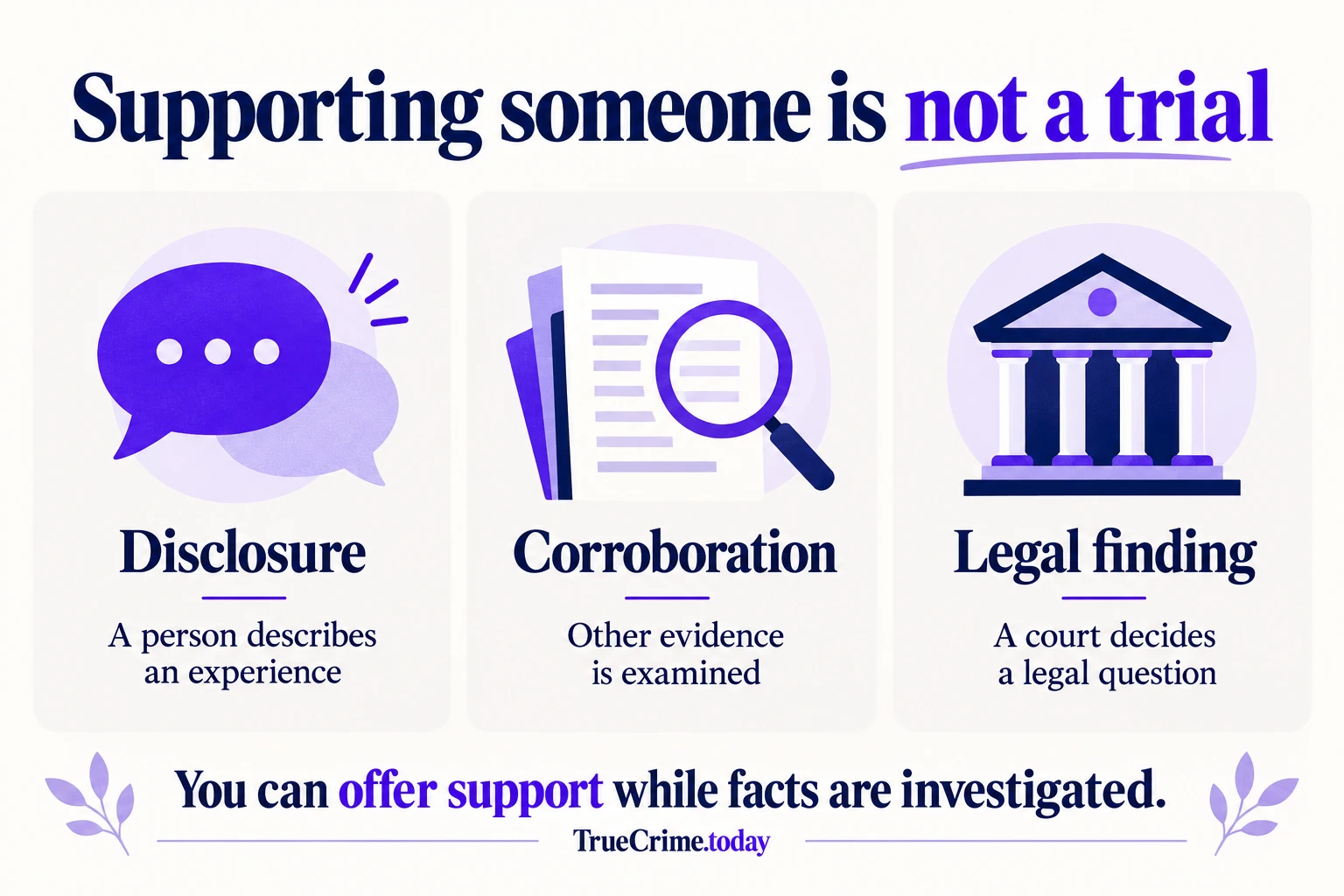
The diagram separates those tasks; it does not rate anyone’s credibility or prescribe an inevitable sequence. A disclosure can prompt an investigation, and some investigations never reach a court. The absence of a verdict does not remove a person’s need for support.
What does serious accountability require?
Our editorial position is clear: violence against women must be investigated and, where guilt is established, punished with the full force of the law. Family status, social standing and popularity must not provide an excuse to ignore harm.
Accountability also requires precision about conduct. New York Penal Law §205.50 defines criminal assistance for hindering prosecution through specified acts and intent, including suppressing physical evidence or obstructing through intimidation. That jurisdiction-specific definition shows why a claim that a relative “covered it up” needs details about what happened. It does not automatically make every disbelieving parent criminally liable.
A sentence follows the relevant offence, evidence and sentencing law. Demanding a serious lawful response is compatible with distinguishing an accusation, a prosecution and a finding of guilt. Online punishment of a guessed identity can harm someone unrelated to the case and leave the actual questions unanswered.
How can you respond without taking control?
RAINN’s survivor-support guidance recommends listening without judgment, thanking someone for telling you and asking how you can help. If an adult discloses abuse to you, let them set the pace of the conversation. Avoid asking them to perform distress, explain why they did not leave or give you every detail.
Before contacting a relative or posting their account, ask what they want and consider their safety. Pressure to confront the person accused or disclose publicly can take choice away again. If a child may be at risk, seek safeguarding advice promptly; reporting duties and suitable services depend on your location and role.
You can offer something concrete: a quiet place to talk, help contacting a support service or company at an appointment if wanted. Ask before sharing the account with anyone else. Consent to tell you is not consent to publish.
Does repeating the slogan protect someone’s identity?
Participants have suggested that many Jane Doe posts could make identifying the Cornell plaintiff harder, including through AI tools. We have not found a verified test establishing reliable protection. Repeating a slogan provides no guarantee that other identifying information will stay private.
Your own sharing choices still matter. Avoid names, photographs, location clues and speculative comparisons. If you support the movement, you can express solidarity without reposting a personal account or attaching allegations to someone you have guessed is involved.
For developments in Cornell, pay attention to dated official statements and court orders. Engagement counts describe attention; they do not decide what an investigation has established.
Do you have to tell your own story to participate?
You can express solidarity without disclosing abuse. A public post is one option, and private support is another. You do not owe an audience your history to qualify for care or to support someone else.
Family loyalty does not require accepting violence or abandoning a disclosure. Seeking help outside the family can create a safer place to discuss what happened. Whether you decide to report, and what duties apply to others, needs advice suited to the circumstances and jurisdiction.
Where can you find support?
In the United States, RAINN’s National Sexual Assault Hotline is 800-656-4673, with support in English and Spanish. In the UK, adults concerned about a child can contact the NSPCC Helpline on 0808 800 5000. These are different services with different audiences; neither number should be assumed to work worldwide.
If you are elsewhere, look for a sexual-violence or safeguarding service in your country and check its hours and eligibility. In immediate danger, contact local emergency services if you can do so safely. You can stop reading, leave a discussion or seek private support without making a public statement.
Ask a question about the slogan, attribution or a dated public record. We cannot provide crisis support or investigate a personal account through this form. Do not send names of survivors, passports, contracts, bank details or other personal documents.
Ask about this discussion