Narcissism and narcissistic personality disorder: where is the line?
A narcissistic trait is not a diagnosis. Understand grandiosity, vulnerability, clinical assessment and what research says about change over time.

TL;DR
Narcissism can describe personality traits; narcissistic personality disorder, or NPD, is a clinical diagnosis. A high questionnaire score, a boastful interview or a selfish decision does not establish the disorder. Clinical assessment considers an enduring pattern, its effects on functioning and relationships, and other possible explanations.
If you are trying to understand a person in a true-crime story, keep three questions separate: what happened, what personality characteristics were actually assessed and whether a clinical disorder was established. You can take harmful conduct seriously without diagnosing its author. Research also finds average changes in narcissistic traits over time, which is different from showing that an individual has recovered from NPD.
When does narcissism mean a trait rather than a disorder?
You finish a personality quiz and see a high narcissism score. Or you watch someone claim all the credit for a shared achievement. Does either result mean NPD?
Not on its own. A trait measure asks about particular characteristics according to its model. A clinical diagnosis asks a broader question about an enduring pattern and difficulties that affect daily life. A description of one act answers something narrower again.
This is why criminal psychology separates the evidence about an act from questions about personality and motivation. A verified deception does not contain a complete psychological assessment.
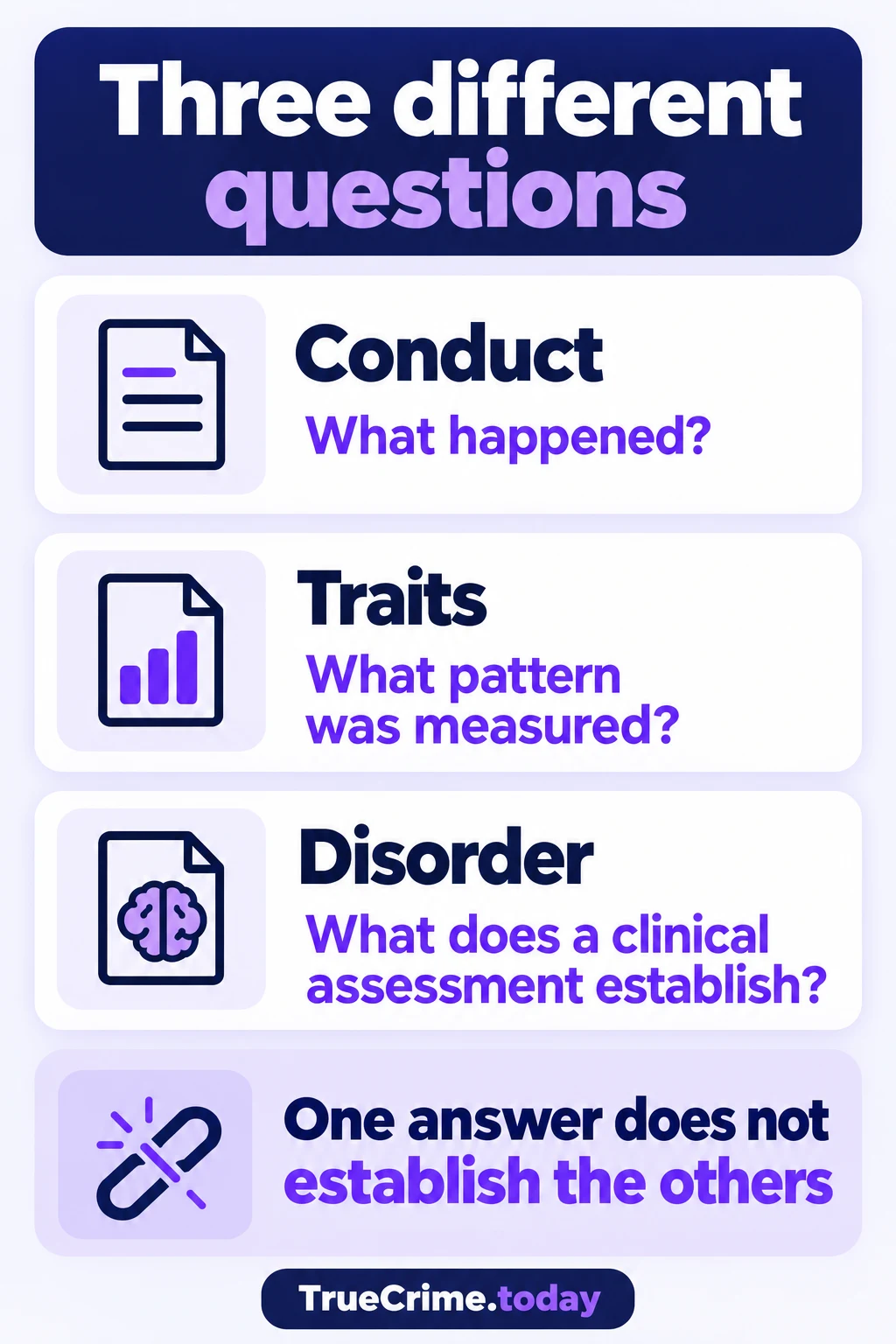
The cards are not stages through which someone inevitably progresses. They show where a new conclusion needs additional evidence.
What makes a personality pattern a clinical problem?
The distinction is not simply between a little self-interest and a lot of self-interest. Duration, context, functioning and the pattern of relationships matter. A professional also considers whether another condition or circumstance better explains what is happening.
The MSD Manual’s clinical description of NPD discusses grandiosity, need for admiration and difficulties with empathy within a persistent pattern. Its DSM-based threshold is one part of diagnosis, not a public scoring game.
That qualification matters. Matching several descriptions on a website is not equivalent to establishing their meaning, persistence and clinical significance in an assessment. Equally, a person does not have to look distressed in every conversation for serious difficulties to exist.
Why grandiosity and vulnerability can appear together
The familiar picture is someone who feels superior and expects admiration. Clinical accounts also describe shame, fragile self-esteem and strong reactions to perceived failure. These experiences can occur alongside outward confidence rather than forming two perfectly separate kinds of people.
A person may seek attention in one setting and withdraw after criticism in another. That possibility makes the clinical picture more varied; it does not make every sensitive or reserved person a hidden narcissist.
When analysing a case, we keep the actual assessment separate from the interpretation added by a commentator. “Looked uncomfortable when challenged” is an observation. “That proves vulnerable NPD” is a much stronger claim.
What does a questionnaire actually measure?
A questionnaire measures what its items and scoring method were designed to capture. Some tools emphasize grandiosity, others assess vulnerable features or broader pathological patterns. They do not all have the same target.
Before interpreting a score, ask which instrument was used, who completed it and which comparison group gives the result meaning. A research questionnaire can be useful without functioning as a stand-alone clinical diagnosis.
This also limits conclusions about empathy or conduct. A higher overall score does not tell you which specific action occurred, whether an allegation is true or why someone behaved that way. Those questions need their own evidence.
Does narcissism decrease with age?
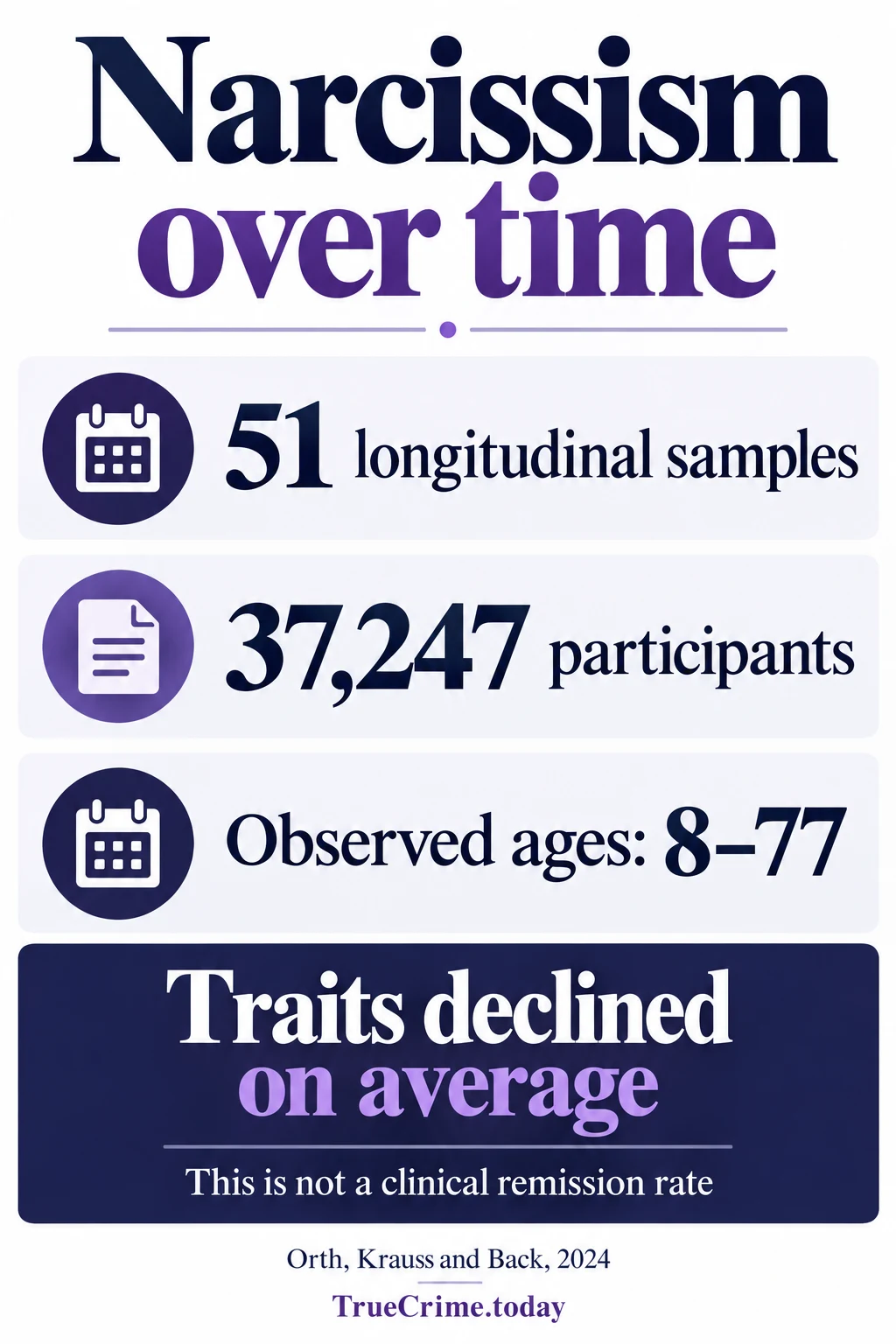
A 2024 meta-analysis by Ulrich Orth, Samantha Krauss and Mitja Back combined 51 longitudinal samples and 37,247 participants, with observed ages from 8 to 77. Narcissistic traits declined on average, while relative differences between people remained fairly stable.
The samples were mostly Western and White or European. These are trait findings, not a clinical remission rate, and not every participant was followed from childhood to old age.
How can people change and still keep their relative position?
Here is an invented arithmetic example, with no real test or participants. Three people have scores of 8, 6 and 4. Later, their scores are 7, 5 and 3. Everyone’s score has fallen, and the average has moved from 6 to 5. Their order has stayed the same.
That is the difference between a change in level and a change in relative position. A stable ordering does not mean nobody changed. A falling average does not mean everyone changed by the same amount.
Neither pattern tells you that a particular person will stop a harmful behavior. If that is the practical question, you need evidence about that behavior, over an appropriate period, rather than reassurance drawn from a group average.
What happens in a professional assessment?
An assessment looks beyond the most striking moment. It considers the history of the difficulties, how they appear across contexts, their effects and possible alternative explanations. The person’s account and other available information need to be understood together.
A conflict, a period of unusual mood, substance effects or another difficulty can complicate the picture. This is one reason a dramatic clip cannot replace the clinical process. The same outward behavior can arise in different circumstances.
Other people’s reports can matter, but they are not automatically accurate. Memories differ, documents can be incomplete and disputes can affect what gets reported. A careful conclusion explains its basis and uncertainty instead of treating every additional account as confirmation.
Why a percentage needs a definition and a population
A prevalence estimate has to say what was counted, in whom and by which method. A community survey, a clinical sample and a questionnaire study do not necessarily answer the same question.
The distinction between a lifetime estimate and a current estimate also matters. So does the classification used at the time. A historical study cannot simply become a claim about the share of all people worldwide who have NPD today.
For the same reason, the percentage of respondents above a trait-score threshold is not automatically the percentage with a disorder. Precision in the number cannot repair an unclear definition of what that number represents.
The workshop programme: an example without a remote diagnosis
Imagine a fictional community workshop. Two people designed the sessions, but the organizer publishes a programme naming only themselves. Messages show an earlier agreement to credit both contributors. When challenged, the organizer alternates between dismissing the concern and saying the criticism is deeply unfair.
You can investigate the credit dispute: compare programme versions, the agreement and the contributions. Those materials may establish that someone deliberately removed a colleague’s name. They do not establish the organizer’s entire personality or its developmental causes.
Calling the response grandiose or vulnerable might offer a hypothesis about the interaction. It is not enough to establish a disorder. A broader clinical inquiry would need a different history and a professional assessment.
The two inquiries need not compete. Removing a name dishonestly can deserve correction and accountability even if there is no diagnosis. A diagnosis, if one exists, would not determine whether every disputed detail of the workshop story was true.
Is narcissism the same as self-confidence?
No. Feeling pleased about an achievement, accepting praise or putting yourself forward does not by itself establish narcissistic pathology. The question is not whether a person ever enjoys being noticed.
Consider what happens around the confidence. Can the person acknowledge others’ contributions, tolerate correction and maintain relationships without repeatedly demanding exceptional treatment? These are matters for a broader account, not a quick test based on one answer.
Confidence can also be uneven. A person can perform well in public and feel insecure elsewhere. That observation does not prove a hidden disorder any more than insecurity rules out narcissistic characteristics.
What empathy does and does not tell you
Recognizing what another person feels, sharing some of that feeling and caring enough to respond are related but different. A convincing statement of understanding does not establish all of them.
In the workshop example, the organizer might accurately understand why the missing credit matters while still refusing to correct it. That would be relevant conduct to describe. It would not measure the person’s capacity for empathy in every relationship.
Avoid the reverse shortcut too. An awkward response or unusual expression of grief does not establish a disorder. What matters is the supported pattern, not how closely someone performs an expected emotion in one scene.
Does narcissism explain abuse or offending?
A personality term is not a finding that an assault, fraud or coercive act occurred. Those events require evidence. It is also not a complete explanation of why any such act happened.
Someone can behave abusively without a confirmed personality disorder. Someone with a disorder cannot be assumed to have committed a particular act. Confusing those statements weakens both the account of the harm and the account of the psychology.
When a story concerns threats or coercion, describe the behavior, its context and its consequences. There is no need to solve a remote diagnostic question before recognizing that the conduct matters. Clinical explanation does not remove responsibility for established actions.
Where do the traits come from?
There is no single developmental story that can be read backward from an adult’s manner. Inherited differences, experiences and ongoing relationships can all be relevant, without one being the whole explanation.
A theory about parenting is not evidence about a particular family. A difficult childhood is not an inevitable path to one adult outcome. Public certainty about one supposed cause often exceeds the available history.
The useful question is what a particular study actually tested. Did it follow people over time, examine correlations at one point or draw on clinical observations? Those designs can inform the discussion without answering the same causal question.
What would meaningful improvement look like?
First specify what is meant by improvement. Fewer destructive conflicts, more reliable behavior, less distress and a change in a trait score are different outcomes. A convincing apology is another kind of information again.
Clinical care can work toward concrete goals, but neither a popular label nor an average research trajectory promises a particular result. Claims that nobody can change are too sweeping; so are promises that the right conversation will make a harmful pattern disappear.
For someone affected by repeated harm, the question may concern what has actually changed over time. That requires sustained behavior and context, not just a new explanation of the person’s intentions. You are not responsible for supplying a diagnosis or managing someone else’s clinical care.
Why childhood needs a different question
Children are developing. Attention seeking, competition and reactions to criticism have to be understood in that developmental context, rather than treated as an adult identity already fixed for life.
A research finding about childhood traits is not permission to label a child a future abuser. The relevant questions concern difficulties, circumstances, needs and changes. Risk is not destiny.
This is another reason to preserve ages when discussing a study. Findings across different stages of development cannot be compressed into a single prediction about every individual.
What the terminology has carried over time
Narcissism has a long history in psychological theory, everyday language and research. These uses overlap without always identifying the same thing. A theory about self-esteem regulation, a trait questionnaire and a diagnostic category have different purposes.
That history helps explain why older texts or popular explanations can sound inconsistent. It does not mean any definition will do. The author still needs to explain which meaning is being used and what evidence supports the conclusion.
An everyday label may communicate frustration, but a clinical or scientific claim asks for more. Keeping the terms precise helps you see which part of a story is established and which part remains an interpretation.
Questions after a test or an interview
Two common questions remain once a label stops functioning as a complete explanation: what sensitivity to criticism means, and whether you need a diagnosis before responding to harmful conduct.
Does sensitivity to criticism mean someone has NPD?
No. Sensitivity is an observation that can have different explanations. A diagnosis needs an enduring pattern, its significance and a professional assessment. Turning discomfort into a hidden-disorder claim makes the conclusion impossible to check fairly.
Can you set limits without knowing the diagnosis?
Yes. You can describe conduct, explain its effects and make decisions about your own participation without identifying a personality disorder. In the workshop example, correcting credit does not require a clinical verdict about the organizer.
What should you check before using the label?
Ask whether the source is describing an act, measuring traits or reporting a clinical assessment. Keep the original wording and the limits of the method. A score or an edited interview cannot silently stand in for the missing steps.
A precise account may sound less dramatic, but it gives you something to examine. “The colleague’s name was removed despite an agreement” can be checked. It does not need to become a diagnosis to matter.
You can ask about a study, a questionnaire claim or the distinction discussed here. Do not send private medical records or personal documents.
Ask about a research finding