5 best true crime podcasts for 2026: choose the kind of story you want
Five true crime podcasts to listen to in 2026, compared by reporting, source material, episode format and time. Find a starting point that fits you.

The best true crime podcasts for 2026 give you a reason to keep listening beyond the next reveal. Maybe you want to follow how a reporter tested a witness’s account. Maybe you have one walk to fill and would rather finish a case than begin a season. Those are different choices, even when both shows sit under “true crime” in your app.
These five are English-language starting points, with a strong focus on US cases and an international case archive in Casefile. Some have new material in 2026; others have older seasons worth returning to. The year means what to listen to now, rather than five shows that all launched this year.
TL;DR
Choose In the Dark first if you want reporting you can follow back to documents. Bear Brook is the next choice for interrogation and forensic questions; Casefile suits a case-by-case listening habit. Your Own Backyard follows one investigation into courtroom reporting, while The Vanished keeps missing people and their families’ unanswered questions in view. This order reflects those listening needs, based on producer archives and published materials. We haven’t listened to every complete series or scored their sound and storytelling.
Five starting points, at a glance
- In the Dark: an investigation with a public document trail; allow time for a season.
- Bear Brook: a focused investigation with transcripts and visual material alongside the audio.
- Casefile: choose a case from an archive; check whether it spans several parts.
- Your Own Backyard: follow the Kristin Smart story, then its dated courtroom coverage.
- The Vanished: begin with a missing-person episode and leave room for an unresolved ending.
You can enjoy true crime as a form of nonfiction without wanting the same kind of story every night. A season that asks you to remember changing testimony may fit a quiet weekend better than a commute full of interruptions.
What puts a podcast near the top?
We give more weight to material you can trace, a clear entry point and a format that matches the listening task. In the Dark comes first because its season-two archive lets you move from a claim to court records. Bear Brook also offers transcripts and supporting material, within a more focused season. Casefile makes choosing an individual case easier. The remaining two suit a sustained local story or a family’s continuing questions.
That order changes with your plans. If you want one case rather than a season, Casefile may be your first choice. If the experience of families matters most to you, The Vanished moves up. Download counts, chart positions and a dramatic voice don’t tell us whether a particular claim is well supported, so we haven’t turned them into points.
We checked official programme pages, episode descriptions, source notes and access information. The last time we checked was October 13, 2026. A listed transcript or court document is a useful way in; we haven’t independently audited every document or the editing of every episode. That distinction matters when you want a listening recommendation rather than a promise that a show never gets anything wrong.
A useful standard comes from the BBC’s 2019 accuracy guidance on editing: combining material should not give a misleading impression of events. That is a way to think about a conversation cut into an episode, rather than a claim that these podcasts have BBC approval.
When one pause or line changes your opinion of a person, case analysis separates the record from its interpretation. The question is who said it, when, and what was happening around it. You can keep that question in mind while still enjoying the story.
Five podcasts, ranked for different listening habits
1. In the Dark
Choose it for: following the reporting behind an investigation.
The strongest reason to start with In the Dark is the public record index for its Curtis Flowers investigation, which includes trial transcripts, statements and exhibits. You can ask what supports an account instead of relying entirely on the narrator’s summary.
Why first: the combination of a sustained investigation and identifiable records fits someone who wants to understand how a case was questioned. The historical season concerns six trials; its old descriptions must be read in their original period, rather than treated as today’s legal update.
For something newer, the current New Yorker programme page lists The Journey, a five-part investigation published in September 2026. A new series and an older record-rich season offer different starting points within the same feed.
The trade-off: this asks for attention across episodes. Choose a season and begin at its first full episode; a latest-update button can drop you into a story whose background you haven’t heard. Check the chosen player and any subscription offer before assuming every version has the same access.
2. Bear Brook
Choose it for: how an investigation handles identification, interrogation and disputed accounts.
Bear Brook publishes episode transcripts and supporting timelines for its second season, which examines the case against Jason Carroll. That gives you a way to compare what was said with the sequence in which investigators obtained it.
Why second: its focused season is a good next step when you want to follow one evidential question carefully. The season-two page lists nine episodes. Start with episode one, then work through the main sequence rather than picking whichever title sounds most revealing.
What stands out: the page places comparisons of accounts and facts beside the audio. A transcript can help you locate wording you missed; a timeline can show whether two statements refer to the same moment. Neither removes the need to understand how the material was collected.
The trade-off: you are committing to a serial investigation, and its historical account needs to be distinguished from later developments. The first season and the currently listed third season cover other stories. Those choices broaden the feed, but don’t make every episode interchangeable. Player access and optional support should be checked on the current programme page.
3. Casefile
Choose it for: selecting a case without committing to a whole season.
Casefile names the researcher and writer and lists supporting material for its Gilgo Beach episode. The example also shows why “one case” doesn’t always mean “one episode”: it is marked as part one of two.
Why third: it offers an easier case-by-case entry point than the two serial investigations. Its archive includes both solved and unsolved cases, while the producer identifies a research and writing team behind an anonymous narrator.
What you gain: you can choose by case, topic or number of parts. The official schedule describes free main-feed releases, with paid early, ad-free and bonus options; it also explains that there are breaks in the schedule. A gap by itself doesn’t automatically mean the programme has ended.
The trade-off: a prepared account can feel more settled than the underlying record. Supporting links show what was used, but they don’t establish that every interpretation is correct. Check the content warning and the number of parts before starting. Its Gilgo Beach example warns about sexual violence and femicide, which may make it the wrong choice for your evening.
4. Your Own Backyard
Choose it for: staying with one local investigation as it moves into court.
The dated archive of Your Own Backyard includes People vs. Flores courtroom coverage and a later conversation with Kristin Smart’s family. The sequence lets you distinguish investigation, trial reporting and reflection after the proceedings.
Why fourth: it suits a listener who wants continuity around one person’s story. That narrow focus makes it less convenient when you want to pick a different case tomorrow. Begin with the original investigation, then follow the later coverage in order.
What stands out: the archive labels its defence and rebuttal reporting separately from its conclusion episodes. That is useful when you want to know which part of the proceeding you are hearing about. The family conversation has another purpose again: memories and the meaning of closure.
The trade-off: the prominent conclusion and family entries are from 2023. This is an archive recommendation for 2026, not a new 2026 season or a substitute for current court records. An older episode can still be worth your time while being incomplete as a present-day case update. Check the player and episode date before sharing a legal claim from it.
5. The Vanished
Choose it for: missing people and questions that remain for their families.
The Vanished has an October 5, 2026 entry about Rylee James Styler whose description keeps the family’s unanswered question in view alongside the legal process. It is a useful reminder that arrests and proceedings may leave other parts of a disappearance unresolved.
Why fifth: it answers a different listening need from a season built around one prosecution. You can choose a person’s story from the episode archive, while accepting that an ending may leave uncertainty. That makes it a stronger choice if you want ongoing attention to missing people than if you want a neatly resolved puzzle.
What you gain: a case-specific starting point and dates you can check before deciding what an episode represents. The archive has entries through 2026, so an old search result needn’t be your only way into the programme.
The trade-off: a family’s account deserves attention, but each disputed claim still needs its own support. We haven’t checked the facts of every featured disappearance. Confirm whether the episode is part of a sequence and whether the chosen app requires anything beyond its public feed; we haven’t verified a single worldwide payment arrangement.
Which format fits the time you have?
A serial investigation suits repeated listening when you can remember names, testimony and changing explanations. In the Dark, Bear Brook and Your Own Backyard are the stronger starting points for that habit. Download the next episode after finishing the current one rather than filling the queue with three different seasons.
A case-by-case feed is easier when your available time changes each day. Casefile and The Vanished let you begin with a subject, though a multi-part case still needs its proper sequence. A short session may mean hearing part of an episode, rather than finding a show that resolves everything in twenty minutes.
For a first attempt, pick one full episode and notice whether you can follow who is speaking. For closer listening later, choose a claim that changed your mind and locate its basis. That is a more useful test of the fit than forcing yourself through a season because it has a famous name.
What a faster playback speed changes
Imagine an episode that lasts 40 minutes at normal speed. At 1.25×, its audio takes 32 minutes; at 1.5×, it takes 26 minutes 40 seconds. Those are calculations, using duration divided by speed, without pauses or app interruptions. They are not measured runtimes of the five shows.
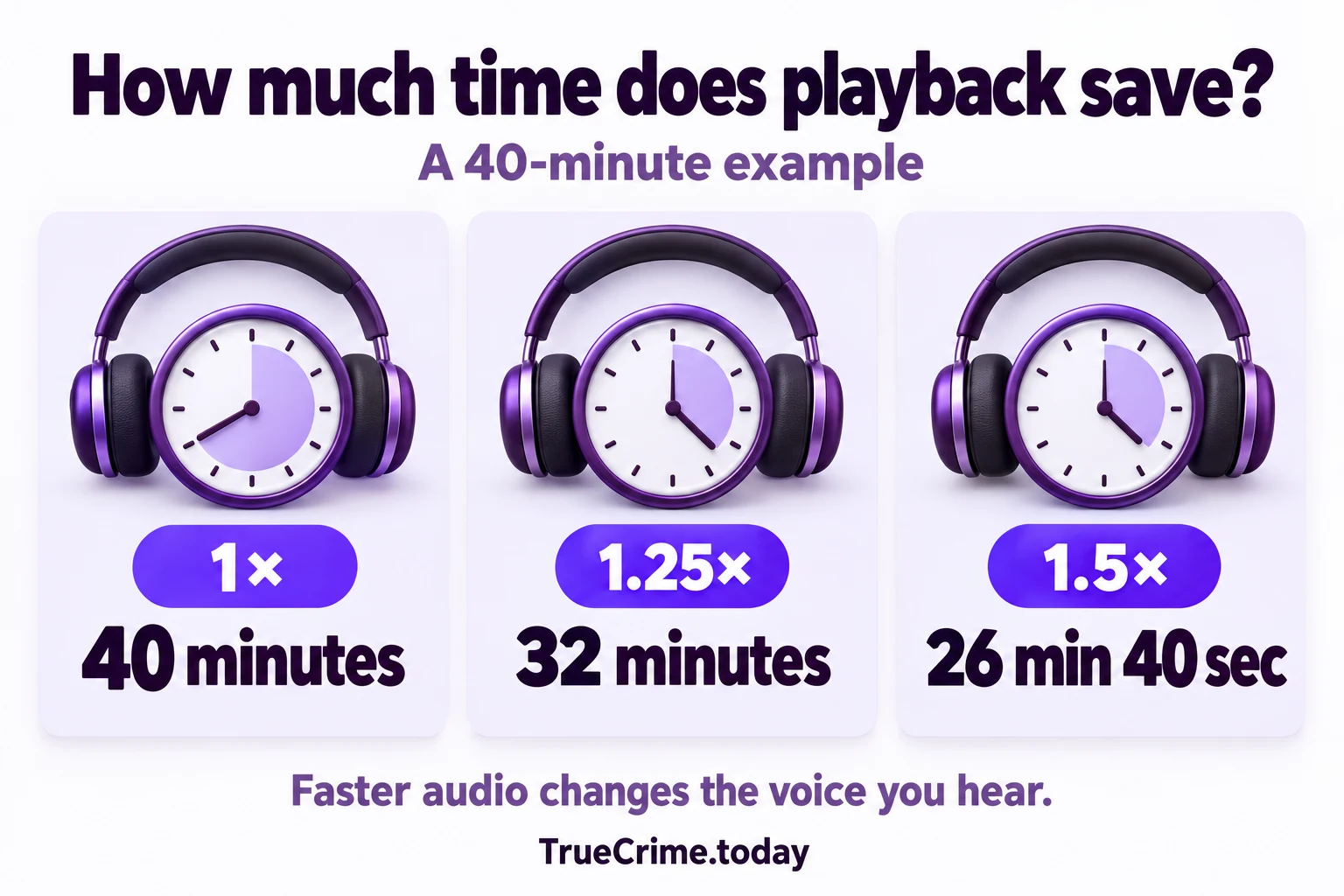
That can help you fit a prepared account into a walk. It also changes the voice you hear. If you are discussing a witness’s pace or hesitation, return to the original speed and the surrounding passage. Even then, a pause alone cannot tell you whether someone is lying.
Before paying for bonus episodes
Start with what is available in your current player. Casefile explicitly distinguishes its free main feed from paid extras and early or ad-free access. For the others, confirm the specific feed and offer rather than assuming a public programme page grants every bonus episode.
You may find a payment is useful for removing advertising or supporting reporting. Neither benefit means the claims become more reliable after purchase. Check the currency, billing period, renewal terms and whether an episode you want is actually included. A subscription to a listening app and a subscription to one show can be different purchases.
When a confident voice gets ahead of the facts
Suppose a host says a person sounded strangely calm during a call. You hear a short clip and start imagining guilt. Before repeating that conclusion, ask whether you heard the entire exchange, whether the clip was shortened, and whether the host gave another explanation. The story’s pacing may have made the moment feel decisive.
The same applies to a supposed contradiction. Two statements can differ because the speaker was asked about different times, because a question changed, or because a later memory is less exact. A contradiction may matter, but you need the two statements and their context before deciding how much weight to give it.
A short routine for your first episode
- Confirm the season, episode number and publication date.
- Read the topic and content warning before pressing play.
- Keep the original order for a serial investigation.
- When a claim surprises you, note the timestamp and who made it.
- Decide whether to continue based on the experience you actually want.
You don’t owe a show another episode if the subject feels too heavy today. Nor do you need to investigate every sentence to enjoy it. Save closer checking for the claim you plan to repeat or the question that stays with you afterwards.
Questions before you follow another feed
Are these all new podcasts from 2026?
No. In the Dark has material published in 2026, and several other feeds have current activity. Your Own Backyard is included for its older investigation and court archive. Recommendation year and release year answer different questions; check the date of the season you choose.
Does a solved case make a better podcast?
A resolution can make a story satisfying, but it doesn’t show how carefully it was reported. An unresolved disappearance can be worth hearing when it explains what is known, whose accounts differ and what remains unanswered. Choose according to what you want to learn, without treating uncertainty as a production flaw.
How often will the choices change?
We last checked them on October 13, 2026. New seasons, changed access and better published material can alter the order. This is a dated selection from public information, with no claim to settle the best podcast of the whole year. Charts or ratings would answer a different question about audience response.
Keep one question after the credits
When you discuss it with a friend, name the episode and the moment first. You may remember a witness’s words while your friend remembers the narrator’s reaction. Those are different pieces of the story, and finding the passage can explain the disagreement before either of you starts defending a theory.
Pick the show that fits tonight, then keep one question about something you heard. Was it a recorded statement, a reporter’s finding or a guest’s interpretation? Knowing which one interested you gives you something concrete to discuss, without turning a memorable voice into proof.
If you send an episode to someone, include its date and the timestamp that interested you. That lets them hear the same passage instead of searching through a whole season for the claim you meant.
Have a question about a podcast, episode or its supporting material? Send its public link and the specific point you want to discuss. Please omit identity documents, contracts, bank details and other personal documents.
Ask about a podcast