YouTube true crime: find footage and check the story
Choose YouTube true crime by format, uploader and source. Check courtroom clips, captions and AI labels before treating a compelling video as proof.
A thirty-second clip can leave you certain about someone you had never heard of a minute earlier. Then you find the longer recording and realise the question, the date or the speaker’s role was missing. You can still enjoy the story. It helps to know what you have actually watched.
For YouTube true crime, start by choosing the kind of video you want: courtroom footage, reporting with interviews, or a creator’s account of a case. Then find the original uploader and the material behind the claim that caught your attention. Court TV is one place to recognise courtroom coverage; its opening-statements recording below also shows why a long video labelled “full” can cover just one stage of a trial.
TL;DR
- Pick a format before picking a channel: a hearing, an interview and a narrated reconstruction answer different questions.
- Check who uploaded the recording, when it was made and where the quoted claim comes from.
- Keep the speaker’s role attached to their words. A lawyer’s opening statement and a witness’s answer do different jobs.
- Read AI disclosures and check captions against the audio when an exact word matters.
- Save the original link and timestamp before sharing a conclusion.
The last time we checked the platform guidance and the example uploads was October 13, 2026. Availability can still depend on your country, account and the uploader’s settings.
Choose the kind of video before choosing a channel
If you want to follow what people said in court, look for a recording of the relevant hearing or trial stage. If you want the case explained, a reported documentary or creator’s narration may be easier to enter. If you want someone’s experience, an interview can offer that without covering the whole investigation.
Understanding what true crime is starts with this difference between real events and the form used to tell them. A reconstruction can make the sequence understandable, while a camera recording can preserve an exchange. Neither supplies everything you might want to know.
Try a search that names the case and what you need: opening statements, testimony, interview, or documentary. Compare the upload with the publisher’s own channel or website. A copy with a familiar logo might still have a different title, missing sections or added commentary.
A real courtroom recording can still show only one stage
Court TV’s upload MA v. Lindsay Clancy | Accused Killer Mom Trial | Full Opening Statements was published on July 28, 2026. Its recorded length is 52 minutes and 22 seconds. The label tells you the part of the proceedings it presents; it does not promise every witness, exhibit and later decision.
As you watch, keep the stage in mind. The Massachusetts model criminal jury instructions distinguish lawyers’ opening statements and closing arguments from evidence. We use that distinction to explain this Massachusetts recording, without claiming that the linked model is the exact script used at Clancy’s trial.
An opening introduces what a side expects to show. It can be useful for understanding the dispute, but quoting it as the court’s conclusion changes its meaning. Later testimony, rulings and the outcome need their own sources. This example is about recognising the footage, rather than deciding the case from an opening.
What the channel badge can tell you
A verified channel can help you identify the uploader. According to YouTube’s channel-verification guidance, the badge distinguishes an official channel and does not represent YouTube’s endorsement. The usual application threshold is 100,000 subscribers, with exceptions possible.
That number measures eligibility to apply, not how carefully a creator checked a witness account. A verified publisher can make a mistake; a smaller creator can cite useful documents. Treat identity, source quality and the meaning of the footage as separate questions.
For a claim you want to check, analysing a true-crime case means tracing what was said back to the recording or document and keeping its limits visible. The channel name helps you begin that work. It cannot complete it.
AI labels answer a narrower question than “is it true?”
YouTube’s current GenAI disclosure rules require labels for meaningful AI changes or generation of photorealistic material, including a realistic event that did not happen or a real person made to appear to say something they did not say.
That is useful when a scene looks like a camera was present. But AI help with a script or other production work does not automatically mean a story was invented, and some minor changes do not require the same disclosure. The absence of a label cannot certify a recording’s origin or the truth of the narration.
Ask what the image is doing. Is it an illustration of a place, a reconstruction of an event, or footage being offered as evidence? A generated scene can explain an idea when its purpose is clear. It cannot document the event it depicts.
A small clip can carry a large conclusion
Consider a hypothetical thirty-second excerpt from the Court TV recording above. Thirty seconds divided by 3,142 seconds, multiplied by 100, is about 0.95% of that upload. We have not identified a particular thirty-second Short; this is a timing example using the longer recording’s stated length.
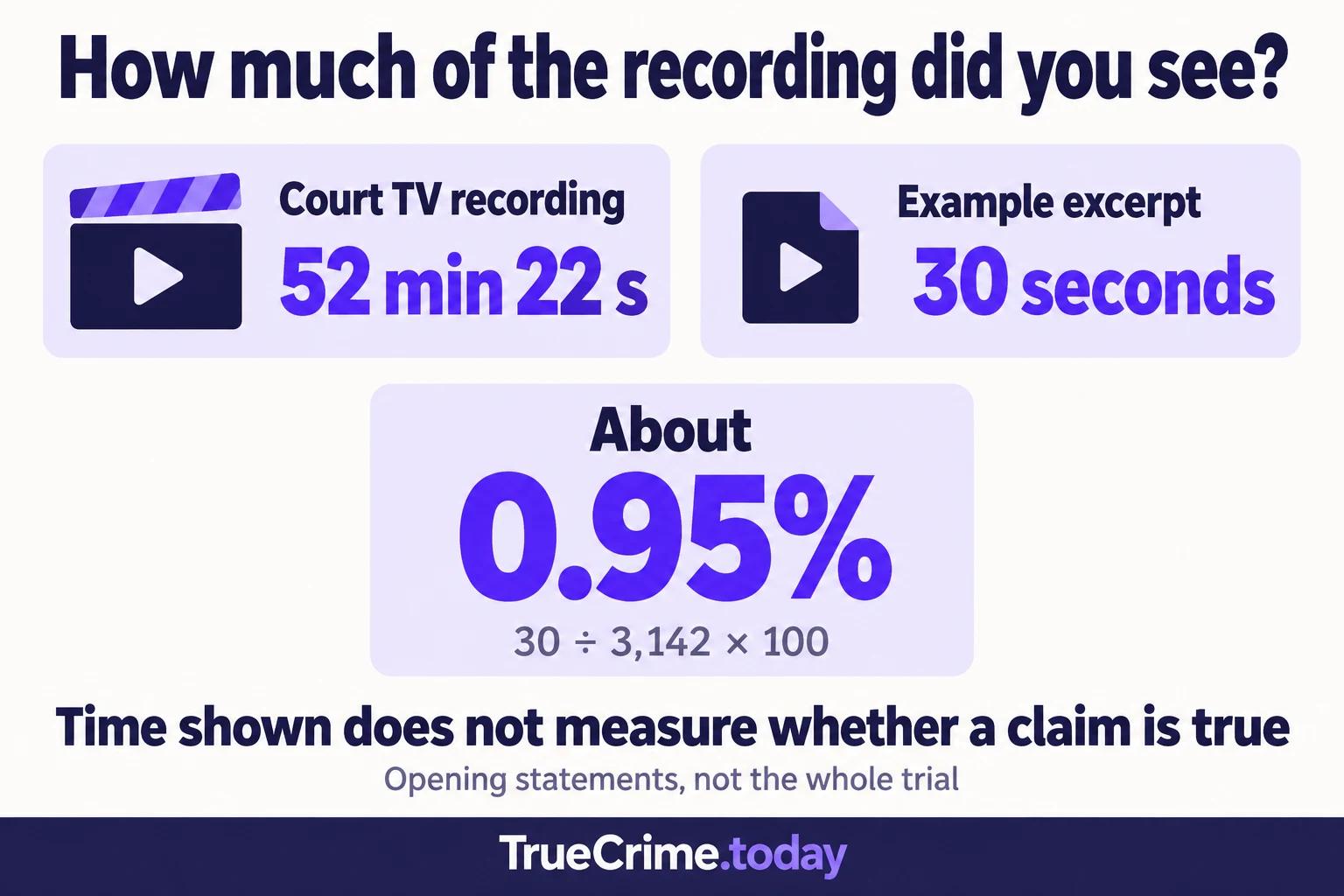
A short excerpt might preserve a sentence perfectly. The percentage does not make it wrong. It tells you how much surrounding material you have yet to see, and gives you a reason to look for the question before the answer or the explanation after it.
There is no viewing percentage that turns suspicion into proof. Watching every minute of this upload would still mean watching opening statements. More footage can restore context; it cannot replace the documents, testimony or later findings that a different question requires.
Three things to keep separate while watching
Who published it: the creator, broadcaster or other account presenting the material. A publisher may have obtained footage from elsewhere. Keep both identities if the origin is stated.
What the camera recorded: a conversation, a room, an action or a document. A camera may record words accurately without establishing that the speaker’s account is accurate. What happened outside its view remains another question.
What the narrator adds: the explanation of motives, sequence or significance. Some commentary is backed by documents; some is an interpretation. Useful narration makes those changes of footing easy to follow.
You may also see archive footage, meaning material made earlier; reconstruction, meaning an event recreated later; or voice-over, meaning speech added over images. Those terms help describe how a story reaches you. They do not, by themselves, tell you whether its claims have been checked.
Find the upload, the recording and the underlying claim
Start with the channel handle and the complete video title. Compare those with the publisher’s public site or an announcement they made elsewhere. This is especially useful when a clip has been forwarded without its description.
Next, look for the recording date and the upload date. An old interview uploaded yesterday is still an old interview. If the date of recording is absent, keep it unknown rather than borrowing the upload date.
Then choose one claim to follow. A title can make several suggestions at once; a concrete claim gives you something manageable to check. “The witness said this” calls for the relevant exchange. “The court found this” calls for the decision. A view count cannot bridge that difference.
Save the title, link, date and timestamp. If the video identifies a source document, keep its name too. This short note is more useful than collecting screenshots of faces whose expressions you are trying to interpret.
Try one scene before committing to a playlist
Pick a moment where you think the video establishes something. Pause and describe the narrow observation: someone speaks, an object is shown, or a narrator makes a statement. Then ask what connects that observation to the conclusion you were about to draw.
Suppose a clip shows a witness answering “yes”. Find the question. If the question had two parts or used a date you missed, your first reading of the answer may change. If you cannot find the preceding exchange, keep the meaning open.
You do not need a complicated setup. The description, a timestamp, the longer upload and a note of the claim are enough for a first check. Use captions or a transcript where available to find a passage, then return to the audio when wording matters.
A useful result is sometimes a smaller conclusion: you know what the person answered, but not whether the answer was true. That is progress. It separates what the recording establishes from what remains to be investigated.
When a transcript helps and when it does not
Captions can help you find a name or return to a passage. Automatic captions can also mishear speech, particularly with accents, overlapping voices or noise. A caption is not a certified court transcript, and its punctuation may imply a sentence break you did not hear.
For an exact quote, compare the text with the sound. Preserve uncertainty if the audio is unclear. If the video offers translated subtitles, check whether the claim depends on a word such as not, might or alleged. Losing one of those changes much more than the style of a sentence.
The same care applies to a still of a document. Can you read its date, heading and surrounding lines? A cropped sentence may be genuine while leaving out the condition that limits it. If those details are hidden, do not fill them in from the narrator’s confidence.
Three viewing situations worth slowing down for
The same check can look different depending on what you are watching. These three situations give you a small question to answer before accepting a larger conclusion.
A witness answers, but the question is missing
A Short can make a pause or an answer appear decisive. Before sharing it, find the longer exchange and identify who asked the question. What was the witness being asked to recall or agree with? If the fragment stops before a correction, the first answer may not be the whole answer.
The result of this check is a more faithful account of the exchange. It does not let you judge the person’s honesty from a pause. Keep the words, the question and any correction together.
A narrator speaks over a photograph
The image may show a person accurately while the words describe an event that the photograph cannot establish. Ask who took the photograph, when it was taken and whether the narrated event is supported by another source.
A photograph can identify a place or person without recording the incident being discussed. If it functions as illustration, treat it that way. The visual can help you follow the account, but the claim still needs its own basis.
Several uploads repeat the same moment
Three channels repeating one recording do not give you three independent witnesses. They give you three presentations of that recording. One may crop the frame, another add captions and a third insert a reaction.
Find the earliest identifiable publisher or the origin named by the uploaders. Earlier does not automatically mean true; it helps you compare the versions. If you find the same mistake or missing phrase in each copy, agreement between the videos has not independently confirmed it.
What comments and thumbnails cannot settle
Comments may point you to an interview or a document worth checking. They can also repeat a title’s accusation until it feels familiar. Save the source a commenter provides, not just their certainty about it.
A thumbnail is designed to help you choose a video. A face beside the word guilty, or an arrow pointing at a glance, does not establish the conclusion. If that is the only basis you can find, leave the claim unresolved.
You can ask a channel about a cited document or a missing timestamp without contacting relatives or searching private accounts. Keep the question focused on published material. Curiosity about a case does not make the people affected available for an audience’s investigation.
Questions before you start another video
A channel can be genuine while a particular claim still needs work. These questions help you decide what to watch next and how much weight to give what you have seen.
Where should I start with YouTube true crime?
Start with your viewing aim. For courtroom speech, identify a broadcaster’s original recording and its stage. For an explanation, look for reporting or narration that identifies its sources. For someone’s experience, choose an interview with a clearly named role. Try one video before following a whole playlist.
Does “full” mean the whole trial?
Check what follows the word. Full opening statements, full interview and full trial describe different amounts of material. The Court TV example covers openings. Its length does not turn those openings into witness evidence or tell you what happened later.
Can a verified channel publish a mistake?
Yes. Verification helps distinguish the channel’s identity, not certify every statement. Look for the basis of the particular claim you care about. A correction, a source document and a clear date are more useful for that task than the badge alone.
Does an AI voice mean the story is invented?
No. The voice may be a production choice while the facts come from identifiable records. You still need to know what is sourced and what is reconstructed. A realistic generated image presented as actual footage creates a different problem from a clearly identified illustration.
Can I quote automatic captions?
Use them to locate a passage, then check the audio before presenting the wording as exact. If you cannot hear the word clearly, say so or paraphrase with that limitation. Do not silently repair uncertain audio into the statement you expected to hear.
Keep a useful note instead of a suspect list
For your first video, keep one claim and its timestamp. For the next, compare how another publisher presents that claim: is there new material, or the same clip with a new title? Later, try following one cited document back to its original publisher.
That sequence is small enough to repeat. It does not require finishing every long stream or learning to diagnose people from their expressions. The skill you are building is recognising what supports a statement and when the support stops.
Make your next watch easier to check
Before you share the next clip, keep its original title, uploader and the few words that matter. Then look for the missing context. You can recommend a compelling story while leaving its disputed conclusions in the words of the people who made them.
Have a question about an upload, a quoted passage or its source? Send the public video link and timestamp. Do not send passports, contracts, bank details or other personal documents.
Ask about a video