Lie detection myths: why feeling certain can lead you astray
Lie detection myths, bias and AI judgments explained through research, error rates and practical examples. What can a suspicious moment actually tell you?

TL;DR
A moment that looks suspicious is a reason to check an account, not proof that someone is lying. Your confidence, your willingness to accuse and your accuracy are different things. A method can improve one while changing the others in ways a headline leaves out.
Research gives us reasons to be cautious about reading intent from behaviour. It also offers some promising ways to examine accounts. The useful habit is to name the claim, check what could support or contradict it, and keep track of what would change your mind.
The clip feels conclusive. What did it actually show?
You watch someone hesitate before answering a question. The caption says they have been caught. After two replays, the pause seems louder than the answer. But the camera recorded a pause. The claim that the person was inventing a story came from the caption, the commentary or you.
That gap matters throughout lie detection, because noticing a behaviour and knowing its cause are separate tasks. Someone might be searching their memory, working out what a question means, or deciding how much private information to share. Those possibilities do not prove honesty. They stop the first explanation from becoming the only one.
We will look at three different outcomes: whether a judgment was correct, how often someone was called a liar, and what counted as truth in the experiment. Mixing them up makes a weak finding sound decisive. Keeping them apart also lets us recognise genuine improvements without promising more than a study tested.
The last time we checked the research discussed here was October 19, 2026.
What the famous 54% figure tells you
Bond and DePaulo’s 2006 review of deception judgments combined findings from 206 documents involving 24,483 judges. Without special aids or training, people classified truth and lies correctly about 54% of the time. They correctly identified 47% of lies and 61% of truths.
Those are historical pooled results from the tasks the researchers reviewed. They are not a permanent ceiling on human ability, a measurement of today’s true-crime audience, or a 54% probability that your latest guess is right. The task, the information available and the mix of truthful and deceptive statements all matter.
The unequal truth and lie scores are worth noticing. A person can be more willing to believe accounts than reject them. Someone else can lean towards suspicion. Neither preference tells you, on its own, how well they separate the two kinds of account. “I spotted more lies” leaves out what happened to the truthful people.
Calling more people liars is a different achievement
Imagine a commentator who labels every speaker dishonest. In a collection containing equal numbers of true and false accounts, they catch every lie. They also falsely accuse every truthful speaker. Their overall accuracy is 50%.
That is an extreme illustration, but it exposes the missing question in many demonstrations: what happened when the speaker was telling the truth? A montage of correct suspicions cannot answer it. You would need the misses, the false accusations and the occasions when the commentator held back, too.
This is why a change in the threshold for saying “lie” can look like sharper perception. If the threshold drops, more deceptive accounts may be caught and more truthful accounts may be rejected. To decide whether the change helped, you need both outcomes and the consequences of each mistake. A successful guess in a highlight reel is not that comparison.
AI improved accuracy and changed the accusations
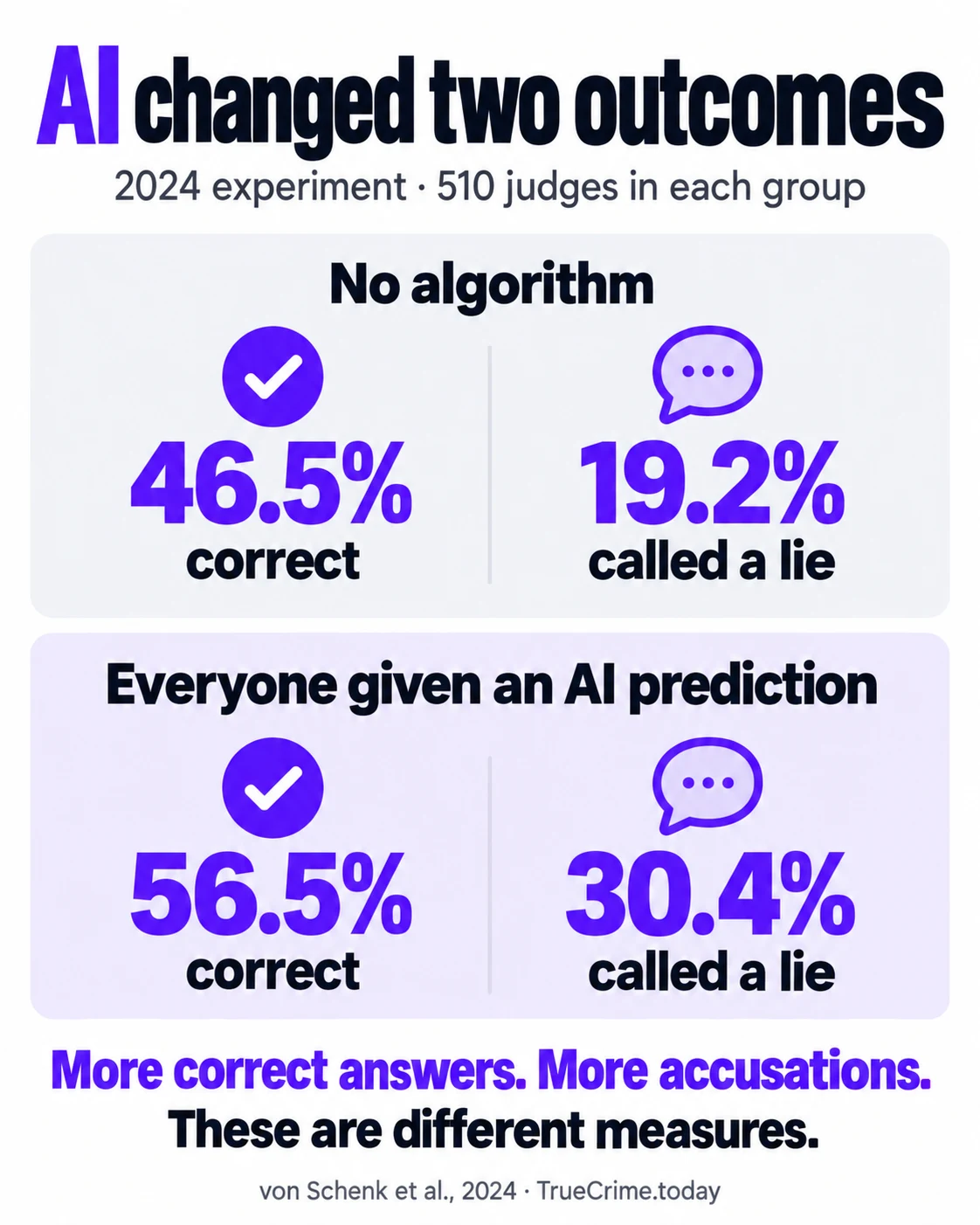
A 2024 experiment by von Schenk and colleagues shows why both outcomes belong in the discussion. It involved 2,040 judges, randomly assigned to four groups of 510. In one group, judges received no algorithmic help. In another, everyone received an AI prediction.
Without the prediction, accuracy was 46.5% and 19.2% of statements were called lies. When everyone received a prediction, accuracy rose to 56.5% and accusations rose to 30.4%. These figures are rounded from the paper.
The gain in correct answers was 10 percentage points. The rise in accusations was about 11.2 points. The result supports a real improvement in that task; it also shows a change in people’s decisions. More accusations do not automatically mean more false accusations. We still need to ask which accusations were right, and how the system would behave with other material.
The people behind those percentages
The material in that experiment came from 768 authors, who supplied 1,536 statements about intended weekend activities under truth and lie instructions. The reference labels came from that procedure, rather than independent observation of everything people later did at the weekend. The experiment tested a particular text classifier and a particular decision setting.
In the group allowed to request a prediction, about 31% chose to do so. Among those who requested one, judgments followed it about 88% of the time. That last figure concerns a self-selected subgroup. It does not describe all 2,040 judges, and it does not establish what would happen if everyone chose the tool freely outside the experiment.
These limits help you interpret the positive finding. They do not erase it. They explain why “AI helped on this task” is a better-supported claim than “AI can tell whether a person in a news clip is lying.”
When unfamiliar behaviour becomes a reason to disbelieve
Sometimes the problem begins with what a truthful person is expected to look like. Lim, Young and Brewer’s research, published online in 2021, used interviews with 30 autistic and 29 neurotypical adults. 1,410 observers rated a video for truthfulness or credibility. The autistic interviewees were perceived as more deceptive and less credible while telling the truth.
The researchers examined five behaviours, including gaze aversion and repetitive movements. Those measured behaviours did not explain the relationship; the person’s overall presentation mattered. It would be wrong to turn the study into another gesture checklist, or to diagnose someone from a recording.
In a case analysis, movements need context before you attach an intention to them. Here the concern is who pays for the assumption: a person whose way of speaking feels unfamiliar may face extra suspicion without any new evidence against their account.
A different 2023 mock-burglary study, involving 32 autistic and 33 non-autistic adults, found similar verbal cues across groups. There is no basis for treating autism as a shortcut to either dishonesty or honesty.
A confident story can explain either answer
Once you decide a speaker is deceptive, almost any response can be made to fit. A quick reply becomes rehearsal. A slow reply becomes invention. A calm face becomes coldness. Visible distress becomes acting. If opposite behaviours always confirm the same conclusion, the explanation has stopped taking a risk.
Try naming the observation before the interpretation: “The speaker paused for several seconds after this question.” Then ask what would distinguish your explanation from the alternatives. A full recording might show that the question was unclear. A dated message might contradict the answer itself. Those checks do different jobs.
This is an exercise in keeping a claim testable, not a finding that every suspicious person is misunderstood. Sometimes the records will support the suspicion. What matters is that the records get a chance to disagree with it. Otherwise, watching more footage can become a way of collecting confirmations rather than learning anything new.
The same score can hide very different mistakes
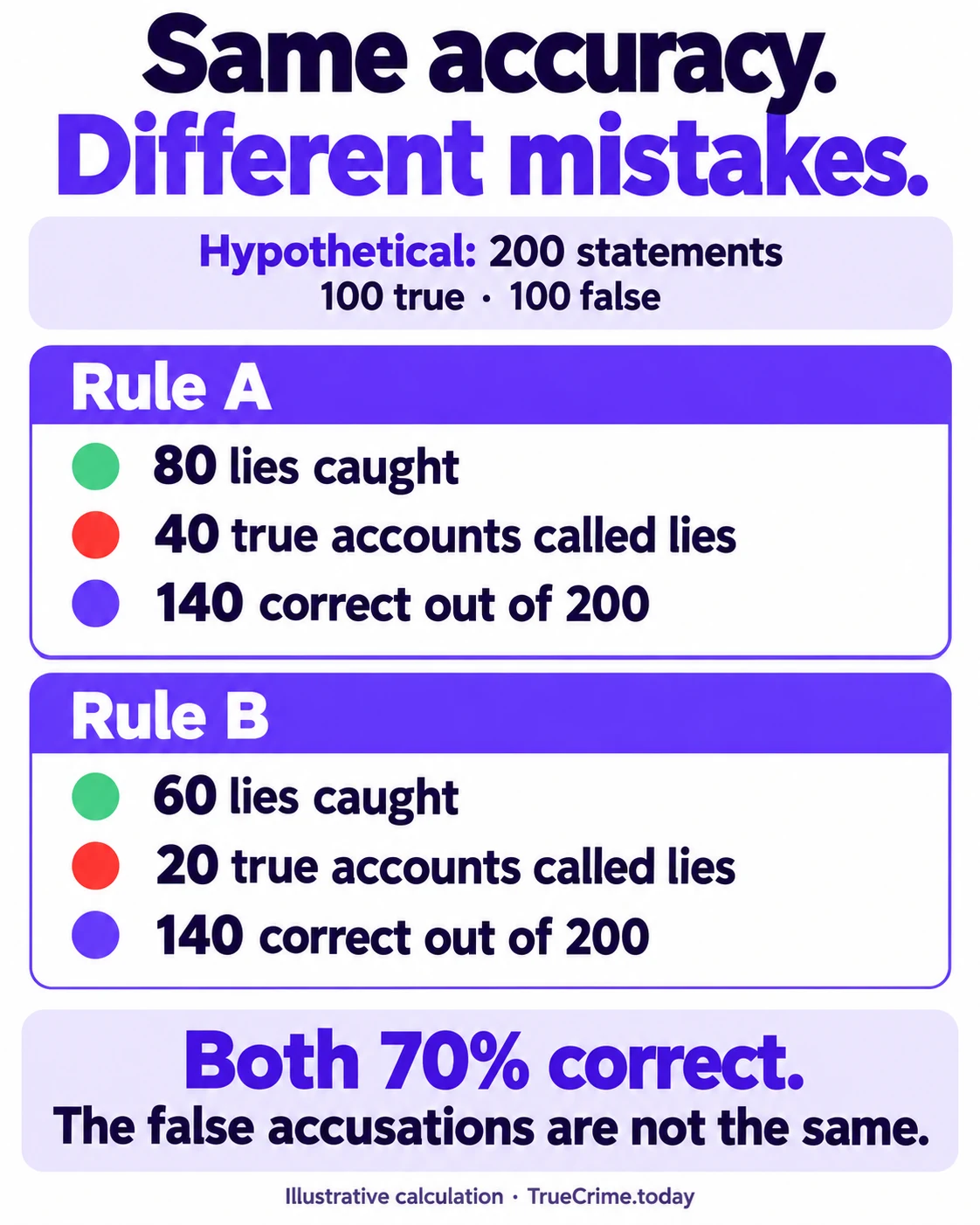
Here is a hypothetical calculation, not a reported experiment. Take 200 statements: 100 true and 100 false. Rule A catches 80 lies but calls 40 truthful accounts lies. It correctly accepts the other 60 truthful accounts. That makes 140 correct judgments, or 70%.
Rule B catches 60 lies and falsely accuses 20 truthful speakers. It correctly accepts 80 truthful accounts. It also gets 140 judgments right: 70%. But it misses 40 lies rather than 20, while producing half as many false accusations.
Neither score tells you which trade-off is acceptable in every setting. A moderator deciding what needs another look is making a different decision from a commentator naming a supposed liar to thousands of viewers. A second look can be reversible; a public accusation can spread before a correction reaches anyone.
Before sharing an accuracy claim, ask for the errors it hides. The single percentage is not enough to show who was wrongly accused or who was wrongly believed.
What detail-based research offers, and what it does not
Being cautious about gestures does not mean every method is equally unhelpful. Verschuere and colleagues reported nine studies in 2023 on focusing on a useful cue, such as detailedness or verifiable information, rather than combining many impressions. The results gave reasons to study that approach further.
A 2025 working paper by Zickfeld and Elbæk tested related procedures with 549 participants. An explicit detail-based decision rule achieved 67%, compared with 64.2% for a multiple-cue condition. An implicit single-cue instruction achieved 62.4%. The authors found support for the explicit-rule result, while the implicit-rule result did not replicate. This was a discussion paper, rather than a peer-reviewed journal confirmation.
That is a more interesting picture than “detail proves truth.” The instruction and comparison mattered. A separate 2024 paper by Lob and colleagues also found that merely providing nonverbal information did not always harm performance, although biasing behaviour could affect the heuristic in other experiments. Removing the video is not a universal cure either.
A cancelled booking and a missing message
Suppose a fictional organiser says a venue cancelled an event. A short interview shows the organiser hesitating over the date. People repost it as proof that the cancellation was invented.
Start with the claim: did the venue cancel the booking, and when did the organiser learn about it? The booking agreement, the cancellation message and the time of receipt could help. The pause does not establish any of those facts.
Now suppose the cancellation message exists, but the organiser received it before selling another round of tickets. That supports a narrower concern about what buyers were told. It does not follow that every part of the organiser’s account was false. Equally, a calm second interview would not answer the concern about ticket sales.
The example is invented to show how an investigation can move away from personality and towards a checkable event. You can finish with a harder question than the clip offered, and a much clearer idea of what would answer it.
Before you turn a suspicion into a public claim
If you discuss the clip, keep the distinction visible in the wording. “The answer conflicts with a dated email” tells readers what the concern is. “The pause exposes a pathological liar” adds a diagnosis and an intention the pause cannot establish.
Give enough of the question and answer for someone else to check your reading. Keep edited excerpts separate from the full recording. If you do not have the original, say so. A second account repeating the same allegation is not independent confirmation merely because it has a different username.
None of this requires people to disclose a diagnosis, trauma or private messages to earn a fair hearing. You can decide that there is too little evidence for a public accusation without deciding that the account must be true. If a record later changes the picture, correct the claim where people encountered it, rather than quietly changing a caption and leaving the old conclusion circulating.
Leave room for an answer that changes your mind
Before the next replay, ask yourself: what could I learn that would make me less sure? If the answer is “nothing,” another hour of footage may only give you more material to fit the same story.
A useful conclusion can be small. The date is disputed. The full question is missing. An email supports one part of the account but conflicts with another. These are things another person can examine without borrowing your confidence.
Research can help us design better questions and judge particular methods more carefully. It has not given an audience permission to read a whole person’s honesty from a gesture. Keep the curiosity. Make the claim precise enough that evidence can change it.
You can ask about a research finding or a specific claim in a published analysis. Do not send private recordings, medical information, passports, contracts or other personal documents.
Ask about deception research