Psychopath vs sociopath: what is the difference, really?
Are psychopaths born and sociopaths made? Understand the terms, what twin research shows and why popular comparisons cannot diagnose someone.

TL;DR
There is no universally accepted clinical test that sorts people into “psychopaths” and “sociopaths” using the familiar born-versus-made rule. Psychopathy is a research construct with several ways of defining and measuring it. Sociopathy has a less settled meaning: some writers use it for antisocial personality disorder, others for patterns they consider more socially influenced. Those uses overlap, but they do not establish two cleanly separated diagnoses.
If a comparison promises that one group always plans while the other always loses control, ask where that rule came from. A description of someone’s behavior cannot, by itself, establish how their personality developed.
Psychopath vs sociopath: what the terms mean
You watch an interview. One commentator calls the speaker a psychopath because they sound calm. Another calls the same person a sociopath because an earlier argument looked impulsive. Which commentator has identified the right condition?
Neither has supplied enough evidence. They have noticed different things and attached labels whose meanings they may not even share. Calmness and an angry outburst can occur in the same person; neither tells you whether inherited differences, experiences, illness or the immediate situation explain what happened.
Psychopathy usually refers, in specialist research, to a pattern involving interpersonal, emotional and behavioral traits. Researchers disagree about parts of that pattern. Sociopathy can be a historical term, a popular synonym or a proposed description of a particular developmental pattern. You need the author’s definition before the comparison means much.
That is why criminal psychology separates questions about personality, motivation and a particular act: evidence answering one of them does not automatically answer the others.
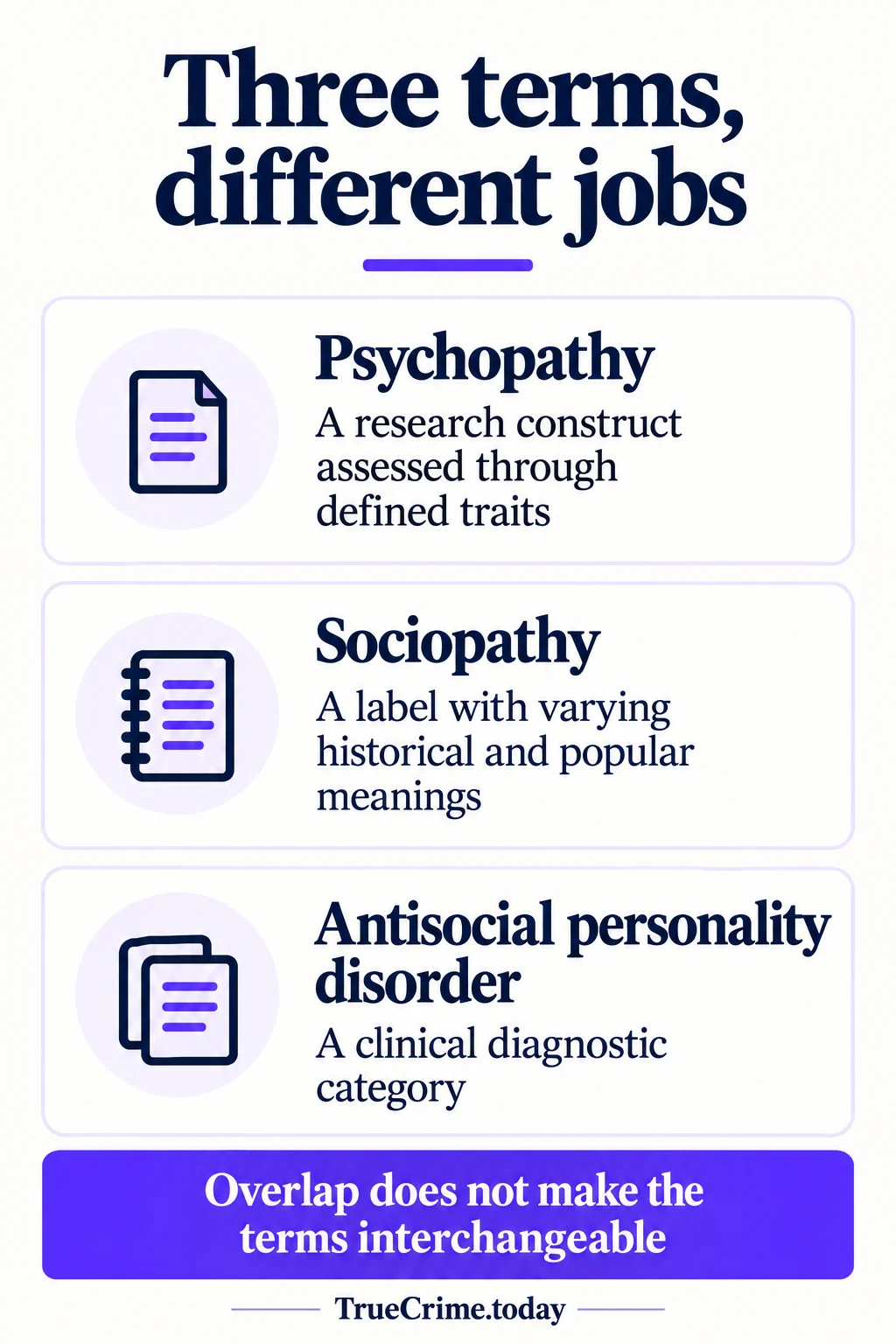
The three cards describe how the words are used. They are not three boxes you can assign a person to after watching an interview.
Why do experts give different answers?
Some experts reserve sociopathy for patterns they believe arose mainly through social experiences. Others barely use the word. Dictionaries also preserve older meanings, including its connection to antisocial personality disorder. That leaves room for two apparently contradictory explanations to be describing different conventions.
In an American Psychological Association interview with researcher Abigail Marsh, she distinguishes the established research use of psychopathy from the looser uses of sociopathy, including accounts that emphasize social causes.
That distinction helps explain the vocabulary. It does not give you a method for establishing a stranger’s developmental history. An expert can choose a definition for a discussion; a widely accepted diagnostic boundary needs more than a chosen definition.
Clinical explainers sometimes make stronger distinctions between the words. Read those distinctions as the author’s account, then look for the assessment method behind them. “This is how I use the terms” and “these are two reliably identifiable clinical groups” are different claims.
Where does antisocial personality disorder fit?
Antisocial personality disorder, often shortened to ASPD, is a clinical category concerned with an enduring pattern of disregarding and violating other people’s rights. It is not a diagnosis of being unfriendly, private or uninterested in parties. A clinician considers a person’s history and the relevant diagnostic requirements.
Psychopathy research often asks additional questions about emotional and interpersonal traits, such as callousness, remorse and manipulation. Some measures also include antisocial behavior. This creates overlap with ASPD, without making every use of the terms equivalent.
When a case report uses a clinical label, our editorial methods for case analysis preserve what the assessment actually concluded rather than replacing it with a more dramatic label.
The same care matters when someone has harmed you. You can describe coercion, threats or repeated deception accurately without first settling a contested personality term. Naming the conduct is often more useful than choosing between two labels.
Are psychopaths born and sociopaths made?
That explanation sounds neat because it supplies both a category and a cause in one sentence. Human development rarely gives us that shortcut.
Inherited differences can contribute to traits associated with psychopathy. Experiences also matter, and a trait can be influenced by both. A genetic contribution does not mean a baby arrives with a finished adult personality. An environmental contribution does not mean a single event explains everything that follows.
The born-versus-made rule also asks more of an observer than they can usually know. An adult’s polished manner does not reveal their genes. A difficult childhood does not establish one particular outcome, and it cannot explain away the need to examine what that adult actually did.
What did the twin study actually compare?
A 2005 study by Essi Viding and colleagues used teacher ratings of 3,687 twin pairs at age seven to investigate callous-unemotional traits and antisocial behavior.
Its selected high-antisocial-behavior groups included 187 pairs with high callous-unemotional traits and 177 without extreme scores on those traits. The estimated genetic and shared-environment contributions differed between the groups. These were childhood trait groups, not adult psychopath and sociopath diagnoses.
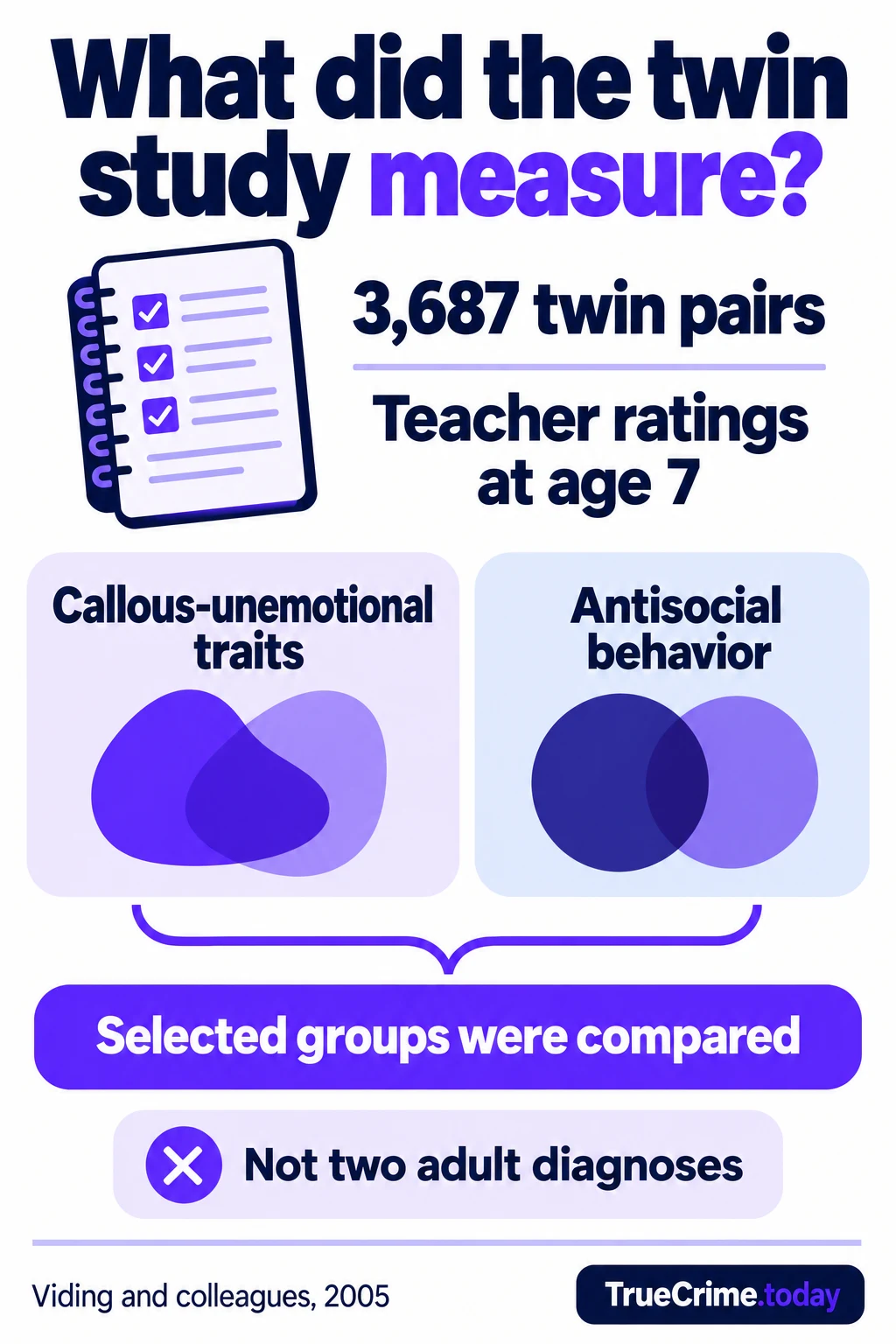
The distinction matters when people use research to justify the born-versus-made slogan. A study has to be interpreted through the participants, measures and comparisons it actually used. Giving the groups new names afterward does not establish that those names identify the same thing.
Genetic estimates describe variation within a studied population under a model. They are not a breakdown of one person’s character into a genetic percentage and an upbringing percentage. Nor does a small estimated shared-environment component establish that relationships or support can never matter.
Does cold planning separate the two?
You will often see the psychopath described as calculating and the sociopath as reckless. That is a memorable character contrast. It is a poor universal sorting rule.
Planning and impulse control are not permanent opposites. Someone can prepare a deception carefully, then react rashly when challenged. Another person can look disorganized in one setting and deliberate in another. An edited account may show the preparation while leaving out earlier mistakes, or show an outburst while leaving out months of planning.
There are real research questions about disinhibition, emotional traits and different profiles. Those questions require defined measures and evidence. They do not make every contrast between a composed suspect and an agitated suspect a clinically meaningful distinction.
A useful description keeps the event intact: the person arranged a meeting, changed an account, shouted when questioned or left without warning. “That makes them a sociopath” adds a conclusion the description has not established.
What about empathy, guilt and attachments?
Another common claim gives one group no empathy and the other a little empathy, usually for a small circle of people. That claim compresses several questions into a single word.
Understanding what someone feels, sharing some of that feeling and caring enough to change your behavior are related but different capacities. A person may notice distress without responding kindly. A convincing apology may show that they know what listeners expect; it does not settle whether they feel remorse or whether their conduct will change.
Researchers can investigate these distinctions. What you cannot do is take one conversation, estimate an amount of empathy and use it to choose a label. Close relationships also require context: having a partner or expressing affection does not settle the wider personality picture.
The same restraint works in the other direction. Emotional reserve, awkwardness or an unusual response to grief does not establish cruelty. Judge a claim about harm by the evidence of harm, rather than by how closely someone performs the emotion you expected.
Why a score cannot tell you which label wins
A measure produces a result within its own definitions. It does not automatically settle the meaning of every word people use around it.
The professional PCL-R instrument has 20 items and combines information from an interview with other records. It is not a public quiz that decides whether the respondent belongs in a psychopath column or a sociopath column. Its interpretation depends on the evidence and the assessment context.
Changing an instrument’s label in a headline does not change what it measured. If a study used a self-report trait questionnaire, calling the participants “diagnosed sociopaths” may add a clinical conclusion that the researchers never made.
Ask what instrument was used, who completed it, what other information was available and what conclusion the authors drew. A confident number can be less informative than a careful explanation of the missing history.
Can we compare how common they are?
Not responsibly as a universal pair of percentages unless the studies define both groups and explain how they were measured. A prevalence figure has a denominator: people in a particular population, assessed in a particular way. The word alone does not supply either.
A prison sample cannot establish how common a pattern is among all adults. A questionnaire threshold cannot simply be swapped for a professional assessment threshold. Two papers using different meanings of sociopathy may not even be counting the same thing.
This is why a tidy “psychopaths: X%, sociopaths: Y%” graphic can mislead even when both numbers appeared somewhere in print. Before comparing them, check the definitions, participants and methods. If those do not line up, the apparent difference may be a difference between studies.
Would either word tell you who will become violent?
A label alone does not establish that a person will commit violence. Neither does the absence of a label establish safety. Risk assessment concerns a specific outcome, a period of time, a person’s history and the circumstances around them.
Claims that one group is always more dangerous skip those questions. So do claims that calmness makes someone more capable of planned harm while visible anger makes another person easier to predict. Those might be a storyteller’s explanation of an event; they need separate evidence before becoming a general rule.
This does not ask you to ignore threatening conduct. A credible threat, stalking, coercion or assault deserves attention because of what happened. You do not need a personality verdict before taking it seriously, and a diagnosis does not replace proof of an alleged act.
A festival organizer, two labels and the same missing evidence
Imagine a fictional organizer responsible for booking a festival venue. They show volunteers a confirmation that the venue says it never issued. When questioned, they give a calm explanation. Later, they angrily blame a volunteer in a group chat.
One viewer calls the calm explanation psychopathic. Another says the angry messages prove sociopathy. The second incident has not resolved the first label. Both viewers have moved from observed behavior to a broader conclusion without the history that conclusion would need.
The booking can be investigated directly: who created the confirmation, what payment was made, what the venue received and whether anyone knowingly misled the volunteers. Those questions can establish wrongdoing even if no personality assessment exists.
A clinical inquiry asks something different: whether a wider, enduring pattern exists, which features are present, what other explanations need consideration and what the available accounts leave uncertain. Keeping those inquiries separate makes both more precise.
What do these terms help professionals do?
Defined constructs let researchers compare findings and test explanations. Clinical assessment can help a professional understand difficulties, consider care and describe patterns that would otherwise remain vague. A forensic assessment may contribute to a particular referral question within its legal setting.
The value comes from the work behind the conclusion. Naming a measure, explaining the evidence and acknowledging its limits gives another professional something to examine. Replacing that account with “a classic sociopath” removes information rather than adding it.
There is also room for disagreement. Researchers may differ about which features belong inside psychopathy and which are associated consequences. That does not make all assessment meaningless. It makes it necessary to say which model a conclusion uses.
What changes when the person is a child?
Children are still developing. Research can identify traits or behavior that deserve attention without treating a child as a finished adult type.
An adult label can make future harm sound inevitable and present support sound pointless. Neither follows from finding a developmental risk. The useful questions concern the child’s behavior, circumstances, needs and response to help.
This is also why the age of a study matters. Findings about childhood traits cannot be silently rewritten as proof of two fixed adult categories. Development is part of the question, not a detail to remove from the result.
Questions worth asking about a comparison
Two questions often remain once the popular contrast falls apart: can a person change from one label to the other, and does the word antisocial mean what it sounds like in everyday conversation?
Can a sociopath become a psychopath?
The question assumes two agreed categories with a measurable border. Without definitions and a method, changing labels may mean only that a writer has changed their description. To study change, researchers need to specify which traits, behaviors or assessment results changed, over what period and with what evidence.
Does sociopath mean someone who avoids people?
No. Preferring solitude, feeling uncomfortable in company or keeping a small social circle does not establish the patterns discussed here. In the clinical term antisocial personality disorder, antisocial concerns disregard for other people’s rights, rather than a preference about socializing. Do not turn an ordinary preference into a personality allegation.
What should you call the behavior instead?
Start with what you can actually establish. “They gave two incompatible accounts of the payment” tells the reader more than “they acted like a sociopath.” It also leaves room to investigate an error, a misunderstanding or deliberate deception.
When a credible professional assessment exists, report its terminology and limits accurately. When it does not, a precise account of the conduct is still useful. The next time a comparison promises two perfectly different kinds of people, ask what evidence would let anyone draw that line.
You can ask about a definition, a research method or a comparison discussed here. Please keep private medical records and other personal documents out of your message.
Ask about a research claim