What is psychopathy? Traits, assessment and what the numbers mean
What is psychopathy, how is it assessed and how common is it? Understand the traits, research findings and limits of judging someone from a true-crime interview.

TL;DR
Psychopathy is a pattern of personality traits involving callousness, limited remorse, manipulative relationships and problems with behavior or self-control. Researchers disagree about its exact boundaries and about how much weight to give different traits. A professional assessment examines a history across situations; an interview clip or online quiz cannot establish the pattern.
If you hear someone called a psychopath during a true-crime discussion, ask what evidence supports that description. The last time we checked the research discussed here was October 21, 2026. The charity example and screening calculation below are invented illustrations.
What is psychopathy, in plain English?
The word often arrives before the explanation. Someone appears calm after a terrible event, a commentator calls them a psychopath, and the label seems to account for everything. Yet calmness alone tells you little about a person’s relationships, remorse or behavior over time.
In research, psychopathy describes a configuration of traits. Callousness concerns disregard for other people’s suffering. Limited remorse concerns the response to harm caused. Manipulation and persistent irresponsibility may also belong in the picture, depending on the model and measure being used.
Within criminal psychology, these distinctions matter because a personality description and an explanation of a particular act answer different questions. Establishing who transferred money still requires evidence about the transfer even if someone’s personality has been assessed carefully.
Think of the term as a claim that needs a definition and evidence. You should be able to ask which traits were assessed, how they were established and what conclusion they actually support.
Which traits belong in the picture?
One influential approach organizes psychopathy around interpersonal, emotional and behavioral features. An interpersonal pattern might involve exploitation; an emotional pattern might involve little concern about harm; behavioral features can include impulsivity and repeated irresponsibility. These broad descriptions require context rather than a count of memorable incidents.
Patrick, Fowles and Krueger’s 2009 triarchic model instead brings together boldness, meanness and disinhibition. Boldness concerns social assurance and low fear; meanness concerns callous, exploitative tendencies; disinhibition concerns difficulty controlling impulses. They are dimensions in a theory, rather than three separate diagnoses.
Boldness is particularly easy to misuse. Confidence can occur without exploitation or recklessness, and researchers debate its place in the construct. A composed speaker cannot be assigned the rest of the pattern because one feature seems to fit.
These models help explain why two measures may emphasize different things. A questionnaire focused on fearlessness and a professional assessment including behavioral history need not identify identical groups. Before comparing scores, you need to know what each score includes.
How did the word get this meaning?
The terminology developed through different clinical traditions. Cleckley’s descriptions of psychopathic personality emphasized a striking gap between an apparently ordinary or engaging presentation and persistent interpersonal and emotional difficulties. Later instruments, including Hare’s checklist, gave researchers more systematic ways to assess features and recorded behavior.
That history does not end in one universally accepted definition. The 2011 review by Skeem and colleagues examined competing accounts, intersecting traits and what follows from them. A useful definition today should tell you which model is being used rather than treat every historical description as interchangeable.
The practical consequence is simple: when an old book, a modern study and a documentary use the same word, check whether they mean the same thing. The history of a label does not make a current assessment unnecessary.
Is psychopathy the same as antisocial personality disorder?
Antisocial personality disorder, often shortened to ASPD, is a diagnostic category concerned with a persistent pattern of disregarding or violating other people’s rights. Psychopathy research overlaps with that territory but also gives attention to interpersonal and emotional features. The terms should not be substituted automatically when interpreting a study.
A sample selected because participants have ASPD is not automatically a sample selected for high psychopathy scores. This matters when a treatment result or prevalence figure travels from one headline to another.
The same precision improves case analysis: quote the conclusion an assessment actually reached and separate it from a commentator’s stronger description. A documented diagnosis, a research score and an audience impression have different evidential histories.
“Sociopath” and “narcissist” also appear in casual discussions. Those words cannot be arranged into a dependable ranking of dangerousness. If the distinction matters to an argument, it needs its own definition and assessment rather than an exchange of labels.
What does a professional assessment involve?
The publisher’s description of the Hare PCL-R specifies 20 items and professional administration using an interview and collateral information. It lists 90–120 minutes for the interview and 60 minutes for reviewing other information. Those details show why a short impression is missing much of the material the instrument expects.
Collateral information means evidence beyond what the person says during the assessment. Depending on the purpose and setting, that can include relevant records and accounts of behavior. The assessor must consider their quality, contradictions and gaps, rather than assume that every allegation is accurate.
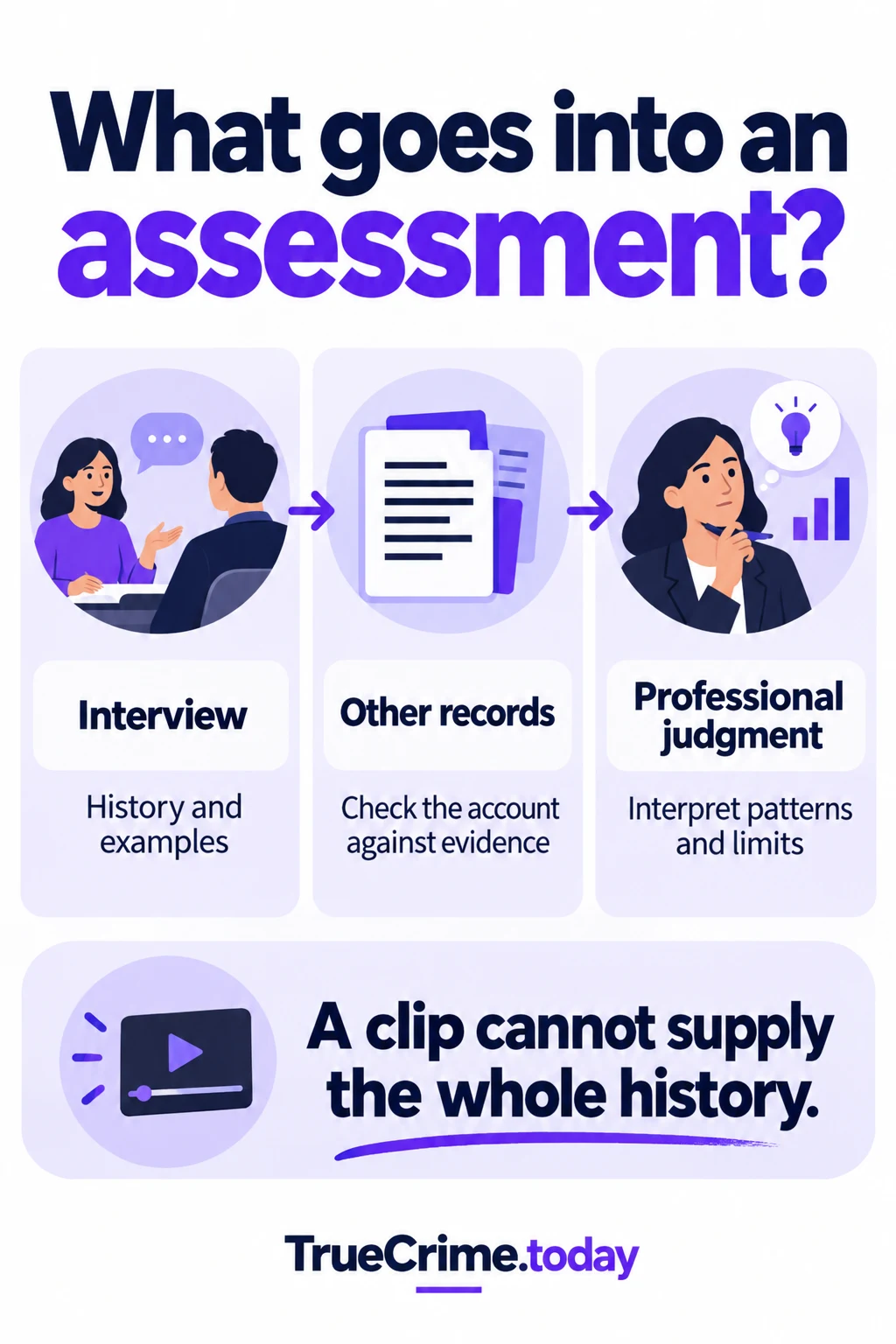
The resulting score belongs to a particular instrument and context. Interpreting it calls for appropriate training and knowledge of the relevant evidence. A number should not become a percentage chance that a person committed a specific offence.
An online list of traits leaves these steps out. Seeing a description of yourself or somebody else can prompt a question, but it does not recreate an assessment with independently checked history.
Why do prevalence estimates range so widely?
A 2021 meta-analysis by Sanz-García and colleagues combined 15 studies, covering 16 samples and 11,497 adults. Its overall estimate was 4.5%, with a 95% confidence interval of 1.6–7.9%. Estimates were 1.2% for the PCL-R family and 5.4% for other instruments. Methods and sampled populations varied widely.
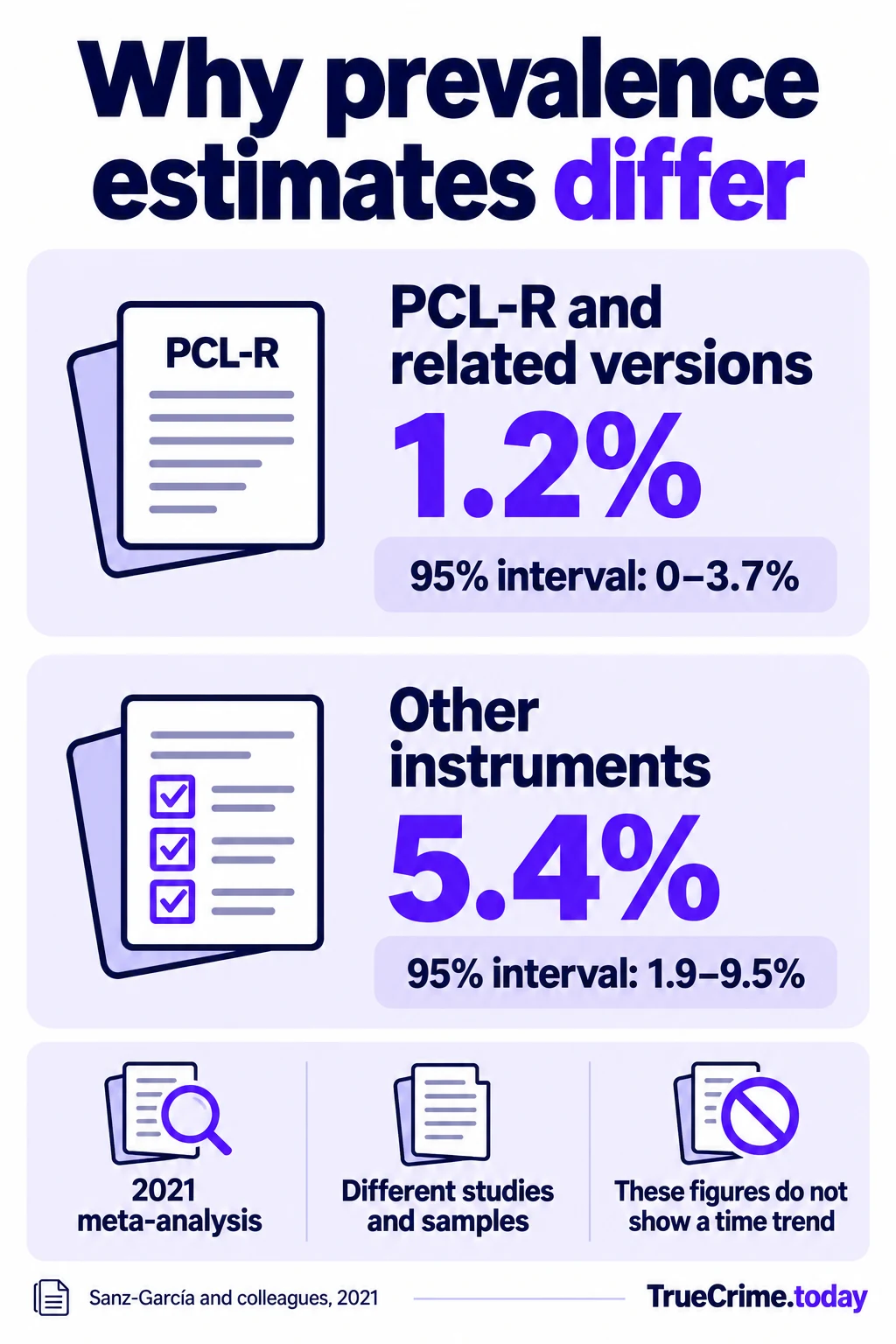
These figures do not describe a rise from one year to another. Nor did the review test every participant twice and show that changing a questionnaire caused the entire difference. The choice of participants and the choice of instrument can vary together.
That is why a headline about how many psychopaths live near you promises more than this evidence provides. An estimate from selected studies cannot identify your neighbors or supply a current census of every country.
Can a confident manner reveal the condition?
A confident manner gives you information about the presentation you can observe. It does not establish the person’s history. Charm, eye contact and fluent speech can occur in many circumstances, and a camera does not reveal whether someone consistently disregards others’ needs.
A long pause is no more decisive. A person might be choosing words, remembering, distressed or avoiding an answer. To decide whether an answer is false, compare it with evidence about its content. To make a personality judgment, a much broader assessment is needed.
There is also a selection problem in edited footage. A film may show repeated close-ups from one stressful day while leaving out years of other behavior. Repetition within that selection can feel like an enduring pattern without demonstrating one.
You can describe what the recording shows: a smile, a statement or a discrepancy. Claims about motive, emotional capacity and an enduring personality pattern require additional support.
How much does a positive screening result tell you?
Here is a hypothetical calculation, using invented performance figures rather than measured PCL-R accuracy. Imagine 1,000 people, ten of whom have a target pattern. A screening method identifies 80% of those ten, producing eight correct flags. If it correctly clears 90% of the remaining 990 people, it also produces 99 false flags.
There are then 107 positive flags, of which eight are correct. The calculation is 8 ÷ (8 + 99) × 100 ≈ 7.5%. A high-sounding success figure on one part of the task can coexist with many incorrect positive results when the target is uncommon.
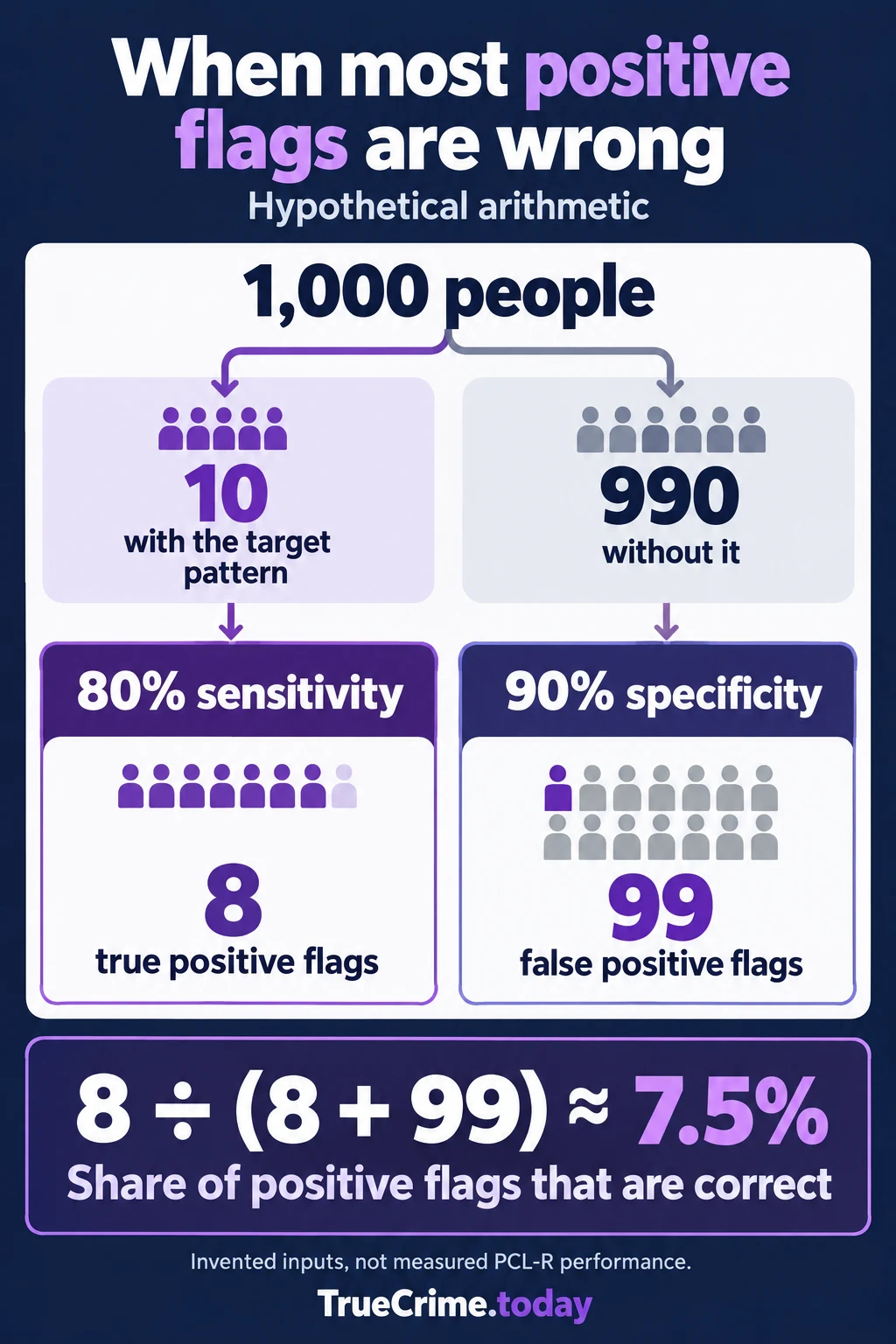
The example does not estimate anyone’s probability of psychopathy. Its purpose is to show why sensitivity, specificity and the starting frequency all matter. Sensitivity concerns finding the target group; specificity concerns correctly clearing people outside it.
An online quiz that announces “90% accurate” without explaining those quantities has left important questions unanswered. You also need to know who was tested, how the correct classifications were established and whether new participants were assessed independently.
Do people with psychopathic traits always offend?
The concept has a strong history in forensic research, which can make offending seem inseparable from the definition. But selecting people from prisons or forensic services changes who is being observed. It cannot establish that every person with elevated traits commits a crime.
Research can find associations between scores and later offending without making an individual outcome inevitable. The behavior already included in a measure may contribute to that association. A prediction about future violence also has to explain false positives, the follow-up period and the setting.
Equally, an absence of criminal convictions does not settle the full personality question. Some harmful behavior may never reach a court, and some personality features may occur without criminal conduct. Each claim needs the evidence appropriate to it.
For a particular offence, return to what happened. A personality assessment cannot replace proof of the act, the person’s involvement or the circumstances.
What explains the traits, and can they change?
Researchers examine developmental, genetic and environmental influences. Finding an influence does not identify one sufficient cause in a particular person. It also does not mean a trait is unaffected by circumstances or intervention.
“Born that way” compresses several different questions: why traits develop, how stable they are, and whether harmful behavior can be reduced. Those questions require different studies. A biological association alone does not answer all three.
Change needs a defined outcome too. Fewer aggressive incidents, better impulse control and lower scores on a personality measure are different results. Improvement in one should not be announced as proof that every feature disappeared.
The sensible counterweight to exaggerated treatment promises is a clear account of what improved and for whom. Declaring everyone permanently beyond help is also a claim that needs evidence.
What does the 2025 treatment trial actually show?
The MOAM trial reported in 2025 studied 313 adult men with ASPD under probation supervision in England and Wales. It compared 157 receiving a year of adapted mentalisation-based treatment alongside probation with 156 receiving usual probation. UCL’s investigator report described lower aggression in the treatment group.
That is relevant evidence against blanket claims that structured psychological work can never reduce harmful behavior in this area. The entry criteria concerned ASPD in a selected group of men, and the outcome was not the elimination of every psychopathic trait in every population.
Mentalisation-based treatment works on understanding one’s own and other people’s mental states. Whether that approach fits an individual is a clinical question. A result from this trial does not make an online course, a relationship strategy or a self-directed exercise equivalent to the studied intervention.
Keeping the population, intervention and outcome attached lets you take a promising finding seriously without turning it into a universal cure claim.
Why are childhood labels a different problem?
Children and adolescents are developing, and research may examine callous-unemotional traits or conduct problems rather than apply an adult label as a fixed identity. The adult PCL-R publisher specifies an age range beginning at 18. Other instruments and clinical questions require their own developmental evidence.
An apparently unfeeling response from a child can raise a question about support and assessment. It cannot establish an unchangeable adult future. Frequency, context, development and other difficulties all matter.
The label can also alter how adults respond. If every behavior is interpreted as proof of a permanent character, useful information about changing circumstances may be overlooked. Describing the behavior and its effects makes the concern clearer without predicting a lifetime.
What would you need to know about the charity treasurer?
Imagine a fictional charity treasurer who repeatedly redirects reimbursements to an account they control. When challenged, the treasurer is calm and offers an engaging explanation. Members call that calmness evidence of psychopathy.
There are two investigations here. Checking the payments requires account details, authorizations and the origin of each transaction. Assessing an enduring personality pattern requires an appropriate professional process and a broader history. Success with the accounting question does not automatically complete the clinical one.
If the records show a diversion of funds, the harm and responsibility deserve attention regardless of whether any personality assessment exists. If a payment was mislabeled, a confident appearance should not prevent correction of the accusation.
The example shows what understanding the concept can improve: it helps you keep different claims apart while taking documented harm seriously.
What can an assessment help with?
A careful assessment can contribute to clinical formulation, research and forensic decisions within its proper setting. It may describe patterns relevant to support or management. Its usefulness depends on the question, the instrument and the evidence available.
That value is compatible with limits. An assessment does not read private thoughts, establish every disputed event or predict an exact personal future. A missing record can remain missing even when a numerical score is reported.
For you as a reader, the useful part is often the reasoning: what observations support the conclusion, which alternatives were considered and how uncertainty was handled. A label without that explanation gives you much less to evaluate.
What should you ask about an expert’s conclusion?
Ask whether the assessment was actually conducted, which instrument or diagnostic framework was used, and what material was available. Then distinguish the expert’s conclusion from a lawyer’s summary or a commentator’s paraphrase.
A quotation should retain its scope. A statement about elevated traits is not automatically a finding that someone met a particular threshold, and a threshold is not a probability of guilt. Details about the purpose of the assessment help explain why those differences matter.
If there is no documented assessment, describe the behavior you can support. Replacing an uncertain clinical label with a precise account of deception, threats or exploitation often makes the claim more informative.
Questions that come up after an interview
Two questions often remain once the assessment itself is clear: what empathy means here, and whether a questionnaire can answer the same questions about you.
Can someone with these traits understand other people’s feelings?
Understanding what another person is thinking and sharing concern for their distress are different aspects of empathy. They need not vary together. A person may identify a feeling without responding with the concern you expect, but a single exchange cannot measure the full pattern or show that all emotion is absent.
Is an online quiz enough to establish psychopathy?
A self-report questionnaire can be a research instrument when its purpose and limitations are understood. A score obtained online does not supply the interview, corroborated history or professional interpretation required for a clinical conclusion. If the result worries you, an appropriate qualified professional can discuss the concern without treating the quiz as a diagnosis.
What should you take away from a case discussion?
Keep the word attached to a definition, the score attached to a measure and the accusation attached to evidence about the act. Those distinctions let you discuss exploitation or harm directly while leaving unanswered clinical questions open.
When someone presents a label as the missing explanation for an entire case, ask what it adds that the record can support. The strongest answer will give you a pattern, its evidence and its limits, rather than a confident judgment about a face.
You can ask about a study, a prevalence figure or an assessment claim discussed here. Do not send private medical records or personal documents.
Ask about a research finding