Eye movements and lying: what a glance can really tell you
Do liars look right, blink more or have larger pupils? Examine the experiments, newer eye-tracking results and the limits of reading an interview.

TL;DR
Eye movements and lying have no simple one-to-one relationship. Looking right, avoiding eye contact, blinking or having larger pupils cannot tell you whether a particular answer is false. Controlled eye-tracking experiments can detect some differences in attention, recognition and instructed deception, with results that depend on the task.
If you are watching an interview, first ask what the eyes were responding to and whether the recording can show the proposed measurement. Research on familiar faces or a timed computer task needs those conditions to make sense. The last time we checked the studies discussed here was October 20, 2026.
Which way do people look when they lie?
You pause an interview just as the speaker glances upward. A caption says the direction reveals an invented memory. Once you expect that explanation, it becomes easy to notice every glance that seems to fit and overlook the ones that do not.
One popular NLP claim links looking up to your own right with constructing an image and looking up to your left with remembering, particularly for right-handed people. Applying this to lies requires an additional leap from a kind of thought to an intention.
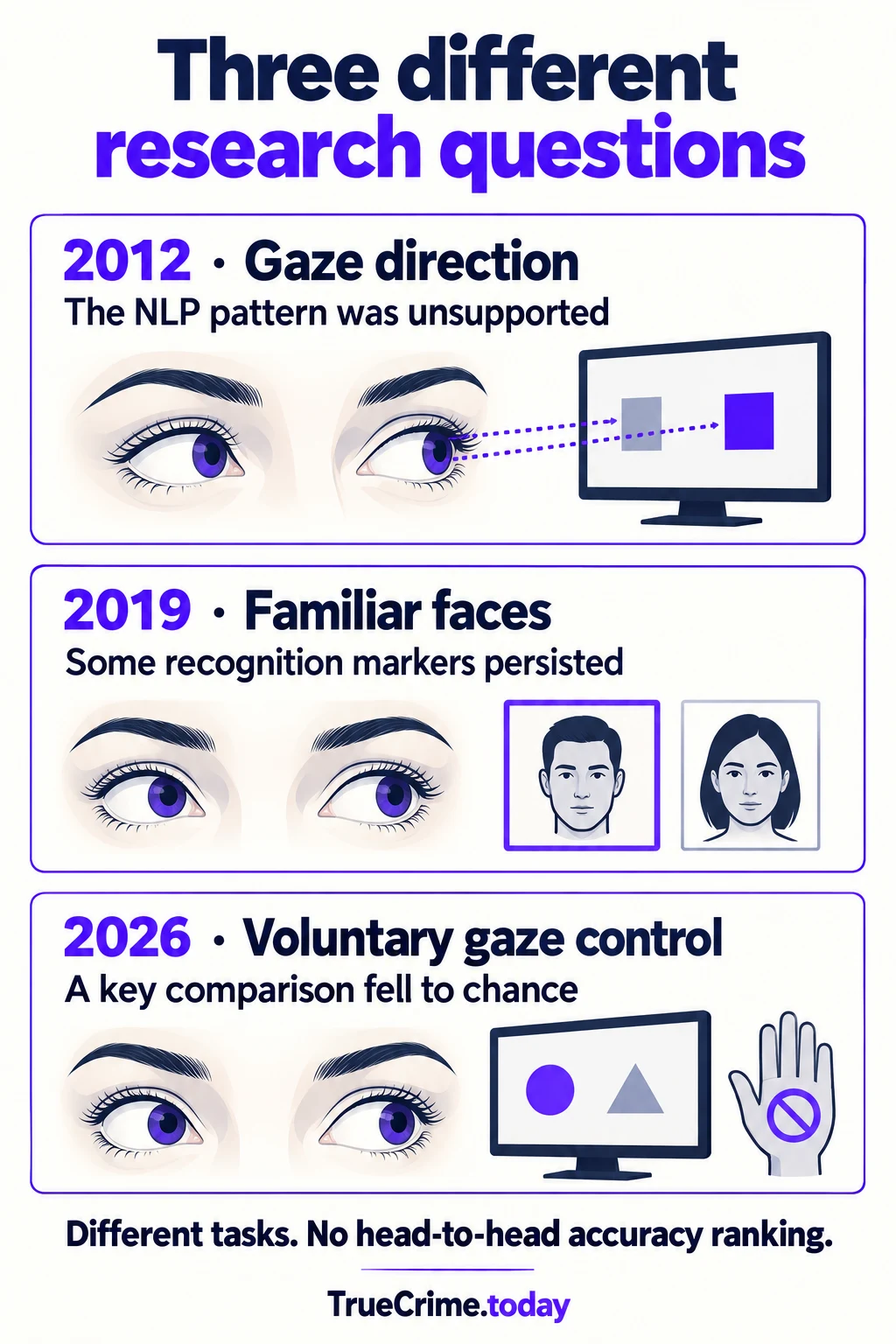
The 2012 experiments by Wiseman and colleagues tested the popular NLP directional claim using 32 right-handed interviewees, 50 observers and 52 public appeals. The three studies found no support for the proposed pattern or an advantage from teaching observers the rule. This challenges that particular claim; other eye measurements need their own tests.
Remember whose right is being described. Your right and the speaker’s right face opposite ways, and a mirrored recording adds another problem. Fixing that orientation would make your description clearer. It would not supply the missing evidence that a direction identifies deception.
In deception detection, an observation becomes useful when it helps you check a disputed statement. “Looked toward the door” is an observation. Whether somebody entered through that door at a particular time calls for information about the event.
Four eye measurements answer four different questions
Gaze direction describes where the eyes point. Blink rate counts eyelid closures over a specified time. Pupil size measures the opening in the middle of the iris. Fixations are relatively stable viewing periods; saccades are the rapid movements between them. These terms help separate an impression from a measurement.
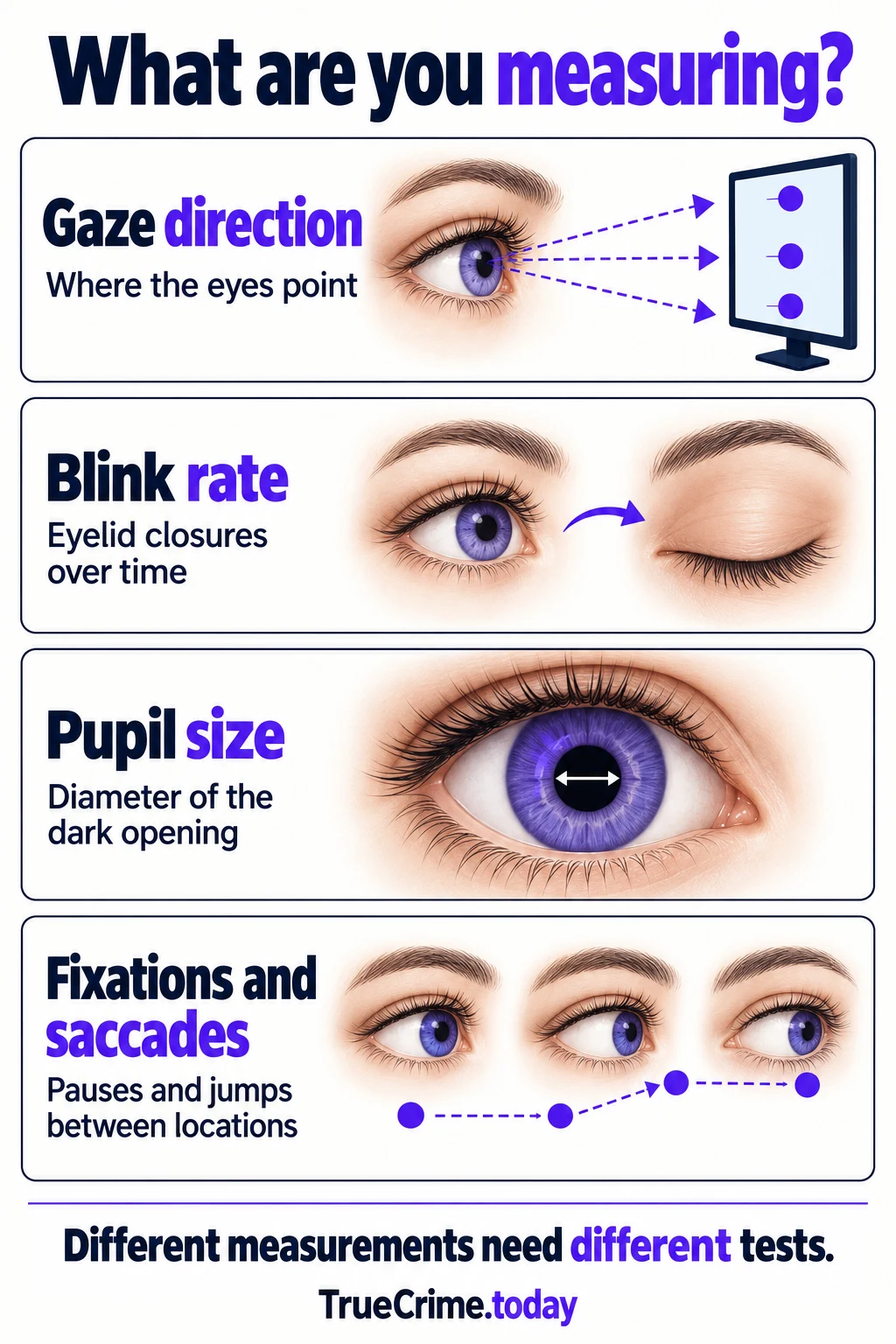
A person can keep looking at your face while making small movements between your eyes and mouth. They can also stare at one spot while their pupil changes. Calling both situations “unusual eyes” throws away the distinction that an experiment is trying to measure.
Even an accurate measurement leaves a question about its cause. A pause in viewing might reflect attention to a detail, deliberate control or a feature of the task. You need a comparison that can distinguish those possibilities before attaching an intention to it.
Why blinking studies can point in different directions
Leal and Vrij’s 2008 experiment involved 13 instructed liars and 13 truth tellers. Relative to baseline, the deceptive group blinked less during its answers and more just afterward. That result concerns a sequence of observation periods, so a clip containing only the answer loses part of the comparison.
Perelman’s 2014 mock-mission study analyzed 32 participants and reported 81.3% classification accuracy, with 88.2% sensitivity and 73.3% specificity. Blinking fell during deception, but the earlier post-answer rebound was absent. Those are encouraging results from a small controlled task, rather than a measured success rate for judging strangers online.
Notice how much the question has changed from “Do liars blink more?” It now includes the task, the comparison period and the outcome being counted. Sensitivity concerns detecting the assigned deceptive group; specificity concerns correctly clearing the truthful group. A headline with the overall score conceals that difference.
For an analysis of a case, you would also need to establish that the original recording contains comparable periods. A cut, a new question or a switch from listening to speaking can change what you are counting. The count alone cannot repair the comparison.
What changed in the September 2026 experiment?
A study published in September 2026 by Milosavljević and colleagues assigned 75 participants to three groups with different knowledge and concealment conditions. It tested 12 eye-tracking measures using four classifiers, with test participants kept out of the training data. Some group comparisons worked well, while the comparison between naive and mock-guilty participants fell to chance when participants controlled their gaze.
The difficult comparison matters. A test might separate people who freely reveal knowledge from others, yet struggle with someone trying to conceal it. Reporting only the easier result would leave you with the wrong expectation of the task.
This finding concerns that particular eye-movement test. It does not establish that every recognition measure or every pupil-based method fails under every countermeasure. It does show why success on cooperative responses cannot settle the question of motivated concealment.
Recognizing a face leaves another question unanswered
Millen and Hancock’s 2019 familiar-face experiment involved 48 students. Some recognition markers persisted when participants followed a prescribed viewing sequence intended to conceal familiarity. That is a useful counterpoint to the 2026 result, though the tasks and comparisons differ. These studies are not competing accuracy scores from one shared test.
Now imagine that a face looks familiar to you because it appeared in yesterday’s news. A measurement that detects familiarity would still leave the source of that familiarity unresolved. Seeing someone in person, seeing a photograph and receiving information before the test can lead to different accounts of the same recognition.
For a concealed-information test, the history of each item matters. Was the detail public? Who could have seen it? What did the person know before the examination? A response to a known item cannot answer all those questions by itself.
What do the 2025 machine-learning results show?
Foucher and colleagues reported two card-task datasets in 2025: 87 people in a computerized task and 36 facing an experimenter. The reported best accuracy reached 74% for revealing versus concealing, and 49% when faking became a third category. These are task-specific results, with a different decision required in each classification.
A three-way task asks more of a model than a two-way task. Even so, you cannot subtract those scores and call the difference the cost of adding one kind of lie in ordinary conversation. The model, task, labels and evaluation procedure need to travel with each number.
Ask which people appeared in training and which were held back for testing. New frames of a familiar participant are a weaker test of generalization than recordings of new participants. The same concern applies to a familiar room or microphone that accidentally lines up with the labels.
A large number of recorded eye positions can still come from a small number of people. More measurements improve the description of those sessions; they do not automatically provide more independent examples of human deception.
A pupil change needs a controlled comparison
A pupil is the dark opening inside the colored iris. A wider dark area in a picture may be tempting to interpret, but lighting, viewing distance, arousal and mental effort all belong in the explanation. A single frame does not tell you which influence produced a change.
Seymour and colleagues’ concealed-knowledge experiment used a 60 Hz tracker, a chin rest and luminance-matched face images. Eight of 60 participants could not be calibrated, leaving 52 for analysis. The familiar-probe condition’s reported pupil means were 3.9 and 4.0 millimeters for irrelevant and probe items. A group mean difference is not an individual cutoff.
That small difference also explains why measurement conditions matter. Before comparing two images of someone’s eye, you would need to know whether the camera distance, angle and light remained comparable. Counting a few extra dark pixels gives no such assurance.
Calibration failures belong in the result too. A method’s performance among usable recordings and the proportion of people it can measure are different questions. Glasses or a tracking problem should not become a suspicion about the person whose data could not be recorded.
Six blinks can be a higher rate than twelve
Suppose one answer contains six blinks over 30 seconds and another contains twelve over 90 seconds. These are invented counts to explain the arithmetic. The first has fewer blinks but a higher rate: 6 ÷ 30 × 60 = 12 per minute, compared with 12 ÷ 90 × 60 = 8 per minute.
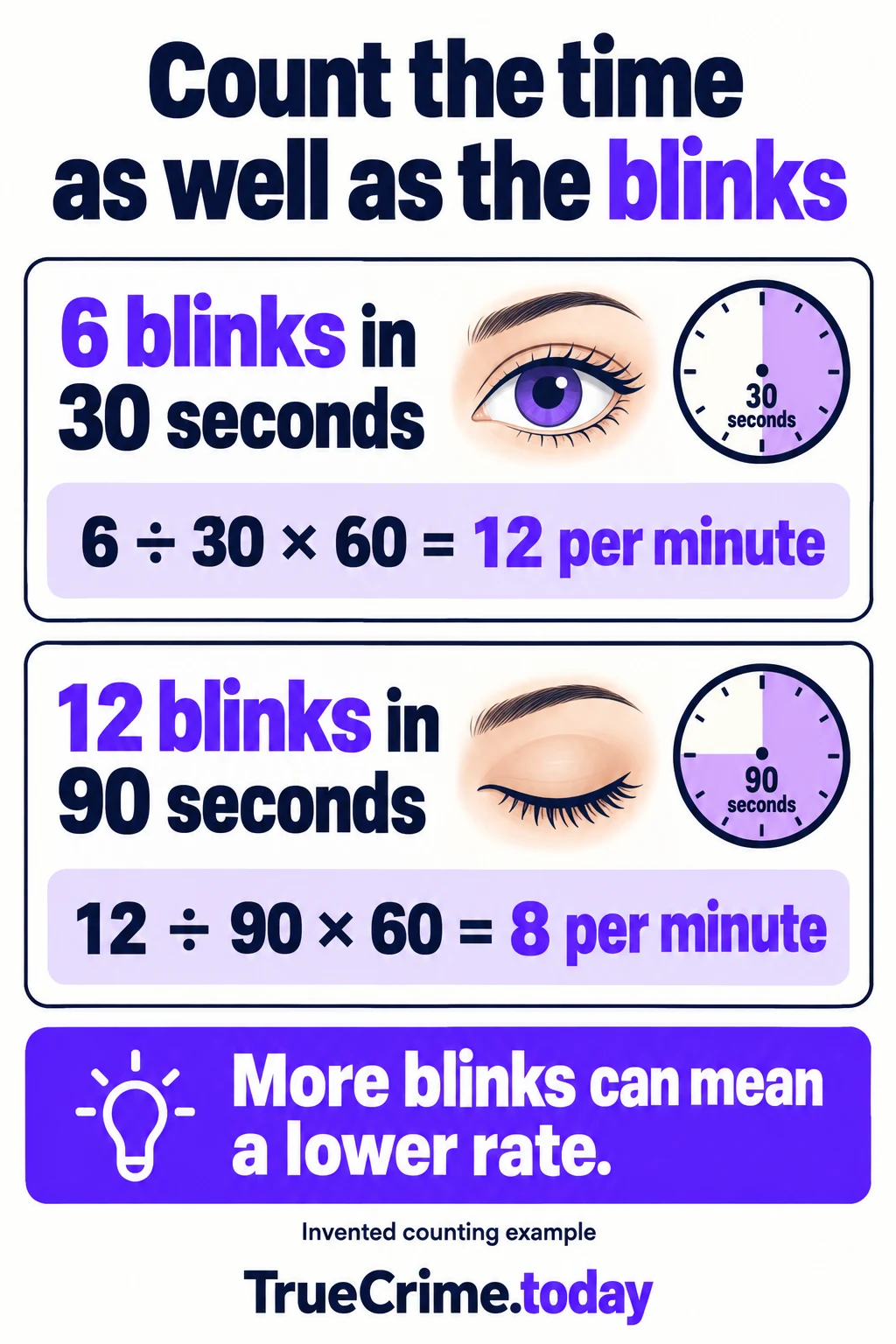
The formula corrects for time. It does not make the two answers otherwise equivalent. One answer might involve reading a message, while the other involves talking without a screen. The rate is a description of those observation periods, with their differences still attached.
There is another trap in calculating a per-minute value from a tiny extract. A single blink in five seconds becomes twelve per minute if you scale it up. That arithmetic is exact, but the short observation gives you little reason to expect the same rate over a whole minute.
Keep the count, duration and circumstances together. If someone offers a universal threshold without explaining how it was tested on new people, the precision of the number should not substitute for that missing work.
Can an ordinary interview video supply these measurements?
A camera pointed at a face may show a glance or a visible eyelid closure. Whether it can produce a usable gaze position or pupil diameter is a separate measurement question. Cropping the image tighter increases its displayed size without recovering detail that was never recorded.
The timing matters as well. A 30-frame-per-second recording has roughly 33 milliseconds between frames. A brief movement may fall between them or be blurred across an exposure. That calculation describes sampling intervals, rather than promising that any movement of a particular duration will be visible.
Editing can remove the moment before a question, join answers from different times or replace a speaker with a reaction shot. A dramatic close-up may be useful storytelling while offering a poor record for measuring a continuous response.
If the sequence is incomplete, stop at what survives: the visible movement in the available frame. There is no sound basis for filling the missing period with an assumed baseline, count or emotional state.
Why a personal baseline can still mislead you
You might compare a difficult answer with a relaxed conversation earlier in the interview. That keeps the person constant, which is helpful, but the situation has changed. Recalling a complicated journey, reading small text and chatting about a familiar subject demand different kinds of attention.
A change from someone’s usual behavior can suggest a question worth asking. To explain it as deception, you would need to separate that explanation from the other changes in the task. Familiarity with a person does not perform that separation automatically.
Avoid treating a natural difference in eye contact as evidence that somebody needs to prove their honesty. People communicate in different ways, and a filmed interview gives you only a small part of the situation. The disputed statement still needs its own evidence.
A camera at the top of the screen changes eye contact
In a video call, you may watch the other person’s image below the camera. To them, your eyes appear lowered even though you are following their face. Moving that image can change the apparent eye contact without changing a word of what you say.
The same problem appears when an interviewer sits beside a lens. Looking toward the interviewer and looking directly into the recording are different actions. A viewer who knows only the final crop may not know where the actual conversation partner was.
Those examples give you ordinary explanations to check. They do not establish that every downward glance comes from a screen or every sideways glance from an interviewer. The point is to recover the arrangement before using it to explain the movement.
What the book-return argument actually needs
In a fictional video call, someone says a borrowed book was returned on Friday. Just before answering, they look toward the edge of the screen. A commentator identifies the glance as the moment the story was invented.
Suppose a notification appeared there. That could explain the direction, yet it would leave the return date untouched. The useful records might be a dated message arranging delivery, a receipt or the book’s identifying mark. They answer questions about the handover.
If a receipt belongs to another book, there is a concrete discrepancy to investigate. Neither calm eye contact nor a suspicious glance decides whether the person mixed up two deliveries, remembered the date incorrectly or intended to deceive.
This is where eye-based commentary should give way to the event itself. Describe the movement if it matters to understanding the recording, then follow the information that can confirm or contradict the statement.
How to judge the next eye-based claim
Start with the outcome being promised: direction, attention, recognition, truthful classification or participation in an event. Then ask how that outcome was established independently, which errors occurred and whether the test included new people trying to conceal information.
For a clip, check the camera arrangement, continuity and observation period before counting anything. For a research claim, keep the positive findings alongside the task limits and failed comparisons. That gives you a way to appreciate useful eye-tracking research without turning an ambiguous glance into an accusation.
You can ask about an eye-tracking finding, a blink-rate calculation or a claim discussed here. Do not send private recordings or personal documents.
Ask about an eye-tracking claim