The science of lie detection: what an accuracy claim leaves out
How lie-detection studies establish the truth, count false alarms and test new people. Research findings, worked examples and the limits of accuracy claims.

TL;DR
The science of lie detection tests whether a defined method separates known truths from known lies under stated conditions. You need to know how the truth was established, which errors were counted, and whether the method worked on new people. A high score on one experiment does not answer all three questions.
There are encouraging findings, especially when questions elicit information that can be checked. There are also weak results, selective reporting and tests that measure something other than accuracy. The worked examples below show how to tell those situations apart. Their numbers are chosen for explanation, not taken from a deployed system.
The missing half of an accuracy claim
An interview clip comes with a claim that the analyst’s method is 80% accurate. You watch a pause, a lowered gaze and a confident conclusion. What would you need to see before treating that percentage as evidence about this person?
For deception detection, the question is whether the method distinguishes false statements from true ones, not whether its description of the speaker sounds convincing. The study must have a way to know which statements belong in each group. Its success rate must then refer to a specified task.
“Accurate” could mean recognizing a requested facial expression, identifying a remembered item, rating a story as believable or classifying a statement as false. Those results can be useful. They answer different questions, and none acquires the meaning of another just because the same word appears in an advertisement.
The last time we checked the research discussed here was October 20, 2026. This is an examination of how the evidence is tested, rather than a catalogue of gestures to watch for.
First, how did the researchers know the truth?
A controlled experiment can assign someone to take an object and tell someone else to leave it alone. The researcher knows the assignment before hearing the account. That gives the test an answer to compare with the judgment, though it also creates a situation quite different from a disputed real event.
Another design asks people to describe an autobiographical experience or invent one. Then the researchers need to explain what supports those labels. Merely asking the speaker which account was genuine is a different level of verification from observing the event or checking an independent record.
A confession, a charging decision and a conviction are also different kinds of information. If the same behavioral judgment helped produce the label later used to validate the judgment, the reasoning risks going in a circle. Agreement with that label would not supply the independent check being claimed.
Before worrying about the impressive percentage, ask what made the comparison answer trustworthy. An error in that answer affects what the study calls a success. Researchers can describe that uncertainty without making the whole experiment worthless.
What the familiar 54% result actually describes
In their 2006 meta-analysis of deception judgments, Charles Bond and Bella DePaulo combined 206 documents involving 24,483 judges. Unaided, untrained judgments averaged about 54% correct, with 47% of lies and 61% of truths correctly classified. Those are results for the tasks reviewed, not a ceiling on every possible investigation.
The two separate rates matter. Calling everything true would correctly label every true statement while discovering no lies. Its overall score would depend on how much truth was in the test. A percentage needs the composition of the material beside it.
Nor should you turn 54% into “a 54% chance this particular person is lying.” The study counted correct classifications against known labels. It did not calculate the probability of guilt for the next person on your screen. That would require other information about the allegation and the situation.
A useful result can disappear inside the wrong outcome
Bogaard and colleagues’ 2026 study of cue knowledge and truth judgments involved 246 participants and eight accounts, four true and four false. Knowledge correlated weakly with credibility ratings of truthful accounts. The association with correct binary truth classifications did not meet the conventional significance threshold, p = .062. Presentation format showed no statistically clear effect in this task.
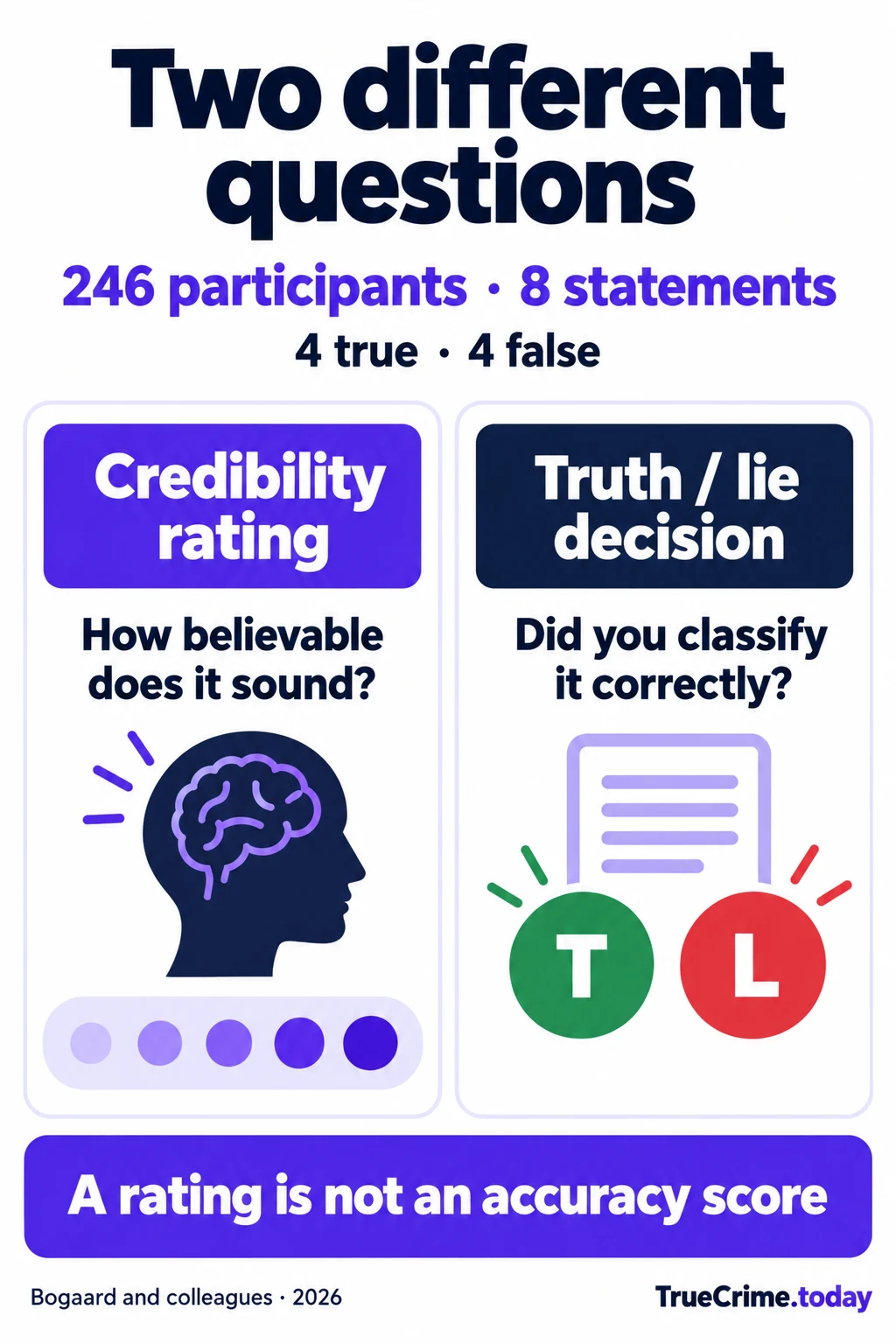
A rating asks how believable something seems. A classification requires a decision that can be marked right or wrong. Someone could rate true stories slightly more favorably and still make the wrong choice at the decision point. Reporting the rating result as an improvement in catching liars would change the outcome.
This distinction also affects how you read a summary. Look for the actual result behind the headline: which statements, which response and which comparison? A tentative association does not become a reliable personal skill through repetition in coverage.
The interview changes the task
Watching an existing clip and leading an interview are different activities. An interviewer can ask a question whose answer creates a new opportunity to check something. A viewer cannot retroactively obtain that information from the speaker’s expression.
Mac Giolla and Luke’s 2021 meta-analysis, first published online in 2020, found 60% average accuracy for cognitive interviewing approaches, or about 55% after one bias correction. The corrected 95% interval, 48.83–61.16%, included chance. Informed observers averaged 75.81%, compared with 52.37% for uninformed observers. Results varied between studies; publication bias and limited practical testing qualified that promising subgroup result.
The fair reading preserves both sides. Some ways of asking questions and directing attention deserve further testing. It does not follow that adding pressure to any conversation will produce a dependable lie test. A technique must be evaluated as it was actually used, including what observers were told to consider.
Why fewer cues can sometimes help
Verschuere and colleagues reported nine studies in 2023 in which judgments focused on detailedness distinguished truthful and deceptive material better than unguided intuition. The material included written accounts, transcripts, recorded interviews and live interviews. It is positive evidence for a defined task, not a rule that a long story must be true.
In case analysis, detail becomes especially useful when it provides a way to check the account. A location, time or named event can lead to a record that supports or contradicts it. The independent record then does work that a favorable impression of the storytelling cannot.
A short account might be constrained by the question. A rehearsed invention might contain genuine places and events around a false claim. Decide what the disputed assertion is before counting detail around it. More description and more verification opportunities need not be the same thing.
Two error rates, two different groups
Sensitivity asks how many of the false statements were flagged. Specificity asks how many of the true statements were correctly left unflagged. Their denominators differ. One is about false statements; the other is about true ones.
A system can increase its sensitivity by flagging more material, while also accusing more truthful statements. Moving the decision threshold may exchange one error for another. A report that gives only the combined score can conceal that trade-off.
Ask what happened to inconclusive results as well. If difficult cases are removed, a success rate for the remaining decisions describes that selected set. You also need the number excluded. This does not make every exclusion wrong; it makes coverage part of the performance claim.
When 80% produces mostly false alarms
Imagine 1,000 statements, of which 50 are deliberately false and 950 are true. Give an imaginary method 80% sensitivity and 80% specificity. These assumptions are chosen for arithmetic; they are not estimates of a real device or of how often people lie.
It flags 40 of the 50 false statements and misses ten. Among the 950 true statements, it correctly leaves 760 unflagged but flags 190. There are 230 flags altogether. Only 40 ÷ 230, about 17.4%, concern an actually false statement under the assumptions.
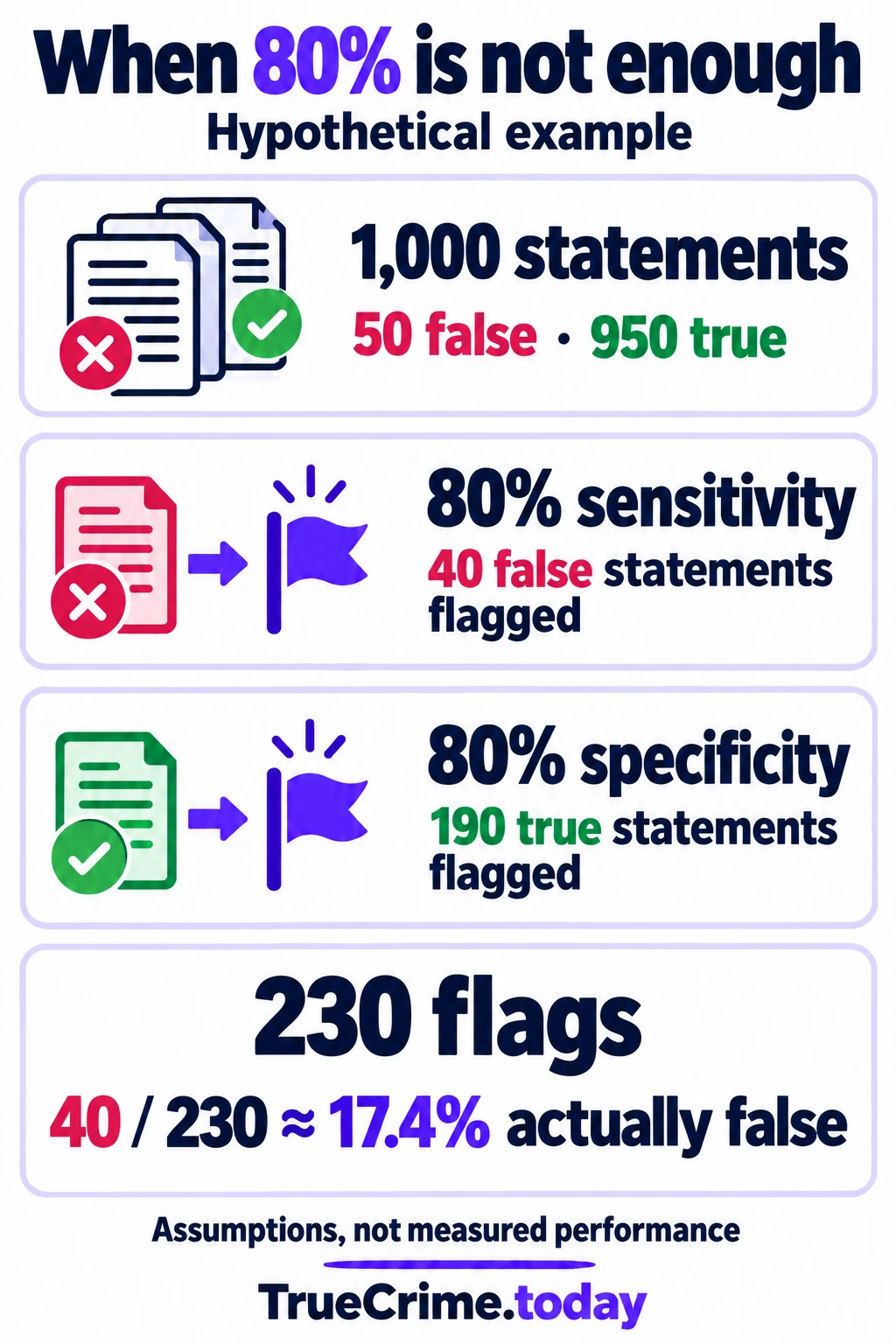
The combined accuracy is still (40 + 760) ÷ 1,000 = 80%. That is why “80% accurate” and “80% of flags are right” cannot be substituted for one another. Change the prevalence or either error rate and the composition of the flagged set changes too.
No one knows the actual number of false accounts in a disputed investigation merely because a tool has flagged some. The example explains which missing information matters. It does not license assigning the assumed percentage to real people.
What a group difference cannot tell you
Two groups can differ on average while overlapping in individual scores. To see the problem, imagine a measurement of 1, 2 and 3 in one small group and 2, 3 and 4 in another. The averages are 2 and 3. Yet an individual score of 2 or 3 appears in both groups.
That invented example is not a deception study. It shows why discovering an average difference is only one part of developing a classifier. A method needs a decision rule, an evaluation on unseen observations and a count of the errors that rule makes.
A correlation has a related limitation. A tendency across a sample is not a statement about every sample member. Nor does a relationship between a cue and judgments prove that the cue tracks actual lying. It may help explain why observers make their decisions, including mistaken ones.
Could the same people appear on both sides of the test?
An automatic system might learn from recordings of several speakers and be tested on different recordings of those same speakers. That can answer a within-speaker question. It does not establish how well the system handles an unfamiliar person.
A model could exploit stable features of a voice, camera, room or recording session. If those features happen to accompany the assigned labels, the score may reflect something other than the behavior the researcher intended to measure. More clips do not necessarily mean more independent people or situations.
For a claim about new speakers, ask whether people were separated between learning and evaluation. For a claim about a new setting, ask whether that setting was actually withheld. The evaluation should resemble the use being promised, rather than merely having a large number of files.
A promising result needs a fair chance to fail
Luke’s 2019 analysis and simulations showed how low power, sparse replication and selective reporting can inflate estimated deception cues. This is a reason to examine the research process, not proof that every reported difference is zero.
Suppose several possible cues and scoring choices are tried, but only the most favorable combination is reported. Readers see the winning result without seeing the opportunities for a chance success. A later experiment using the chosen rule may perform differently.
A preregistered test records important decisions before the outcomes are known. Independent replication then asks whether the result survives another sample or team. Neither is a guarantee of correctness. Both make it easier to distinguish a planned test from an explanation assembled after looking at the results.
What changes outside the experiment
Real accounts may mix accurate background with one concealed act. A test built around wholly assigned stories might not reveal how a method handles that mixture. Participants may also prepare, cooperate less, misunderstand a question or know what cue is being assessed.
A frightened truthful speaker and a practiced deceptive speaker can challenge a simplistic decision rule for different reasons. The useful question is whether those conditions were included and which errors occurred. An intuition that the real setting is harder is not itself a measured field error rate.
Readers should be able to see these gaps. Researchers need conditions that can expose them. Anyone presenting a practical method should state where it has been tested and how uncertain decisions are handled. A small improvement could still be useful for generating questions if its limitations and costs are understood; an accusation needs evidence about the actual claim.
The expense receipt and the confident conclusion
Consider an invented volunteer group’s review of an expense claim. Someone says they paid for supplies on Friday. The interview seems detailed, and the speaker looks calm. A statement marked as an automated “lie” seems to settle the dispute in the opposite direction.
Start with what “paid” means here. The order could have been placed on Friday, the card authorized that evening and the transaction posted on Monday. Those are different events. The same account could be imprecise about the date without being a deliberate fabrication.
Now suppose the receipt belongs to another purchase. That discrepancy deserves investigation whether the speaker looks calm or anxious. Find out what the record identifies, whether there is another receipt and what the person meant. Neither a sympathetic performance nor a suspicious score supplies those answers.
The earlier arithmetic helps explain why the flag is a question to check, not the conclusion. The record example adds a second requirement: even a genuine contradiction needs interpretation before it is called an intentional lie. This is a fictional demonstration, not an allegation about a real group.
What to keep with a claim about accuracy
Keep the tested task, the truth criterion, the people and settings, the separate errors and the handling of uncertainty together. Then ask whether a new sample reproduced the result and whether the proposed use matches that test.
The science can move forward without promising a single tell or a universal percentage. A better method should make a claim clear enough to be wrong and a test transparent enough for others to check. When you watch the next confident interview analysis, that is a more useful question than whether its conclusion sounds certain.
You can ask about a research result or an accuracy claim discussed here. Do not send private recordings or personal documents.
Ask about a research claim