Cognitive load and lie detection: what harder questions reveal
Do unexpected questions expose lies? Research on reverse recall, interview accuracy and evidence disclosure, including what happens to truthful answers.
TL;DR
Cognitive load can change how people answer, but difficulty answering does not establish a lie. Experiments have tested reverse recall, unexpected questions and extra tasks, with mixed results. Interviewing can also produce information that can be checked against evidence. The useful question is what a particular method adds, how often it misjudges truthful answers and whether that result carries beyond the experiment.
The pause comes after the question
You are watching an interview. The question suddenly changes, the person stops talking, and the commentator announces that the story has fallen apart. Something has changed. You still need to establish whether the person is inventing an answer, searching a memory or trying to understand what was asked.
That distinction matters for lie detection. If an interviewer deliberately makes a task harder, signs of difficulty are partly a response to the interviewer. Calling that difficulty deception assumes the very thing the technique is meant to test.
Cognitive load means the demands a task places on attention and working memory: holding information in mind while doing something with it. Recalling an evening in reverse order adds work even when every event happened. A useful interview method has to show that the extra work helps distinguish answers, rather than merely making everybody less fluent.
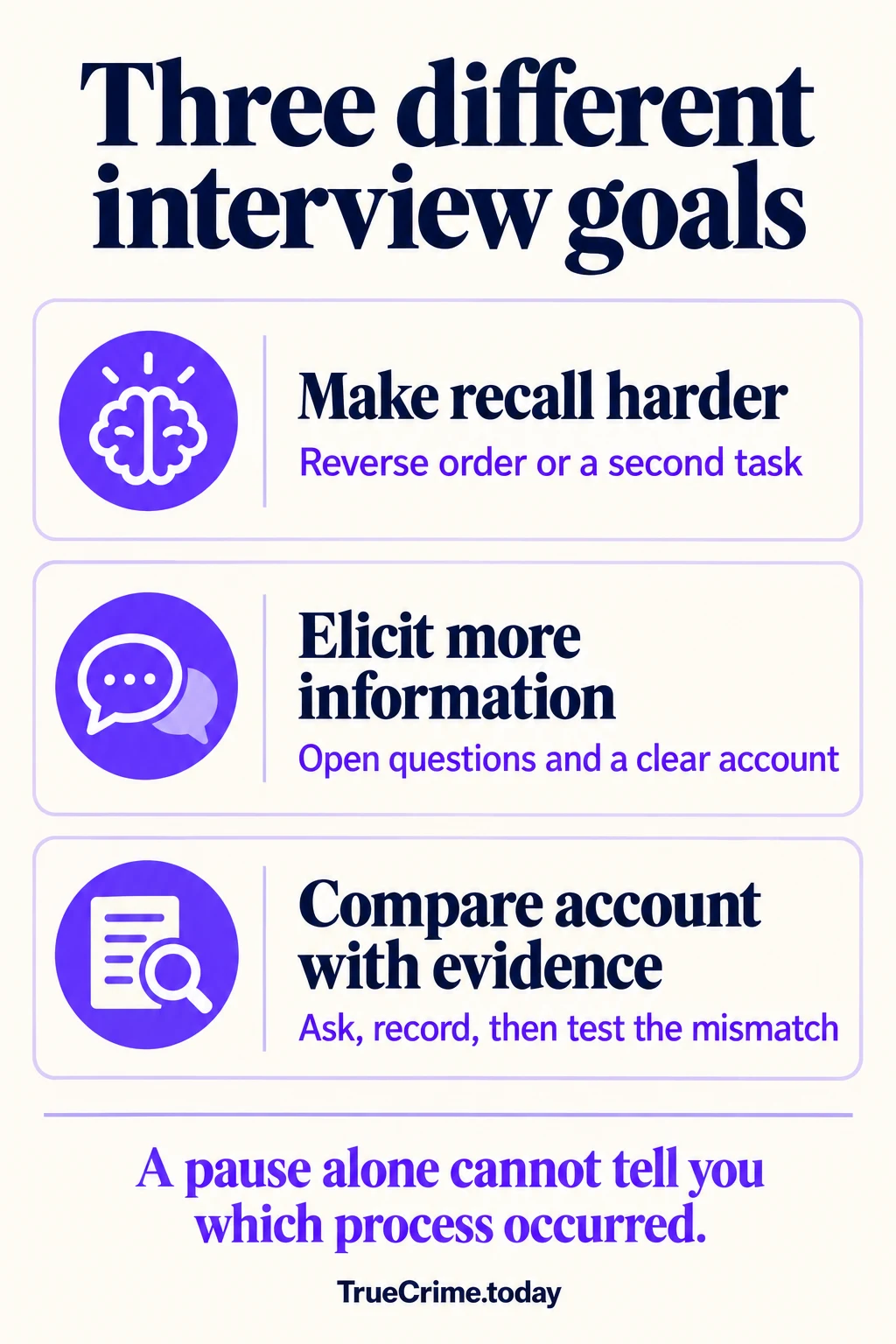
Three ways to change an interview
One approach adds a demand. An interviewer might request reverse chronological recall or ask someone to complete another task while answering. The prediction is that a person constructing a lie will have fewer resources left to cope. That prediction needs testing against truthful people facing the same request.
Another approach helps the person say more. An open invitation, a sketch or an unrelated demonstration of a detailed account may prompt information the person initially left out. The gain could be a name or location that can be checked, even if the interview never produces a reliable truth-or-lie judgment.
A third approach compares an account with evidence already available. Strategic Use of Evidence, usually shortened to SUE, concerns what the interviewer asks and when evidence is disclosed. An account given before disclosure can be compared with the record afterward. The relevant result is a particular agreement or mismatch.
When analysing a true-crime case, keeping these goals separate helps you identify what an interview actually achieved. More detail, more difficulty and a contradiction with a recording are different outcomes. Success at one does not automatically establish success at the others.
Why a lie can take more work
A person inventing an account may need to suppress a known fact, construct an alternative and keep that alternative consistent with what has already been said. They may also be watching whether the interviewer believes them. Those are plausible reasons for some lies to take effort.
The comparison changes when a lie is a short, rehearsed denial and the truthful answer requires reconstructing an unfamiliar journey. A person can also tell mostly true details while concealing one action. The effort needed for an entire interview cannot safely be assigned to every sentence inside it.
Theoretical reviews published in 2022 and 2023 questioned how consistently researchers specified and tested these explanations. The challenge is to identify which extra task should affect which kind of lie, and why it should affect the truthful comparison less. Finding a difference after changing a question does not by itself settle that mechanism.
You can see the problem in a mundane situation: remembering whether you sent a message before or after leaving a shop. The answer might require checking your phone. Your hesitation would reveal that the answer takes work; the reason for that work still needs examination.
What happened when people told the story backwards
A 2008 experiment by Vrij and colleagues involved 80 mock suspects reporting a staged event truthfully or deceptively, with or without reverse-order recall. The reverse condition produced more cues to deception, and police observers became better at classifying the accounts.
That is a positive finding worth retaining. It tested a defined task with an experimentally known truth. It does not establish that someone who struggles to reverse a real, distressing memory is lying, or that every use of reverse recall has the same effect.
The outcome also involved observers interpreting whole accounts. It was not a stopwatch rule declaring any pause longer than a set number of seconds deceptive. If a video analysis turns that experiment into a universal hesitation threshold, ask where the threshold was tested.
A promising average needs its denominator
Vrij, Fisher and Blank’s 2017 meta-analysis reported total classification accuracy of 71% for a cognitive approach and 56% for a standard approach. Its direct comparison used 14 experiments and combined different interventions and ways of classifying statements. The 15-percentage-point difference cannot be assigned to one surprise question.
A later meta-analysis by Mac Giolla and Luke, published in 2021, focused on human observers. Across 23 independent samples, 1,781 observers made 15,907 judgments. Pooled accuracy was 60%; a statistical adjustment for possible publication bias estimated about 55%, with an interval spanning 50%.
The studies also produced a much higher average for observers told which cues to attend to than for uninformed observers: about 76% versus 52%. The informed evidence came from a smaller set, and training and study design were difficult to separate. Those subgroup results suggest a research question rather than a guaranteed benefit from taking a course.
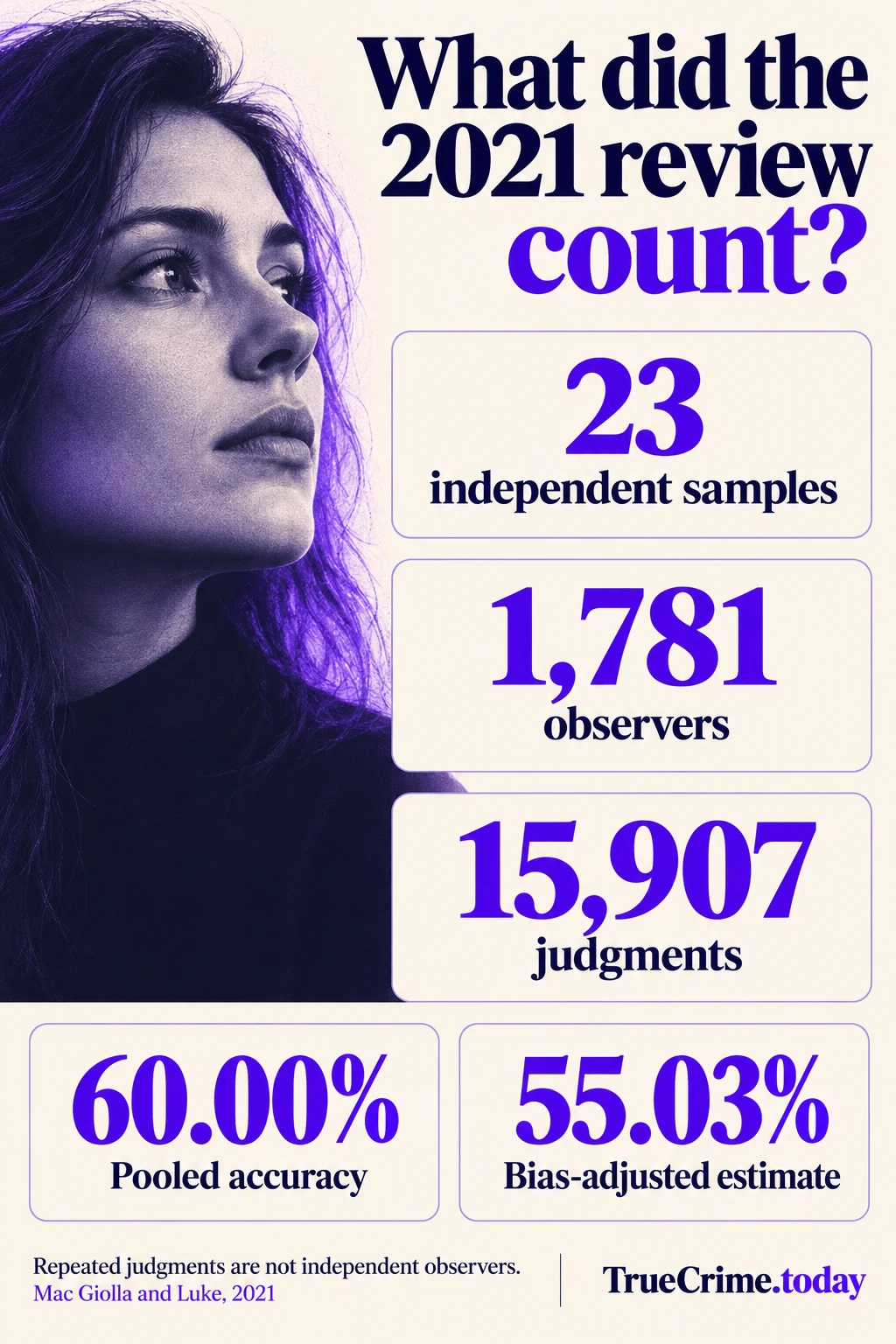
The two reviews do not form a time series showing that the same technique became worse. They asked different questions of different study sets. Repeated judgments by one observer also do not create thousands of independent people. Both details matter when a promotional claim borrows the largest number.
The unexpected-question experiment that disappointed
In a 2018 experiment on unexpected questions, 120 Sussex students either completed a campus task or pretended they had. Ten doctoral students interviewed them. Each interviewer handled 12 interviews without knowing the assigned truth status or receiving outcome feedback along the way.
Some questions concerned the task generally; others concerned planning or spatial and timing details. The interviewers achieved 54% overall accuracy, which did not exceed chance statistically. Unexpected questions did not deliver the expected overall improvement, and truthful accounts became harder to classify correctly.
The lesson is narrower than saying surprise never helps. A question can be genuinely unexpected and still fail to separate the groups usefully. What counts is the comparison with truthful answers, not how clever the question sounds or how awkward an individual response appears.
When extra load made truths slower
A 2018 meta-analysis by Verschuere and colleagues brought together 21 reaction-time studies involving 792 people; 11 studies were unpublished. People generally answered truthfully faster than they lied. Yet adding cognitive load did not widen that gap. It slowed truthful responses and made the difference smaller.
Those experiments used computerised response tasks. Their result should not be treated as a verdict on every extended interview. It directly challenges a tempting shortcut, though: if a truthful answer takes longer under pressure, increasing pressure has not necessarily made truth easier to identify.
Think about the measurement before watching a slow answer. Was the time measured from the same point in the question? Did the person understand it immediately? Was the answer rehearsed? A public clip rarely supplies the controlled comparison needed to turn elapsed seconds into a judgment of intent.
What strategic use of evidence actually tests
SUE gives the interviewer a different source of information: an account can conflict with something independently known. In Hartwig and colleagues’ 2006 study, 82 police trainees interviewed 82 mock suspects. Trained interviewers achieved 85.4% accuracy, compared with 56.1% among untrained interviewers, and elicited more account–evidence inconsistencies from deceptive participants.
That result belongs to that controlled experiment. It is not an 85.4% guarantee for a real investigation. The benefit involved how evidence and questions interacted, so presenting it as proof that visible mental strain exposes lies would misdescribe the method.
A 2021 review by Oleszkiewicz and Watson compared early, late and gradual evidence disclosure. Late and gradual disclosure elicited more contradictions with evidence from guilty mock suspects than early disclosure. The review did not establish that gradual disclosure produced more new investigative information than early disclosure. More contradictions and more useful new facts remain separate outcomes.
The evidence itself also needs scrutiny. A wrong clock, shared device or incomplete recording can make an accurate account appear inconsistent. The person must have a genuine opportunity to explain the specific mismatch.
A bicycle, a door record and three possible explanations
Consider this fictional example. Someone says they collected a bicycle from a shared storage room after dinner. Asked to describe the evening backwards, they pause and put the collection before a phone call. You now have a sequence that needs checking, not a demonstrated lie.
Suppose an access log records their account opening the storage door at 18:42. First establish what the system records. Does it identify an account, a door opening or an identifiable person carrying that bicycle? A borrowed access card would separate those facts immediately.
There are at least three live explanations for the timing difference: the person remembered the sequence incorrectly, the record does not establish what you thought it established, or the person deliberately concealed an action. Each explanation points to a different check. Visible effort while answering cannot choose among them.
A useful follow-up would isolate the unresolved fact: what places the collection after dinner? A message, a witness or an original recording could help. Repeatedly demanding a faster answer would add pressure without necessarily adding information about the bicycle.
A detailed answer can help without proving honesty
A person may initially omit details because they do not know how much information is wanted. Helping them understand the request can produce a fuller account. That is one reason to distinguish information gathering from a test intended to overwhelm a liar.
College of Policing guidance for England and Wales describes asking for witnesses’ own words and using open questioning when obtaining initial accounts. The goal is useful, accurate information. It does not make every fluent, detailed statement true, and the named guidance should not be treated as a rule governing every country.
The same distinction applies to drawings. A sketch can locate a doorway or show what a person could see from a chair. It may offer something to compare with a scene. A poor drawing, by itself, does not reveal whether its maker is being honest.
The interviewer has a mental workload too
A 2025 experiment by Giorgianni and colleagues assigned 120 people to hear an interview or watch it with sound. Those hearing audio proposed more and better follow-up questions and classified truthfulness more accurately. Recall of the account did not differ. The material came from just six mock interviews, with three truthful and three deceptive accounts.
The researchers interpreted the audiovisual task as the higher-load condition, but participants’ self-reported load did not differ reliably between conditions. That leaves an open question about the mechanism behind the presentation-format effect. The study does not show that deleting video from an investigation improves it.
For a viewer, it raises a practical question: while tracking every hand movement, have you missed what was actually asked? Separating a transcript pass from a visual pass can help you keep your own observations organised. That viewing habit is not itself a validated lie-detection test.
What would count as a useful test?
A method should be evaluated on unfamiliar people and material, with rules set before the outcomes are known. The truth needs an independent basis, and the test must count truthful people judged deceptive as well as lies correctly identified. A set of solved crimes cannot supply the missing comparison.
Results should also be reported for the intended task. Helping someone recall more, identifying a false statement and recovering a new lead are different achievements. A group difference in answer length does not tell you the accuracy of a rule for an individual answer.
There is another cost to count: what information is lost when an extra task makes a sincere account harder to give? A technique that produces more suspicious-looking behaviour could still leave an investigator with a poorer account. Any claimed benefit needs to be weighed against that loss.
How to watch without turning effort into guilt
Keep the original question, the answer and enough surrounding conversation to understand the request. Then state the smallest unresolved fact. You might need to establish a time, a location or the meaning of a record. That gives your next question somewhere concrete to go.
If you describe someone struggling with reverse recall, you can stop at that observation. Explaining the struggle as deception requires more evidence. A useful interpretation stays open to a truthful memory error, a misunderstood request or an unreliable record as the investigation develops.
The strongest result may be a checkable detail that changes the story. Its value comes from what the check establishes, including when it clears up an innocent mistake.
You can ask about an interview experiment, a cognitive-load claim or a comparison with evidence. Do not send private recordings, passports, contracts, bank details or other personal documents.
Ask about interview evidence