Facial Action Coding System: what FACS can tell you about a face
How FACS records facial movements, what action units mean, and why a smile or emotion label cannot establish a lie. Research, examples and visual guides.

TL;DR
The Facial Action Coding System, or FACS, describes visible facial movements. It does not turn those movements into a verdict about a person’s feelings, honesty or guilt. An action-unit code can help researchers record what happened on a face. Explaining why it happened is a further task.
Facial research has found useful patterns, including patterns across countries. It has also shown why a posed expression, a smile and an automated emotion label need different kinds of evidence. When you watch an interview, keep the movement, the possible feeling and the disputed factual claim separate.
The code on the screen is only the beginning
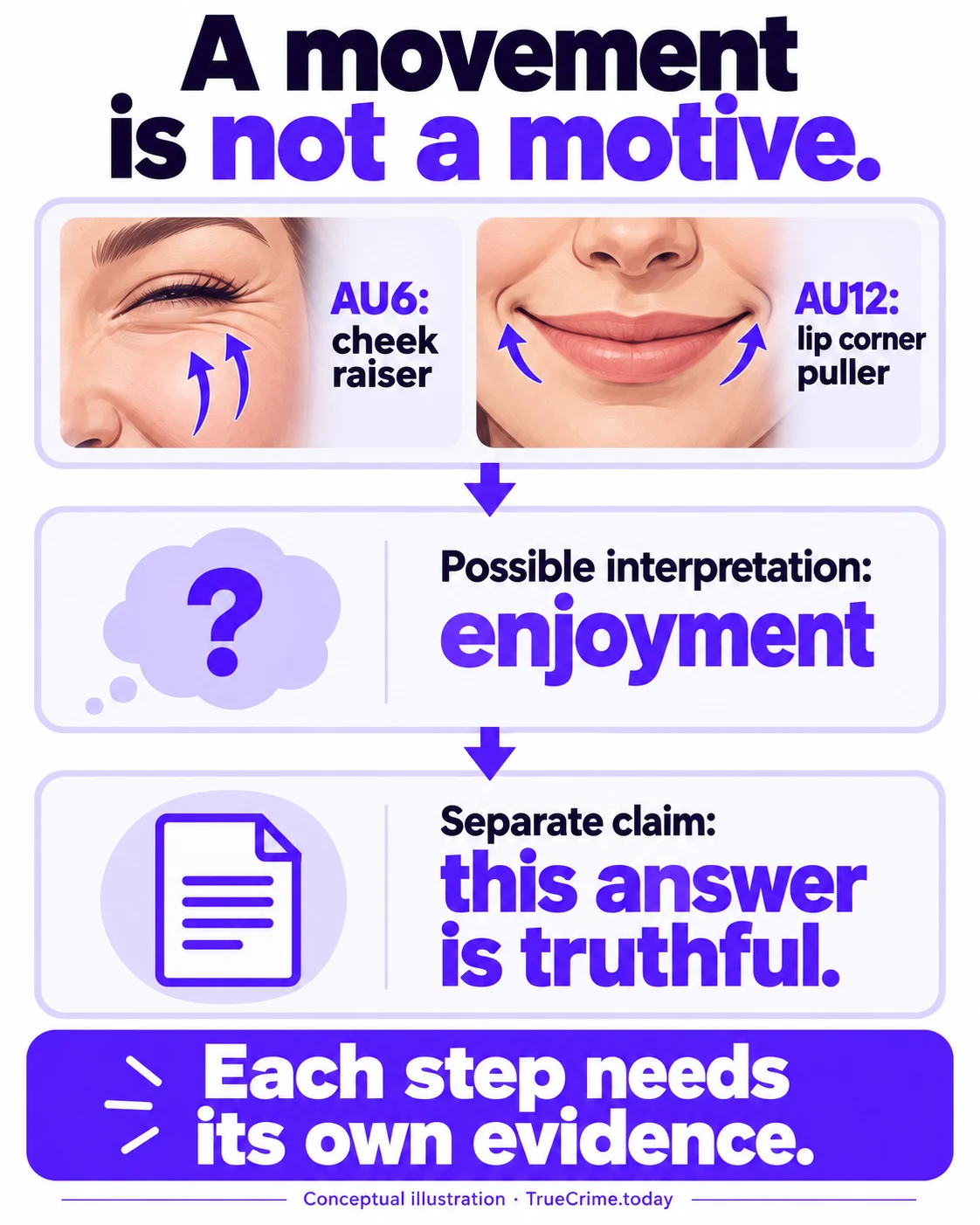
A video freezes on someone’s face. The commentator points to AU6 and AU12, then concludes that a smile reveals enjoyment of a deception. The numbers make the explanation look precise. But which part of that explanation do the numbers actually describe?
The official description of FACS calls it an anatomically based system for recording visible facial movement through action units, usually shortened to AUs. It was first published as a manual in 1978 and revised in 2002. The provider’s description establishes what the system is intended to code; it is not an independent test of whether a commentator can detect lies.
A code can be correct while the attached explanation is wrong. To assess the explanation, you need to know where the observable description ends and an inference about a feeling begins. Even a well-supported emotion judgment would leave another question: what establishes the truth of the statement being discussed?
The last time we checked the research discussed here was October 20, 2026.
What an action unit actually describes
AU6 refers to cheek raising; AU12 to pulling the lip corners. These descriptions help separate components that might otherwise be bundled into the ordinary word smile. An AU is not a direct electrical recording from a muscle, and its number is not a score for the strength of an emotion.
A careful coder looks at visible changes, their timing and their combination. The neutral or starting appearance matters. The official test instructions tell coders not to count an action already present at the start unless its intensity increases. They also specify special handling for speech-related movements. A mouth opening while someone speaks cannot simply be treated as a surprise display.
This distinction matters in lie detection: a movement can be described without identifying a false sentence. Once the label becomes “fear of being caught,” the claim has moved beyond facial coding. The observer now needs evidence for the feeling and for its alleged cause.
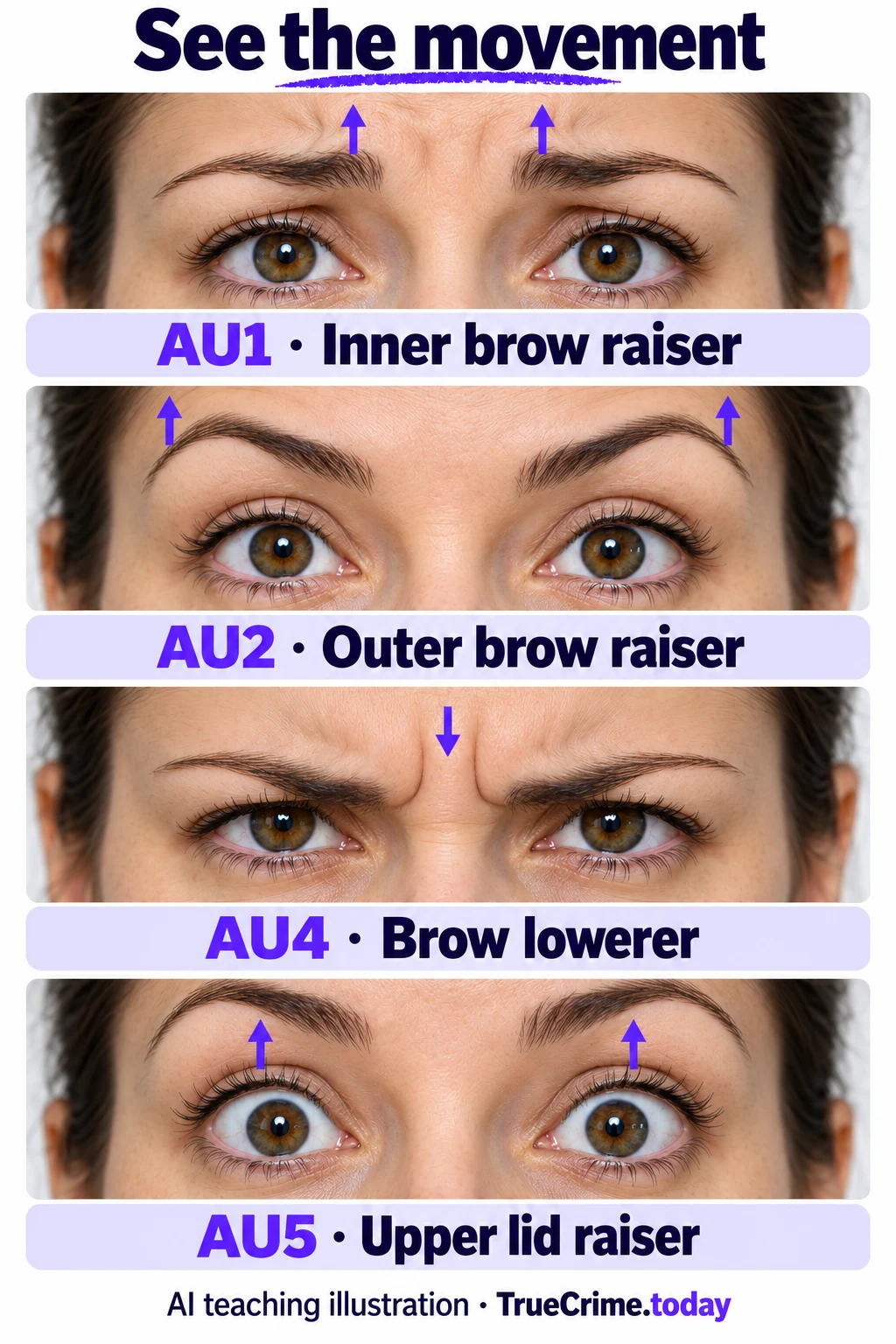
Four movements around the eyes, side by side
Look at the eyebrow nearest the bridge of the nose, then follow it towards the temple. AU1 raises the inner part; AU2 raises the outer part. They can occur together, but they describe different changes. A single “raised eyebrow” label loses that distinction.
AU4 lowers and draws the brows together. AU5 lifts the upper eyelid, exposing more of the eye. Try comparing the brow line before looking at the eye opening: a wider eye and a higher eyebrow are not the same movement. These are four descriptions you can check against the starting face, rather than four feelings to assign.
The same care applies below the eyes. AU9 wrinkles the nose; AU15 pulls the lip corners down; AU20 stretches the lips sideways. AU25 means the lips part, while AU26 describes the jaw dropping. Lips can separate without the jaw making a large downward movement. That difference matters when a paused speaking face looks startled.
The drawings make the changes easier to see, but they are AI-created teaching illustrations, not photographs from a study or certified FACS practice items. A proper coding decision requires the original sequence and the manual’s criteria. A drawing cannot establish that every other action is absent.
The same smile can have more than one history
A Duchenne smile combines movements involving the cheeks and the mouth, commonly discussed through AU6 and AU12. It is often presented as a guarantee of genuine enjoyment. That shortcut does not survive a simple question: can people make the combination deliberately?
Krumhuber and Manstead examined that question in 2009. Their first experiment found similar amounts of Duchenne and non-Duchenne smiles when people reacted to amusing material and when they were instructed to pose. Other parts of the work examined how viewers judged the smiles and the contribution of movement over time.
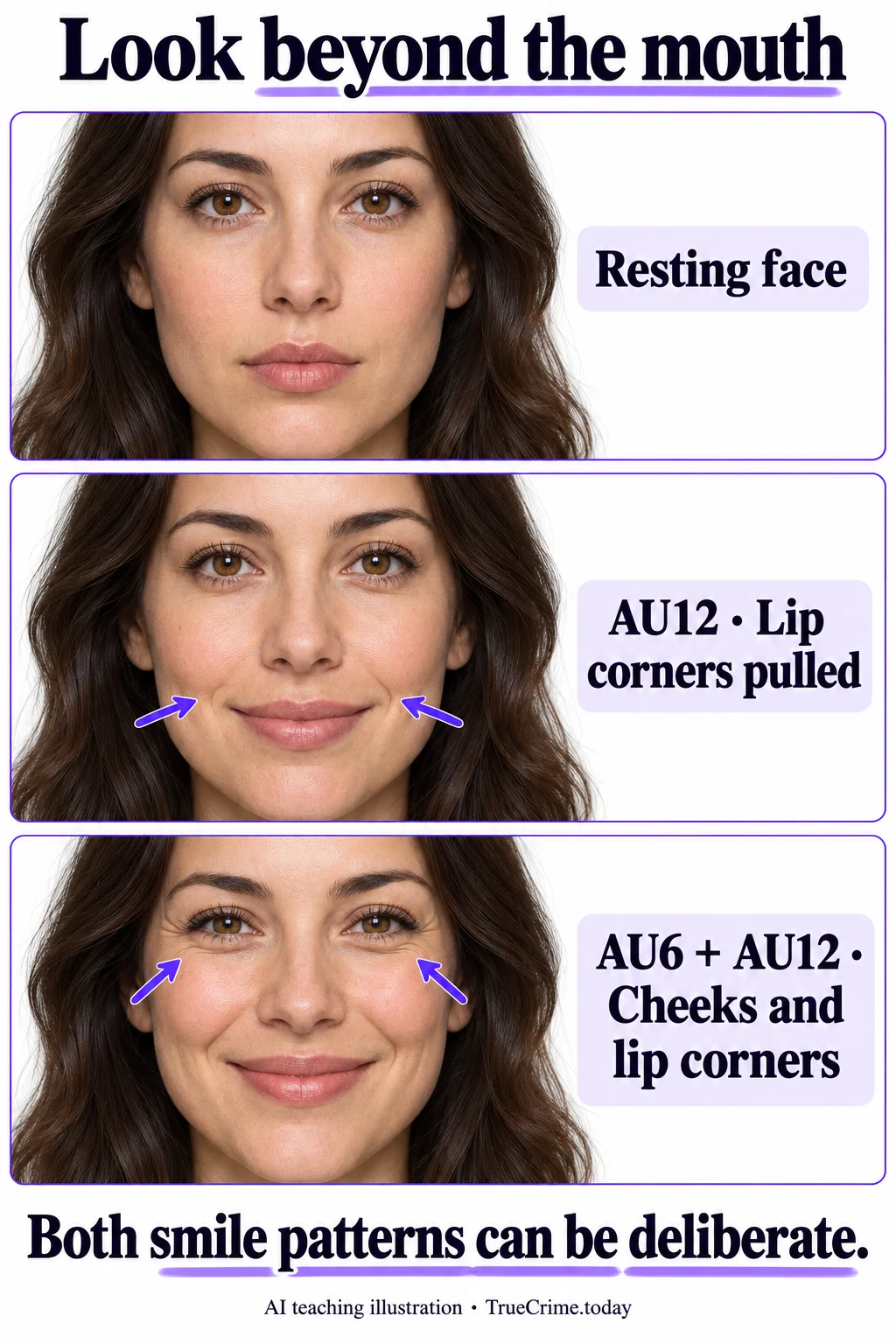
Compare the mouth first, then the cheeks. In the middle illustration the corners move; in the bottom one the cheeks rise too and change the area beneath and beside the eyes. The distinction gives you something visible to describe. It does not tell you whether the smile was a greeting, a response to amusement or an attempt to look friendly.
The result does not mean every smile is fake or every observer is helpless. It means the presence of that combination alone cannot certify spontaneous enjoyment. Nor would enjoyment automatically concern the disputed question. Someone might smile at a greeting, a remembered joke or an attempt to ease an awkward exchange. You still need the surrounding interaction before attributing a motive.
What 230 people were asked to do
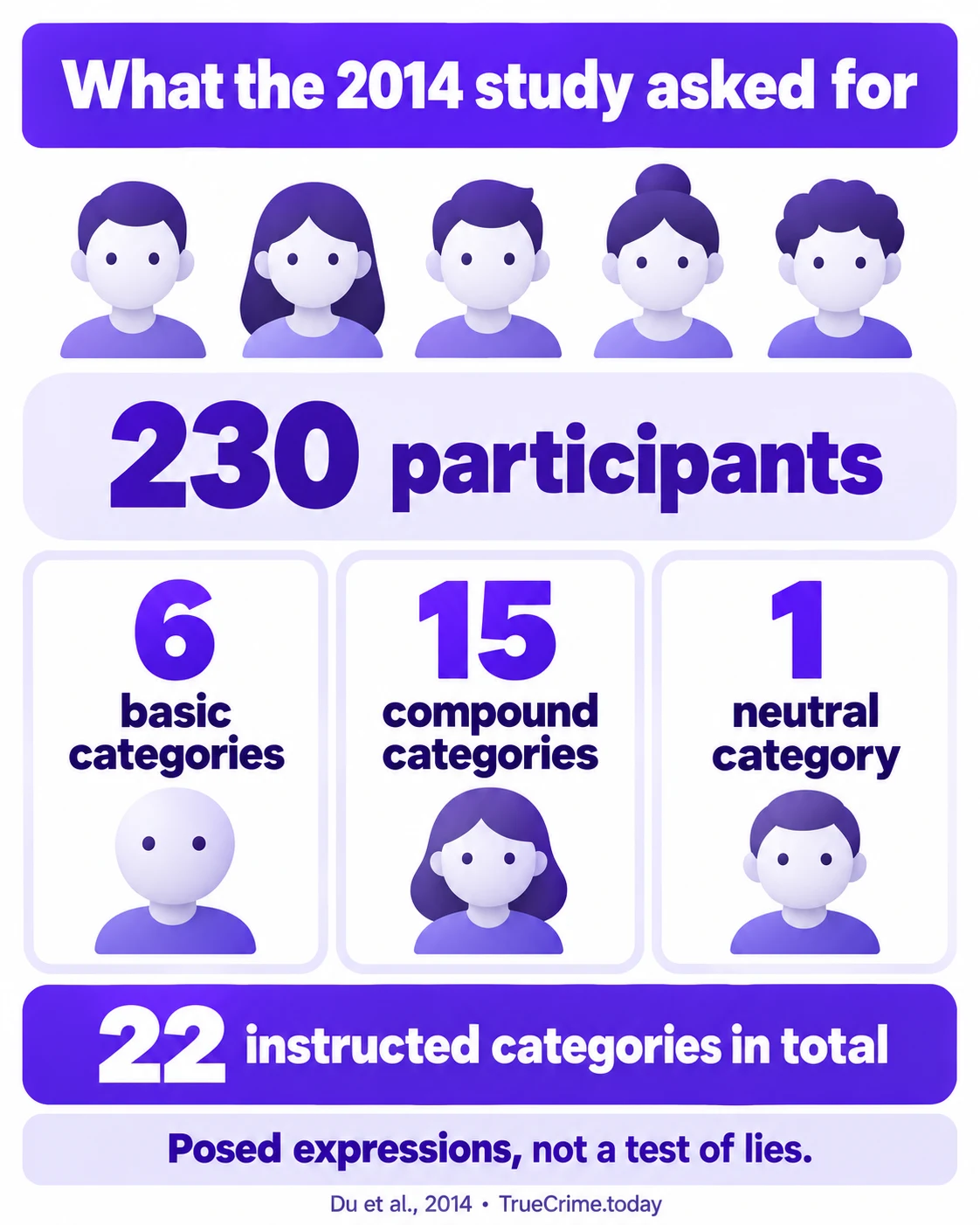
Du and colleagues’ 2014 study of compound facial expressions recruited 230 people from a university area. The researchers examined 22 categories: six single-emotion categories, fifteen compound categories and one neutral category. People produced expressions following prompts and scenarios; the team analysed facial actions and computational classification.
The study found structure in how people produced those requested displays. It also showed why reducing everything to a short list of familiar expressions can miss distinctions. “Happily surprised” and “angrily surprised” were treated as different categories rather than identical copies of surprise.
This is positive evidence for studying facial patterns. Its scope matters just as much: the participants were asked to produce expressions, rather than independently proved to be feeling every named state. The research did not test whether a defendant lied, whether a witness was reliable or whether a viewer could infer an intention from an interview still.
Six poses, and the facial actions behind them
Here are six familiar requested displays. In Du and colleagues’ dataset, the recurring combinations included 12 + 25 for happy poses, 4 + 15 for sad poses, 1 + 4 + 20 + 25 for fearful poses, 4 + 7 + 24 for angry poses, 1 + 2 + 25 + 26 for surprised poses and 9 + 10 + 17 for disgusted poses. AU7 tightens the eyelids, AU24 presses the lips, AU10 raises the upper lip and AU17 raises the chin.
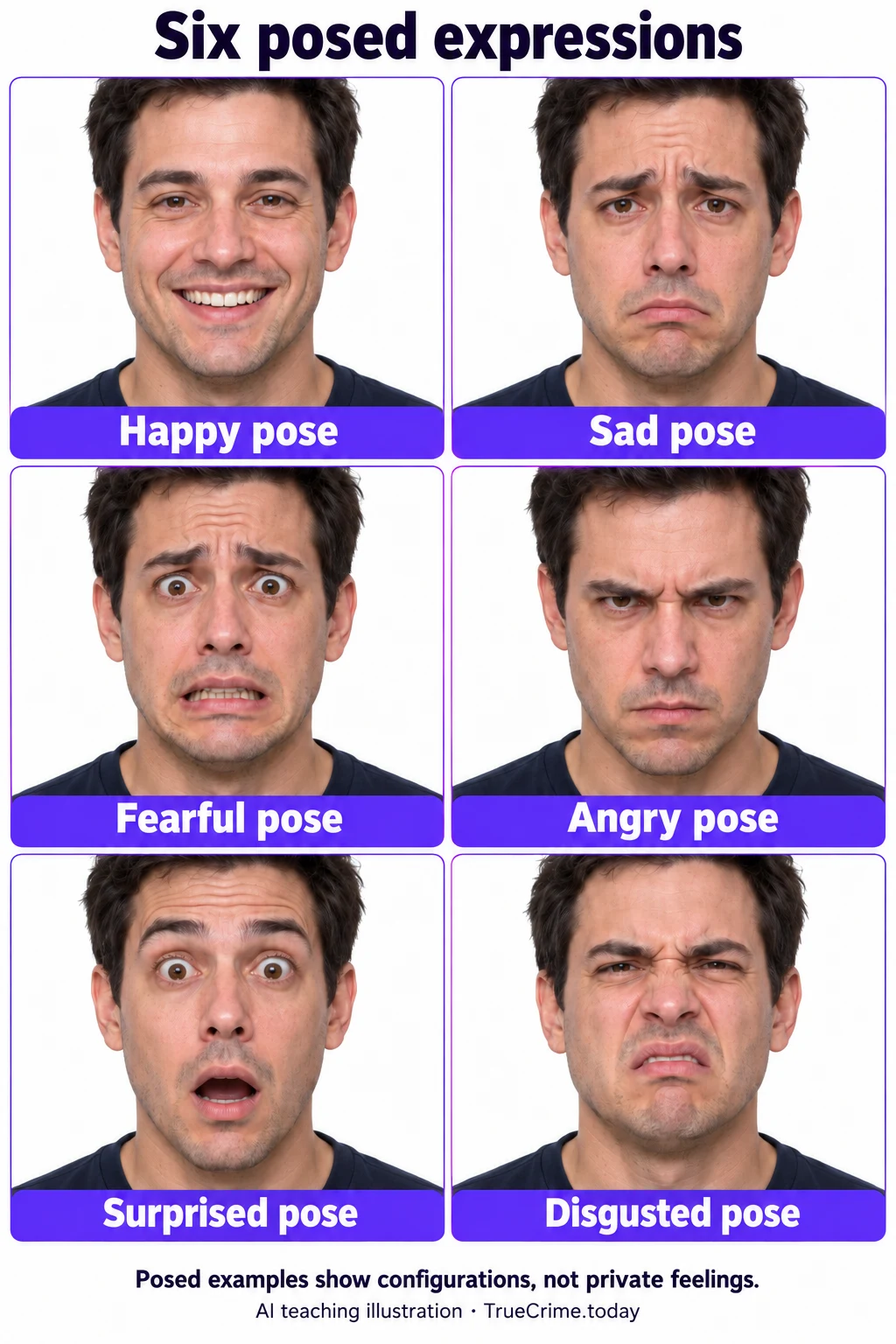
Start with fear and surprise. Both can involve raised inner brows and parted lips. The fearful example adds drawn-together brows and a sideways stretch of the mouth; the surprised example opens the jaw. Now compare sadness and anger: drawing the brows together appears in both, while the mouth and eyelid changes differ. One shared feature does not identify the whole display.
There was variation even under instruction. The paper listed AU6 in 51% of happy poses, AU1 in 60% of sad poses and AU5 in 66% of surprised poses. Its recurring combinations used a more-than-70% threshold. These are frequencies within selected posed photographs, not probabilities that someone with a given movement feels that emotion.
That makes the portraits useful for learning differences, while leaving room for faces that do not match a neat example. If someone’s smile lacks a clear cheek raise, the missing feature is not evidence that the person is lying.
Why more categories do not mean more mind reading
Twenty-two categories can sound like twenty-two private states a camera has learned to read. In the study, the categories helped define the task. The distinction is between recognising a requested display and establishing what someone actually felt when no instruction was given.
A classifier might learn to distinguish the images in that dataset. That would not show that its output has the same meaning in a low-resolution video, with a partially hidden face and a different reason for smiling. The test material, the category choices and the way answers are established are part of the result.
For a case analysis, the next question is which claim about the event the facial finding helps to check. “The lip corners moved” does not establish that a message was deleted deliberately. Moving from the first statement to the second requires information that the expression dataset did not provide.
The evidence for patterns deserves a fair hearing
Caution about individual inference should not become a claim that faces contain no useful information. Cowen and colleagues studied six million internet videos from 144 countries, examining sixteen expression types and their associations with social contexts. The paper appeared online in December 2020 and in a 2021 issue of Nature.
The authors reported that context-expression associations were 70% preserved across twelve world regions. This is evidence for shared patterns in the material analysed. It is not 70% accuracy in identifying a person’s private feeling, and it is not a lie-detection score.
The analysis used machine-learning systems to classify expressions and contexts. The sampled videos and their labels matter. Large numbers help examine broad associations; they do not convert an unobserved internal state into a known answer. The results support shared patterns across populations. They still leave you with a separate question: why did this person make this movement?
Culture changes the question as well as the answer
Jack and colleagues took a different approach in 2012. Fifteen Western European and fifteen East Asian Chinese observers each categorised 4,800 facial animations generated from changing facial actions. The researchers reconstructed the observers’ representations of six familiar emotion categories, with a don’t-know option available.
They found cultural differences in those representations and their timing. This is not a rule that tells you what every person from either region feels or sees. Thirty observers are still thirty observers; thousands of repeated judgments do not make thousands of independent people.
The study and the large video analysis also asked different questions. One investigated how selected observers interpreted generated movements. The other investigated expression-context associations in internet videos. You cannot settle the whole debate by choosing the larger number. You need to ask what was measured, whose interpretation supplied a label and how far the finding travels beyond that task.
A moving face is not a collection of stills
A still image removes the approach to a movement and what followed it. A cheek may rise as the person starts a greeting, then remain raised as the next question begins. Freezing only the later moment can attach the movement to the wrong part of the conversation.
Consider an illustrative 30-frame-per-second recording. Six consecutive frame slots cover 0.2 seconds at that rate. The time from the first sampled frame to the sixth is only five frame intervals, about 0.17 seconds. Neither calculation establishes the true start and end of the movement between samples. This is arithmetic about sampling, not a duration rule for classifying microexpressions.
Playback speed, dropped frames and compression can complicate the observation further. Slowing the video may help locate a visible change, but it does not reveal a feeling that was never independently measured. Describe the time span and the recording’s limits before making the label more precise than the footage allows.
Agreement between coders is not agreement with a feeling
Two trained coders might independently identify the same cheek movement. That agreement is useful: it suggests the movement description can be reproduced under those conditions. It does not independently establish enjoyment, fear or deception.
Barrett and colleagues’ 2019 review examined the difficulty of inferring emotion from facial movements. It distinguished recurring associations from a sufficiently specific, generalisable connection to an emotional state. A movement may occur with an emotion and also occur for other reasons. Seeing it is not the same question as asking how often it appears when someone reports that emotion.
This does not make coding pointless. It clarifies what a good result contributes. Researchers can use systematic descriptions to compare conditions, timing and interactions, then test possible explanations. The mistake is letting reliable description stand in for a different claim whose evidence has not been collected.
A stronger action is not a stronger proof
Coding can record how pronounced a movement is, as well as whether it occurs. FACS intensity levels run from A to E; an absent action is a different observation. These are ordered levels of visible action. E does not mean five times as much emotion as A, and a stronger brow movement does not mean a stronger intention to deceive.
The 2017 Sayette Group Formation Task database helps put intensity in perspective. It recorded 96 people in 32 groups of three, producing 172,800 frames. Twenty actions received occurrence annotations; five also received intensity annotations. Within the intensity-coded material, levels A through E accounted for 42%, 39%, 15%, 3% and 1%. The two lower levels together made up 81% of that distribution.
This was a selected sample of young adult social drinkers, with alcohol, placebo and control conditions. The proportions describe that annotated material; they are not the distribution of all human expressions. They do show why learning only from exaggerated faces leaves out much of what a coding task may contain.
The same project left 22% of frames uncoded because the face was obstructed. That is a practical issue when watching a conversation: if a hand hides the mouth, you may lack an observation. Treating the hidden area as expressionless would add a finding the camera did not provide.
What 130,000 annotated frames can establish
Mavadati and colleagues’ 2013 DISFA database recorded 27 adults, with 4,845 frames per person. That gives 130,815 frames, often described as about 130,000. The participants watched video material in a laboratory while twelve facial actions were coded on an ordered 0–5 scale. A second coder assessed recordings from ten participants; agreement, measured with an intraclass correlation coefficient, ranged from 0.80 to 0.94 across the actions.
Those coefficients describe agreement on intensity, not 80–94% success at detecting lies. The result supports a positive use of FACS: trained observers can produce comparable movement descriptions under specified conditions. The next research question can then concern when the movements occur, rather than whether two people meant the same thing by “a funny look.”
The frame count also needs its denominator. In an illustrative test, 1,000 adjacent frames of one person give many views of one face, not 1,000 independent people. If a model sees that person’s neighbouring frames while learning, a later score on other frames of the same person does not answer how well it works on an unfamiliar face. Ask how people, not just images, were kept separate in the test.
What an automated score needs to establish
A system may output an action-unit intensity, an emotion category or a probability-like number. Before accepting it, ask which outcome the system was trained and tested against. Human AU annotations, instructed displays and reports of feelings are different reference answers.
Also ask whether the evaluation used previously unseen people and recording conditions. A result from well-lit, unobstructed faces may not describe a compressed interview with glasses, a turning head or a hand covering the mouth. An unobserved area should not quietly become “no movement.”
Finally, read the number according to its defined scale. A displayed 0.8 might be a model score rather than an 80% calibrated probability that the person feels an emotion. Even a calibrated emotion estimate would not identify whether an account is true. The questions about the face and the questions about the event need their own tests.
The smile during a refund interview
Imagine a fictional interview about a disputed accommodation refund. Just as the interviewer begins asking about the transfer, the guest smiles. A short clip is shared as evidence that the guest enjoys misleading the audience.
The longer recording shows someone entering the room and greeting the guest immediately beforehand. That context supplies another possible explanation for the smile. It does not prove the refund account true. The relevant checks are still whether a transfer was initiated, whether it settled and what the guest knew when describing it.
Suppose a bank record later contradicts the claimed payment date. That is a factual inconsistency worth examining, regardless of whether the smile was polite or amused. Conversely, an apparently sincere expression would not repair the inconsistency. You can describe the smile accurately and still need the bank record to check what happened to the money.
Three ways to get the face right and the explanation wrong
The apparent glare. In a fictional recording, someone draws their brows together while reading a small date on a receipt. Describing a brow movement may be reasonable; calling it anger at the question adds a cause. The wider shot might show the person looking for reading glasses. Check the object of attention before deciding what the expression concerns.
The friendly smile. A speaker pulls their lip corners as a new interviewer enters. Even if the smile also includes cheek raising, that does not tell you whether a later answer is correct. Compare the timing of the greeting and the answer, then check the disputed detail against its records.
The surprised-looking word. Freeze someone halfway through an open vowel and the mouth may look like the surprised pose above. Resume the recording and you can see that the mouth shape belongs to speech. A still is evidence of that recorded instant; it is not automatically an emotional episode.
These are invented examples, not reconstructions of criminal cases. Each gives you a concrete question to check in the recording. The aim is to improve the description before it becomes an accusation, rather than to replace one confident mind-reading story with another.
What a careful facial description should contain
Start with the visible movement, the part of the recording and the surrounding interaction. Say when the image is too unclear to distinguish an action. If you offer an emotion interpretation, identify it as an interpretation and explain what additional information supports it.
Keep the factual dispute beside its actual evidence. A time-stamped message may establish a sequence; a movement code describes the face during part of that sequence. Neither becomes the other merely because both are precise.
FACS gives researchers a disciplined vocabulary for observations. Its value increases when we preserve that discipline. The more serious the proposed conclusion about a person, the more carefully we should check whether the evidence belongs to the movement, the feeling or the alleged act.
You can ask about a facial-research finding or a claim in a published analysis. Do not send private recordings or personal documents.
Ask about facial research