Microexpressions and lie detection: what the studies really test
What microexpression research actually measures: concealed emotion, conflicting duration cutoffs, training results and the limits of lie detection.

TL;DR
Microexpressions are brief facial expressions that researchers study as possible signs of concealed emotion. Their value for lie detection depends on what was measured, how the expression was defined and whether the result holds outside the experiment. A movement can be real while the explanation attached to it is wrong. If you watch true crime breakdowns, keep four questions separate: what moved, what emotion it might express, why that emotion arose and whether the person’s words are false.
What counts as a microexpression?
You pause an interview because a commentator has circled someone’s mouth. The person seems to smile for an instant, and the caption says they have revealed a lie. Before deciding whether that conclusion follows, you need to know what the commentator means by “microexpression.” Duration alone cannot supply the missing motive.
Researchers have used different time limits. A narrow definition counts expressions lasting about 40–200 milliseconds, while other studies include expressions lasting up to half a second. The term can also refer to a rapidly developing expression rather than a short expression from start to finish. Those definitions select different events from the same recording.
This distinction gives the microexpression question a narrower scope within deception detection: you are evaluating a particular facial measurement, rather than every possible way of investigating a false account. The useful comparison is between tasks that measured the same thing. An emotion-label test and an interview about a planned offence have different correct answers.
Why do tiny expressions look so revealing?
The idea is appealing: someone tries to conceal a feeling, the face briefly reveals it and an attentive observer notices. The modern research tradition builds on work associated with Paul Ekman and Wallace Friesen. Experiments have investigated whether emotion can appear despite an instruction to conceal it.
That possibility deserves attention. You can genuinely learn something about expression without learning why a particular person felt that way. Fear could concern an accusation, an unrelated threat or the consequences of being misunderstood. Someone recalling an upsetting event may also try to keep a conversation manageable. Concealing a feeling and making a false factual statement require separate evidence.
A paused image can make the explanation seem more certain than it was. Once an arrow labels a movement as contempt, every replay invites you to search for contempt. The original question can disappear from view while the commentator’s interpretation becomes familiar. Familiarity with that interpretation provides no new observation of the person.
How were the claims tested?
For this discussion, the useful evidence comes from original experiments on emotional concealment, a mock security interview and training tasks. They answer different questions, so their percentages cannot be combined into a single accuracy score. We also consider published criticism of the assumptions connecting expressions, feelings and deception.
In an emotion-concealment task, researchers may know which film a participant saw and what expression they were instructed to display. In a mock interview, they may assign a person to tell the truth or conceal an intention. A course exercise may instead ask the viewer to choose an emotion label. “Correct” has a different meaning in each setting.
Check who supplied that answer. An experimental instruction can establish the assigned condition. A participant’s report gives evidence about their experience. Agreement between two facial coders shows that they applied a coding rule similarly. None of these measurements automatically establishes how accurately a stranger could identify a false claim in a public interview.
What did the experiments find?
The disagreement becomes easier to follow when you keep the task and duration rule beside the result. Three examples show why a general statement such as “science proves microexpressions work” leaves too much unanswered.
A narrow definition made the signal rare
In 2008, Stephen Porter and Leanne ten Brinke examined 697 expressions across 104,550 video frames in an emotional-deception experiment. Brief microexpressions appeared in about 2% of expressions and in roughly 22% of participants under the narrow definition. Other inconsistent emotional displays were more common. That contrast supports studying leakage while showing how little material the fastest category supplied. It does not give a percentage for catching liars in criminal interviews.
A broader definition produced a positive result
A 2018 experiment on concealed malicious intent analysed 77 participants in a mock security setting. Combined negative expressions separated the assigned truth and lie groups at limits of 0.40 and 0.50 seconds, with no statistically supported separation at 0.30 seconds or in the 40–200 millisecond range. The finding depended on the definition and task. The authors disclosed employment at Humintell, which sells related products; that interest belongs alongside the methods when judging the claim.
Training improved the task people practised
A 2025 pilot study of microexpression training followed 27 adults with low mood over three weeks. Emotion-recognition success rose from 37.4% to 57.2% between the first attempt and last session. That is 19.8 percentage points, calculated by subtraction. There was no control group, and the task did not test whether accounts were truthful. The result gives you a concrete example of improved performance whose meaning stays tied to the test.
A separate 2021 experiment by Döllinger and colleagues compared microexpression training, multimodal emotion training and a control condition. Improvements followed the trained skill, with no general transfer between the two tested emotion-recognition domains. Even a benefit within emotion recognition needs careful description before it becomes a promise about another task.
Why emotion and deception stay separate
Imagine that a viewer correctly notices a brief expression and correctly identifies fear. There is still an unanswered question: fear of what? If the answer is supplied by the allegation rather than by evidence, the interpretation has travelled further than the observation.
Judee Burgoon’s 2018 published critique challenges the assumption that a particular expression has a single emotional meaning and that an emotion has a single connection to lying. This is an interpretation of the research, rather than an additional accuracy experiment. It helps explain why a positive group difference cannot settle the meaning of one person’s expression.
Your notes can preserve that distinction. When analysing public interview footage, record “the mouth corners rose after the question” separately from “the person enjoyed deceiving the interviewer.” The first description identifies something another viewer can check. The second requires evidence about a mental state and its cause.
FACS, the Facial Action Coding System, can describe visible facial actions using action units. A code for a movement helps make observation more consistent. Attaching an emotion label introduces an interpretation; attaching a false statement introduces a further claim. A precise-looking code does not remove either step.
How many frames are you actually watching?
Timing creates another source of confusion. At 25 frames per second, adjacent frame samples are 40 milliseconds apart. A hypothetical 200-millisecond movement spans five frame intervals. This calculation describes sampling time; it cannot guarantee five clear pictures of the entire movement. The event’s position between samples, lighting and compression also matter.
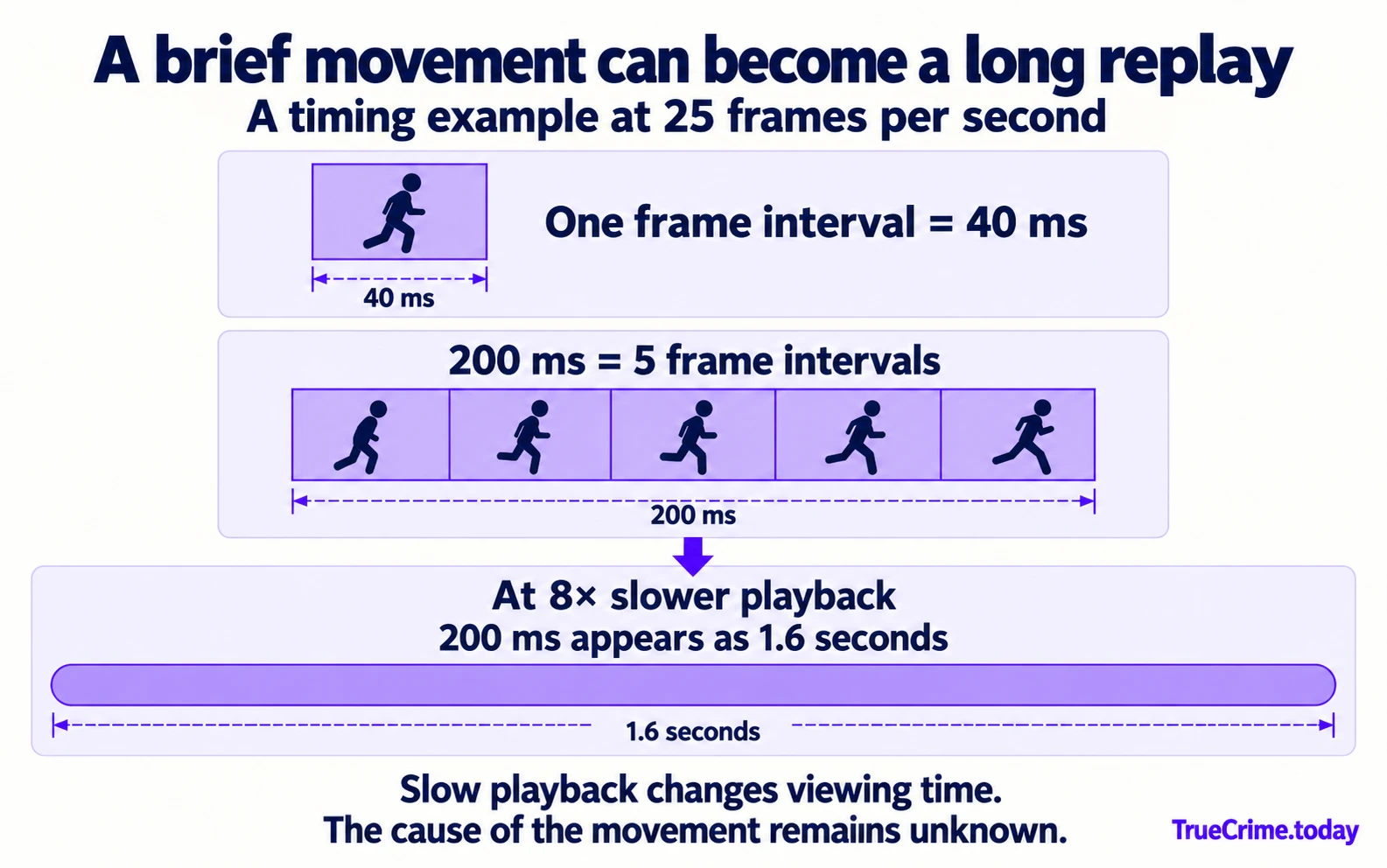
If you replay that event at one-eighth speed, its apparent viewing time becomes 1.6 seconds: 0.2 multiplied by 8. The original movement still lasted 0.2 seconds. Slow playback lets you inspect available frames for longer; it supplies no missing frames and gives you no extra evidence about motive.
Researchers also distinguish onset, the time taken to develop an expression, from its total duration, including its ending. Yan and colleagues’ 2013 work examined these definitions separately. If one commentator times only the rise of a movement and another times the complete event, their measurements can differ without either person having found a different face.
Repeated viewing can be useful when it corrects a description. It becomes less useful when each replay merely strengthens the same unsupported explanation. Write down what changed in your observation after replaying. If nothing changed except how sure you feel, the recording has supplied no additional corroboration.
Try the claim on one fictional interview
Suppose an interviewer asks, “Did you see your neighbour on Tuesday?” The person pauses and briefly raises a corner of their mouth before answering, “I saw them later that week.” A commentator calls the movement concealed amusement and concludes that the person is lying about Tuesday. This is an invented example, with no real suspect attached.
Start with the words. The answer leaves Tuesday unresolved. It may be evasive, a request for time to recall or simply imprecise. You can ask a useful follow-up without deciding which explanation is correct: “Which day do you remember, and what helps you place it?” The question tests the account’s detail instead of requiring the person to display an approved face.
Now consider what would help. An independently dated message about meeting on Thursday could support the later encounter. A travel record might help establish where the person was on Tuesday, subject to what the record actually measures. Neither item explains the mouth movement automatically. The account and the expression can remain separate questions throughout the investigation.
The opposite error is also possible. Someone may make a false statement with no brief expression visible in the recording. A method based on spotting an event cannot treat an absent event as proof of honesty. Camera angle, image quality and the person’s behaviour all affect what a viewer can observe.
This leaves you with a more useful result than a score for sincerity: an unresolved date, a possible follow-up and a clear description of what the video does and does not show. You can revise those notes when better evidence appears without having to defend a judgment about the person’s character.
What changes for viewers, interviewers and software?
For a viewer, the immediate risk is mistaking an edited explanation for independent evidence. Publicly identifying someone as a liar can spread an accusation well beyond the interview. Be especially careful when the person’s role, the question and the full answer have been cut away. A convincing explanation can still depend on missing context.
For an interviewer, an observed change may suggest checking whether a question was understood or whether the person needs time. An accusatory follow-up can change the emotional situation itself. If the interviewer first creates pressure and then treats the resulting discomfort as confirmation, the reasoning becomes circular.
For software, naming the target is equally necessary. A system may detect facial movement, sort clips into emotion categories or predict the labels in a research dataset. To claim it detects lies, the evaluation needs trustworthy truth labels and testing that does not let the same person’s identity leak between training and test material. High performance on an emotion dataset does not answer that separate question.
A responsible report should also count false accusations and missed lies, rather than showing only successful examples. A collection chosen because the outcomes are already known makes a persuasive demonstration. It gives you little information about what happens when an evaluator must decide before knowing the answer.
What should a stronger study show?
A more persuasive test would specify the duration rule before examining results, describe how expressions were coded and test the proposed method on genuinely separate people or recordings. It would report errors in both directions and show what the facial measure adds beyond information already available from the words or context.
For a training claim, ask whether the improvement exceeds a suitable comparison group’s improvement. Then ask whether it persists with unfamiliar faces, spontaneous expressions and a different task. Repeating a practiced emotion exercise and evaluating an unseen interview place different demands on the observer.
For a public demonstration, you can check a smaller set of things yourself. Is the original recording available? Is the timing measured or guessed? Does the presenter offer more than one explanation for the movement? Are mistaken judgments shown alongside successes? These questions help evaluate the demonstration without pretending you have run a controlled accuracy experiment.
Keep a short record of your own first impressions and what later evidence changed. The aim is to notice when a memorable face is carrying an argument that should rest on a verifiable statement. Improving that habit does not require claiming that you can read hidden thoughts.
What can you reasonably conclude?
Microexpression research contains genuine observations of brief emotion, findings that depend on duration rules and evidence that people can improve on specific recognition exercises. Those results deserve their actual scope. They leave several unanswered questions between a facial event and a reliable conclusion that a particular sentence is false.
When you next see a circled twitch, identify the observable movement, check the question around it and ask what evidence tests the claim being made. You may end with an unanswered question. Keeping that question open is useful when the recording cannot settle it.
Ask about a study, duration cutoff or interpretation of a microexpression claim. Keep the question general and do not send private interview recordings, passports, contracts, bank details or other personal documents.
Ask about microexpression research