Body language and lie detection: what gestures and gaze can tell you
Can body language reveal a lie? Watts, Deskovic and Tankleff cases, eye-movement studies, police observations and the evidence behind the outcomes.

TL;DR
Body language cannot reliably tell you, on its own, whether someone is lying. A glance, a hand movement or a change of posture can have several causes. Some experiments find differences between truth-telling and lying groups, but those findings depend on the task and measurement. For an individual interview, the useful question is what the person claimed and which evidence could check it.
Three suspicious movements can have one ordinary cause
You watch an interview in which someone shifts in their chair, touches a sleeve and looks away. A commentator counts three signs of deception. The count sounds persuasive, especially when each movement gets a replay. Yet all three might belong to one uncomfortable response to the question, the chair or the room.
In deception detection, several observations do not automatically provide several independent pieces of evidence. If they share a cause, adding them together can exaggerate what you have learned. To learn anything from the list, you need to know how often that particular combination occurs in truthful accounts too.
This matters because a true crime interview gives you a person, a conversation and an edited recording at once. Their movements may be real while your explanation remains uncertain. You can notice a reaction without deciding its cause, then ask whether the answer itself leaves a fact unresolved.
Chris Watts: what the reaction video can show
Chris Watts watching his neighbour’s surveillance footage is an unusually tempting example. You already know he murdered his pregnant wife, Shanann, and their daughters, Bella and Celeste, in Colorado in August 2018. When you watch the earlier recording with that knowledge, a reaction can seem to give the whole story away.
The video below is police body-camera footage published by 9NEWS from the district attorney’s release. It records Watts in the room where the neighbour’s recording is being watched. You can examine a real interaction rather than an analyst’s reconstruction. It cannot tell you the precise thought behind a movement or demonstrate that a viewer could identify an unknown killer the same way.
There are two recordings to keep separate: the police camera records the conversation and reaction; the neighbour’s camera records activity outside the house. The arrest affidavit says the latter showed Watts backing his truck into the driveway at about 5:27 a.m. That provides a time and an observable action. A reaction to seeing the recording provides neither a complete account of what happened inside the house nor an explanation of everything being loaded.
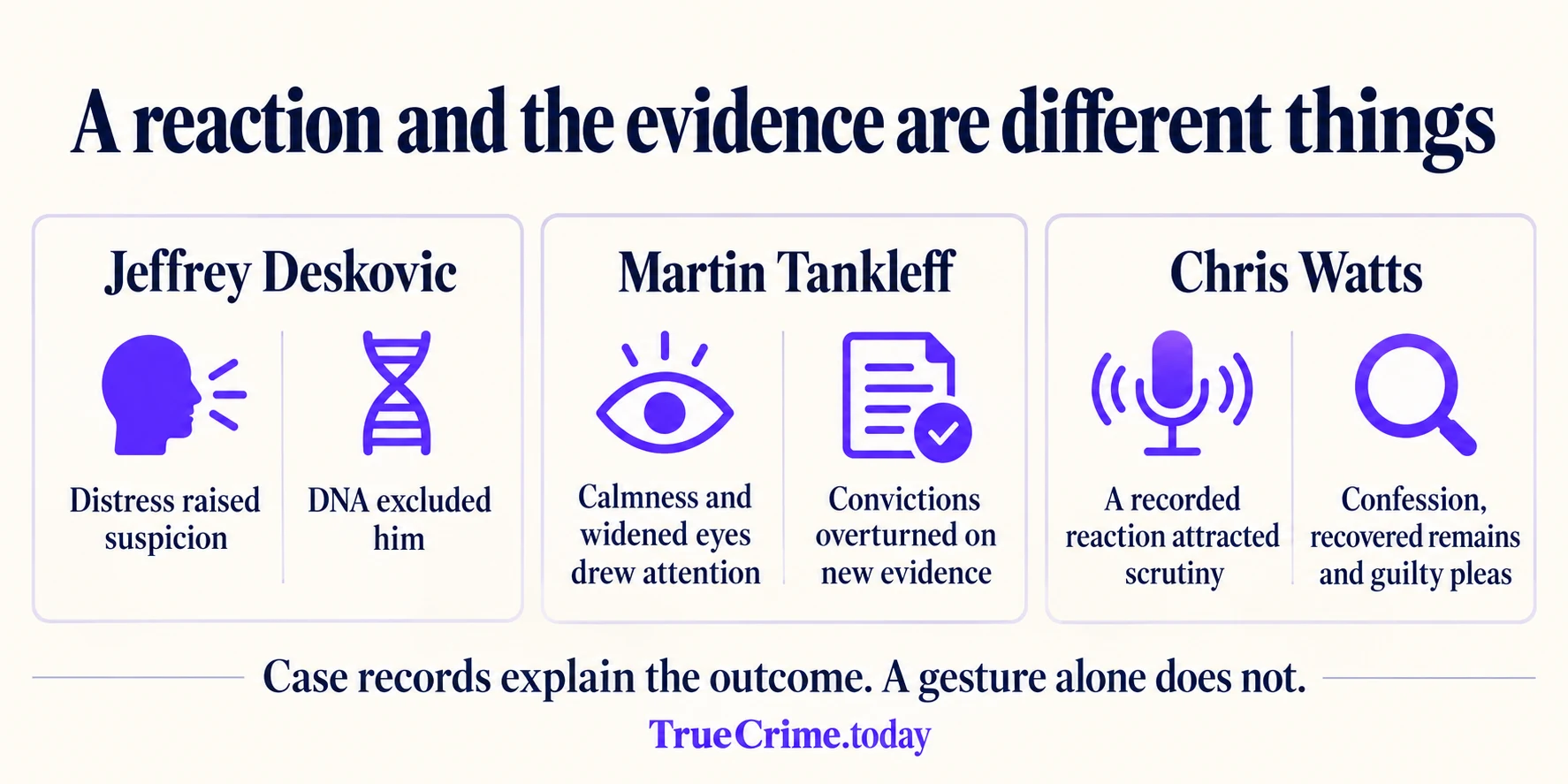
The investigation also involved admissions, the recovery of the victims’ remains, crime-scene processing and laboratory work. Watts pleaded guilty in November 2018. Those developments give the story an outcome that the earlier reaction alone could not establish. A neighbour’s concern can be worth following up without becoming a validated test for guilt.
If you want to judge the skill of an analyst, ask what they predicted before the outcome was known, how specific that prediction was and how many similar predictions they got wrong. Replaying a convicted killer’s movements answers none of those questions by itself.
Jeffrey Deskovic: grief became a reason for suspicion
Deskovic was 16 when police investigated the 1989 killing of his schoolmate Angela Correa in Peekskill, New York. The Innocence Project’s account of Deskovic’s case says that seeming unusually distraught was among the reasons he attracted suspicion. He also tried to help investigate. Neither reaction established involvement in the killing.
After prolonged questioning and polygraph sessions without a parent or lawyer present, he confessed. Before trial, DNA testing excluded him as the source of semen recovered from the victim. The prosecution continued, and he was convicted in 1990. In 2006, further testing and a database comparison identified Steven Cunningham. Deskovic was released that September, and the charges were dismissed that November.
The disturbing detail is that the exclusion existed before the conviction. A confession and a persuasive story about the suspect outweighed evidence that needed explaining. A review commissioned by the Westchester district attorney later examined those failures. It would oversimplify the case to blame a single tear or a single investigator’s impression; it involved interrogation, forensic evidence and decisions made over years.
For you as a viewer, the case exposes a problem with treating emotion as a clue with a fixed meaning. If conspicuous grief can indicate guilt, what response would count against the suspicion? The interpretation needs a possible way to be wrong. Otherwise it can absorb every reaction it encounters.
Martin Tankleff: widened eyes, a false claim and a later reversal
Tankleff’s case gives us a specific account involving the eyes. After the 1988 attack on his parents in New York, an officer described his eyes widening and his speech stopping when told his father was still alive. Detectives also described him as unusually calm. These are retrospective accounts preserved in a 2008 state investigation report, rather than measurements made in a controlled experiment.
During questioning, a detective falsely told the 17-year-old that his father had identified him as the attacker. Tankleff’s resulting confession became central to his trial. The 2007 Tankleff appeal judgment overturned the convictions on newly discovered evidence and ordered a new trial. The charges were dismissed in 2008. That sequence matters: an appeal allowing a new trial and a later dismissal are separate decisions.
The official accounts also disagree in ways a neat internet retelling might omit. The state commission defended the police procedures and found no coercion; the appellate court granted relief on the new evidence. You cannot turn the commission into an official admission that reading his eyes caused the wrongful conviction. Nor does its defence of the interview validate a scientific connection between widened eyes and guilt.
What you can trace is the risk of building the later interview around an early interpretation. Once a reaction seems incriminating, the questions can become more accusatory. The resulting stress may then appear to confirm the original suspicion. To break that circle, you need evidence that could contradict the investigator’s account.
What exactly did researchers count?
Research separates behaviours that everyday commentary often bundles together. Eye contact means looking towards another person’s eye area. Gaze aversion concerns looking away. A brief directional glance, the length of a fixation and a pupil measurement are different observations. An overhead glance chart cannot stand in for all of them.
The same distinction applies to hands. Gestures that accompany an explanation differ from self-touch, such as rubbing a hand or adjusting clothing. A change of sitting position differs from a count of foot movements. If the categories change between studies, a headline about “body language” may conceal several different questions.
The Sporer and Schwandt meta-analysis published in 2007 examined 11 observable behaviour categories. Only three showed reliable overall associations after the researchers weighted results by sample size: nodding, foot and leg movement, and hand movement decreased with deception. There was no general evidence of avoiding eye contact while lying. The findings varied across conditions, so neither fidgeting nor stillness becomes a dependable individual test.
When analysing body language in videos, you also need to know what the camera makes observable. A person might face an interviewer beside the lens. A glance that looks evasive to you could be directed at the person asking the question. Cropping can hide that geometry entirely.
Did eye direction reveal a lie?
The 2012 tests of the NLP eye-direction claim by Richard Wiseman and colleagues used three approaches: 32 right-handed participants giving paired truthful and deceptive interviews, 50 observers with or without brief instruction, and 52 archived public appeals. None supported the proposed left/right pattern or an instruction advantage. The public appeals extended the question beyond low-stakes laboratory interviews, although their classification relied on external case evidence rather than random assignment.
That finding concerns a specific prediction about direction. It does not say that eyes never respond to attention, memory or effort. Nor does it turn a glance in the opposite direction into a new clue. Reversing a rule that failed its test does not establish the reversed rule.
Tankleff’s widened eyes illustrate another distinction: eye opening and gaze direction are different observations. Evidence about one cannot validate a claim about the other. A written account of surprise also lacks the repeated, calibrated measurements used in an eye-tracking experiment.
There is also a practical ambiguity before any psychological interpretation: whose left do you mean, and is the recording mirrored? Resolving the orientation would make your description clearer. It would not repair the missing evidence for the underlying truth-versus-lie claim.
A newer experiment found a gaze difference
A 2024 mock-crime experiment with Chinese participants by Li and colleagues provides an important counterexample to a blanket dismissal. Its 50 non-student participants were assigned to 25 truthful and 25 lying interviews about a staged wallet theft. The lying group showed longer gaze aversion and more self-touch. This was a difference within that task, not a published universal accuracy rate for watching strangers.
The result makes context worth investigating. It does not justify calling gaze aversion a Chinese trait or assigning a person’s motive from their nationality. Participants, incentives, questions and definitions all belong to the experimental setting. Another setting can change which process dominates the behaviour.
Researchers discuss several competing processes: an emotional reaction, effort involved in answering, and attempts to look convincing. These can pull movement in different directions. Someone trying to appear honest may monitor their gaze; someone recalling an awkward event may look away to think. The visible action does not identify which process produced it.
Honest witnesses can get details wrong
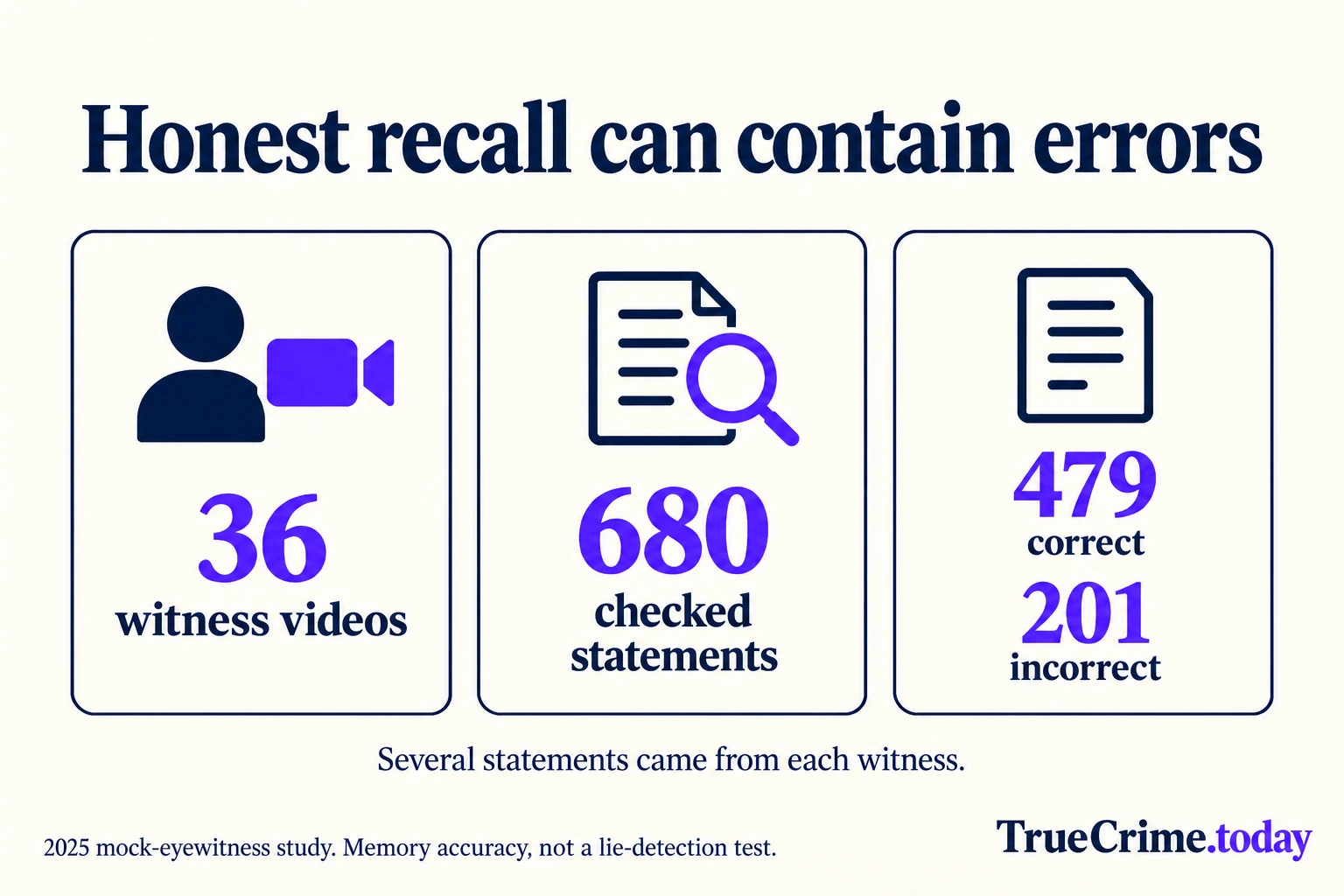
A 2025 study examined 680 checkable statements within 36 selected mock-eyewitness videos. Of those statements, 479 were correct and 201 incorrect. The measured non-verbal cues did not predict statement accuracy or observers’ credibility ratings. The witnesses were reporting honestly, so an incorrect statement was a memory error rather than an assigned lie. Also, 680 statements do not mean 680 independent witnesses.
This changes how you read an apparently confident account. A sincere person can misremember a detail. A hesitant person can describe something accurately. You need a way to check the detail rather than treating either confidence or discomfort as the answer.
In that study, non-native-speaking witnesses were also perceived as less credible, but the measured non-verbal cues did not explain that difference. It would be misleading to turn the finding into “their body language caused the bias”. The result leaves an explanation to investigate rather than supplying one.
Why controlled eye tracking asks a different question
Eye-tracking research can ask whether someone recognises a familiar face while denying recognition. In Millen and colleagues’ 2020 experiments, a calibrated eye tracker recorded responses to known, newly learned and unfamiliar images. The researchers measured fixation counts, duration and returns to image regions. Familiarity affected those measurements, with results varying by stimulus and task.
That is a genuine research question. The experimenter knows which items are familiar and can compare eye measurements under specified instructions. In a public interview, you usually lack that setup, calibration and independently known set of answers. A camera clip does not recreate the experiment just because both involve eyes.
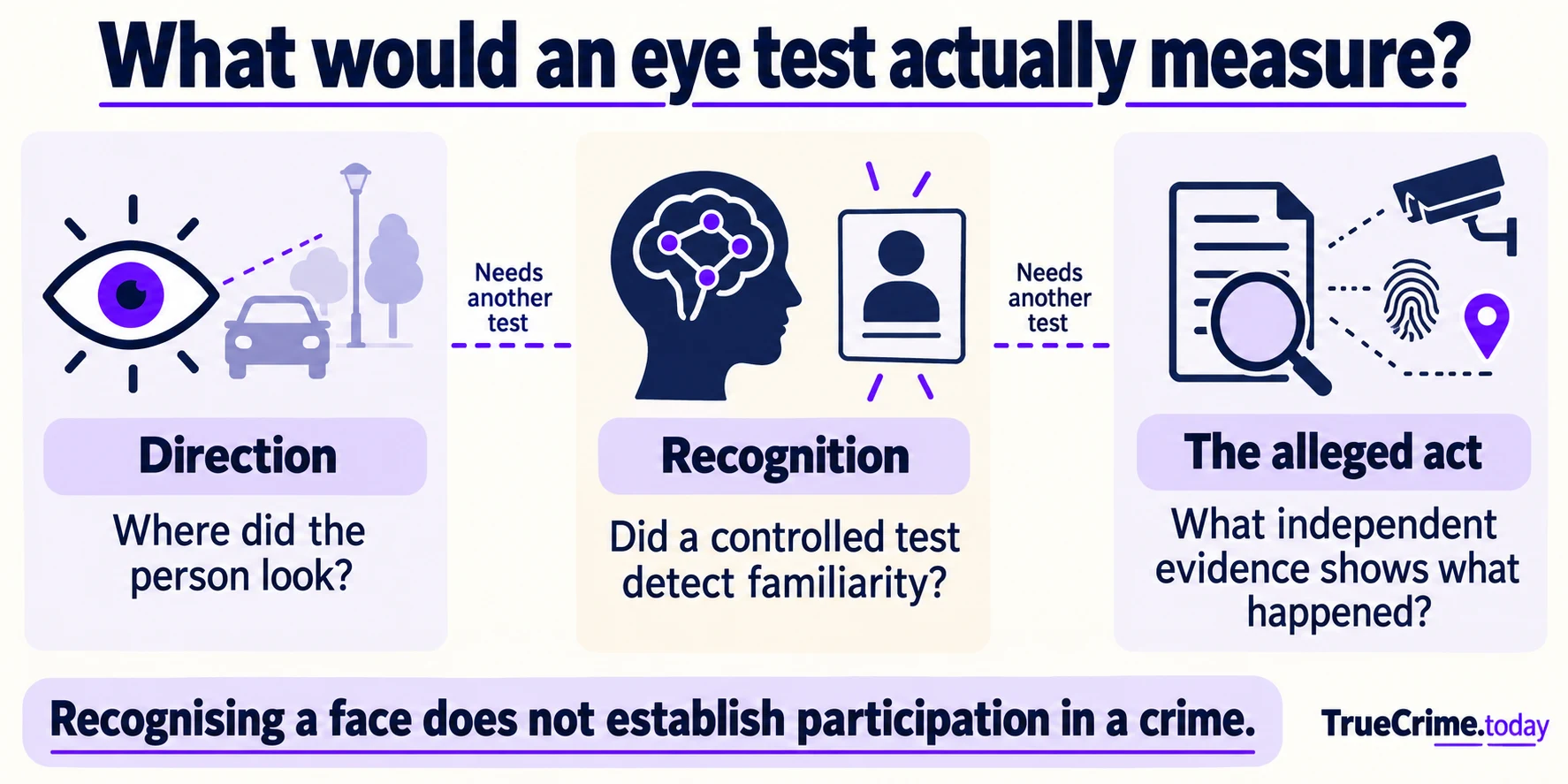
Recognition also has its own limits as an inference. Knowing a face can have an innocent explanation. Even if a test established familiarity, the cause of that familiarity and its relevance to an alleged offence would need other evidence. “Recognised it”, “lied about recognising it” and “committed the act” are separate propositions.
Pupil size and fixation duration deserve equally precise descriptions. They require suitable measurement conditions and a defined comparison. A viewer spotting a dark patch in compressed footage has not reproduced a calibrated pupil measurement. The apparent technical sophistication of the term should not hide the quality of the recording.
Do gestures and posture work any better?
A crossed-arm posture might be comfortable, protective or a response to temperature. A hand can move to show a distance or to adjust a sleeve. These are possible explanations for an ambiguous observation, not a replacement dictionary in which each movement has a new fixed meaning.
The first question is often whether the movement has been described correctly. Did the hand indicate the size of an object while the person explained it? Did the chair move before the difficult question? Was the clip cut between the question and the reaction? Those details can change which explanation is even plausible.
A practical limit follows: you cannot give every movement its own diagnostic weight without evidence. The 2007 synthesis found fewer movements in some categories during deception. The 2024 experiment found more self-touch in its lying group. Different measures and settings can produce different results without either study supporting a universal gesture code.
Can a personal baseline settle it?
A baseline usually means comparing a person’s behaviour with how they behaved earlier. It sounds fairer than judging everyone by the same stereotype. The earlier conversation may concern an easy topic while the later one concerns a bereavement, an accusation or something difficult to recall.
If the question and the stakes change together, a change in behaviour does not isolate dishonesty. It tells you that something about the situation or response changed. You still need evidence capable of distinguishing a lie from other explanations.
You would need a demonstrated method for choosing comparable segments and evaluating the resulting differences. Watching a few minutes of small talk does not establish that method. A person’s unfamiliar behaviour may deserve a follow-up question; the baseline does not supply the answer.
This also limits the claim that several cues become reliable when seen “in a cluster”. Sleeve-touching, turning away and changing posture could reflect one underlying response. Without a tested joint model, you cannot multiply their supposed accuracy or treat them as three independent confirmations.
When observing behaviour did uncover a weapon
There are useful examples of observation leading to evidence. In Terry v. Ohio, decided in 1968, the US Supreme Court described a detective watching two men repeatedly walk along the same stretch of street, look into a shop window and confer. After watching for about 10–12 minutes, he suspected preparation for a robbery. His subsequent pat-down uncovered concealed guns, and Terry was convicted of carrying a concealed weapon.
The sequence involved repeated actions connected to a place and a possible activity. The recovered weapon was evidence that could be inspected. That is quite different from assigning dishonesty to a glance during questioning. The case does not establish that an eye-direction chart works, or that the suspected robbery plan was proved by a facial expression.
The Court upheld the particular stop and limited weapons search. Its legal decision concerned the justification and scope of police action, not a scientific accuracy rate for behaviour reading. You should keep those questions separate when someone cites a successful police intervention as proof of a psychological technique.
What happened when an agency used behaviour screening?
A larger operational example comes from US airport security. In a 2017 audit, the Government Accountability Office found that the Transportation Security Administration lacked valid supporting evidence for 28 of 36 revised behavioural indicators. Its review rejected 175 of 178 cited sources as valid support applicable to the indicators. Examples included swallowing and how widely someone’s eyes were open.
These are counts of indicators and supporting sources. They are not a passenger error rate. Also, this describes the programme reviewed in 2017, rather than claiming the same list is in use today. The practical lesson is that collecting many references does not establish the specific connection a screening decision needs.
Why a convincing success story cannot give you an accuracy rate
A montage of guilty people looking uncomfortable tells you nothing about innocent people who looked the same way. You need both groups, scored without knowing the outcomes, and a record of unsuccessful judgments. Otherwise the selection already contains the answer you are supposed to detect.
Try an explicitly fictional calculation, using a test far more clearly specified than a casual video analysis. Imagine 1,000 answers: 100 lies and 900 truthful replies. Suppose the test catches 90% of lies and wrongly flags 10% of truthful answers. It produces 90 correct suspicions and 90 false suspicions. Of the 180 flagged answers, only half are lies.
Those percentages are assumptions for the example, not measured performance for body-language analysis. They show why a claim such as “90% accurate” leaves you short of an answer. You need to know how the method handles truth, how it handles lies and how common lying was in the setting being tested.
A murder case chosen because its ending is famous cannot supply those numbers. You can learn from the sequence of decisions in Watts, Deskovic or Tankleff without pretending the three cases are a representative sample. Their value here is in exposing the difference between noticing, interpreting and independently checking.
Try the cue cluster on a fictional interview
In an invented interview about a courier pickup, the question is: “Was the parcel collected before you left?” The person shifts in their chair, touches a sleeve and looks down before answering, “The driver normally comes at four.” A commentator declares the cluster evidence that the parcel was never handed over.
The answer states a routine and leaves this particular collection unresolved. You can ask which day they mean, whether they saw the collection and what they base the time on. The movements do not fill those gaps. A different camera angle might also reveal that the person looked towards a document on the table.
Suppose a pickup scan later appears. It could help establish a recorded event, provided you know what the scan marks and how it was produced. It might record a label being processed rather than a physical handover. Checking that distinction moves the inquiry forward without requiring a diagnosis of the sleeve touch.
Even a false time needs interpretation. It could reflect a mistake, an assumption based on routine or a deliberate falsehood. Evidence about the person’s knowledge would help distinguish those possibilities. An unanswered factual question is a better starting point than a confident claim about their character.
What a stronger body-language claim would need
A test should define the behaviour before scoring the interviews, establish the truth independently and include new people and recordings. The scorer should not already know the answer. It should report how often truthful accounts were wrongly flagged as well as how often lies were missed.
A useful result would also show what the behaviour adds beyond the words and known circumstances. If a system succeeds by recognising a speaker or the topic, that does not demonstrate that its posture measurements identify deception. The comparison needs to match the promised skill.
For your own viewing, keep the original question, normal playback speed and visible context available. Write down the observed action and then list the unresolved claim. If a new fact would not change the commentator’s conclusion, ask whether the interpretation can actually be tested.
How to describe a reaction without deciding guilt
You can say that someone looked towards the door after a question, provided the recording supports that description. Saying they looked for an escape because they were lying adds a motive and a truth judgment. Each addition needs evidence of its own.
Body-language research contains measurable findings, disagreement and useful limits. The strongest habit you can borrow is precision about the task and the observation. A reaction can help you notice a moment worth clarifying. Whether the account is true remains a question about the account and the evidence that can check it.
You can ask about a body-language study, gaze measure or claim about a cue cluster. Do not send private interview recordings, passports, contracts, bank details or other personal documents.
Ask about body-language evidence